
Jure Georges VUJIC[1]
TO A NEW PARTNERSHIP OF THE WORLD: ” DOMINIUMS » GEOECONOMICS AND SILOS OF INFLUENCE
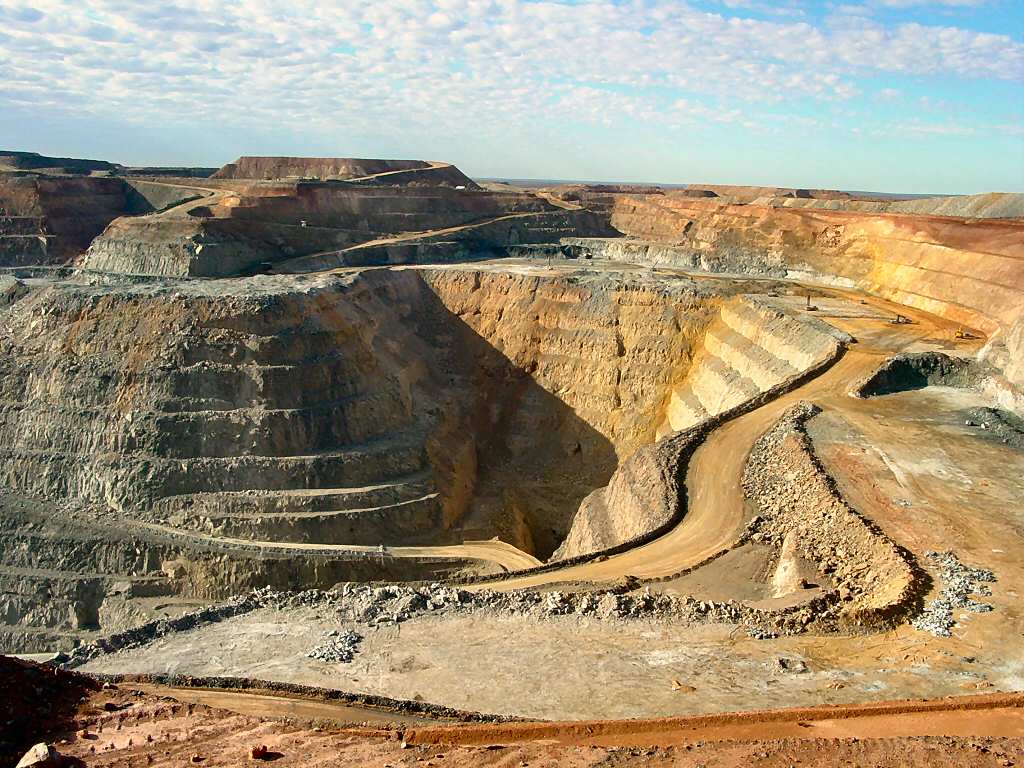
Illustration : « Kalgoorlie’s Super Pit » [2] (Australie, 2005)
IN A GLOBAL GEOPOLITICAL CONTEXT marked by the return of neo-empires and protectionist policies, which emerge after decades of “peace dividends” and the so-called “happy globalization” of free trade, the scarcity of resources and, of course, the rivalries of power for their control, are returning to the forefront of the geopolitical scene, as they require a “take” and exercise of a monopoly over a given territory or territory. Although its resources are not intrinsic value in themselves, their geo-economic influence capacity is their geo-strategic value.
Like energy, agricultural and food resources, oil and gas, digital technology has become a battlefield in geopolitical and geoeconomic rivalries between states and large private technology companies for the appropriation of new spaces. This new capitalism, that the essayist Arnaud Orin in The world confiscated[3] nomme « capitalism of finiteness It is characterised not only by the application of protectionist and predatory policies for the capture of resource territories, but also by the desire to have access to real monopolies of rent and exploitation of natural and energy resources. Contemporary digital capitalism is characterized by privatization and militarization, not only cyberspaces and refuge territories (implantation of data centres), whose dynamics are no less monopolistic than that of previous industrial and financial capitalism. Historian Fernand Braudel has rightly stressed this constant of capitalism which, despite its various forms of discourse, remains fundamentally monopolistic. This monopolistic feature is perfectly illustrated by the dominant position of GAFAM (Google, Apple, Facebook, Amazon and Microsoft) in the global digital market: a company like Google holds more than 90% of the global search engine market. Microsoft Windows has 73% of the world’s computer operating system market share. While the European Union (EU) is struggling to regulate the digital market and prevent mega-mergers of companies in the sector, as well as large cartel groupings, the same process of monopolistic concentration is visible in countries such as Russia and China which, on the contrary, benefit from merger and acquisition strategies.
Moreover, even though digital technology is often presented as an intangible asset, its monopolization, de jure or de facto, allows it not only to take advantage of this dominant position, but above all to perceive a form of rent linked to its monopolistic status (buildings, land, forests, deposits, warehouses, patents, intellectual property, submarine cables, satellites, data centres). It is from this monopolistic position that mega-corporations or states seek to control resources such as rare metals and data, giving them exceptional character and sovereignty. In the face of the increasingly limited sovereignty of States, we are witnessing the takeover of private companies over sovereign rights traditionally within the State sphere. Above all, the vast distribution networks, monopolized on the one hand by a small number of companies and on the other hand by public enterprises with new technologies, and their “public” attributes, once again confirm the logic of full sovereignty. The more they colonize space (seabed, atmosphere, cyberspace), the more they monopolize sovereign and functional rights in these spaces, or even tax legislation (in the form of taxes, contributions, compulsory advertising or contracts).
Neocolonialism and system of ” dominiums » geoeconomics
The fundamental distinction between the principles ofimperiuminalienable sovereignty and dominium alienable by disposal. Limperium the exercise of sovereignty over an area, while the dominium the rights to exploit resources in the same area. These legal concepts will mark European history and, more particularly, colonial history. Indeed, the colonizing powers could do without the capture of theimperium a local political entity to control and exploit a coveted resource; it was enough to acquire the dominiumby assignment or concession. In an unstable world where natural and energy resources are becoming increasingly scarce, the dominiums, i.e. the privatization of certain portions of “sovereign” territories by way of assignment, or by way of concession, allows certain large multinationals or states to monopolize the exploitation of these resources without prejudice to the principle of sovereignty, not to mention, of course, the extra-territoriality of the United States, a lever of global economic domination that allows the United States to apply and unilaterally impose US law on sovereign states and territories.
The practice of dominiums During the colonial period and after 1945, the famous Quincy Pact between the United States and the Saudi monarchy, which guaranteed Saudi monarchy military protection in exchange for access to oil, was a very good example in history. It is also the history of the oil domination in South America, of the major international companies of the time (in exchange for royalties All Western States – Standard Oil of New Jersey, Mobil (regrouped today in ExxonMobil), Texaco, Gulf and Standard Oil of California (Chevron), British Petroleum (BP), Royal Dutch-Shell. Today, although there are other sources of non-fossil energy, the search for new oil supply opportunities is the subject of growing geopolitical rivalries between the major global and regional powers. Thus, although the discovery of the technique of hydraulic fracturing for the extraction of oil and shale gas has allowed the United States to reduce its heavy dependence on oil from the Middle East, the Trump administration, robustly reviving the “Monroe doctrine” and which has embarked on a real military campaign against narco-cartels along the coast of Venezuela, is more than aware that the territory of Venezuela has in the Orenoca Valley (the extra-heavy crude reserves of the Orenoca Oil Belt – CPO), a vast oil deposit where probably the largest continuous accumulation of hydrocarbons on the planet is located. This is also the case for the Guyana plateau between the Orenoque and Amazon rivers in South America, a new eldorado black gold, also with reserves of gold, diamonds and other natural resources, and rare metals[4]. On the other hand, the Trump administration announced the opening to drilling of 34 concessions in the waters of the Gulf of Mexico to “ensure that industry offshore American remains strong.”
Even in the digital field, the “functional” sovereignty of mega-corporations confirms today the dynamic of “control of territories” and of conquest of “resources”, a dynamic conquering exposed by the founders of geopolitics (such as Friedrich Ratzel and Halford J. Mackinder) but also by the geo-economic approach developed by Edward Luttwak[5] and by Pascal Lorot[6]. This control of the territories presupposes the conquest and allocation of specific resources for the production of the final product (semiconductors, electronic chips and other digital components). On the other hand, just as the emerging capitalism of the 16th and 18th centuries was based on a spatial logic of colonization and exclusivity, like the warehouse system (with its transcontinental networks of commercial counters such as those of the East India Company) around which the ancient empires of the 1900s and 1940s were organized. [7], allowing the transport and control of goods to meet the needs of the metropolis, this same spatial logic underpins digital data flow networks. This is evidenced by the establishment by private technology companies of a global territorial network consisting of huge data centres and digital nodes in port terminals, which are hubs digital, reminiscent of ancient imperial silos. It is precisely this ” tournant logistique which allowed digital giants and distributors like Amazon to occupy a dominant spatial position. Thus, the control of strategic digital platforms and digital submarine cables allows technology giants to establish their monopoly and sovereignty over these vast global spaces.
From this perspective, Henri Lefebvre considered that capitalism survived through the production of space, very often a space of polarization and geo-economic discrimination. Indeed, this production of space (division into strong and weak areas – resources – and strategic transport corridors) influences the foreign policy orientations and decisions of some governments, as evidenced by Trumpian announcements, barely veiled, of territorial conquests of Canada, Greenland, which also reflects the geopolitical issues of the Russian-American-Chinese region in the Arctic for the control of new river routes and the appropriation of submarine funds.[8].
Since ancient times, especially since the Renaissance and the great scientific discoveries, awareness of the enditude of the Earth and the world has greatly fueled greed and the race to appropriate natural resources. It is precisely this ” Anxiety of limits Together with the long process of secularization promising a “paradis on earth”, which will be a powerful engine of the great territorial conquests and will contribute to the rise of Mercantist capitalism and then industrial capitalism at the end of the 19th century; a process that Alexander Koyré characterized as the passage ” a world closed to an open world of infinite space »[9]. We find this same spirit of “illimitity” concomitant with hypergrowth after a period of great imperialism and colonization, from post-industrial capitalism to the race for space, until the 1990s with the paradigm of ” mondialisation heureuse ” Thanks to innovations in new information and communication technologies (ICT), this paradigm has led to the discovery of a new digital space, the vanguard of the conquest of a new frontier to be exploited. However, this unbridled race towards productivism and extractivism, and its negative environmental impacts linked to uncontrolled expansion, have now reached their limits and lead to the return of scarcity (particularly noticeable in terms of energy resources, water and rare earths). On the other hand, this quest for the emancipation of all natural and physical constraints has been widely fed and propagated by technological utopia and Californian ideology.
Rarity capitalism and “third globalization”
Today, a world dominated by the proliferation of wars and conflicts, from Ukraine to Africa and Asia, is confronted with a form of rarity capitalism, a major economic upheaval and paradigm shift: the transition from an abundance world to a rarity world[10], illustrated by neo-imperial and protectionist policies such as Trump’s tariffs. The extractive phase of capitalism, based on the uncontrolled exploitation of world material and natural resources, would give way to a new form of rarity capitalism, which will have to deal with the limits of energy and the scarcity of strategic resources on a global scale.
This new geo-economic environment is characterized by the scarcity of energy resources, including rare metals, water resources and agri-food resources. It creates a highly conflicting and competitive environment where scarce natural resource management and resource security policies play a major role. Demand for strategic metals could double by 2030. Some metals (copper, lithium, cobalt) are becoming increasingly rare, such as lithium, whose demand could be multiplied by forty by 2040, doubling the available supply. Strategic metals are found in a limited number of countries (mainly China, Indonesia, Chile, Argentina and the Democratic Republic of the Congo), making many other countries, particularly Western countries such as France, dependent on them for their supplies. For example, China accounts for 60% of world rare earth production. The European Union defines 34 ” Critical raw materials (metals and rare earths), among those considered strategic for the economy, as having a high risk of supply shortage.
According to FAO data (Food and Agriculture Organization of the United Nations, 2014), 45 countries, including South Africa, Cyprus and Morocco, face water shortages (less than 1000 cubic metres per capita per year), while another 29 countries, such as Algeria, Israel and Qatar, experience extreme shortages (less than 500 cubic metres). The UN warns about the imminent depletion of underground reserves, on which one third of the world’s population depends. 20% of these reserves are overexploited.
This new geopolitical configuration is characterized by the growing importance of emerging countries and BRICS, as well as the growing rivalry between superpowers such as the United States, China, Russia and the European Union. In the context of the return of a geopolitics of resources, the power of a given territory, whether regional, national, supranational or global, is no longer measured nationally, but rather its status as a geostrategic node, a resource-intensive area. The number and geostrategic importance of data centres and hubs digital, as strategic nodes, are essential in this new global geoeconomic reconfiguration, which some authors call the ” Third Globalization »[11]. This reconfiguration began with the creation of the World Trade Organization (WTO) in 1995 (based on the Washington Consensus, a phase that is still going on today) and, after the 2008 financial crisis, builds on the awareness of scarce resources and results from an obsession to control energy, food and water resources.
A new international order between “a-polarity” and systemic revolution.
In this historical context of transition between the former post-Westphalian liberal system and the international Bretton Woods system of 1945, the bipolar cold war and the unipolar “century”, the world today faces the return of a hybrid neo-imperial governance model, with a reconfiguration and division of the world into major spheres of influence (dominiums “energy”, strategic nodes and silos of resources): the United States, Russia-Eurasia, and China, a period that some call ” new imperialism ” According to Robert Cooper, everything could be summed up in the resurgence of the 19th century distinctions between civilized, premodern and ” Failed States “, presented as a contemporary opposition between postmodern, modern and premodern states. It is obvious that postmodernists, embodied in the liberal and progressive EU, are trying unsuccessfully to revive the international legal model of universal norms and the global redistribution of goods as a factor of “balance” in the face of the rise of populism and illiberal forces. The only certainty is that the functioning of the global system is changing: a bipolar, unilateral and multipolar system becomes a-polar, without ” global hegemon stabilizer “The role that was given to the United States before Trump came to power. This turbulent and disruptive period, without a central superpower, is fed by the ” jungle law » by Hobbes or by the anarchic chaos described by Robert D. Kaplan in The Coming Anarchy[12].
In this context, the latest major National Intelligence Council (NIC), entitled ” Tendances mondiales 2040 (GT-2040), outlines a future world scenario ” sans leadership where competition between powers will be more fierce and more belligerent. China is mentioned 159 times, compared with 67 for Russia (compared with 187 in the previous report, and 135 in the previous report). This envisaged global anarchy will not prevent a significant development of connectivity, with perhaps several billions of objects connected to the Internet by 2040. However, public debt will increase and explode in the long term with the rise of protectionism; technology giants will consolidate their oligopolistic positions; and technology will be more destructive than liberating. Modern countries will face the challenges of ageing; the words ” fragmentation », « imbalance », « contestation », « strategic uncertainty and ” unpredictability Key concepts discussed. Finally, the same report points out that if monde errant It is based on the continuation of current trends, the contours of ” silos They are emerging, depicting a planet divided into spheres of influence. The competitive coexistence In addition, it envisages two co-operating blocs without major conflicts, which obviously does not exclude the unforeseen possibility of a general global disaster, evoked in terms of ” tragedy and mobilization »[13].
The current disorganization of the international system and the brutalization of international relations are the result of a series of processes within a historical context: the erosion of strategic stability (from 1991 to 2001) following the collapse of bipolarity and the disappearance of the USSR, followed by periods of stabilization, as the establishment of Putin’s new Eurasian geopolitics (2001-2011) facilitated the transition to a multipolar configuration, illustrated by the emergence of a strong hybridization of state and non-state asymmetric threats and conflicts (from 2011), including a risk of nuclear escalation. Globally, the most destabilizing threats to the international order are systemic and destructive in intensity, such as the war in Ukraine and a potential Chinese attack on Taiwan, which affect the balance of powers and affect global actors, middle powers and their spheres of geopolitical influence. At the socio-political level, the current situation is characterized by a triple dynamic of fragmentation, polarization and alternation of escalation and de-escalation, leading to a reconfiguration of military alliances in the face of the risk of conflict between China, the United States and Russia. It is not surprising, therefore, that the White House’s new national security strategy (information contained in a more detailed version of the strategy) proposes the creation of a new group of global superpowers, independent of the G7, called the “G7”. Core 5 or “C5”, a new G5 composed of a core of five countries meeting regularly: the United States, China, Russia, India and Japan.
It is undeniable that today, in a context of scarcity of natural and energy resources, there is a return of geopolitics of resources.[14] the disinhibited practices of aggressive capture and control of resources, with free trade opposition from the past, policies not only protectionists but land captures, land grabbing Some call energy imperialism. It would also be for others the neo-realistic reaffirmation of Kenneth Waltz’s resource position, which would imply not only a hegemonic desire to capture, to control scarce resources, but also to ensure maximum security of sources and supply routes, and primarily the security of geostrategic nodes, which today constitute real “neo-imperial silos”, most often located in Central Asia, the Caucasus, the Horn of Africa, the Gulf of Guinea, and extending from the Venezuela-Colombia-Ecuador-Bolivia rectangle to the Arctic and Siberia.
Any attempt to redefine an international order can therefore only be considered from the perspective of the global planetary order and in the search for forms of balance and stability of the planetary nature. Indeed, the Hegemonic stability The United States has been providing a relatively stable balance for 70 years (the Hegemonic stability Kindleberger) is disappearing forever, paving the way for a new ” tectonics of The European Commission’s research and development programme, which was launched by the European Commission’s[15]. This dynamic of global geopolitical reconfiguration will largely depend on the evolution of the dynamics of ” Capitalism of Rarity This is a fundamental change in the relationship between space, resources and demography. n
[1] Jure Georges Vujic is a geopolitician, author of several books and articles in philosophy, politics and geopolitics published in France and Croatia, associate researcher of the Academy of Geopolitics of Paris and member of the Scientific Council of the journal Geostrategic AGP.
[2] Photo by Brian Voon Yee Yao, Kalgoorlie’s Super Pit Gold Mine, Australie, 2005 (Wikimedia Commons), lien : https://commons.wikimedia.org/wiki/File:Kalgoorlie_The_Big_Pit_DSC04498.JPG ; Source : « Mine d’or », Wikipedia, lien : https://fr.wikipedia.org/wiki/Mine_d%27or (Links consulted on 8 January 2026).

[3] Arnaud Orain, The world confiscated. Essay on Capitalism of Finitude (XVI-XXI century), Paris, Flammarion, 2025, 368 p.
[4] Georges Jure Vujic, ” Venezuela Facing the Geopolitical Challenges of the Rare Earths in South America”, in Geostrategic, N°67 (“The Security Issues – Iraq-Venezuela”), Paris, Académie de Géopolitique de Paris, April 2025, pp. 55-68, link : https://academiedegeopolitiquedeparis.com/le-venezuela-face-aux-enjeux-geopolitiquesdes-terres-rares-en-amerique-du-sud/ (accessed January 8, 2026).
[5] « Edward Luttwak », Wikipedia, lien : https://fr.wikipedia.org/wiki/Edward_Luttwak (accessed January 8, 2026).
[6] « Pascal Lorot », Wikipedia, lien : https://fr.wikipedia.org/wiki/Pascal_Lorot (accessed January 8, 2026).
[7] Op. Cit., Arnaud Orain, The world confiscated…
[8] Georges Jure Vujic, “The Baltic, a new northern powder keg? Geopolitical challenges and security threats”, Académie de Géopolitique de Paris, 6 août 2024, lien : https://academiedegeopolitiquedeparis.com/la-baltique-une-nouvelle-poudriere-du-nord-defis-geopolitiques-et-menaces-securitaires/ (accessed 8 January 2026); Georges Jure Vujic, “Towards a new great war in the North? ” Académie de Géopolitique de Paris, 17 juillet 2025, lien : https://academiedegeopolitiquedeparis.com/vers-une-nouvelle-grande-guerre-du-nord/ (accessed January 8, 2026).
[9] Alexander Koyré, From the world closed to the infinite universe, Paris, Gallimard, 1988, 352 p.
[10] The concept of rarity and, more broadly, the economy of rarity (which is opposed to the abundant economy) is the basis of modern political economy, as it places at the centre of its reflection the scarcity of resources and the need for rational choices in accordance with the priorities and constraints of the international environment. Based on the principle of the universal reality of resource limitation, many economists such as Lionel Robbins, Malthus, Ricardo, and E. Ostrom advocated a form of sobriety and optimal allocation of resources in the face of the scarcity of natural resources and exponential growth of needs.
[11] André Larané, “Trade and trade. False-like “third globalization” Herodotus, 6 avril 2025, lien : https://www.herodote.net/Faux_semblants_de_la_troisieme_mondialisation_-synthese-2424-348.php (accessed January 8, 2026).
[12] Robert D. Kaplan, The Coming Anarchy. Shattering the Dreams of the Post Cold War, New York, Knopf Doubleday Pub. Group, 2001, 224 p.
[13] Global Trends 2040. A more contested world, National Intelligence Council (NIC), Mars 2021, 156 p., lien : https://www.dni.gov/files/ODNI/documents/assessments/GlobalTrends_2040.pdf (accessed January 8, 2026).
[14] Kattalin Gabriel-Oyhamburu, “The Return of Geopolitics of Resources”, L’Espace Politique, N°12, 2010-3, posted on February 11, 2011, link: https://journals.openedition.org/espacepolitique/1796 (accessed January 8, 2026).
[15] Robert Strausz-Hupé, Geopolitics. The Struggle for Space and Power, New York, G.P. Putnam’s Sons, 1942, 274 p.
Leave a comment