
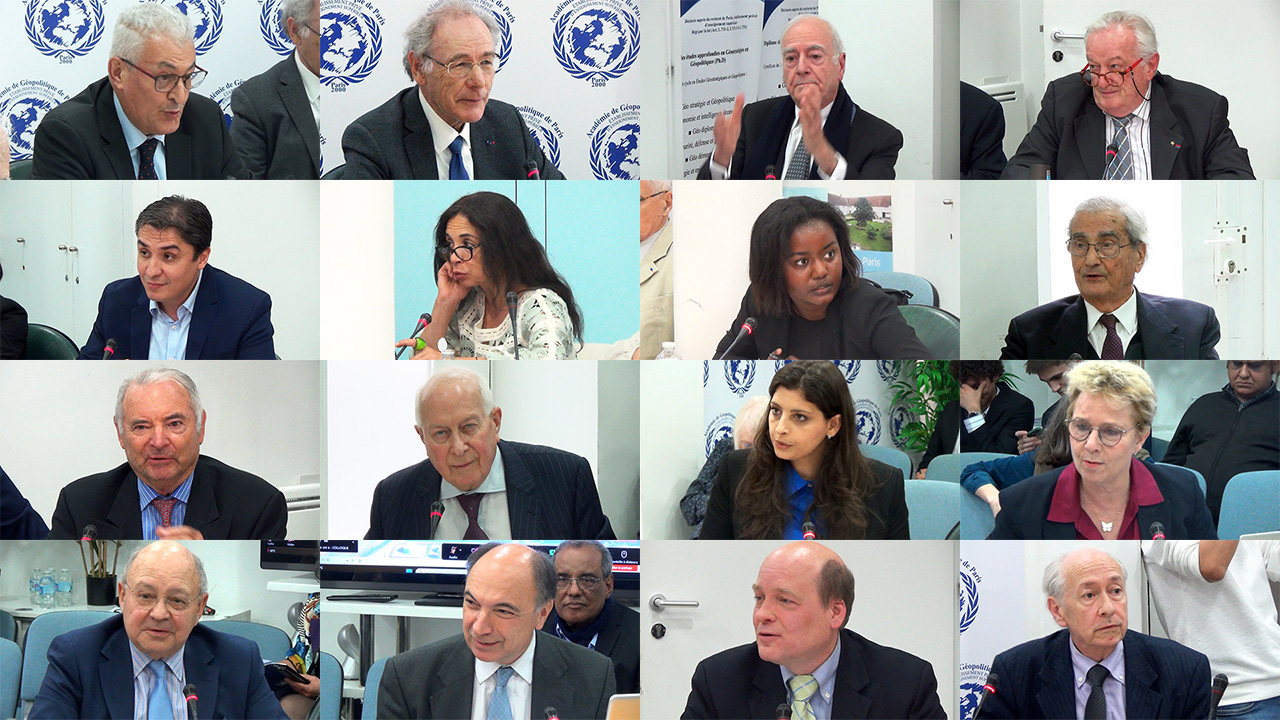
On Tuesday 13 May 2025, the Académie de Géopolitique de Paris (AGP) organised a conference entitled “What future for the Atlantic?” at 5 rue Conté in Paris.
The coastal countries of the Atlantic basin, the second largest in the world (extended, many states, economic weight), share direct and interconnected interests, and face various problems threatening its economy (illegal fishing and other problems related to fishing, natural disasters, illegal trafficking, etc.). By September 2023, thirty-two of them launched the Partnership for Atlantic Cooperation, the first multilateral forum to bring together as many North Atlantic and South Atlantic countries, and to address a wide range of issues (economic development, environment, science and technology, etc.).
But following Donald Trump’s inauguration as President of the United States, the question of the future of the Mediterranean basin, which is too little discussed, arises again. What future for the Atlantic alliance? What future for Greenland, Canada, the Panama Canal? The Atlantic Cooperation Partnership? What are the consequences for international trade, particularly in the Atlantic? The symposium was able to provide elements of a response to These questions are addressed through a variety of approaches.
COMPTE-RENDU
Dr. Ali RASTBEEN, President of the Académie de Géopolitique de Paris (AGP), “Atlantic, mirror of global powers and uncertainties”.
Mesdames, Messieurs,
The Atlantic Ocean, a vast area that connects the European, African and American continents, has been central to the history of international relations for centuries. Long perceived as a space of conquest, trade and rivalry, it is now imposing itself as a complex theatre, where the dynamics of power, regional vulnerabilities and global change intersect. In a context marked by the rise of multipolarity and strategic recompositions, the Atlantic is a mirror of contemporary power relations and the uncertainties that cross the world order.
The North Atlantic basin remains dominated by the Euro-American powers, which have historically made it an area of stability, security cooperation and economic integration. The North Atlantic Treaty Organization (NATO) is the most emblematic expression of this, as a politico-military alliance ensuring the collective defence of its members. The importance of transatlantic trade, supported by a dense network of ports, communication cables and logistics corridors, reinforces the strategic nature of this area, the epicenter of Western globalisation.
On the other hand, the South Atlantic shows more contrasting dynamics. While States such as Brazil, Nigeria, Angola and South Africa are gradually strengthening their naval, diplomatic and economic presence, the region still suffers from fragmented maritime governance. Piracy in the Gulf of Guinea, illegal fishing, or the lack of integrated security structures hinder the emergence of a coherent regional order. This lack of coordination paves the way for external interventions, including China, whose economic expansion is based on the financing of port infrastructure and the securing of its trade routes.
Three maritime hubs play a structuring role in Atlantic architecture: the Strait of Gibraltar, a strategic crossing point between the Atlantic and the Mediterranean; the Panama Canal, a link between Atlantic and Pacific and an essential link in globalized value chains; Finally, the Caribbean Sea, an increasingly coveted logistical interface, particularly in the context of geopolitical tensions in Latin America. These transit areas are at the heart of the logics of power, energy flow control and military projection.
The economic importance of the Atlantic is undeniable: more than 90% of international trade through the sea, and ports such as Rotterdam, New York, Lagos and Santos are among the most active in the world.
The Atlantic is also at the centre of energy issues, particularly through the major reserves offshore and Brazil. These resources fuel lusts, especially powers like Russia or China. But this wealth is accompanied by major ecological issues: overfishing, marine pollution, ecosystem degradation are a long-term threat to Atlantic biodiversity, posing the question of a more sustainable development of maritime areas.
The Atlantic also plays a key role in regulating global climate. Such phenomena as Gulf Stream, by redistributing heat between the tropics and temperate latitudes, directly influence European and African climates. However, global warming, ocean acidification, rising sea levels and increasing frequency of extreme events threaten this balance. Such disruptions require a coordinated response based on enhanced international cooperation, both in scientific and political terms.
In this context, NATO reaffirms its role in the North Atlantic in response to growing tensions with Russia and the challenge of Western norms. There has been an intensification of military manoeuvres, modernization of surveillance capabilities and increased attention to critical infrastructure, including submarine cables. Conversely, the South Atlantic remains a space for structuring. The absence of a security architecture comparable to NATO leaves room for regional or South-South initiatives, but also for vulnerabilities to transnational threats.
In addition, the development of emerging technologies reconfigures maritime power logics. Satellite monitoring systems, the automation of port infrastructure and the exploitation of marine renewable energy are redefining relations between states, companies and civil societies. In this new context, the ability to integrate these innovations in a sovereign and sustainable manner becomes a strategic issue.
Ultimately, the Atlantic is no longer just an area of domination or competition: it becomes a space to govern collectively. The coexistence between the integrated areas of the North and the more fluid dynamics of the South draws a geopolitics at several speeds, where power relations combine with environmental and economic imperatives.
In the face of global challenges – whether security, climate or technology – riparian states are called upon to rethink their ways of cooperation. It is no longer just about controlling the Atlantic, but about building together a maritime order based on shared security, sustainability of resources and regional solidarity.
Mr. Rector Gérard-François DUMONT, Professor at the Sorbonne University, Economist and Demographer, President-founder of the journal Population & Avenir, Vice-President of the Académie de Géopolitique de Paris (AGP), ” Is the Atlantic Ocean a border? ».
Thank you very much, Mr President, and thank you for the excellent organisation of this afternoon’s reflection on the Atlantic Ocean. So, what is a border? A boundary is defined in a simple way by a dividing boundary. So it’s about whether the Atlantic Ocean is a boundary or not. And for that, I will suggest that you first consider that the answer to the question asked is negative. Then we will see if it is positive. And finally, I’ll offer you a short summary.
First, indeed, we can consider the Atlantic Ocean to be no border. It is not a frontier if we first consider the political values on both sides of the Atlantic Ocean, since in fact the values of everything that is America have been largely born in the European part of the Atlantic Ocean. Including in all their diversity, since we will find both the Pilgrim Fathers with their Puritan logic, but also the attitude of William Penn, who considers that this territory must have the sense of otherness.
Secondly, it is obviously the whole question of the religious values on which I will not return, but which, too, have crossed the Atlantic. And then, of course, the linguistic features, as America speaks different languages that all come from Europe, including Latin America, following the famous Treaty of Tordesillas of 1494. And finally, another important political feature is the fact that a whole part of the Atlantic territories have a similar historical heritage, since three quarters of these territories have been colonies, and these countries have succeeded in decolonizing themselves vis-à-vis European peoples.
The second element of geopolitical parameter, the question of settlement. Here too, it is clear that the settlement is largely of European origin, although of course there were Aboriginal people before the arrival of Europeans. And I would like to add above all that this European origin has been overwhelmingly dominant until the years 1965, although unfortunately, in addition to the European shores, populations forced into slavery on the African shores.
Third, the geopolitics of mobility gives us the impression, again, of the absence of frontiers, since the history of mobility within the Atlantic is an increasingly traverseable territory within shorter deadlines. When the pilgrims wanted to cross the Atlantic, so in 1620, it took 66 days. Then, if I’m now in 1890, when there are all these boats leaving from Cherbourg to New York, it takes 7 to 10 days. If I look at air flights in the aftermath of World War II, these flights are still quite long compared to today, since in 1946, we are still around 24 hours. Why? Because it takes two technical stops, one at Shannon in Ireland and the other at Gander in Newfoundland. So we have to wait for both the progress of aviation and, above all, the arrival in 1960, basically, of direct flights, so that there is this much faster possibility of crossing the Atlantic. And this development of direct flights will then concern Africa, with today’s direct flights from Casablanca to New York or from Lagos to New York, which to some extent erases the Atlantic Ocean.
I will quickly go on to another element which also means the absence of borders, which is the question of geopolitical defence. I simply note that when NATO is created, in reality in the first members we see all the European countries, bordering and therefore having Atlantic coastlines, with the exception of Spain, which will only enter NATO in 1982. So, in fact, there is a kind of defensive union between America and Europe. And even if Africa is not in NATO by definition, at least at that time – so in 1949 – to some extent, as a number of African territories are at the time colonies of European countries, indirectly we can say that they are a little part of NATO and therefore of the same defence zone.
Finally, the fifth more recent element is that technology has destroyed borders in light of the evolution of information geopolitics with all information and communication technologies that allow instant contact between all the shores of the Atlantic. And so, to a certain extent, the Atlantic becomes almost a Mediterranean, that is to say a zone of contact, thanks to this evolution, and this evolution which also translates into a real structural change in that the people who immigrated to America to 17ème They could not continue to maintain regular ties and relations with their countries of origin. There, it is the whole process of diasporization that has been able to set up and deploy since technology destroyed borders.
So, in conclusion to my first point, we could consider that the Atlantic is not a border. And yet, I will try in a second point to show that there are still some arguments that may suggest that the Atlantic is a border.
The first argument relates first of all to civilizational diversities and especially to religious diversities. The real change took place mainly between Europe and the other shores of the Atlantic, the characteristic of Europe being a very important rise in atheism which is not seen on the other shores of the Atlantic. So this is a significant change. And we can illustrate it, if you want, by a detail. Every time there is a new Congress in the United States, there is a statistic that tells us how many Mormons there are, how many Jews there are, how many Catholics there are, etc. in the United States Congress. So we have a religious distribution of the United States congressmen, which is not seen in any European country, obviously not in France, which is a secular country, but in others as well.
So this change is significant from a civilizational point of view and is in addition to another element, that is, probably Promethean approaches that I think are stronger in Europe compared to what exists in America in particular, and perhaps linked to the previous point I mentioned.
The great change that has taken place in my view is mainly in the area of settlement, since, roughly, until 1965, the regulation of the United States ensures that the majority of the American population remains Anglo-Saxon with a quota policy that discourages the arrival of Asians in the United States. The great reform, it will be done at that time, under Kennedy and Johnson. And then, I would say, for me, the United States has de-Atlanticized. And we see it in the figures, that is, at the same time as we look at the figures, we see that there are more and more Africans in the United States, but at the same time, if you look at other figures, you see that there are far more people from China and India in the United States than Africans. So it is this desatlantization of the population, particularly of the United States, that shows that the United States has become what I call a “world-state,” as we have this diversity of populations that has developed over the last few decades. And to a certain extent, Latin America is following this trend a little, obviously with a much lower intensity than that of the United States.
Thirdly, mobility issues. There is a problem, however, that although the Atlantic exists, and although I tried to mention that this border existed as little as possible, there is still the phenomenon that Paris or Dakar or Casablanca cannot be at the time of New York. This is something, geographically, which still has some importance, that is, it inevitably complicates unification around the Atlantic, which complicates relations. And so, you see, if, for example, America as a whole were, I would say, at the level of Nigeria, so basically in the same time zones, the relationship problems would be a little different, and we live it periodically as soon as there are important events in the United States where we would have to change our sleep schedules in order to be able to be fully informed about what is happening there. So there is a geographical permanence that has not been abolished despite all the technological developments I mentioned earlier.
Finally, the last point of divergence is of course all the problems of external geopolitics that we have seen in recent years. I’ll mention two.
Firstly, there is a certain divorce between the countries of Europe and the United States in terms of the conception of defence and its role in the world. And the second element is the attitude towards China. In this regard, the Atlantic is completely disunited, i.e. it is clear that the United States is in a spirit of rivalry. On the contrary, in Latin America and especially in Brazil, there is the idea of maintaining a balance between China and the United States. African countries, they seek their interests, which is normal and therefore they have no interest in cutting themselves off from each other, according to a logic we understand. As for Europe, everyone here can think what they want. Rather, I have the impression that Europe is somewhat being dominated by China, both by Europe’s energy, industrial and climate policies in recent years, which have the consequences that everyone knows.
In conclusion of this presentation of the thesis and the antithesis in relation to the question asked, I simply want to finish by quoting and recalling André Siegfried’s famous sentence, pronounced at Sciences Po if my memory is good, which said: ” Gentlemen, England is an island and I should stop there ” So I want to conclude by saying: ” The Atlantic is an ocean and I should stop there ” And I should obviously do as Siegfried: then, present you a blank page to encourage you to meditate on the sentence I just said. Thank you for your attention.
General Jacques PERGET, Comptroller General of the Armed Forces (2S), former lecturer in international relations (Université Paris-Dauphine) and former holder of the “Pierre Massé” Chair in Industrial Economics (Paris 2-Assas), “The Atlantic relationship seen by the United States”.
I will deal with my subject from the following remark: that in the West, at least, we seem to be experiencing a time of ederation. That is to say, the opinion, of course, but above all the politicians, in the West – I insist a lot – manifest in their behaviour a kind of surprise. So, and that’s going to be my point of view that I’m going to try to develop, I think we shouldn’t be surprised, because in the past, there’s plenty of clues that would allow us to imagine how things would evolve. From then on, I will develop my remarks in three parts as quickly as possible. Part one, the manifestations of sideration. Part two, an attempt to explain this sideration. And last part, since there is actually no sideration, how can we envisage the future, at least in these future perspectives?
So, on the first point, sideration. Of course, the formal sideration. Sideration is purely and simply due to the international situation and its evolution, that is, for some time now to an increase in tensions and to what the late Pope Francis recalled: A war, a situation, a state of war in pieces. Obviously, in the face of the manifestations of this state of war, there is something to be riddled with.
We are also struck in the West by the behaviour of the United States. That is to say, we are even talking about treachery, a complete change in the relationship between the United States and Europe. And so, sideration that can lead to extreme words.
And then, you have another reason for sideration, you hear it by listening to the radio, seeing, watching television, the views that are expressed, including from my military friends, which I find in this case rather good compared to many civilians in states of crisis, which are not so far away. I find that the comments on the development of the national situation have to change one’s mind, to change one’s mind relatively quickly. So of course, there’s something to be riddled by.
And, I think that the cause of this sideration, of course, is a latent concern, or even an anguish, especially in the face of the next day, since we are stunned, we are even more embarrassed to see the future. Then why? For me, but this is a personal point of view, I think we have remained very attached, opinion and of course opinion shaped by the leaders, to an Atlanticist vision of the world that is very old. It originated a long time ago, but found its concrete expression in 1945. It is clear that the Atlantic world dominates the world through the United States. We have never been so close to the dream of many to have a concrete expression of globalism with global governance. The United States is the ally of the Soviet Union, which at the time intends to remain so, ally of the United States, let us not forget. And the United States, apart from the territorial control of the Soviet Union and its satellites, the United States is absolutely everywhere on the planet. They’re even in China. They’re everywhere.
So we have a picture of the future of the world from there, quite clear. And that, of course, led to a whole series of ideas, including how international economic relations should evolve. We’re not going to talk about that because it would be too long, but I insist a lot on that. Things have changed and they have changed gradually, albeit gradually but extremely significantly. Today, of course, we can no longer talk about a global world, except a few retarded ones. But who remained retarded until a relatively recent time. So, as far as the world is concerned, we obviously have two blocks today, each of them being increasingly fragmented and even divided in some cases. It’s not exactly the same thing. And so, you basically have two blocks, you have the Western world, which at the bottom is North America and the western part of Europe, and then with some enclaves here and there around the world. And then that’s it. And then everything else is the BRICS world.
And I add a component that we don’t talk about (or talk about). I expect a lot of surprises from the third force I’m going to talk about, Islam. Islam, unquestionably, rides today, if you want, geographically speaking and geopolitically speaking, extends transversely and obliquely from the Pamir and goes to the south of the Sahel, etc. That is to say that for these two blocs, which are otherwise divided, this Muslim world is itself very unhomogeneous, the least we can say. It is even quite differentiated, but it remains that it is forces that have constantly asserted themselves.
So of course, all the ideas, from that, about globalism, about multilateralism, about many things that end up in “-ism”, are a little beaten – and many – in breach by the evolution of things.
And of course, for a very long time, we wanted to hide all this. We did not want, because it was only an evolution that took place, not over a century, but over three quarters of a century. So, we should still have been a little more awake. That’s what I mean.
So the explanation of our sideration, so it’s the following. It is mainly due to three causes on which I think it is not bad to come back.
The first cause is that, as I have just told you, this ignorance of reality, this absolute will to reject the reality of the national phenomenon, even when the notion of nation, over time, is not the same. It is a very plastic concept, but it remains a fundamental reality, denied in particular in some French schools to which I belonged. There is no doubt that the national phenomenon is a phenomenon that, contrary to what has been said, has continued to grow over this long period. Let the national reality change. I stress this very much. There are general comments, but I can hardly do otherwise.
The second error, in my view, is due to an intellectual error in analysing the meaning of history. That is to say, we considered that there was indeed a sense of history and that this sense of history went towards globalization, and carried by very specific ideas which were those of a certain liberalism. Remember Fukuyama and the end of history, that is, the triumph of certain ideas.
Finally, I think that there is a mistake in our assessment of Europe’s view of the United States. That is to say, we see the United States as Europeans.
The United States was born a little bit of Europe, that’s the least we can say, but I will remind you that the United States – and in my opinion it helps to shed light on President Trump’s current behaviour and policy – the United States, because of its origin, has always been fascinated more by the West than by the East. The conquest of the West was, in the end, the way to make the United States, of course. And beyond the conquest of the West, it is the Pacific. As a military, I can assure you that, of course, the United States is paying great attention to NATO, but they are paying even greater attention to the military apparatus that must be maintained and developed in the peaceful zone. And power relations are not at all the same.
We are fascinated because we still believe we are the center of the world. Well, it’s not. The United States sees things completely differently. They see it differently, but they also see it on other levels. And in particular, we are bewildered to see President Trump’s policy.
I, for my part, find it sometimes part of the politics of its predecessors. Above all, I would like to stress two facts: President Trump, of course, is a protectionist, but the United States has always been. President Trump, he is a protectionist, that is, he wants to protect, he wants to protect a certain space. He refers to McKinley, so it’s a time that’s already beginning to be quite old. I, for my part, go much further in time. I think we should remind Monroe, that is, the Monroe doctrine. With, I repeat, Monroe having a certain idea of Europe and a very distant idea of European affairs. And so President Trump, in my opinion, fits perfectly in this line, then with his style. Of course, President Trump’s style is a little unusual compared to McKinley’s or Monroe’s. And this is all the more explained by the fact that the United States – And here I think President Trump is not entirely wrong, because the facts, I believe, make him right – the United States is no longer at all in their position in 1945. They have lost, as they say in business schools, huge market shares. And so, the notion of having to retreat to the space of North America isn’t that farfetched. So we could develop all this.
So, if we incorporate this data, that is, the United States is looking for a new health, just to say, on the understanding that they have lost a lot of market share in all areas outside and also that their domestic situation is not so good. She’s even pretty bad. Which allows me to think that Trump’s election was not as accidental as some commentators said.
So, if we integrate all this, what are the prospects for the future?
For my part, again – this is a personal point of view and so I boldly give myself to your critics – I think his politics, his behaviour and his politics are bound to fail. As everyone knows about his foreign policy calculation, he wants to get closer to Russia and he wants to train this team to better control China’s powerful arrival. Breaking the Russia-China team, I think, is just a sight of the mind. Even if the agreement between these two countries has never been perfect and even if it is not a model, they cannot happen to each other.
Secondly, we must realize also that Russia, if it does not necessarily want war, must win this war. This is absolutely indispensable. On the other hand, the United States has never wanted this war, which is why it is ready to negotiate, simply because the situation ex ante Before the invasion of Donbass they were extremely favourable. They were therefore not going to declare war even though the situation that existed before 2022 was quite satisfactory to them. Thus, in the first 4 months of the war of 2022, an authority, not least, that is, the Chief of Staff of the American Armed Forces, General Mia Li, spoke four times to say: ” We must support Ukraine, but we must already consider the end of this war and negotiate ” He repeated it four times and with an authority, personally, that left me a little pantois. My turn to be stunned. So if you want, the United States, they have to get free of that hindrance that this war is. And so, Trump’s strategy, I don’t see how it can succeed.
So, if it doesn’t, what happens? Well of two things one, or there is a confrontation, which seems difficult to me, between the bloc of the West and the bloc of the East (I don’t think we will be able to fight for Ukraine), the same thing in the China Sea, and then the Mass is said, so we must find a diplomatic solution.
It is for the Middle East, however, that there is a risk of slippage. But in this situation, personally, and what may be happening may give me reason, I think that inevitably, slowly but surely, the three countries, the United States, Russia and China, will be brought, provided that they save the face diplomatically, and that is always possible, will arrive at some sort of understanding, forced understanding, agreement despite everything.
And there could thus form a sort of triad, a sort of three-way Yalta, in the long run reaching agreement only on one point, the distribution of the planet. If that is the case, then personally I am very concerned, because given our positions until recently, not to say so to this day, I think that first of all the future of Europe seems a little bleak to me, that is, it will be marginalised. As for Africa, its vocation at that time would be to be depopulated…
So, in relation to this scenario hypothesis, how can we react? First of all, I think that with regard to Europe and also France, and especially France, we need to regain some autonomy. Especially for France, because otherwise our future, I do not see it personally. Secondly, we have completely forgotten Greenland, Canada and also Panama, but especially Greenland and Canada, so much we are determined and concerned about the rest. There is something very, very important.
S.E.M. Jean-Pierre VETTOVAGLIA, Former Ambassador of Switzerland (1988-2007) to Vienna, Bucharest and Paris, former Personal Representative of the Swiss President for La Francophonie in Paris (2000-2007), Director of an International Trade Finance Bank in Geneva (Trade Finance, BIC-BRED), essayist, director of the collection “Crisis prevention and peace promotion” (published at Bruylant), and lecturer on the analysis and foresight of international relations, ” Transatlantic relations seen in Europe: stories of vassalisation and the difficulties of prospective analysis beyond Donald Trump’s mandate ».
« Often people don’t want to see, hear and talk about truth because they don’t want their illusions destroyed »
Friedrich W. Nietzsche
Introduction
Europe is in shock, KO standing, abandoned in the middle of the ford.
Driven into the war in Ukraine by a narrative concocted in the United States by neoconservative circles and by the Biden administration in particular, it today reacts with a proven warlikeness continuing alone a war that it could not win alongside America.
Faced with chronic deficits, however, it plans to invest hundreds of billions of euros in rearmament. It is a bit like continuing World War II and the Cold War in a total and radical detestation of Russia.
We have an ambivalence of America never so exacerbated[1], a complacency towards itself of Europe that is considered to be a great world power in a modern transcription of the Fable “La Mouth et le Coche” and a latent Russian revanchism.
It is not impossible that if the liberal Europe “wokized” does indeed gather the hatreds of Russia (it is proven), the same spirit provisions might well be found in the surroundings of President Trump and of course with the BRICS and the South Global. All this takes place in a context of dehumanization of the enemy based on ideologies and reborn nationalisms.
Moreover one of the best historians of our time Antony Beevor returns to us in May 2025 in the last issue of Foreign Affairs with the following title that seems appropriate: ” We are still fighting World War II : The Unsettled Legacy of the Conflict That Shaped Today’s Politics ».
Here we Europeans, more vulnerable than ever before, abandoned by our main sponsor, in a world long described by Hubert Védrine: that of ” Jurassic Park ” We are no longer immune from the chaos of the world, on the contrary, the world that is increasingly challenging our declared universal Western rules.
Nothing that is said or done today fits in with a logic that is bound to persist beyond the upcoming US presidential elections, so great is American versatility. No one knows where Europe is going with apoplexy. What will it look like in 2030?
The American policy introduced in 1945, the subsequent choices made with the creation of the Atlantic Alliance in 1949 and then those of President Clinton, who ultimately rejected any serious rapprochement with Russia in 1993 were constants in the search for a single objective: the weakening of Russia and even its dismemberment.
American politics had been explained in detail by Brzezinski in his books and by Wolfowitz’s neoconservatives with their doctrine of ” premptive action and foundations, such as the ” Rand Corporation the doctrine of ” Full Spectrum Dominance Bush II and Obama, or the doctrine of the ” Council on Foreign Relations (CFR) by Richard Haass. She was the legacy of the ideas of the famous English geographer Halford John Mackinder.
This enshrines Washington as the world’s largest open-air psychiatric hospital (expression by John Whitbeck, on his blog.) Others see in DC initials, a shortcut for ” Dysfunctional Capital ».
General de Gaulle often pointed out that America was our ally but that we were not his vassals.
And Lord Ismay, NATO’s first SG, summarized the Atlantic Alliance in one sentence: ” Keep the Soviet Union out (of Europe), the Americans in and the Germans down ».
The truth is that the United States has long been able to make the weight of its domination more than bearable for its protégés, sheltering them from Soviet conduct, thus ensuring their hegemony a form of legitimacy. There is no greater domination than that which is accepted and agreed upon. One could even speak naively of a ” benevolent hegemony But the United States is quite exclusively friends of the United States, as it has just been discovered.
European leaders live in the immediateity of every moment, which does not help them to understand the current developments.
These preliminary findings make it possible to distinguish the true and very constant attitude of the United States towards Europe. What they have succeeded is in fact unheard of: it is Europe’s more or less freely agreed sextuple vassalisation. Atlantism can be defined as a military vassalisation of Europe (1), Political vassalization (2), economic and industrial vassalization (3), financial vassalization (4) and double legal vassalization (5), as well as a situation of vassality in the digital field (6).
They are briefly summarized as follows:
1.- Military Vassalization with NATO places Europe under American military command, led to the purchase of American weapons (aircraft, missiles, etc.), and to host 37 military bases in Europe, including 13 in Germany for a total of nearly 100,000 US soldiers stationed in Europe via Kosovo (Bondsteel, Pristina), Romania (Mihail Kogalniceanu, Costanza) and Turkey. The protection of Article 5 of the North Atlantic Treaty is hardly credible, except in cases where it is invoked by the United States itself to “defense” them, which was the case once… on the occasion of the Iraq war. Nothing to do against the ” Pentagod The name given to the Pentagon and its 5 main tentacles that are Raytheon, Lockheed Martin, Boeing, Northrop Grumman and General Electric.
2.- Political vassalization through a multitude of institutions. The White House, the Secretariat of State, the think tanks, the press and media « mainstream » American set the tone just like their many lobbies. Their messages are usually echoed by a Europe conquered by the narratives developed in London and across the Atlantic. On all subjects of international politics and Israel in particular.
3.- Economic and industrial vassalization.It is enough to read the work of the École de guerre économique française and its Research Centre 451 to find out who is the enemy, from whom French companies are the targets and what are the shadow wars that endanger our European economies. We see the American war machine at work.
4.- Financial Vassalization with the Dollar Godwhich still dominates the bulk of global transactions, although the percentage of world trade denominated in dollars is constantly but very gradually decreasing.
5.- And finally the double legal vassalisation through the concept of ” rules based order and the extraterritoriality of American law.
6.- Not to mention a real state of digital vassalization
What are the three-year prospects of these six sectors:
1.- military, most questions do not have a definitive answer.
Will the United States abandon NATO, partially withdraw or remain by continuing to insist that Europeans take more responsibility for financing the institution? What will become of the IAMD and BAMD, complementary to the nuclear guarantee but fully equipped and controlled by the United States?
Will we finally see the beginning of the beginning of a European defence at the price of huge deficits, inevitably marked by the acquisition of American weapons? Is a London-Paris-Warsaw-Berlin axis being formed in the relative indifference of southern Europe and the hostility of some Eastern European countries?
Where will the bellicism of some European leaders and the media lead us to their pay, of which we know they are less and less independent? We hear statements from Europe focused on confrontation rather than real attempts to resurrect relations with Russia. The recent cease-fire proposal concocted last week in Kiev (early May 2025) by Macron, Starmer and Merz, the Poles and Kaja Kallas, is thought in such a way that it is known that Putin cannot accept it. We even hope that he will reject it because the aim is to blame it again and paint a Russian devil on the wall. NATO has never given peace a single chance. We will see if negotiations are soon to resume in Istanbul.
What will become of the strategy to prevent Europe from normalizing its economic and energy relations with Russia, a long-standing strategic objective of the United States?
How will Europe be involved in the American “pivot” towards Asia?
Trump’s America-Ukraine agreements on minerals and other rare earths, oil, gold and copper will provide protection to Kiev more effective than Article 5. Like the possible management of Ukrainian nuclear power plants by Washington. Moscow is not deceived…
The Russians won the war, but they lost peace. Crimea and 4 oblasts, recognized or not, by the international community are not much without the take of Odessa. The Black Sea no longer belongs to them. And they’re gonna have a diet that hates them at their door. With a strong presence of Blackrock, of Vanguard(mass acquisitions of arable land) Big Pharma “, Rothschild houses, Goldman Sachs, Georges Soros, the Bush family and GAFAM, Bill and Melinda Gates, Ukraine will be locked in the West, whether it is a member of NATO and the EU or not. The United States will reap the fruit of what remains of Ukraine and Europe will pay for the broken pots by others… The agreement on minerals breaks the Russian dream of a neutral, disarmed and denazified Ukraine because it perpetuates a strong American presence. The United States and Europeans will continue to help Ukraine militarily and strengthen its army. Russia will have to learn to live with a hostile regime at its gates under the protection of the West. It is a huge failure in relation to WHO goals. Especially since sanctions will not be lifted for a long time. The blocking of Ukraine’s accession to NATO is merely a line in the sand. Zelenski is more revanchard than ever. It is possible that this constitutes too many bitter pills for Moscow.
The war could well resume before long with infinitely more deadly means.
We are all tetanized, as when three gas pipelines out of four of the company were destroyed. Nord Stream. Europe must leave its present state of deep lethargy, especially since it only reacts politically to crises… The bet is huge: no longer dependent entirely on American goodwill…
Donald Trump’s coming to power has also led to a significant deterioration in press freedom in the United States. But the same has been true for almost three years in Europe mainly because of the war in Ukraine. We are witnessing live operations of “Viol des Foules through political propaganda” dear to Serge Chakotine…
(Reporters Without Borders publishes an annual country ranking and presents a difficult situation worldwide. The USA would be in 57e position on 180 behind Sierra Leone… Freedom of the press is no longer an achievement in the United States, but in Europe, as Switzerland is no exception. The Committee for the Protection of Journalists (CPJ) also notes this. In France, a significant part of the national press is controlled by some great fortunes. These rankings are based on quantitative records of abuses committed against journalists, with Israel sharing the final places with China and North Korea. However, Israel is the country that has killed the most journalists in the last 18 months, cf. General Dominique Delawarde who has kept a precise count).
We know this: power rarely carries in its heart the real interests of its ordinary citizens. The reason for defending freedom is not due to the imperatives of profit. The Second World War was not over that Charles E. Wilson, future ” Defense Secretary “, CEO of General Motors, called for a permanent war economy for the United States as war production led to a staggering rise in profits. ” War is good for business “He said. Exports of arms are by far the most profitable. President Richard Nixon said: ” The only international organization that never worked was NATO. Because it’s a military alliance and we lead it ” This is for Europe’s military vassalisation.
As he liked to joke about Boutros Boutros-Ghali, it is not enough to say ” yes to an American representative, you have to tell him ” yes, Sir “… And Trump’s narcissism is evil.
2.- politically, How will a Europe split into different parts, crumbling over an international law that the US has never respected, unless it is to their advantage?
Who will dominate Europe: the USA with the English, Poles and Baltics, Ukrainians, Germans and French helped by Von Der Leyen and Kaja Kallas? There are many debates in hasty meetings, conferences, polemic statements… Most of them have no tomorrow, with flies in the pocket that want to advance the stage. Trump’s America considers Europe to be negligible. It is true that it is politically deeply divided with significant economic differences with, here and there, ruling parties or sovereignist, anti-Otanian, slavophile, or old enmity between neighbours.
She never took sides against the United States in order to mark her independence, she never denounced Donald Trump’s elucidations of Greenland, she never denounced the Biden government for its sabotage of Nord Stream 2 a deadly blow to its economic development and cheap energy…
She does not protest when the “Lucifer effect” dear to one of the world’s most renowned psychologists, Dr. Zimbardo, seizes both an entire country, Israel, and the American ruling classes? (The Lucifer effect being a psychological process that pushes to carry out malicious acts contrary to your own values).
Israel threatens France publicly when an official Israeli source states: ” If France recognizes the State of Palestine in June, we will reply by annexing the settlements in the West Bank ” There is no public reaction. On 10 May 2025, the former European Commissioner for Foreign Affairs, the filmed Josep Borell, not only publicly accused Israel of committing genocide in Gaza, but condemned the United States and Europe for complicity in the largest campaign of ethnic cleansing since the end of the Second World War. He continues by stressing that Gaza has received three times more explosives than those released by the Hiroshima bomb… Half of the bombs are supplied by the US. He concludes by saying that Europe has the capacity to protest and influence Israel, but does not.
It misjudges the effects of its vassalization on BRICS and the so-called global South in general. It also seems to misjudge the complexity of crises caused by failed globalization. It is concentrated on Europe alone.
Only one thing remains to prevent popular discontent from sending Europeans back into a political coma: war, the most primitive war.
Two Swiss and German professors from Zurich’s famous Polytechnic School, one of the world’s top 30 universities, announces the invasion of Europe this year but not in September 2025 (know why?) and the other announcement that summer 2025 will be the last summer of peace…
So is politics… Poor of us! I would like to paraphrase Pierre Dac about Europe: ” She’ll have the future behind her back as long as she doesn’t turn around to look at the reality she’s running away from… ».
3.- economically and industrially, The balance sheet is dark.
What remains of European leaders, let down by America as less than nothing? When they made many financial sacrifices to help Ukraine and emptied their arsenals with their military support to that country? Not to mention the pharaoh expenses they will face as part of the re-establishment of the Kiev government and their own rearmament.
The deterioration of the European economies with its deficits and overtaxation in France in particular, leads to the collapse of the whole system.
The market comparison of US and European companies is alarming: Spotify (first company in the European Union) weighs 93 billion dollars… Amazon and Alphabet more than 2000 billion, Microsoft, Nvidia and Apple Over $300 billion. The scale of the European downgrading is not a debate.
In addition, 300 billion private European savings will invest in the US in the coming years. Not to mention the hundreds of billions of European purchases promised to Trump by European governments (Great Britain over 100 billion, Switzerland over 150 billion, for example). It would take $20,000 billion in long-term savings that Europe would have to emerge if it were to develop a technology industry comparable to the US. The recruitment of a few U.S. researchers in disinherence is not going to do so, even if Mr. Macron believes he has found the solution.
But it is through savings that innovation is financed, not debt. The 800 billion to invest in defence that we do not know how to finance say a lot about the European shortage. Retirement savings account for between 7 and 12% of GDP in France, Germany and Italy, compared with an average of 143% of GDP in the United States.
All this, not to mention an economic crisis due to the cost of energy, deindustrialisation through the relocation of enterprises, delays in research and in the whole computer sector and that of artificial intelligence. Not to mention unemployment, a poor education sector, continued and necessary investment in social protection, and the reduction of political dysfunction.
4.- financial, the disaster is not far away. Financial strangleholds most European governments. IMF dictates are no longer necessarily far away.
Donald Trump, from his first term in office, resolutely launched a policy of militarizing the use of the dollar and the SWIFT payment system to pursue US unilateral interest.
Putin said on June 6, 2019, denouncing: ” the degeneration of the universalist model of globalization and its transformation into a parody in which international rules are replaced by the administrative and judicial laws of a single country ».
The US system of monetary domination is thus based on the exclusivity of certain high-tech services, the control of all capital through the control of payment systems, on global networks of intangible service providers (auditors, consultants, lawyers, etc.) reporting all the information available in Washington and on the almost universal competence of the ” Department of Justice (DoJ) due to the use of the dollar for more than half of international transactions.
5.- in terms of legal domination, America’s control is total.
5.1. It replaced international law with its own rules (“Rules based order”). The Charter of the United Nations is reduced to ” machin General de Gaulle spoke of it, the US does not respect it more than the State of Israel, which wants to dissolve it… Legal vassalisation means for Europeans to multiply official communiqués and declarations referring to the ” rules based order “, the champion of all categories of the most servile subjection having been the filming Annalena Baerbock.
International law based on the Charter and customary law are being replaced by the entirely U.S. concept of ” rules based order (I do what I want, you can’t do it).
This right is nothing but the application to the rest of the world of rules set by the United States alone and at their sole convenience. However, while international law appears to be in the interests of the United States, the United States does not hesitate to refer to it and to place itself under its protection.
If the Wolf of Little Red Riding Hood had big teeth, it was to eat him better…
5.2. The world is under constant threat of the harmful effects of the extra-territoriality of American law.
American law has become the norm for many European countries, subjecting businesses and individuals to US political decisions. Large companies have discovered at their expense the existence of economic war and the concept of the war of law through the extraterritoriality of American law. The economy is becoming a weapon of war through law.
The subject of the extraterritoriality of American law emerged in 1990 following the American desire to sanction any trade relationship between Europe and Cuba. This subject has reemerged since the 2000s following multiple convictions of European companies by the US courts whose amounts have paid the chronic: $9 billion in 2014 for BNP Paribas to end the prosecution. The Swiss banks were not spared. (UBS $1.53 billion in 2012, $2.6 billion for Swiss Credit in 2014).
The means of extending the jurisdiction of the US attorney to any foreign company is quickly found: the use of the dollar, the use of an American service provider (e.g. digital messaging) or of any product (e.g. electronic component) or the use of a U.S. service in a transaction justifying the jurisdiction of the DoJ, if only the use of a photocopier or a public prosecutor. smartphone American. This refers to binding criteria that are as tenuous as possible to justify prosecutions or sanctions that appear to have no other purpose than intimidation, weakening of a competitor or eliminating an opponent. For example, sanctions against Airbus and those that threaten companies that continue to work with Iran that forced Total and Peugeot to leave the country.
World law tends to be the law of power ruling the world that tends to impose everywhere. The United States is a regulatory body for international transactions and arrogates the role of the world’s economic agent.
American law becomes what guarantees competition, productivity, profitability and growth. This unequal scheduling is degrading and unacceptable.
Rabies have again returned today against the extraterritorial application of American law, but it is only spreading. Sanctions are essentially an American specialty. Russia and China have no countries under sanctions… Putin once again saw it right when he said in February 2007 at the Munich conference on security issues: ” All that is happening now is the result of attempts to establish a unipolar worldview in international affairs… We want new demarcation lines and new walls ».
6.- Digital sovereignty seems out of reach for Europe. A Europe without cloud I don’t think you’d manage.
Puces, smartphones, ordinateurs, clouds, software, social networks, messaging, platforms, all or almost all of this comes from outside Europe. Only for the cloud and software, the cost of dependency on the United States is currently $290 billion. This means loss of economic value and associated jobs.
Europe cannot manage without Windows and Microsoftwithout services cloud d’Amazon and Google, IA dOpenAI, or even mail from Meta andApple. A simple ” executive order may mean ” shutdown » digital for the country concerned…
Overall conclusion: fasten your belts, it will tingle.
Antoine de Rivarol, writer of the second half of the XVIIIème in his book, ” Modern philosophy » : « The most civilized empires are always as close to barbarism as the most polished iron east of rust; nations, like metals, are brilliant only surfaces ».
David Ray Griffin published in 2018 ” The American trajectory, Divine or Demonic? ” In fact, the trajectory of the United States has shifted from one to another.
John Mearsheimer in particular wrote: ” It has long been believed in the West that the United States will spread liberal democracy around the world, promote an open international economy and create international institutions to manage this. The policy of restoring the post-war world to the image of America was supposed to protect Europeans ».
Today the moral and political authority of the United States is being put to the test and its allies are not found in the values, substance and ethics of American politics. Well “Let’s dance on the volcano”, because we are all metaphorically in Naples near Vesuvius. Gustave Flaubert used the formula in a letter to Eugene Delattre on January 10, 1859: ” We said we were dancing on a volcano! Not at all! We stumble on the rotten board of a vast latrine. Humanity, for my part, makes me want to vomit and we should go hang ourselves if there were not, by this way, noble spirits that disinfected the atmosphere ».
Eisenhower described in 1953: ” Every gun that is made, every warship launched, every rocket fired signifies, in the final sense, a theft from those who hunger and are not fed, those who are cold and are not clothed. This world in arms is not spending money alone: It is spending the sweat of its laborers, the genius of its scientists, the hopes of its children… This is not a way of life in any true sense. Under the cloud of threatening war, it is the humanity hanging from a cross of iron ».
En traduction : « Every rifle that is made, every warship that comes out of a shipyard, every missile launched ultimately involves stealing those who are hungry and not fed, those who are cold and not dressed. A world on the path of war is not just spending money: it spends the sweat of its workers, the genius of its scientists, the hopes of its children… It is not a way of living in the true sense of the word. Under the clouds of war that are gathering together, there is all humanity as hanging from an iron cross ».
President Eisenhower predicted this disastrous development in his speech of January 17, 1961, before passing the torch to John F. Kennedy.
« America is today the strongest, most influential and most productive nation in the world. While it is understandable that we are proud of this pre-eminence, we realize that the first place and prestige of the US depends not only on our unrivalled material progress, our wealth and our military strength, but also on how we use our power in the interests of world peace and the improvement of the human condition… This combination of an immense military institution and a large arms industry is new to the American experience. Its total economic, political and spiritual influence is felt in every city, in every state parliament, in every federal government office. We recognize the imperative need for such development. But we must not fail to understand its serious implications. Our work, our resources, our livelihoods… all are involved; the very structure of our society. In government assemblies, we must therefore avoid any undue influence, whether solicited or not, by the military-industrial complex. The potential risk of a disastrous rise in illegitimate power exists and will persist. We must never let the weight of this combination endanger our freedoms and our democratic processes. We should never take anything for cash. Only a community of quick and informed citizens will be able to impose a real interlacing of the enormous industrial and military defence machinery with our peaceful methods and purposes, so that security and freedom can flourish together…
In « The arrogance of power Fullbright wrote: Only a nation at peace with itself, with its mistakes and successes, is able to understand others generously… A powerful nation, but lacking confidence in it, has every chance to behave towards others and towards itself in a dangerous way… She can’t recognize any mistakes, she must win in any quarrel, if she’s trivial… Gradually, but indisputably, America shows signs of this arrogance of power, suffered in the past by great nations, which weakened them and sometimes destroyed them. In these circumstances, we are no longer up to our possibilities and our promises as an example of civilization given to the world. » (William Fulbright, The Arrogance of Power,1966).
American exceptionalism is a national vanity ridiculed by events. But America remains ruthless.
Without sovereignty, Europe’s freedom is only a lure.
And the truth is expensive. Sometimes it forces you to lose your face. For many like Macron, Starmer and Merz, Von Der Leyen and Kaja Kallas, it’s worse than losing control of the narrative. Our politicians are not meant to think freely, but to survive socially and politically. The group protects, the truth isolates the one who exposes it. Remains comfort in the lie they practice consistently. They are unable to face reality for what it is.
It has been known since the work of American psychologist Leon Festinger on cognitive dissonance. When a reality contradicts our deep beliefs, the brain shortens. So we rationalize, we arrange.[2]
« We are now justifying censorship in the name of freedom. The engine of conformism is running at full speed. We start by defending positions that we know are false to melt into the mass and, by force, we really believe in it. It is not that people are stupid but that they have too much to lose: their reputation, their political group, their place in the pack ».
That is why we see academics, military and politicians defending absurdities. Intelligence does not protect against this drift of the human brain, adapted not to understand the real, but to denigrate at any cost what is contrary to its beliefs.
« In this psychological state, the facts are no longer taken. The man is then impermeable: you can show him the most blatant evidence, the most blatant contradictions: he will not react. His mental system deactivated his thinking review system. He is no longer a rational citizen, he is an ideological soldier, only able to look through the little bit of the lorgnette authorized by his doctrine. ».
Peggy Sastre ajoute : « That’s why knowing and making the truth known was never enough. We always had to survive the pack. And today, like yesterday, few are ready. Not because they’re cowards, but because they’re alone. And, at some point, resistance to the number ends up using ».
Bassem LAREDJ, Geo-political and Geo-Security Consultant, Middle East and North Africa, Director-founder of Amane Risk Consulting, and Doctor of Public International Law, « Challenges and challenges of the Atlantic area for the Maghreb ».
Thank you, Mr President. First of all, I would like to thank you for this invitation and I am very honoured to be with one of the panelists so prestigious. With regard to my speech, it will focus on the challenges and challenges of the Atlantic area vis-à-vis the Maghreb countries.
It should be noted that the Maghreb, which is located in the north of Africa, consists of five states, namely Morocco, Mauritania, Algeria, Libya and Tunisia. There is even an international organisation called the Arab Maghreb Union, which is an empty shell today, unfortunately, because of the bilateral tensions between Algeria and Morocco, but in any case, this geographical area has a maritime facade that leads directly to the Atlantic, particularly through Morocco and Mauritania.
For the specialists, if there was real Maghreb integration, and especially thanks to its Atlantic façade, this would allow very important economic development for all the countries of the region and would strengthen bilateral trade within the zone and also with sub-Saharan Africa, but also with regard to South Europe.
And so my presentation will focus on the main countries involved in this Atlantic area, which are Morocco and Mauritania. There is also the Non-Self-Governing Territory of Western Sahara that will be included in this debate, and that does not mean that the other Maghreb States are not interested in the Atlantic. We often talk about the Algerian case where parts of the territory are actually only 500 km away. So he also has an interest in this space.
So my speech will be in two points. In a first point, I will first address the question of the economic importance of Atlantic space for the Maghreb states, which I have quoted, which have a maritime facade, and in a second part, geopolitical issues, in reality, of this space within the Maghreb space itself.
As far as the economic importance of this Atlantic area is concerned, I shall first address the issue in relation to Morocco. I do not know if you can visualize Morocco, but the country has a strategic location on the African continent and it is the only country in reality on the African continent that has two maritime facades, one overlooking the Atlantic and the other overlooking the Mediterranean. This is the case with France, for example. But at the international level, there are very few States with this geographical location.
And so, on the African continent, so Morocco is located in a location, as I said, very strategic on one of the most important maritime axes across the Strait of Gibraltar. So we have three very important maritime axes on the African continent, or three routes, we’ll say. First there is the Strait of Gibraltar, here we have Morocco. We also have the Suez Canal with Egypt and the Cape of Good Hope with South Africa. And therefore, this strategic location of Morocco explains why Morocco, in a very effective way, launched the Tangier Med project, which is actually located in this area very close to the Strait of Gibraltar and therefore is in fact linked between the Mediterranean and the Atlantic area. And it’s one of the busiest lines in the world, it’s the second line in reality, with more than 100,000 ships passing through this strait every year, representing 20% of the world’s container traffic.
And so Morocco, in relation to this Atlantic facade, has taken a very ambitious approach for many years in reality to make the most of the resources that this space can provide. And he also uses this space to export his goods to the rest of the world. In recent years, the country has increased its international collaborations and partnerships to promote investment in various sectors related to this Atlantic area, including renewable energy, the maritime economy and the strengthening and development of its entire coastal zone. And so investments focus mainly on coastal tourism, construction of port infrastructure. And so, we see that Morocco has a real port strategy in this area, especially on its Atlantic flank, the exploitation of natural resources. It should be noted that Morocco, through its Atlantic façade, has one of the richest areas in terms of fisheries resources worldwide. It is the same for Mauritania, which we will see a little later. There are also prospections that are regularly launched for the discovery of gas and oil. And so we feel that gradually, in reality, I will not say that there is a lack of interest in Morocco in relation to the Mediterranean facade, but there is an increasing interest in reality in this Atlantic facade. And this can be explained for various reasons. As I have just said, there is this economic aspect, but also the fact that Maghreb, Maghreb construction, is not moving forward. So finally, it blocks Morocco’s economic potential to engage in intra-Maghrébin trade. So it actually pushes him to go to other areas and this Atlantic space allows him to go to the conquest of Africa, part of Africa at least. And so, this Atlantic façade of Morocco offers the country a real lever of growth.
Within this framework, Morocco is developing a real port strategy. And so, by 2030, the country intends to establish six port hubs that will cover the entire Moroccan territory. Of course, with, there is the will to extend the port of Tangier Med, which remains a strategic port. But there is also the other side, further south, and particularly in Western Sahara, with the Dakhla Atlantique project, which will play, with the aim of playing a central role for the future of Morocco, in relation to its development will and to extend its influence in the sub-Saharan region.
And so, as a reminder, today there is an international dynamic in relation to this disputed territory of Western Sahara, which has the status of a Non-Self-Governing Territory according to the United Nations. But today, at the international level, there is a dynamic that goes in the direction of Moroccan claims in this territory, especially since the Trump administration’s recognition during its first mandate of Moroccan sovereignty over this territory and therefore the validation, we will say, of the Moroccan autonomy plan in this area. And so, through this strategy that targets this territory in particular, Morocco seeks, as I said, to develop its relations with sub-Saharan Africa. And so, it becomes the new map, in reality, of Moroccan diplomacy today, the development of this geographical area.
Next to Morocco, we have the other country with a large maritime façade, and we will find roughly the same patterns of interest in this Atlantic area, it is Mauritania.
Like Morocco, Mauritania also has one of the world’s richest marine ecosystems, thus promoting international cooperation in this area, particularly in Mauritania’s Exclusive Economic Zone (EEZ). So we have a multitude of fisheries agreements that are signed, especially with European partners, like Morocco.
Mauritania also has an economy based largely on extractive industries, including iron ore. And in this context, the Atlantic area also plays a fundamental role for Mauritania, because it is from there that it will be able to export its minerals, and in particular through the port that is in the north of the country, not very far from the border with Morocco or Western Sahara, according to how one is positioned, the port of Nouadhibou. And so, in Mauritania, we have two strategic ports: the port of Nouadhibou and the port of Nouakchott.
Besides this, the Atlantic area now allows Mauritania to become a real energy power, especially since the discovery and operation of the gas field of Grande Turtle, what is called GTA (Grande Tortue Ahmeyim). So he took office in 2024. And it is a gas field that is located on the Atlantic maritime facade of Mauritania, which is on the sea border between Mauritania and Senegal.
And so, the promising forecasts of this field (we are talking about 25 trillion m3) enable Mauritania to project itself in reality in the future and to launch, in any case the authorities have committed themselves to launching a policy of major works and modernization of infrastructures, including port infrastructure.
Also within this Atlantic area, we have the strategic pipeline project which must actually link this gas field, GTA, to Nouakchott and Nouadhibou. And so, in this context, there are projects under study which must also go through the Atlantic area. And so, we have gas pipelines. offshore which are planned to connect GPA to Nouakchott and Nouadhibou. So here, it was my first part that addressed the economic interest of this Atlantic area.
Here, I am addressing the second part which deals with the geopolitical issues of this Atlantic area in relation to the Maghreb states themselves. And we will actually see that this Atlantic space, I would not say, is a source of tension but is a map in reality that can be used for geopolitical interests within the Maghreb space and beyond.
And so, as a reminder, the king of Morocco launched in 2023 what is called the Royal Initiative for the Atlantic, and therefore, which is directed especially towards the countries south of the Moroccan territory, and in particular the countries of the Sahel, the landlocked countries. And so the idea that was put forward by the king of Morocco in relation to this landlocked Sahelian zone (so we speak mainly of Niger, Mali, Burkina Faso and Chad) was to put at their service, we will say, Moroccan infrastructures, especially port ones, those located in Dakhla, Dakhla Atlantic, to allow them finally to gradually integrate world trade, so to be able to export their products and to be able to import. However, at present, this project remains difficult to implement because of its financial cost. Nor should we forget that the States I have just mentioned, which are landlocked, the Sahel States, are considered among the poorest in the world.
So we will have to make an effort, a major financial effort to be able to connect this area. And so, in reality, there is another geopolitical aspect behind this proposal.
First of all, there is the fact that these States finally recognize the Moroccanity of Western Sahara, because if they fall within the framework of this process, logically, since trade will take place through Western Sahara, there is a de facto recognition of that territory which belongs to Morocco. The other problem with regard to this Moroccan project is Mauritania’s position, which remains very ambivalent at the moment and which has shown even a certain reluctance with regard to this project, because simply, Mauritania does not necessarily want to favour Moroccan ports, because it itself has its own ports to put forward, the port of Nouadhibou and Nouakchott, in this strategy to try to de-enclave this Saharan area.
Another geopolitical point related to this aspect of the importance of Atlantic space is the Africa-Atlantic gas pipeline project. It is a project under discussion that must start from Nigeria. It has to cross 13 countries, arrive in Morocco and then go to Europe. The idea is for Morocco, in any case, to become a hub energy through this project. This pipeline project must pass through the Atlantic area.
This project is also used by Morocco as a lever of strategic and regional power and which also competes with another project that has been set up and negotiated by Algeria and Nigeria, the so-called Trans-Saharan gas pipeline, and which must cross the territory of Niger. We finally find ourselves with several competing projects and we see that finally, this Atlantic area is an element of power for states that have an Atlantic facade.
Noura MEBTOUCHE, Head of Mission in Administration, Economic Researcher
I just wanted to intervene very quickly on two or three elements concerning the American strategy. At the seminar on Atlantic cooperation held from 17 to 20 July 2023, which brought together different think tanks, including Africa Center for Strategic Studies (the minutes of the seminar are on the Internet and I can give references to those who are looking to read it) the main issues raised were piracy, illicit trafficking, arms and drugs in particular, on both sides of the Atlantic and particularly in the southern hemisphere. They are, as we know, factors of maritime insecurity, illegal fishing, threats, crimes and maritime vulnerabilities were mentioned at this seminar in 2023 in order to better highlight possible continental and regional responses and assess the existing ones.
I would have liked to speak very quickly about the United States strategy within such a framework, a framework which, let us recall, is catastrophic. We know that African and South American States are very much threatened by piracy and also by drug trafficking, that there are militias on both sides of the Atlantic, that it is a space that is very little controlled and that it also concerns us, since drugs go back to our homes, to the North, militias and weapons too.
So, on the issue for the United States, I’m trying to be quick, in that context, the United States is acting a bit like the sheriff of the world of this place. I wondered what their strategy and purpose could be. Morocco has a particularly important place in this new cooperation agreement. Everyone remembers that the same Donald Trump, now in the reins of the United States, was also at the initiative, a few years earlier, of Abraham’s agreements that brought together Israel and the United Arab Emirates on the one hand, and Israel and Bahrain on the other. So he’s not at his first and we’ll see that there’s another one. We therefore always come back to the Middle East more or less directly, which is still present in this partnership exclusively Atlantic through Morocco. In the end, would Morocco not have become a pivotal state in the United States’ policy of influence?
And I was going to add that it still remains of soft poweras long as they do not use their armed force in the region. Therefore, the strategy referred to here can be seen as an incentive. And the challenge for the United States is also to find a medium to enable them to intervene in the region, in a context where the other global force represented there by the armed forces of the Wagner is present in West Africa. I wondered whether or not it was an alibi that would allow the United States to reconstitute its action on the ground by making two strikes with one stone and by acting under the guise of cooperation both in South America and in West Africa, the two parts of the world that are precisely part of the South and are inclined to suffer the brunt of armed militias, particularly jihadists for West Africa, which operate through drug trafficking, knowing that there are bridges between the two.
Only 32 countries are involved. It is also because a number of states have refused this US entry by preferring to remain in the new paradigm opened by the prospect of grouping and cooperation within the BRICS. Equally mysteriously, Brazil, which is one of the main Member States of this new governance, has nevertheless joined transatlantic cooperation. It is a new attempt to restore the importance of the United States in the world, rather subtle, indeed.
We reverse the problem and prevent conflicts, and that is what Donald Trump’s strategy is for me, we reverse the problem and prevent conflicts, we establish a mechanism of cooperation in advance of any potential conflict that might well prove useful in the event of a need for peace. I was going to add, we forgot that Donald Trump is still at the initiative of peace agreements in 2019. He had presented a peace plan for Palestine during his first mandate in 2019, which may seem more or less clumsy, but one may wonder whether, somewhere, the United States would not be launching a new paradigm based on peace and cooperation.
Dr. Ali RASTBEEN
Thank you very much. Anyway, soon we’ll be holding a conference on American politics. And now you are invited to intervene on this subject.
Leo KELLER, specialist and in charge of Geopolitics, Contributor Review Politics and Parliamentarian, author of the geopolitical blog Blogazii
Jean-Pierre (Vettovaglia), I assure you, the European continent, we are the only group that has emerged from post-history and the future is not that dark. Now, sir, just a little hairy question to scratch. That Trump is an incompetent moron, everyone knows that. I say it, everyone knows it. But I’m not so shocked about that. What shockes me at Trump’s is the nasty ideas he’s wearing. That’s the red line.
Jorissa WATIKILU, Ambassador of the Congolese Youth in France, President of the Tamar Nketo Foundation, « African youth: catalyst for sustainable and inclusive transatlantic cooperation ».
Thank you very much, Mr President. Good morning, everyone. My theme today is African youth: a catalyst for sustainable and inclusive transatlantic cooperation.
In a rapidly changing world, African youth today represent one of the greatest demographic and creative forces in the Atlantic region. The overall context today is the strategic importance of the Atlantic basin (32 coastal states, 17% of the world’s GDP, including 20% of maritime trade, according to World Bank reports in 2023). This therefore includes a new challenge of climate crisis, economic inequalities, and above all political instability.
Hence the question we are asking ourselves today, how can this African youth become a key player in strengthening cooperation and stability in this strategic space?
There will be three plans for my intervention. The first is to look with you at the demographic and economic potential of African youth, then its leading role in boosting transatlantic cooperation and, thirdly, the strategy for effective integration into Atlantic initiatives.
The first point: strategic demographic and economic potential. Key figures: 400 million young Africans today, 830 of whom are expected in 2050, according to OECD. More than 60% of the African population is under 25, according to the African Union (AU). This youth is innovative, because it is growing rapidly in the start-up Africa, more than 44 per cent of fundraising in 2022, according to the Partech Africa Report, leadership in the field of fintech, sustainable agriculture and renewable energies, but beyond this innovative growth there are also geopolitical issues.
These geopolitical issues, we all know, are the marginalization of this youth. Discrimination against young people would create increased risks of migration, social instability and cross-border crime. Conversely, we believe that its inclusion today represents an opportunity for sustainable growth and regional stability.
We often tend to say that youth is the future. I think that today’s youth is the “present,” and that’s because today all the questions about the future of the world arise today, and that saying “youth is the future” is not necessarily including them now, I think that in this context we need to empower African youth, it is also the present. We need to integrate it into organizations, into our decision-making bodies, at all levels.
The second point would be to understand also a driving force for the transatlantic corporation: the role of the diaspora. Today, 46 million Africans in diasporas, especially in the Atlantic coastal countries, according to the UN in 2023. To be more pragmatic, I would say that the diaspora today is an investment, is capital, and that capital must be able to create economic and cultural bridges, the transfer of skills, financial transfers. For example, initiatives such as educational mobility programmes, transatlantic entrepreneurial projects, start-up African countries and Europe. All this can be combined as a vector of soft diplomacy, but also one of the elements of the soft power d’avenir.
African youth can help rebuild a more inclusive multilateralism within the framework of the Partnership for Atlantic Cooperation.
And finally, what are the strategies for effective integration? Today, the first strategy, I would say, is to promote higher education and vocational training adapted to transatlantic challenges. For example, the blue economy, climates, energy transition, future themes. Creating Transatlantic Youth Innovation Platforms, i.e. startups, investment funds dedicated to young African entrepreneurs, strengthening North-South cultural and scientific exchanges, mobility programmes, double degrees and above all funding research projects, institutionalising the role of youth in the governance mechanisms of the Atlantic Cooperation Partnership, for example the creation of an Atlantic Youth Council.
And finally, African youth is a strategic vehicle for building a resilient, inclusive and innovative future for the Atlantic basin. My call for action today would be as follows: not integrating African youth is a major strategic loss. To accompany him is to build the stability and prosperity of tomorrow.
Xavier HOUZEL, Senior Partner (Vernes Partners SARL, Geneva), oil and energy specialist, « The defence of Europe ».
Since the Ukraine War and Donald Trump’s accession to the United States’ supreme judiciary, the question of defending the values of Europe and its territory has been on all lips.[3]. But what Europe is it, if not a succession of empires?[4], knowing that Russia remains a European state and that England is also, although no longer part of the European Union.
Since the end of the cold war, the European Union has neither imposed itself in Moscow nor as a partenaire or as a coherent puissance military with an armament industry to its measure[5]. This may not be its only fact – it barely recovered from a devastating conflict to which the USSR had also greatly contributed to ending. However, responsibility lies with America’s will for power and with thehubris of its successive leaders, determined to get their country out of isolation (cf. doctrine Monroe) by imposing on the rest of the world and for three quarters of a century already what it has agreed to call American order.
America has methodically financed its military power “on the back of its European allies”, tetanized by the threat of the countries of Eastern Europe, ostracized under the convenient pretext of their communist ideology. The historicality of the approach is attested by facts which can be considered overwhelming.
From the Monroe doctrine to the famous « Lafayette, here we are! »
The War of 14-18 had forged the American army to the test of trench fighting. When the United States entered the war on 6 April 1917, the American army was in pain. It has fewer troops than Belgium, most of its soldiers have never fought and their equipment is of poor quality. The European banks finance the expeditionary force.
America uses totalitarian shipments
But it was only after the Japanese attack on Pearl Harbour and following the wars in Korea (from 1950 to 1953) and Vietnam (from 1955 to 1975), that the American Congress decided to create the formidable lasting defence industry that is its own, even today. The twofold financing of its research and industrial tools and that of its current huge armada will be obtained through three arrangements perfectly locked,
- first, that of the billboard, whose privilege was granted to it by the Accords conclus en July 1944, between 44 countries, and which Bretton Woods system,
- Then, the Marshall Plan, which gave birth to the European Economic Cooperation Organization (EECO), whose members accepted the aid and coordination measures it imposed, while the countries which refused to do so gathered around the Soviet Union to form the socialist camp. This plan was designed to give aid recipient countries to buy exclusively American.
- and finally by the creation of NATO to materialize under American control only the hard core of the so-called Western bloc. A treaty was signed on 4 April 1949, which established the North Atlantic Council (CAN), and established a defensive military alliance against any armed attack on one of its members in Europe, North America or the North Atlantic region north of the tropic of Cancer. The contours of Europe are thus drawn in accordance with this grid which enshrines Western Europe, but which excludes the Soviet world of the time.
The false argument of communist danger
The Alliance, which was born in the general context of the beginnings of the Cold War, and more specifically during the Soviet blockade of Berlin, was initially intended to ensure the security of Western Europe by establishing a strong link with the United States, the only means in the eyes of Europeans after the Second World War to guard against any expansionist attempt by the Soviet Union.
View of Moscow, and though changing in nature, NATO still remains today a structure born of a logic of confrontation, which continues to widen towards the East, therefore considering Russia as a hostile power.[6]. Thus, from its creation until 1991, NATO’s designated opponent is the USSR, which itself forms theWarsaw Pact in 1955 following the accession of the FRG to NATO and its rearmament.
According to the words of its first Secretary-General Lord Ismay, the role of NATO was then ” keep the Russians outside, Americans inside and Germans under guardianship ” Not surprisingly, despite the assurances given by the Westerns to President Yeltsin during the thawing of their relations with the Soviet Bloc: the 2014 Maidan coup d’état, fomented… by the Americans !
At the same time and for 75 years, on the pretext of accompanying the decolonization of former European possessions, or even to accelerate it (in Indochina, Algeria, West Africa), the United States will infer the Persia of Shah, Arabia of the Seoud (by the Quincy Pact) and the very young State of Israel, of which it makes its 51ème Virtual status. This is not a defence of Europe against itself, but rather a re-iteration by the Americans to it. The historicity and conflict of decolonization At this point, they are part of an unexpected imperial approach: the American hegemonic bulimia.
The American false brother, the British Trojan
In December 1962, the continental European base previously known as free from any hardship was removed. It is open to all winds – both the cold wind blowing from Moscow and the air holes of a European Union unfinished and benign. American President John F. Kennedy and British Prime Minister Harold Macmillan meet at Nassau, Bahamas, and conclude special agreement under which the United States undertakes to provide missiles Polaris in the United Kingdom but in return for admission of dependence.
This will not prevent the same United Kingdom from applying for entry in 1973 into the European common market without defence, before leaving him like a Trojan horse as he had entered after this famous apostrophe of the very pro-Atlantic Macmillan : ” If they want us, they will have to make it easy for us ! ».
America plays the expansionist card in turn (Greenland, Canada and Panama); She tries to blackmail the rest of the world to swallow her debt
Now, suddenly, America decides to turn to the Pacific and China, at the same time as simultaneously the South Global – frustrated – turns away, with the BRICS, from the American model and order ?
The UN Security Council becomes inoperative. NATO, more dependent than ever on Americans who are reluctant to finance it. The military-industrial complex of continental Europe is a fantasy: only France, which avoids its best to buy American, has atomic weapon without having to ask anyone for permission; But his neighbors are reduced to quia.
The semantics of the battlefield
We quickly arrive at the semantics of the battlefield: how and with whom – between England, a nuclear power inferred in the Pentagon since the Bahamas Conference and demilitarized Germany after its ambush towards Nazism – hastily rebuild a sufficiently autonomous European armaments industry? Will the Franco-German couple then have to regroup[7] ? What budget will we need then? Who will pay what or will do among the 25 or 27 – and what types of weapons will have to be provided… obsolete tanks or drones? Will Europeans have to appropriate NATO?
It is a work of experts – a pragmatic case of situations – and they give themselves there with the strength of research seminars and on the occasion of television shows more exciting than each other. In the IHEDN Monday Papers[8] covering eight decades of the French defence industry, we see how, in particular thanks to General de Gaulle and Pierre Mendès-France, the French model remains relevant, in terms of study and development capabilities, provided that human capacities are available to support it, which is the case. This model, as described, responds, if it can be transposed across Europe, to the European need for long-term strategic autonomy.
As regards aeronautics, for example, three European aircraft compete for investment ” on paper » : Dassault Rafale, Saab Gripen E/F and IEurofighter Typhoon. Behind these choices there will be different industrial, strategic and diplomatic logics.
The European Union is an invertebrate animal. His relations with Russia vary from Peter the Great to Joseph Stalin and Vladimir Putin[9]
In 1913 Stalin was the only Marxist to set out the norm, the sum of the ingredients needed to form a nation. He wrote: ” The nation is a stable human community, historically constituted, born on the basis of a community of language, territory, economic life and psychic formation that translates into a cultural community. ». Western Europe (the common market and then the European Union) is not a nation-state. She remains an assortment of couples who make themselves and undo themselves. What, from WHO, would you want the 25s and (soon) the 30s or more to be able to defend themselves, collectively or not?
Dramatization of geopolitical issues and financial concerns
The dramatization of the issues related to the two conflicts in the North of Ukraine and in the South of the Israeli-Palestinian conflict is a way to forget and make forget the concrete challenges that not only Europe but, first and foremost, the United States are facing.
In order to prevent China from being tempted to demand payment of the US bonds it owns and then provokes the collapse of the US Treasury and the collapse of the dollar, Trump handles blackmail at customs duties. He’s bluffing, but it works for a while! Engaged in a commercial arm, it seems that the two economic giants, China and the USA, have reached a satisfactory temporary agreement[10] .
La NBD (New Bank of Development) – officially launched in July 2015 – was founded by BRICS member countries: Brazil, Russia, India, China and South Africa. In 2021, it already allows financing in the local currency of its members. The idea that a rearmament of Europe in the midst of the monetary chaos that is predicted could prefigure its resurgence is another chimera at the time of artificial intelligence and new energies.
Mais que faire alors ?
The warning given to Europeans by two wars and the prospect of an American withdrawal from the European sphere seem, at first glance, to make him an obligation and why not even give him a chance! But that would be another step towards a third world war. Ironically, today’s technological advances in lethal devices and the diversity of types of weapons of mass destruction now on the shelf (a swarm of six drones loaded with electronics costing a total of EUR 50,000 will destroy a Leclerc tank worth EUR 8 million) give Europe an advantage – from just about nothing and knowing that the world is different from what it was yesterday with quantum computers and smart robots.
In the immediate future, and because time is running out, it is legitimate and it is a duty for some (cf. The Pope, how many divisions ?) to ask: Is there an alternative to the massive (military) rearmament of Western Europe ? And wouldn’t that be a priority? ? A sine qua non, in short? The answer is “yes” and it means that it starts by looking « Peace », d’abord Russia and Ukraine, whose conditions are known and then, between the twin states of Israel and Palestine, which must be imposed on both[11].
Or c’est ce qu’elle ne fait pas
It is a matter of common sense and moral ascendant, but no bayonet or cannon, as there are good arguments, and even, at worst, economic weapons not lethal but of guaranteed efficiency. It’s not by threatening Iran’s Hellfire that he will eventually be persuaded not to acquire nuclear weapons, it is by providing him with ultra-modern atomic mini-reactors to replace outdated Soviet power plants. It is, however, murderous madness to want to bomb him preventively.[12], as the US Congress intends to do.
The weapons are made to not have to serve them
Even in this case, the European Union, not to talk about Europe, devra, avant toute autre chose, learn to defend oneself against itself, starting with a constitution[13], failing which it will experience difficulties in mastering its own defence, even if in the meantime it has acquired the means, as it is now plausible and useful that it does, but only in the spirit of the Latin proverb, Si vis pacem, para bellum ».
H.E. Mr. Eugène BERG, Essayist, consultant, Ex-Ambassador de France, specialist in Russia, Ukraine, Pacific, Ex-Consul de France in Leipzig (1994-1998), « The place of Morocco in the Atlantic area ».
I am speaking for reasons of my own, but since you were kind enough to say that I had a very small part in the initiative of this conference, like ” there is no free lunch You were kind enough to invite us, but I still have to pay a little modestly. First, I will give myself – this is my cute sin – to, not ego-history, but ego-geography.
I consider myself a child from the Atlantic and the Mediterranean. My mother was born in St Petersburg and after the Russian revolution she went to Cherbourg, which is mentioned by our dear Rector. Then I lived two years in New York, three years in Mexico, I often went to Acapulco, on the Atlantic, I lived in Namibia (Atlantic), I visited Cape Town a lot, I went to Cape Sparttel (Morocco), I even wanted to buy a house there, Atlantic and then Mediterranean. My father lived in Nice, he left the largest emigration, Simferopol, with the debris of Wrangel’s army. Besides, we know very well that there is a link between the Black Sea and the Mediterranean, and I live in the south, near the Mediterranean, an inner sea. So, I’m a bit of an Atlantic man. And Morocco is at the epicentre of all these concerns.
So, beyond laughter, why? The idea that is dear to all of us and that you have set out admirably: everyone is talking about Asia-Pacific. Remember, 1980, Pacific: centre of the world. We talked about Asia-Pacific. And then we found “Indo-Pacific”. Think about it, everyone’s made presentations, it sells books and everything. And I thought, “But the Atlantic, it disappears, no one talks about it anymore.”
Look, when you take a map of the Atlantic, what do we find? On the famous chop points, Malacca, there are twelve in the world. I counted seven or eight in the Atlantic. Magellan, Cape Town, look at the North Sea in places, of course Panama, Gibraltar – We’re gonna make a tunnel, 40 miles, you know? For the first time, there will be a tunnel. There’s already a German company doing a feasibility study, it’s going to be 40 km all, and it’s going to cost 15-20 billion. The European Union asks itself, “Will I finance this? “, etc.
There is no real conflict. When you take a map, which we all have in mind, you take from Gaza to Kashmir, there are 80 per cent of the world’s geopolitics. There, apart from a few grains of sand, there is no real conflict. The Golan is not an open conflict. Look, there’s a vast area: give me a major conflict of interest? No? So this is not a zone of peace, but an area which, unfortunately, could be of cooperation, it has been, and is not.
The countries you take, purchasing power parity or not, out of the 12 global GDPs, there are 8 that are in the Atlantic. Apart from the heavy trucks (China, India, Japan and Indonesia) they are all in the Pacific. It’s Canada, it’s the United States, it’s Brazil, it’s Mexico, it’s Germany, France, Great Britain, Italy, Spain, and it’s the best: we haven’t disappeared yet! It’s still wealth.
The main problem is the four areas of cooperation. You have beautifully shown the north axis, the Atlantic axis, etc. Indeed we lived 80 years with the Atlantic, and so we have something that is sick. Is it repairable? There is now the United States, Brazil. It doesn’t work here too. You have spoken of Monroe doctrine, unfortunately between the North Atlantic and the South Atlantic there is not really real cooperation, that everyone knows, and unfortunately nobody wants to talk about it. We would have wanted someone to talk about Mexico’s geopolitics, the Rio Branco. Everyone knows that Brazil wanted to be the South Atlantic giant. When I was ambassador to Namibia, there was an ambassador from Brazil, maritime cooperation, and then there were a lot of studies.
And then, we now have the Moroccan project, which has done it well, explored it, it is making an alliance of African Atlantic States, as there is a Pacific alliance. It will take time, we know all the problems, but so Morocco is also the link between Europe and Africa. I remember, young, I don’t know if you were born my dear, King Hassan II who said ” Look, there are three countries bordering both the Mediterranean and the Atlantic, France, Spain and Morocco. ” It’s not for nothing that the 2030 World Cup is Portugal, Spain and obviously Morocco. We’ll have the Gibraltar tunnel, Hassan II wanted to make a bridge, it didn’t happen. So there was on the four rings that could have created a space for cooperation, the Pacific idea. It’s up to you to appreciate which one walks, but now we’re not looking. Obviously, who says cooperation, says leadership. You showed me: where is the leadership?
That’s a little bit why this theme is interesting. But we will not exhaust it today and I thank you for taking it and really we are amazed by the wealth of presentations, exchanges, and it is really exciting because finally we are all Atlantic children, whether we want it or not, for the worst or the best. And so to say that we’re screwed, that the future is behind us, well, no, still not. It is up to us to open up to sharing and cooperation, precisely between Europe, Morocco and the Maghreb, all this must be done with Africa, you have shown it well.
This subject is exciting because precisely it comes out of the clichés “it’s ruined Europe”, “Atlantic is the past”, “it’s imperialists, capitalists, decadents”, while “the future now is the Pacific, we know”… No, they have their problems, we have ours, and the game remains open. As our friend Umberto Eco said, ” The work is open » !
Dr. Ali RASTBEEN
The subject of the next speaker is in German, it is he who will pronounce it, but it is a German expression which means about ” suicide for fear of death ” You have the floor.
Leo KELLER, specialist and in charge of Geopolitics, Contributor Review Politics and Parliamentarian, author of the geopolitical blog Blogazii, « Selbstmord aus Angst vor dem Todt ».
It’s not easy to talk after my boyfriend, Eugene “Wikiberg”! Mr. President Rastbeen, thank you very much for having trusted me, ladies and gentlemen, ambassadors, ladies and gentlemen, in your rank and qualities, Denis Bauchard, thank you very much for coming (he is the former Ambassador of France to Jordan and Canada) and thank you to my neighbour who had my little jokes during some speeches.
Selbsmort aus angst vor dem Tod“suicide for fear of death”. I have deliberately kept Bismarck’s quotation in his juice, as it perfectly illustrates the dilemma that will sing out the future European defence policy within the Alliance. In addition, with a little effort of imagination, one could consider that the Rückkehrversicherungsvertrag Bismarck is the ancestor of NATO Article 5.
The RückkehrversicherungsvertragIt may be one of the smartest things in the history of geopolitics. Still with a little imagination, what could be his cousinship with the Otanian doxa? Bismarck’s policy, once its objectives had been achieved, was very reluctant and cautious about military escalation. Prudence was his realpolitik, but without reaching the “pactomanie” of Dulles, the alliances were his favourite scheme to preserve peace. But preserving the peace and world order inherited from 1945 is precisely the philosophy of the Alliance, a defensive alliance, let us not forget.
Moreover, and it is the second meaning that will characterize and include the European pillar in foreign and defence policy, “suicide for fear of death”. To paraphrase Raymond Aron, who told me that last week, I was talking to him about it… I would say “probable but imperative independence, impossible divorce.”
The Alliance concept is revolutionary. In the XVIIème and XVIIIèmeclassical alliances were polychrome. Allies could, if they felt it was in their interest, separate themselves to meet with the enemy of the past. With NATO, the Alliance is both monochrome and based on cooperation. There is no replacement ring.
So Trump, sir. Trump, our lost illusions, anger, disgust, but maybe the hope of our awakening, Jean-Pierre.
Jean-Pierre VETTOVAGLIA
You trust the Swiss army, huh?
Leo KELLER
Oui, tu as raison oui… « Șezó sprach Zarathustra announced the superman. Trump, on the other hand, will at least have announced the immaculate nonsense. So what are the dangers that threaten NATO and the Atlantic Alliance? Some relate to ignorance or intellectual laziness. Others are unfortunately more serious. Before pointing out the internal and external dangers that NATO faces, then the solutions, let me have a few introductory misscellanees.
Some analysts or leaders who are completely ill-informed, but so ill-intentioned, have very lazyly accepted the version of the USA abandoning Europe and the Atlantic Alliance, and I join my comrade and master, Eugene. Others go back to Obama’s presidency. But the New Pivot has never meant abandoning Europe. It only implied and indicated that Europe and the Alliance no longer had the exclusive link. Bar point. With better proof, just to prevent the damage Trump could not fail to cause, Barack Obama qualified in November 2016, during his farewell tour, Angela – and Angela alone! –, I quote: ” She has been probably my closest international partner for these eight years ” It didn’t stop him from listening to Angela’s conversations. Maybe he was curious, and wanted to know some crispy details! The address was clear and clear, she was adamantine and struck at the corner of reality. In Asia, and once again I join Eugene, in Asia, among the democratic countries, Japan, the only power of importance, but it possesses even less than Germany the attributes of a world power. So let’s stop scaring us.
Terminus aquo. Another idea that travels stupidly like crazy grass. Trump could leave the Alliance, at least NATO. So, ladies and gentlemen, a little bit of American constitutional law, don’t try me. Yes, Trump is no longer imbecile. He could therefore, as a first step, withdraw from it only by his presidential authority. Even if we are in a legal blur – let us not talk about politics – Congress will block this decision. Although the Congress is populated by trompian frogs of benignness, a simple majority in only one of the two chambers would be sufficient to break and condemn this abracadabrant project. Since 2021, the NDA Act, National Defense Authorization Actintroduced by Democratic and Republican congressmen, prevents the President from unilaterally withdrawing from NATO. If the President fails, the Supreme Court will be seized not of the opportunity, but of the legality of this act. Terminus a quem. Ultima ratio regom. Jean-Pierre, do you like quotations? I love them too and I like Latin formulas.
Trump, in an access tohubris of which it is customary, goes over, engages then during the year planned for the denunciation, a political battle led probably by the State Department, forcing Trump to give up. Moreover, the adults in the room – there are still a few – know perfectly well that Trump cannot dispense with NATO in his conflict with China, even because in the event of conflict, Europe, of course, could not intervene militarily, but could participate in a blockade of the vital artery for China in the Strait of Ormuz.
Deux constats s’imposent.
Trump continues to tympanize European governments with our truly ridiculously weak budgets. Quid novi ? Robert Gates was already in June 2011 and we can no longer firmly in his farewell speech on the future of NATO, I quote: ” I am the last in a series of US defence secretaries who have urged allies in private and in public, often with exasperation, to respect NATO’s agreed criteria for defence spending. Only 5 out of 28 allies meet this criterion ” Henry Kissinger, who was viscerally attached to the American-European alliance, said before Congress in 1973: ” It is unrealistic to expect the American public to continue indefinitely a commitment that is not matched by comparable efforts by our allies ” My English is bad, Jean-Pierre, that’s why I don’t translate it. Today, 23 of the 32 members reach or exceed this 2% threshold.
Second, NATO’s life has been, and has been, in a hurry since 1949, of violent crises. The least was not the conflict between two essential members of its Southern apparatus: Greece and Turkey. They like to castrate each other. NATO has also left its geographical comfort zone several times, the most important being Afghanistan, even though this idiot Trump did not know. Finally, in November 2019, President Macron, usually more inspired, must recognize it – and I am not one of the anti-macronists – declared that NATO was ” brain death ” But geography and facts are stubborn. NATO has shown, while the rule of unanimity is mandatory for major decisions, an inventiveness of doctrine and remarkable flexibility. She was able to welcome new members in her midst and, a good daughter, was not grudged by accepting the return of France, a child prodigy, but rebel. In German, we could say: der Wunderkind, n’est-ce pas ?
External dangers now. So NATO was created according to the tasty formula reported by Jean-Pierre. So I’m not going to quote it, but since you mentioned Lord Ismay, there is something absolutely delicious. This was not planned, but during the Cyprus conflict, Henry Kissinger, whose modesty was not the first of the qualities, was called upon to deal with the Greek-Turkish conflict in Cyprus. And Kissinger who says, “I will, I’m busy in the Middle East, I’m busy in Vietnam, I’m busy in Panama, etc. I will but it is an impossible task and you remind me of Lord Ismay” who, during the Second World War, in a conference of the British Imperial Interarms Staff, wanted to sink the U-boots The English ships were unbearable. Then we ask Lord Ismay what his solution is. And Lord Ismay says, “Look, it’s very simple, you have to lower the sea level”! You know her, Eugene. And on that, the British generals say: It’s a great idea, but how do you intend to do it to see the German submarines by lowering the sea level? And Lord Ismay said: Look, I have given you the general strategy, the details, you have to deal with it.
Donc, Jean-Pierre, Ihre Intervention war brillant und außergewöhnlich. What about today? The Americans threaten and blackmail us to satisfy their mercantilist faith. But not just! It’s not just that. It was not ruled out that the temptation to reconstitute the alliance of the three empires did gangrene Trump’s obscure and confused mind. The Russians come back as never before, as the Cold War lead rod imploded. As for China, Deng Xiaoping’s famous formula: ” Hide your strength, bide your time “It’s not the only thing that’s going to happen.” Show your strength, it is our time ” Fountain of narrow clothes and Bolshevik boyards. Place to an acromegaly and totipotent China. The delta of US and Chinese GDP has, of course, been considerably stifled. But the fable of a Chinese empire, technologically, militarily, economically, anything you want, irresistible, even if right next to a skeletal and skeletal Russia, can join the dusty shelves of self-realizing prophecies. As for the Germans, after Angela’s revolutionary declaration of May 2017, which said: ” The time when we could rest completely on others – Hear the Americans – is partially over ” So the Germans are wailing in a Zeitenwende Still hazy. Radoslaw Sikorski, former Polish Foreign Minister, wrote in Foreign Affairs : « What I fear most is German inaction ».
NATO, brain dead? E pur si muoveHey! Another danger, therefore: the concerted offensive of authoritarian regimes, even though the BRICS are a military fantasy.
Fourth danger: NATO members’ poor preparation for a hybrid attack on the Baltic countries through the Suwałki corridor. In 1949, the threats were purely military. Today, fake news, the intimidating fulminations and hybrid provocations piloted from Moscow directly brave the hearts and lungs of NATO member countries. This is probably the most urgent and destructive threat. The calculations of the Rand Corporation and Brookings Institution demonstrate that 150,000 men would be needed to thwart a Russian invasion of the Baltic States. However, due to logistical constraints, we can only deploy 30,000. The “War Games” of the Rand We have only three brigades.
A brief mention is the geographical expansion of the threat field, the Arctic, which, with rising global warming, will sharpen the predatory appetites of Chinese and Russians. The problem of redefining borders will then arise. We’re not gonna be sad. The item would contain 13% of oil reserves and 30% of undiscovered natural gas. Another type of threat is climate migration.
Now let’s see the internal dangers. That’s what we talked about during the delicious lunch. They are much more important to me. Internal hazards, they are much more destabilizing. The first immigrants had embraced the sermon on the mountain. Here I quote, it’s old English: ” Ye are the light of the world. A city that is set on a hill cannot be hid ” The Americans, on this particular point, cannot imagine themselves any other than the Primus inter pares. But what was true in 1949 and at the extreme applicable limit, and allowed the creation of the Atlantic Alliance, is much less so in 2025.
Two phenomena are of particular concern to the NATO deterrent force, whose idea of trust in democratic institutions and the community of values is the raison d’être of its sustainability. Many NATO countries, and I insist, are now taking an overtly roaring path towards anocracy. It’s one of the greatest dangers.
To remember, the Alliance was cemented by common democratic values. No one could express it better than Kissinger in his master book The world order. The Marshall Plan and NATO succeeded because a political tradition of government persisted in Europe, even if it was weakened. This choice towards anocracy is not without consequences in terms of foreign policy and unity of the Alliance, and especially its values. Values, soft powerEven if its designer just died, the values! Of course, Europe’s power will probably never be able to compete with the American hegemon or stalemate it. But its only progression, indisputable, irritates the Americans to the highest degree. Frankly, I don’t care. Let’s recognize it, it doesn’t date Trump. It is at the origin of what Kissinger described as a transatlantic misunderstanding (Eugène Berg: “in 1957”). Yes, congratulations. He wrote this together with Nuclear Power and Foreign Policy. Yes, I told you, this guy is Wikipedia! Our strategic interests are divergent. We must have the courage to recognize and manage them as harmoniously as possible. After bringing Europe to the baptismal fronts, our American friends would like to attend this funeral, especially since Trump and Vance. In this regard, Mauriac could be paraphrased: ” Ils aiment tellement l’Europe qu’ils en voudraient 27 ” Only decency, Mr President, prevents me, and the women who are there prevent me from bringing back the nauseating words, yes, I am an old generation, sick but authentic Trump.
Perhaps even more emphatic: American ideological and societal values move away from European civilization and reveal a greater bliss every day. Let’s not be afraid to shout proudly: Kiwis europæanus sum. C’est beau, c’est musical, c’est noble. Kiwis europæanus sum. Globalization has geographically reduced the Atlantic Ocean to the inland sea, but it has expanded its political scope. That time seems far away where a telegram from Foreign Office en 1949 disait : « Countries that have been nurtured to civil liberties and fundamental rights ».
Closer to us, Henry Kissinger solemnly declared in Brussels in December 1973: ” The Atlantic Alliance must be more than a military pact. It must be a community of shared values and political purpose ” To complete the comparison, let us mention the LUNAIRE dialogue of 4 May during the show ” Meet the Press ». Oui, vous allez voir pourquoi c’est lunaire…
During the broadcast Meet the Press with Trump, to the question of Christine Walker (” But given those numbers that you are talking about, don’t you need to uphold the Constitution of the United States ? “) – the guy swore to protect the United States Constitution (he is the president of the world’s first power, it’s not Liechtenstein, hmm…) – and he says: ” I don’t know. I’m not a lawyer ” That, frankly, we found out he wasn’t a lawyer or an academic. ” I don’t know. I was elected to get them out and the courts are stopping them ” Do you realize? The guy, he dares to say, ” And the courts are stopping them ». Vous avez dit abruti ? « O tempora, o mores » !
By way of conclusion – because even at the meal of the gods it is necessary to know how to leaveAgape – One of the avenues of my reflection comes from Kissinger’s interview at Time Magazine 1984. Listen carefully, it’s worth its peanut weight: ” I am not talking about traditional border sharing, paying more than for the existing effort. I have in mind something more structural, a more rational balance of responsibilities ». I repeat, a more rational balance of responsibilities ” And it was Kissinger who inspired the 1974 Ottawa declaration, which recognized the role of the French and British nuclear forces, the ultimate tribute to the general. 16 June 1974.
In conclusion, what can be the priorities of the current NATO Secretary-General Mark Rutte? One, to preserve European security which will be tested and tested in the Baltic countries. Two, maintain the American commitment. Kamala Harris wasn’t Biden. Three, develop cooperation with Japan, Korea, and deepen the Istanbul and Gulf Council initiative. Four, define in-depth assistance to Ukraine. Five, deepen the new model of forces defined at the Madrid summit of 2022 and 2023 in Vilnius. And finally six, work closely with the plan of Ursula Von der Leyen (…). This is the best way to move towards a genuine European defence that would not be at Washington’s command. If there are two things I want to launch in my speech, it is the nauseating messages that come from a number of leaders and…
Yes, Jean-Pierre, we need a European defence. Yes, we have the ability to do it, but it must not be at Washington’s command. Finally, let us leave the word of the end to Kissinger: ” A transatlantic disunion would be a geopolitical tragedy, perhaps a nightmare ” Ladies and gentlemen, thank you for your attention.
Xavier HOUZEL
I do not think there is enough emphasis on the fact that America is in crisis, a very deep crisis and that it is almost bankrupt. That’s what explains Trump’s attitude with his rodomontades
concerning customs. And here it is serious, because the statistics show it and the threats of the BRICS approach are to be taken very seriously. And that, Europe is protected by its weakness and the fact that it no longer wants vassality. That is all I wanted to say, but it is an important factor that has not been stressed enough.
Imen CHAANBI, Expert in Geopolitics, Geostrategy and Strategic Watch, Director of 5WE Consulting and Strategik.IA, Deputy Secretary General of the Geneva Geostrategic Observatory « Atlantic partnership. Between strategic space in recomposition and fragmented governance: towards a new Atlantic architecture? ».
Ladies and gentlemen, for a long time, the Atlantic Ocean was seen as a simple maritime corridor, a transit space between Europe, Africa and the Americas. But today, that look changes profoundly. The Atlantic is becoming a central strategic space. A space where rivalries of powers, crucial economic stakes, major environmental challenges and, above all, a desire to rethink geopolitical balances on a global scale are now playing out.
This ocean, which links 32 countries on four continents, is no longer a mere trait of union. He became an arena. An arena where the ambitions of the great powers such as the United States, China, Russia and the growing aspirations of the African, Latin American and Caribbean countries intersect. Why the reconfiguration? Because the Atlantic today focuses on several fundamental issues.
Enjeux fondamentaux
First, shipping routes. They are at the heart of world trade and have become objects of geopolitical competition. The Red Sea has become a hotspot of geopolitical tensions or confront the major regional powers (Iran-Saudi Arabia). Their security is essential to the economic stability of many regions. Thus, the naval presence of the powers in the North Atlantic and the South Atlantic is increasing. Thus Russia has reactivated patrols in the North Atlantic and is strengthening its ties with countries like Venezuela. China, for its part, finances port infrastructure in Angola and Cape Verde, asking the question of a medium-term military projection.
Then the submarine cables. Invisible but vital, these digital arteries provide over 95% of global information flows. They are therefore both connectivity symbols and strategic targets in the event of conflict or tension. Cables like EllaLink between Portugal and Brazil, for example, show the desire to create independent circuits, apart from American or Chinese influence. Internationally, cables help China develop its new silk roads by increasing global connectivity and facilitating trade. In response to Beijing’s assertive strategy in the Information War, the United States decided a few years ago to partner with Australia and Japan to create submarine cables in the Indopacific, thereby countering Chinese plans by competing on this ground.
In addition, the Atlantic is full of resources. Energy resources offshore – notably off Brazil, the Gulf of Mexico or Angola. A third of the world’s oil and gas comes from the bottom of the ocean. But the Atlantic Ocean is an area rich in fisheries resources. It provides life for millions of people, especially in West Africa. Atlantic fishing is often associated with a strategic area, rich in demersal and pelagic species, such as cod, herring, place, or cod. Atlantic fisheries account for more than 25% of global catches
But also rare metals, essential to the digital and energy transition, coveted by all major powers. The European Union is 90% dependent on a few major producers such as Mexico, Chile, China, the Democratic Republic of the Congo (DRC) and South Africa. Faced with this wealth, tensions multiply. Illegal fishing, piracy, drug trafficking and human beings pose threats to regional stability. The Gulf of Guinea, for example, has become one of the world’s leading sources of maritime insecurity.
The flow of illegal migrants[14]from Africa has favoured trafficking in human beings. These networks often work with other criminal groups to deliver drugs[15]from South America to Europe via Africa. There are also criminal networks specialized in the bunkering Oil[16] and arms trafficking[17].
Marine pollution has an impact on the ecosystem and biodiversity. Marine garbage gyres are simultaneously affected by West Africa, the West Indies and Europe. Mineral deposits are mainly located near the hubs biodiversity, which often includes many endemic species.
These cross-cutting challenges show that no country can address them alone.
The Atlantic Partnership
In this context, the Atlantic Partnership was born in 2023. This unprecedented political project, led notably by the United States, brings together 32 countries bordering the Atlantic. It aims to rethink the governance of this space, to create a structured dialogue between the North and the South around common principles: security, respect for international law, territorial integrity, sustainable development. It is characterised by a ” commitment to an open Atlantic free from interference, coercion or aggressive action ».
But this partnership is not limited to the Atlantic. It is part of a global dynamic.
In the Indo-Pacific region, China sees this initiative as a strategic counterweight. The United States seeks to coordinate its Atlantic policy with its indo-pacific strategy to limit Chinese and Russian influence.
India observes this development with caution, seeking to strengthen its own partnerships with Africa and Latin America so as not to let the Atlantic become a Western guarded hunt. The United States, for its part, articulates its indo-pacific strategy with that of the Atlantic to form a global anti-hegemonic architecture (China/Russia).
What is the challenge ? Avoid the perception of a “circumclement” of China that could exacerbate tensions.
East Asia, although not directly riparian, is affected by the redefinition of marine and digital flows. Countries such as Japan or South Korea fear being marginalized by new digital or logistics corridors linking Latin America, Africa and Europe. Hence the need to integrate these actors to avoid technological gaps. Asian telecom giants (Huawei, NEC) are excluded from certain transatlantic submarine cable projects for security reasons.
What is the challenge ? Integrate Asian countries into future digital projects without falling into a block logic.
In Africa, expectations are high, but also fears. African countries want to avoid a new form of neocolonial domination. They require balanced partnerships, technology transfer and recognition of maritime sovereignty. The Gulf of Guinea countries hope to strengthen their maritime security through this framework, particularly in the face of piracy and trafficking. Nigeria, Ghana or Angola want projects to be co-built, not imposed from the North.
In Latin America, particularly Brazil and Argentina, a multipolar vision of the South Atlantic is being promoted, based on South-South dialogue and environmental cooperation. Brazil advocates that the Partnership should not simply be an extension of NATO and include shared governance with the countries of the global South. Argentina or Uruguay want environmental issues (ocean, fisheries, climate) to be at the heart of the dialogue. Regional organisations such as ZOPACAS (Zone of Peace and Cooperation of the South Atlantic) or CELAC (Community of Latin American and Caribbean States) affirm themselves as key players in this recomposition.
What is the challenge? Maintain regional strategic autonomy while participating in an expanded cooperation framework.
Even the Arctic, on the northern edge of the Atlantic, becomes a strategic extension. Global warming is opening up new roads, fuelling lusts and driving Atlantic countries such as Canada, Denmark and the United States to strengthen their presence in the region. Greenland and Canada see this Partnership as a tool to defend their interests against Russian and Chinese Arctic ambitions. The increasing militarization of the Arctic is driving some Atlantic countries to strengthen their surveillance capabilities.
What is the challenge? Articulate existing cooperation frameworks (Arctic Council, NATO) with this new Atlantic dynamic without duplication or tension.
In the face of this increasing complexity, three major scenarios of evolution are emerging.
The first is a fragmented, multipolar Atlantic where several power centres – USA, Morocco, Brazil, Nigeria – share influence. This model would be characterized by an increased fragmentation of relationships, with distinct zones of influence across continents and regions. This could encourage bilateral or regional cooperation on specific issues, but with a risk: that of broken governance and ongoing tensions.
The second scenario is that of an Atlantic dominated by a North axis, USA/EU. In this case, the Atlantic area would be governed by a strengthened and more coherent set of institutions, with joint initiatives to address global challenges (climate change, cyber threats, trade regulation, etc.). However, it could perpetuate historical imbalances between North and South and fuel distrust among emerging countries.
Finally, the third scenario – probably the most desirable but also the most ambitious – would be a cooperative Atlantic. Shared, inclusive governance that gives a real voice to the countries of the South. Governance capable of collectively addressing climate, security and economic issues while respecting sovereignty. This implies overcoming ideological differences, competing interests and legacy of the past.
Today’s Atlantic is no longer that of colonial rivalries or the only transatlantic relationship between Europe and the United States. It has become a global strategic space, a crossroads of interdependencies, a ground for recomposing power relations.
But it also carries hope. Hope for a new North-South cooperation. Hope of a shared, co-managed, protected space. Finally, hope for an alternative model of governance in the face of bloc logic, hegemonic confrontations, and fragmentation of the world. It’s not just about securing the Atlantic. It is a matter of rethinking it as a common good, a space for the future, where ambitions must rhyme with responsibility, sovereignty and solidarity.
Charles de Gaulle: ” Yes, it is Europe, from the Atlantic to the Urals, it is Europe, it is all Europe, which will decide the fate of the world. ».
« The only way that offers some hope for a better future for all humanity is through cooperation and partnership. », Kofi Annan.
Two personalists, two epochs, two quotes…
In short, these two quotations highlight the importance of European and global unity and collaboration to ensure peace and progress.
Fabienne LISSAK, Professor of Crisis Communication, Editor-in-Chief of Impact Business, « Panama Canal is an essential infrastructure for global maritime trade ».
Thank you, Mr President. Thank you all for welcoming me. I was in Panama a few weeks ago.
Major subject, the Panama Canal, for the United States, it reduces the journeys between New York and San Francisco, from 22,500 km by the Cape Horn road to 9500 km. Clearly, interest. A central issue also in understanding geopolitical, contemporary economic dynamics. And you’ve noticed that since his inauguration on January 20, Donald Trump returned to his doctrine. America First, well explained by our friends in front of us, and the Ambassador and Mr. President, and among those statements supposed to put the United States on the track of their past, the American President claimed to want to resume the Panama Canal, and he thus inscribed himself in the long history of American imperialism. You said it, there are not so many surprises, in truth, we are in the Monroe doctrine, and this has provoked strong reactions from this small Central American state.
The idea of linking the two oceans, which we are dealing with today, is not new (the Pacific to the Atlantic Ocean), it is logical. The canal was already mentioned in 1534 by Charles Quint. And it took centuries for the project to succeed. The success of the Suez Canal eventually triggered its design. So the Panama Canal became essential to North American foreign trade. A veritable bottleneck, 72% of the goods it borrows each year come from or to an American port. This nerve centre, at the forefront of the news since the beginning of the year, was in fact barely mentioned at its inauguration. It was almost discussed, and for cause, 1914, it was the beginning of World War I that caused much ink to flow at that time.
I am interested in several ways in this. Professor of crisis communication, actually when you have such a sea motorway (14,000 ships transit each year), I who have worked at Eurotunnel (400 trains a day), the infrastructure always happens something. As soon as there’s a crisis, there can be consequences. A real wave of shock, we saw, in March 2021 at the Suez Canal, when the container carrier Ever Given400 meters, blocked the canal for six days. The price? the marine data society Lloyd’s List estimated that blocking the Suez Canal had cost $9.6 billion. The cargo passage was like that. So yes, it’s central, I believe in infrastructure. First of all, it is a moral imperative because it enables basic services such as water, electricity and water to be provided throughout the economy. But infrastructure is also an overriding economic necessity. They are strong links in our international value chains. I work a lot at SITL, International Exhibition of Transport and Logistics, where I hosted six conferences, I designed the storytelling Last year. These subjects, we saw at the time of the Covid, when there was a rupture of the supply chain We find ourselves extremely poor, we see all our vulnerabilities.
Only 80 km, if I may say so, but the global economy really relies on fast supply chains. So today, the canal is an essential logistics accelerator, especially for trade between the east coast of the United States and East Asia. The transport of liquefied natural gas (LNG), agricultural products and manufactured containers is also important. If we talk about world trade, it’s 10%, it’s huge, it’s going through the Panama Canal. And I was saying, the United States is very dependent. 40 per cent of U.S. container traffic, valued at approximately $270 billion per year, is transiting through the sea. China also ranks second in terms of its dependence on the canal, accounting for 21% of transport. For Panama, of course, the canal is strategic. It contributes 25% of its annual revenues. We’re around 5 billion euros. And so the canal paid almost $2.5 billion last year to the Panamanian tax authorities.
How much does crossing a ship cost? $100,000, won, for a commercial ship, absolutely, congratulations Mr. Berg. And so, yes, Panama is economically linked to the United States, but also by its geography and history. We’ll go back in detail.
The news, well, Donald Trump, you followed him, multiplied the interventions to regain control of Panama. I take the words of the White House Chief: ” what has been ours must remain ours ” Finally, its doctrine, it is quite simple finally, if we understand it, and if we remember it. But the canal appears above all as a strategic lever in its antagonism against China, as my neighbour said in particular.
And Mark Rubio, Secretary of State at the head of American diplomacy, visited for his first visit abroad since he took office on February 2, which is a sign of the importance of the subject – I didn’t know I’d have Mr. Rubio as my neighbour, precisely, bravo for the relevance of the table plan! And so, he complained, Mr. Mark Rubio, that the Panama Canal was passing through China. So, having a European tropism, we are talking very little about this area of Panama. This area is a bit of an impense of French and European strategic reflection on the Indo-Pacific, while this canal is an object of geopolitical covetousness of America, for South America.
So, what exactly did the White House tenant say with the finesse we know him? ” China manages the Panama Canal that was not given to it, which had been given to Panama in a stupid way, but they violated the agreement and we will take it back or something very powerful will happen ” The real problem, according to Trump, is that the canal is not in the hands, the neutral control of Panama, but in the hands of China.
We make a little historical reminder. In 1996, Panama granted a company based in Hong Kong, Hutchison Whampoa, the management of the ports of entry of the channel. Cristoba on one side of the Atlantic, Balboa on the Pacific side. At the time, Hong Kong was still a British colony and no one in the United States saw it as a threat. But in 1997, Hong Kong returned to Chinese control. Since then, the Beijing regime has had little or no direct influence on the activities of all Hong Kong companies.
So, what are the reasons for this American anger? Indeed, political reasons. The US President sees China’s growing influence through membership in Panama, on the new silk roads, as has been mentioned, implemented by Beijing. It is the central axis of China’s strategy to increase its influence abroad, to secure its supplies. And when Mr Rubio – definitely very powerful, Mr Rubio – passed on February 3 in Panama, two days after Panama withdrew from this network of new silk roads. On 9 April, the Americans broke the nail: Pete Hexet, Secretary of State for Defence, said ” all is settled, American ships will no longer have to pay tolls when they pass the Panama Canal ».
Second question: how much does it cost to pass an American military ship? Because yes, if something happens in Taiwan – these are certainly topics of your round tables – well the ships of the US Army and the naval army will pass through Panama. This is getting tough. We’re $341,000 per ship. Last year, normally, the US Navy paid $13 million to Panama. We know that costs, tariffs, is still the first cursor for Donald Trump, hence these words.
At the same time, much of China’s exports were actually doing so and Chinese actors actually invested in infrastructure. So what are the points? Company Hutchison Port, as I said, operates both harbour terminals. His operating contract was renewed in 2021 for 25 years. The Colón Free Zone, on the Atlantic side of the canal, now houses the headquarters of 18 Chinese companies. The construction of a fourth bridge over the canal is a $1.3 billion project, led by a Chinese consortium. This reflects Beijing’s commitment to strengthening its presence in the region.
And then there was the expansion of the canal locks. A major construction project was carried out, inaugurated in 2016. It was done by a European consortium. Sometimes we still manage to place our pawns. Oh, my God! And a ship, what was the first ship to pass? The Chinese shipowner, COSCO. Definitely, there are still some clues, and Panama, as it must be said, has given to Beijing in recent years. In 2017, Panama broke diplomatic relations with Taiwan.
So, anyway, there are signals. The Chinese made another last step by building the subway under the canal. They are building a subway, a metro line that is to connect in 2028 the capital of Panama, on the east bank of the interoceanic track to the west bank, of a length of 25 kilometers. Until now, the journey through both bridges can take 2 hours. So it’s supposed to unblock the other two bridges. The work for this line is carried out by a consortium of companies led by a South Korean giant Hyundai and the tunnel construction is carried out by the Chinese CRTG, China Rail Tunnel Group.
So sometimes we say, “No, but it’s completely a lubi.” You’re gonna tell me I’m defending Donald Trump… I still explain the economic interests there.
Has China remained in cross arms? That’s not his style. Well, what did China do? She simply put pressure on this well-known group, Hutchison. And since the attacks of Mr Trump, the family of the founder of CK Hutchison, Mr Li Ka-shing, owner of this conglomerate which includes, in addition to ports, distribution chains. It’s huge.
Aware of the impasse between the United States and China, he tried to sell and turned to the US asset manager BlackRockIt is still huge, which is ready to invest $22 billion in 43 ports to take control of this American channel. The boss of BlackRock is in intense conversation with Donald Trump. They talk a lot. We were gone like this with a U.S. reconquest, but the Chinese didn’t hear it out of that ear and blew the operation. It’s very recent. The agreement should have been signed on 2 April. Well, no, it’s not BlackRock who could have put his hand for now. Big deal at $22 billion. It must be said that China has spared no effort. It recently requested Chinese state-owned companies to refrain from any collaboration with companies related to Li Ka-shing. So we understand why at once he thought, “Well, finally, BlackRockIs that a good idea? In short, it’s playing.
The historical reasons for this anger, the very acute situation in which we are now, refer us back to 1869. The French engineer Ferdinand de Lesseps had made himself known, as you know, for the drilling of the Suez Canal. This one, along Egypt, connects the Mediterranean and the Indian Ocean via the Red Sea and thus avoids detour through the Cape of Good Hope. Worried by the success of this operation, Ferdinand de Lesseps, the French, created the Universal Company of the Panama Interoceanic Canal with a capital of 300 million. And at that moment, France wears colors in the world, we shine. It was then that Paris was nicknamed “Paname”. At the time, the canal project aroused enthusiasm and as a financial and cultural centre, Paris was almost at its height. It is said that Parisians, very elegant like Mr. Keller, are the city of the elegant.
But the dream comes up against a harsh reality. Engineers face enormous technical challenges there, in a hostile tropical region. It’s not like Suez, it’s not a desert. There’s malaria. Yellow fever, thousands of workers will die. Marshal soil, diluvian rains. And so, society is running out of money, running out of workers. That’s terrible. The Universal Panama Interocean Canal Company issues bonds. Thousands of French will buy, it’s good, the funds are running out very quickly. The company was put into liquidation in 1889. The dreams of the savings of 85,000 investors fly away. I, who worked at Eurotunnel, remind me of memories…
So the story doesn’t end there. The press in 1892 revealed Panama’s scandal, one of the greatest scandals in the Third Republic. 510 deputies, 6 ministers, are accused of being bribed to hide the magnitude of the company’s financial difficulties (somewhat: “there was Trump’s grandfather”). There is a well-known name that will return to the debate, Ferdinand de Lesseps, his son Charles, are criminalized, but also the engineer Gustave Eiffel. Oh, there! We like him, Gustave Eiffel. He has a beautiful aura. Well, this scandal makes Panama synonymous with fraud. And in the Parisian slang, “Paname”, it actually becomes a mockery way, in popular circles, to designate the city itself. So the meaning turned out.
So, if Ferdinand de Lesseps failed, the ambition to connect the world’s two largest oceans across Central America had not disappeared. The United States, eager to facilitate trade and establish its dominance over the region, was already considering a channel through Nicaragua. But finally, a Frenchman comes to look for them and, after the French failure, they defer their attention to Panama. The geopolitical context seems to provide a shooting window.
In 1899 there was a civil war in Colombia, and in 1901, not seeing the end of the conflict, the Colombian liberal conservative leaders called on the US government to help. He agreed to support them against concessions. Here we go. That is how, after the Thousand Days War (i.e., a war that killed 100,000 people in Colombia), Panama is indeed lost by Colombia. On 18 November 1903, shortly after Panama’s declaration of independence: the United States and the new Panamanian government signed the Hay-Bunau-Varilla Treaty, which granted the United States control of the canal area in exchange for financial compensation. That is, there are only 15 days that separate the creation of the Panamanian Republic from the signing of the Convention with the US. Against $10 million and an annual annuity of $250,000, Panama leaves the United States with life rights.
So we thought Donald Trump had a whiff at once. In fact, this story, however, is a long history of relations, an intrication of relations between Panama and the United States. And finally, it became almost a North American colony. Between 1904 and 1913, 56000 people worked on the construction of this famous Panama Canal. Well, after having cleared 200 million lands, built 3 locks, deplored more than 5000 dead, the United States and the world finally celebrate the passage of the first boat through the canal. It’s 1914.
The other reasons for Donald Trump’s excitement, who talked about it even before being invested in January in truth is that Jimmy Carter, a Democrat, signed an agreement to return the Panama Canal to the United States. Then, over the years, I made a small shortcut, Latin America was increasingly rejecting American imperialism, the Panamanians were beginning to claim their sovereignty, and Omar Torrijos, the Panamanian leader, was negotiating with the United States after having called the UN. In 1977, the Torrijos-Carter treaties were signed. It is Democrat Jimmy Carter who makes control, which makes Panama, a process that ends on 31 December 1999, a transfer that is not unconditional.
Another challenge for this canal is only 80 km, but it’s incredible the historical, geopolitical, strategic facet, well, it’s the climate challenge, drought. The canal is exposed to a chronic lack of fresh water aggravated by global warming and the El Nino phenomenon. Drought episodes were still recent in 2023 and the canal was even forced to reduce the traffic from 38 daily passages of ships to 22, which, of course, reduces the transit volumes. We increased in 2024 to 423 million tons instead of 511 million last year. And these droughts multiply. It must be said, as we may see in the diagram, that it is much more complicated than the Suez Canal, which was relatively simple, a passage dug to connect the two seas, the Red Sea and the Mediterranean Sea.
There, the functioning of the Panama Canal is complex. A triple lock system at the entrance as well as at the exit, which allows huge ships to climb on an artificial lake, Gatun Lake, located about 26 metres above sea level. And so, this system implies having to empty the first lock at each new boat. This discharge discharges about 200 million litres of fresh water into the ocean for each vessel. When the canal discharges six to eight million cubic metres of fresh water a day, it represents half of the daily water consumption in France. So, actually, there is an ecological impact. So there are lakes in this area that provide drinking water. And it must be said that they also provide half the population of Panama, 4.5 million people. So, with the drought, there were times when there had to be a choice: do we supply water to the population or the canal? The canal must have sacrificed itself. So a real challenge on this side, even if from time to time, the canal reduces the maximum draught that had passed there in 2023 from 15 to 13 meters.
There is a real concern, so there are other alternative projects that are mentioned. We’re talking about a canal project on the Nicaragua side. Political challenge for the United States, of course. For the United States, the canal is underexploited. 38 ships a day, they think we can do better. And in this context, I do not hide from you that the Panamanians have started to fear an American invasion. It must be said that this happened on 20 December 1989. They ended the dictatorship of Noriega, former – I believe – CIA member, anyway.
And so right now, Panama is totally transi in a country where pride is a cardinal value. The reaction was very strong. The country has been chanting for weeks that the Panama Canal does not belong to the United States, Trump, or Panama. The problem is that it is all alone and that it is very small, Panama. There’s a real fear. And so, as we can see, Panama has always been a strategic actor, very disadvantaged in power relations. 4 million people, I said, an area of 75,000 km2 compared to 500 million Americans over 9.9 million km2. It’s still quick to see.
Let’s talk a little bit about France. The Panama Canal represents only a small part of French commercial traffic. However, if there are disruptions on this path, it could impact French interests. Of course, we are talking about the ultramarine territories of the Caribbean and the Pacific, which have incidents of supply. In fact, the canal has significant challenges in terms of access to Indo-Pacific space for France. So, in 2023, France joined the marine conservation corridor of the East Tropical Pacific with Costa Rica, Panama, Ecuador and Colombia, so I am closely following these issues. It still remains very, very far and very small, but finally, it is true that France, the second maritime space in the world after the United States – you are doing perfectly well to talk about ocean subjects not mentioned enough in the events.
The Trump presidency and its ambitions have placed Panama on the forefront, pushing it to seek alternative partnerships, particularly with the European Union. Perhaps France would benefit from reconnecting with Panama more closely. What is certain is that the Panama Canal is both a mirror, an engine of global geopolitical and economic dynamics. It embodies the link between sovereignty, trade, diplomacy. It has become a real stumbling block that links the Atlantic and Pacific oceans and controls essential maritime flows, which is threatened by a phenomenon of drying up and which bears witness to the transformation of Central America, which has become a major theatre of operation of the Chinese-American rivalry. Here, I hope I made you want to go.
Gérard-François DUMONT
Just one point, because Madame did not have time to say: the best proof that the United States considers that the Panama Canal belongs to them is that Mr. John McCain, a candidate for the presidency of the United States, was validated by the United States Congress as being born in the United States, which is an obligation of the United States Constitution, when he was born on the Panama Canal, where his parents served.
Francisco RUBIO, Former legal director of Médecins du Monde, former judge of the National Court of Asylum, magistrate, « Atlantic, organised civil society: the vanguard or last bulwark of cooperation? ».
Thank you, Mr President, for this invitation. Before accepting it, I must admit that I have been thinking, because I was wondering, in all the topics that were being dealt with, what civil society was going to do in this context. And I thought it might still be an opportunity to introduce this subject, which is too often overlooked by civil society.
So, just one example, when in France, we commemorated the First World War, I realized that over the five years of commemoration, not a single symposium, not a single meeting on philanthropists and the First World War. This was very surprising in that, for example, the rescue of the Belgian population and the rescue of the people of northern France, where the occupation had been very, very severe, had been carried out by a mission which had lasted four years, chaired by Hoover, and which had invested, in today’s dollars, $75 billion. So civil society played a fundamental role, whether in England or elsewhere, during World War I.
I’m gonna be quick, since time has passed, and I’m just gonna hold here four or five dates.
1492, Christopher Columbus, America, well here is already the first appearance of a civil society around the Atlantic, with what I would call religious missions. When we have been able to walk around the world, whether in California, in the Congo or in Latin America, religious missions, what identities between them around the Atlantic? Whether it is the Jesuits, whether it is the Dominicans, and when you sometimes have great difficulties to go, because there is the civil war, in Ivory Coast where I was at that time, it is still through the convents of the religious that you travel. I’m not going to dwell on the religious, are they civil society or not? I don’t know, but at last it’s an event I just wanted to mention here. Because it was, I would say, a cultural identity around the Atlantic.
So, second point, I will retain a second date, 1775. So there, three prominent civil society specialists, Professor (Charles Davis?) in the United States, Davis in Great Britain and Ambassador Michel (…) in France, retain this date because it is the birth of society for the abolition of slavery in Pennsylvania. So why the birth of a civil society around the Atlantic? But because two years later, there was the birth of the same society in Great Britain and in 1788, the birth in Paris of the Society of Friends of the Blacks, just before the French Revolution, where Robespierre, La Fayette and many other important characters who were going to make the French Revolution. Above all, the important point is that it is the birth of coordinated operations between the United States, France, Great Britain and many countries, so that there will be international campaigns for both the abolition of slavery, it will be quite long, especially at first, the prohibition of the slave trade, it will start with a number of treaties and then we will end up with abolition. Did we get there? I don’t know. I can simply tell you that, as a judge at the National Court of Asylum, we were still dealing, particularly with Mauritania, with applications for refugees for reasons of slavery in Mauritania. So it’s always a long way, and still today in Geneva, there are many meetings on these human rights issues.
Third date I will remember, 1907. It is a date that goes a little unnoticed, but it is the creation in Brussels of the Union of International Associations. So between, I would say, 1775 and 1907, it is a flowering of international associations. The International Union of Associations, in 1907, will group 1200 or 1700 structures. And the ambition is already to have some kind of international siege and there is a battle, Ambassador, between Geneva and Brussels, to find out where the siege is going to be. So the International Union of Associations is going to be in Brussels, and today it is still important because Brussels is an international city. And then Geneva, Geneva that will compete with the creation in 1865 or 1863, I no longer know, of the International Committee of the Red Cross (ICRC), another example of international, transnational association.
And so, the associations, if you want, that are members of the International Union of Associations and that will spread around the Atlantic, are human rights associations, women’s and feminist associations which are extremely numerous, and which are often associations first born in Europe, then exported to the United States and come back with a lot of money to rework the whole, I would say, of the Atlantic arc. So this is the third date I wanted to remember.
I recall that at that time, there are permanent seats of these associations in Brussels or in Vienna, Paris or London, that they have interpreters in their international conferences and that they will serve as role models and that they will inspire the League of Nations (SDN) a great deal of harm today because it failed, but this League of Nations allowed the expression of international civil society, because they had the right – it would be unimaginable at the United Nations level – to speak at the General Assembly of the League of Nations. So this is something.
Here, we can see that States regained control of international organizations, especially after the Second World War. And I will simply recall that if there were many international associations, well in 1815 was created the first international governmental organization, between Switzerland, France, Belgium, Germany (which is not called Germany at that time) and which is the Commission for Navigation on the Rhine, which is historically the first, which is in Basel. It is the first international governmental organization. For a long time, international associations had already had international seats and before States, ranging from conferences to conferences, and diplomatic negotiations, but there were no permanent organizations.
So I will end with a real cataclysm for civil society, this is the arrival of Mr Trump, of course, in the United States, because it will affect not only the humanitarian, but I think it will affect the entire civil society around the Atlantic, in any case, because the cutback in funding has been extremely brutal.
USAID was the first donor of these humanitarian associations, with nearly $80 billion each year. So even the great American philanthropists like Gates, Rockefeller and others, will not compensate. Moreover, France, for example, has cut its development aid by almost 30% in this year’s budget. I believe that the same is true of many European countries. So I think that there, regardless of direct human damage, on hunger, on vaccinations, on human health, there is also the will, probably on the part of Mr Trump, to reduce the influence of civil society through these funding. And I think that, for the world in general, and especially for all African countries, the cut is extremely brutal and that it is a very hard cost, I think, to European civil society.
So it was believed that this Atlantic civil society, notably through the International Criminal Court (ICC), through the Anti-Personnel Mines Treaty… Let us look at the progress made since the signing of this treaty in Ottawa. Today, everyone says: ” Oh, anti-personnel mines, but that’s great. We have to put them back in place, we have to put them back everywhere. It’s the best protection against the Russians ” All right, that’s the road that’s been taken, from the mines that everyone hated and that suddenly become the best way to defend themselves against a possible Russian attack…
On the International Criminal Court, listen, I believe the path speaks for itself, attacks are daily. And I was talking about it on occasion, at noon, the judges of this court are now directly involved by the Trump administration. They can no longer have credit cards, they cannot take airline tickets, as well as their families, because any bank that gives a credit card to a member of the International Criminal Court would be prohibited from working in the United States. The same for airlines, etc. etc. So here, see, a direct action on them.
I end with that because I’m getting a little out of the subject, and I hope I’ve held on to the time you generously granted me, Mr. President.
Fabrizio Donini FERRETTI, Economist, energy advisor, CEO of Chora Finance (Paris), Founder and Partner of Crescent Capital (Istanbul), « Transatlantic gas flows: context, realities and implications ».
Thank you, Mr. President. I am going to deal with a somewhat narrow aspect, but the current situation in the transatlantic world, indeed, which is the gas flows. Apart from accordion music and author cinema, energy is one of the areas where Europe was not yet totally influenced by the United States, but fortunately, this damage has been repaired… I will illustrate my point with some diagrams because otherwise it would be a little austere.
In short, just to put things in context, you have here on the left a diagram that shows you the global demand for primary energy. Europe is what is in yellow up there. You see it’s pretty weak and decreasing in time.
Which means two things. On the one hand, we are relatively less exposed in a way than others to the energy turmoil, but at the same time we are relatively insignificant in terms of influence on this area. This graph is important because it shows you the price of gas on the three poles where the world gas price is formed, which are the Henry Hub in the United States, which is the blue line at the bottom, the yellow line, vaguely yellow, which is the price of gas in Amsterdam, which is the European pole for fixing the price of gas, and the vaguely green line that is above, which is the price of gas in the Far East, which is the main place of consumption at world level today of gas.
What is important with this curve, and the rest of my speech will be a sort of illustration, is that, as you see, the price of European gas, until the conflict in Ukraine, which is the peak, was closer to the US price than the price in the Far East, which allowed Europe to have a certain energy competitiveness thanks to Russian gas, of Russian origin. The situation has changed completely with the conflict, and now we are roughly exactly, for reasons I will explain, at the Asian price which is much higher than the American price.
Liquefied gas (LNG) will be at the centre of my remarks, since we cannot transport the gas in the Atlantic other than as liquefied gas, of course. You see here which regions export liquefied gas. The United States, mainly in light blue at the bottom, you see the extremely rapid increase in United States deliveries on the world market.
I will deal first with Europe, then the United States, and then with interactions.
What is interesting about Europe is two things. It is on the one hand that, tendingly, consumption or demand is falling, as you can see on the left side, and that the square in dark blue that is at the bottom, which is the delivery of Russian origin, obviously falls even further to the benefit of other suppliers, and mainly American suppliers. So this is not a situation that is being observed everywhere, since global gas demand is currently increasing. So this element has two main causes, one is the increasing energy efficiency of the European system, but this energy efficiency was a little misguided because you know that this efficiency, this energy intensity, is the ratio of energy consumed to the unit of GNP. However, if this efficiency, this intensity improves, it is not so much by virtue, but mainly by deindustrialisation. To the extent that all heavy or energy intensive industries have left Europe almost completely.
I would say that there are two conflicting injunctions on the European side. On the one hand, it is the issue of energy security, which requires strong, lasting links with sources abroad, and secondly the decarbonation policy, which contradicts it, since it is said to suppliers: “Listen, we will not need you for a long time since we want to decarbonize”. And these two injunctions, coupled with a form of free-trade ideology a little extremist of the European Commission, which makes it difficult to sign long-term contracts, make it difficult to satisfy our needs without obviously giving our suppliers a long-term and solid counterpart.
So the adjustment, during the crisis we are experiencing, was made almost exclusively thanks to American liquefied gas, of American origin, I will explain why, and thanks to the contraction of our industrial economies. This fall in demand was not exclusively offset by additional imports.
I will give you details of the sanctions of the European Union, but just to note one or two points.
The first is that the Commission is examining the possibility of releasing itself from existing contracts by using force majeure or other clauses, so finding a kind of legal hole, if I may say so, by which to escape coercion. This is extremely dangerous because obviously it is a message sent to any other supplier that in case of a crisis one will find a way to escape from these obligations in a more or less brilliant way.
The second element concerning gas is that there is no ban, as you may know today, on the import into Europe of liquefied gas of Russian origin. For various reasons. One is that we need it. The second is that it is a commodity that can be bulk and therefore can be transported anywhere in the world, like oil. It is extremely difficult to control the origin and destination of these shipments. And so, we’re pretending that this issue doesn’t have to be addressed. However, when gas prices rose very sharply during the crisis, of course, the price of Russian liquefied gas rose just as sharply and largely compensated for what they lost in gas exports by pipeline.
There is one measure which, on the other hand, will hinder Russia, which is not yet active to my knowledge, is the ban on transhipment of Russian LNG tankers into European ports. Since during the winter season it is not easy to navigate in the Arctic, LNG tankers and icebreakers are forced to transfer their cargo to nearby ports and then transport them by LNG tanker. So, if we can’t do this in nearby ports, it complicates Russian logistics.
If we look here at the impact of this policy of sanctions on Russia, we find that it is zero on oil or more or less zero on oil, it has been significant on gas, even so little by little the Russians are building new facilities of liquefaction and so it’s okay, but it’s going to take a little time. And in any case, the Russian trade balance has not really moved as they have reduced their imports to competitive.
The impact on prices in Europe is important because, of course, higher prices are less competitive and less competitive.
You can see that an important level is crossed. If you look at the graph on the right which are the prices at the TFL in Amsterdam, which I was talking about earlier, then the peak of the crisis, the war in Ukraine, is what we see immediately. But we see that after this crisis there is a higher level which is different, which is clearly different from that of the previous 20 years. And that is the problem facing the European Union.
Where does our gas come from? It’s on that diagram. Demand is at the bottom of the horizontal, and sources at the top. You see that American liquefied gas, which is the small blue square, is the element that has made it possible to balance the whole. This is one of the two factors, the other being the decline in demand, the fall in consumption.
Why? Because liquefied gas, of course, costs more to transport and manufacture than gas by pipeline. So, there’s about $4 per million BTU, which is a typically British measure that’s equivalent to 1,000 cubic feet, $4, basically, to liquefy, transport and regasify gas. To put this in perspective, the price of gas in the United States is between $3 and $4 per million BTU, so that’s double, just the price of liquefaction is double. Which explains why, of course, if we get liquefied gas, suddenly, it significantly increases the final cost. Beyond a number of thousands of kilometres of pipeline, of course, gas delivered by pipeline becomes more expensive, but it really takes at least 5000 or 6000 km distance.
Now, looking at the US side, the fundamental revolution is unconventional gases. And that’s what made this whole thing possible.
Unconventional gases are shale gas, tight tank gas (as they say in English), or coal gas, all gases that are in tight pockets. This technological revolution, it allows exactly, it is it that allowed us to supply us with gas during this crisis. It should be noted in anecdotal terms that the locations where shale gas is found in the United States correspond to the Republican vote, more or less… So you see their importance because on this graph that shows you the American gas production, you see that all that is in color is shale gas. It started almost nothing a dozen years ago and now it’s three quarters of production.
This has allowed the United States to become a gas exporter. Now you have a green color, 7-8 years ago. This is when the supply of U.S. gas production exceeded previous consumption. Had there not been shale gas, there would not have been sufficient gas production to supply the world market with liquefied gas, and therefore we could not have supplied ourselves with gas during the crisis in Ukraine.
Question of the room: What about Qatar?
Qatar is of course one of the largest suppliers, but it delivers almost everything in Asia, on long-term contracts that are at fixed prices.
The second element, and to answer the question more fully, is that the structure, the architecture of gas contracts, has changed. It changed because of the American gas, for three reasons.
The first is that deliveries on U.S. contracts are free on board, that is, the gas is sold on boarding, and so, you can then umpire it, sell it as you wish, load it in Texas, sell it three times en route, etc. Therefore, it feeds an international gas price arbitration.
The second reason is that there is no rigid destination clause. In most Russian gas contracts, for example, there was a rigid destination clause. Russia delivered to Germany, or France, or Italy, and it was quite difficult to entertain quantities. There is no such clause, and therefore we are in a “pure” market from the point of view of deliveries.
The third element is that prices are fixed on the Henry Hub and so this means that when US producers have an interest, netback Sort of, when they want to sell gas, to sell you gas, they do. If they don’t, they don’t. Or they may not. That, that is particularly, is likely to be important later in the event of fluctuation. So this change in contract architecture created a unified global market for gas prices. One of the reasons why the price of European and Asian gas is almost accurately linked to some transport costs ready.
It also means that everyone is totally dependent on the fact that we are aligned with the price of the highest demand, which is that of Asia. Why is that possible? Normally, this would not be possible on a traditional tank, which has a long lifespan. This is possible for a technical reason that is related to shale gas. This is because, unlike reservoir gas, shale gas produces its maximum for a small period of months after drilling. And so, you drill, you produce what you can produce. Then, 15 years or 20 years of production is still possible, but at low speed, but you can interrupt without cost, I’d say lost, stranded cost In English, you can interrupt quite easily and start again when prices are again higher. You can’t do this with conventional tanks, or you’ll ruin the tank. Therefore, U.S. drillers look at prices, if they suit them they drill, if they don’t suit them they drill, which makes it possible to adjust very quickly to world demand, and to prices in particular.
So all this is a market that is expanding. There are a lot of new infrastructure that is being created and built. Now, I put an example to you, to the left, these are the liquefaction terminals. You see that the United States, Russia and Canada, which want to escape the American constraint, are building a very large number of them. To the right is the demand. Of course, China, India and Germany have built too many of them, as they will not know what to do with them in a short time. I already told you about that.
If I return to transatlantic trade between Europe and the United States, on the left, you see the state of equilibrium, if I may say so, consumption at the bottom and imports at the top, and production at the top in the United States. You see that LNG exports, which is the tiny light green band at the bottom, do not represent much of the bulk of demand. This means that there may be, if there is a significant increase in U.S. activity, there may as well be sufficient domestic demand to absorb much of this gas. So we cannot necessarily rely on this production forever. And as we can see on the right, where only the part traded in the market is taken, it is interesting to see that U.S. gas imports, which come mainly from Canada, are one of the reasons why the U.S. can export all this gas, since Canadians, so far, had very few liquefaction terminals, and their gas fields are far from the Atlantic coast. Therefore, we must not forget that Canada has such an important role in the gas balance of U.S. capacity to export gas.
Question in the room: What about the Egyptian Mahdist consortium in Egypt, Israel and different countries?
Yeah, I’m gonna go. That’s an excellent question. I just wanted to show before the adjustment of European needs – here I took the 27 of the EU, it is mainly made by variations in American supplies. The rest is pretty stable. So imports from Qatar, Africa, etc., are still pretty stable.
I am dealing with the other point on imports from Egypt, etc. We have tried to negotiate an agreement with (…) so that the Israeli gas is transported in Egypt and then liquefied and passed in Europe, in the current geopolitical context, as you can imagine, it is not obvious. We’ve signed agreements with Azerbaijan, but they’re using this as a lever to pressure them not to be bothered about Armenia. Turkey prevents Cyprus from drilling freely. So the Eastern Mediterranean is a false good solution, in reality, because it is more risky, quantitatively speaking, than Russia, even now. So, actually, we’re pretty close to American gas.
That being said, all this depends on countries to countries, since countries like Italy mainly source in Algeria, so there are big differences within Europe. The most dependent is Germany, which takes almost all of US LNG (or LNG).
Can we say that energy, American gas, is a tool of American domination?
No real domination, because it is a market, as I said, global, and they themselves only sell if they have an interest, of course, but we are in a moment of greater fragility because we cannot be assured of these supplies and even less of their price. Volatility has increased considerably in the markets, so with volatile gas prices, the arrival of actors who are purely financial in the gas markets and therefore speculating on this volatility, all these factors cause the slightest global event to disrupt the gas market, whether in Asia, Europe, the Atlantic, where you want, to have an impact like that of oil. But it wasn’t before. So this is a novelty on the price of gas. Now, which says gas, says electricity, since most electricity is indexed in Europe to the price of gas, and therefore it creates a much greater intrinsic volatility in our markets.
Leo KELLER
But tell me, it seems to me there was a time when we started to know how to break up shale gas, where the Americans didn’t want to export shale gas.
Fabrizio Donini FERRETTI
Oui effectivement.
Leo KELLER
What did make that paradigm shift?
Fabrizio Donini FERRETTI
I think it was Joe Biden who had banned the design of liquefaction plants for “unsuitable” countries. Anyway, Trump blew this up when he came to power. In Trompian politics, if I may say, it’s important because drilling it means contributing to structurally improving American competitiveness and lowering prices, the structural costs of their system.
Leo KELLER
But if they cut costs too much, shale gas extraction is more profitable. They’re stuck in between.
Fabrizio Donini FERRETTI
Yes, but extraction itself is not expensive. It is transport, cross-border management, and storage.
Jean-Pierre VETTOVAGLIA
We were offered zero-dollar gas…
Fabrizio Donini FERRETTI
It’s the whole chain, the cost is about $1, it’s not much. So we are in a situation of greater volatility, greater instability, and it is not obvious that the race for decarbonation will solve the issue since the more we depend on renewable energy, the more gas it takes to stabilize systems, or batteries, but it is very expensive.
Jean-Pierre VETTOVAGLIA
Mr President, perhaps the speaker could have clarified something that I am impressed with, but it is that the European Union bought more Russian gas in 2024 than it gave Ukraine money. It is still a very good proportion to have in mind.
Ilya PLATOV, Professor of Universities, Director of the Russian Department at INALCO, “The Spitzberg, the strategic crossroads between the Arctic and the Atlantic: geopolitical issues and competing imaginations”.
Thank you and hello to everyone. I hope you are not yet very tired because I propose a trip to the Great North, on a discreet archipelago, but highly symbolic, the Spitzberg or the Svalbard, depending on the point of view.
It is located halfway between the North Pole and continental Norway, it is the territory both the northernmost of Norway, a singular legal space and also and especially a strategic point of contact between the Arctic and the North Atlantic. You can see here the pole’s point of view, so the Arctic terrain, connected with the Atlantic, see here that the Spitzberg has a strategic position, it is indeed the passage of all this interface between the Arctic Ocean and the Atlantic Ocean.
So, I say discreet, but it is not a small territory, and it represents about 60% of the area of France, 62,000 square kilometres. There is a non-permanent human presence which has been attested for at least four centuries and which developed first thanks to whalers, but above all to the exploitation of coal mines at the beginning of the XXème century.
Today, the continuation of extraction has little to do with economic rationality. It is, in any case, a pretext for Russia’s continued presence on the archipelago. Indeed, the settlement of the island – apart from the main island – is populated, is maintained only thanks to the investment and support of the Norwegian state, but also of the Soviet and then Russian state. It has about 3000 permanent inhabitants, the figures for 2024.
Why are the Russians present in the 1930s? The USSR needed a source of coal from these regions further north, closer than the Donbass basin. And in 1990, there were about 2400 Soviets, twice as many as Norwegians. Today there are mainly two agglomerations, in fact three agglomerations, of two villages, Langearben is Norwegian, and Barentsburg is Russian. There is also a village of researchers, a population of 44 scientists, coming from more than 50 countries, whose population elsewhere Norwegian comes for a good half today from the Philippines, Thailand apparently, so we speak not only Norwegian, but English and other languages. And there are also Russians who came with Norwegian visas, who live with Norwegians, as well as Ukrainians. Besides, among the miners – as I said, coal mining continues – many come from Ukraine, Donbass, while in the main Norwegian city there are more than 2500 inhabitants.
And they are still extreme climatic conditions, it is a population of 60% male, from 20 to 50 years, there is no road between localities, it is an extreme climate, a permanent permafrost. Moreover, no deaths are recorded locally, burial is prohibited. Here you can see the presence of Russians, Norwegians. You have an Orthodox church in Barentsburg, built in 1996, and there, the Lutheran Church next door.
So here, you have pictures of Barentsburg in 2022. You see in the distance the coal mines that are still working, but, as with Norwegians, we extract less and less and tourism takes over as the main source of income for the inhabitants. Some images: here, a house in Barentsburg, so the Russian city, and these are constructions of the 1940s and 50s. There’s a pretty bad state. This is the “modern” Barentsburg, because it is mainly Brezhnev buildings that have been covered, which look modern.
It’s the Trust Arktikugol which receives funds to continue mining coal, it is closely linked to the Russian state. Besides, among the miners, I told you, there are many Ukrainians. There is a peculiarity, however, that is that it is a population without a bathtub, since there is a rotation every 7 years among Norwegians, every 5 years among Russians, it can be variable, so a population without a bathtub, although on the continent there are dynasties. In the miners of Donbass, from generation to generation one is a minor, the father or uncle was a minor, a kind of honour. So that’s the toughest wire, you can say, transmission. Here’s the logotype flagArtikugol, this Russian company that operates coal. So you see this very clear difference between the two populations, Norwegian and Russian, even the signal signs are different.
There are actually more polar bears in the Spitzberg. A population of 4000 polar bears. So they can arise at any time and sometimes they are very hungry. And you can see it here, the Norwegian sign, the Russian sign, the logotype of Russie Unie, you should not over-interpret the thing, certainly the first one that was found by typing on Google, but it is fun, it is the youtuber Iliavar Lamos, globe-trotter who noticed that.
As I told you, no deaths can be officially recorded, and older people are transferred to the continent. It is even forbidden to be buried, because permafrost prevents the decomposition of the bodies. There is also no birth, even though there were maternity wards that operated in the Soviet era. So it’s somewhere outside the normal life cycle, which also reinforces its symbolic character.
It is an archipelago under geopolitical pressure. Today it crystallises tensions between Russia and NATO. For example, just not long ago, on 14 May 2025, Russia accused Norway of militarizing the archipelago. And Russia called on the Norwegian side to abandon all activities that undermine the international legal foundations of the archipelago. So Norway is accused of violating a 100-year-old treaty. In fact, there was in the Treaty of Paris of 1920, there was a non-militarization clause, i.e. no defensive installations can be built, or any belligerent installation. Thus, for example, the Russians interpret the supply of Norwegian vessels to the Norwegian navy as being intended, for military purposes, therefore in violation of this treaty. We must go back, the Treaty of Paris I mentioned grants Norway full sovereignty over the archipelago while guaranteeing the other signatories, including Russia, equal economic access and prohibiting any military use of the territories, as I said. So this status has generated tensions at sea. Norway considers that the Treaty applies only to territorial waters, while Russia and the European Union, moreover, claim (…) in their exclusive economic zone (EEZ) for fishing, snow krill for the European Union, and cod.
Moreover, fishing also becomes more abundant because of global warming, while on Earth too, there is pressure. So that’s on the Russian social network, you may have some… interested in it, it’s not in the public interest, but it’s quite representative, it’s Medvedev who is accused of having offered Norway the maritime space and continental shelf of the Barents Sea. We’ve got the exclusive maritime zone. And here you have a Russian military parade in Barentsburg.
However, the situation has changed since Sweden and Finland joined NATO. The Baltic has become an Otanian lake. On the other hand, this passage towards the Atlantic is becoming even more strategic. We don’t have time to go back to the concept of bastion, but you have these passages here towards the Atlantic, which become points of tension, of focus. Russia also has the feeling, with global warming and the development of new Arctic roads, of a kind of feeling of loss of a natural rampart. We are talking about ice, precisely, it is ice (it is ice).
There are other interesting aspects of Spitzberg. Perhaps one more point, there are competing stories about the Spitzberg. In fact, geopolitics is not limited to strategy, but also engages stories to the imagination shared by toponymy. Norway is talking about Svalbard. Svalbard is the Viking anchor. Russia prefers Spitzberg. This battle of names reflects symbolic struggles of sovereignty.
The name Svalbard comes from the Icelandic Annals of XIIème century, which means ” cold rib found ” And this toponym was reactivated by Oslo in 1925 to assert some kind of narrative sovereignty. Russia continues to use Spitzberg, which means ” montagne pointue ” So this is not a linguistic detail, but a symbolic appropriation tool. For Norway, it is a marginal territory, but of high ecological and scientific value. In Russia, the ancient name of the archipelago is known as the Grumant. And lately, we can read the idea of the “Holy Russian Islands”, so it is a misinterpretation of the toponyms of Mercator taken over by political actors to affirm a Russian historical continuity. So we recall the Pomors (or Pomores), the ancient Russian presence on the archipelago. And somewhere, the Spitzberg will be part of an imaginary ensemble from the Russian north. And to this too, the nostalgia of Sovietism: you see the statue of Lenin (the northernmost of the world) in the ghost town of Pyramidn, now abandoned but reinvested by nostalgic tourism, here is (photo): Lenin, “our goal, communism”. Here too (photo), an Olympic pool.
Here, prospective hypothesis, what if Greenland becomes American? A question we have to ask ourselves. Then, the Arctic balance will be transformed, taking the territory without Denmark’s avalanche would cause a serious crisis, so everything depends on how it will be acquired. The 1920 treaty I mentioned will be tested. Russia will seek to increase its presence in Barentsburg, perhaps not to annex it, but to ask for a base, for example, to have a military base. It will then be a timely time, and the return to article five will be unlikely, the Russians are here.
In conclusion, the Spitzberg is a fragile territory. For a touch of Russian black humour at the end, you have here (photo) the snow fox: in Russian, “polar fox” is also a familiar, euphemistic expression, to say: ” We’re screwed! ” So the Spitzberg lives in language. Moreover, in Russian culture, the idea of a sacred space is associated with the idea of a death space. We had seen earlier the only church on the island, which was erected as a result of an aircraft accident that had killed more than 140 people in 1996.
Laurent LADOUCE, Research Officer for the Federation for Universal Peace (FPU) and Director of Culture and Peace.org, « Can the Atlantic world still surpass itself? ».
The Atlantic world is a geographical and historical space, it is also the theatre of a modern epic, which takes over the Mediterranean epic, and could prefigure the peaceful epic.
The close Atlantic ties between Europe, Africa and the two Americas coincide with the Modern Times and their founding myths: Renaissance and Reform, great discoveries, colonization of the New World and Africa, revolutions, utopias.
We immediately think of 1492. Christopher Columbus would be one of the ten most influential men in human history[1]For better and for worse. Many places in the two Americas bear his name: Colombia, in South America, British Columbia, which is a province in Canada, the city of Columbus in the United States, the District of Columbia[2], the prestigious Columbia University in New York. The mythical character of Columbia is the equivalent of Marianne, symbol of the French Republic.
We distinguish a pre-Columbian world from the Colombian era. As many figures in Atlantic history, Columbus left an illusion, that of exploring Asia.
A few years after the death of the great navigator, Spain took the motto of Emperor Charles-Quint, Plus Ultra, literally « further », « beyond ». Ideal overtaking chivalry, Plus Ultra will become, after the Reconquista, synonymous with exploration, discoveries, conquests, colonization, plundering of treasures, especially gold and silver.
“Extreme Ravisation, the Highest Joy”
Before referring to tangible external objectives, Plus Ultra expresses the quest for unlimitedness, fullness. Stefan Zweig speaks brilliantly in his biography of Magellan. As the navigator discovers the Detroit that will bear his name, Zweig depicts the hero’s feelings.
” This moment is the largest qu’ait connu Magellan, one of these moments of extreme rapture that a man enjoys only once in his life. His dream was finally fulfilled. What thousands of others before him had just thought, he realized He found the way to the other sea. This unique hour justifies his whole life. Suddenly something happens that no one could have expected from this iron man. He who has never betrayed his feelings, he is defeated by emotion. Magellan is crying with joy. Magellan experienced for a short moment the highest joy that can be given to the man who creates: it is to have realized the dream that tormented him. » [3]
Zweig is lucid, however: Magellan lives a joy as sublime as ephemeral. So much hassle will mark his crossing of the Pacific. Arriving in the Philippines, this man until then wise and careful gives way to the demon of vanity. He causes a local kinglet to take his life. He won’t see Seville again. The glory of the first circumnavigation returned to his second, in whom Magellan saw a traitor.
Plus Ultra sums up the history of the Atlantic, a dream of greatness and excess, which will inspire holiness and ignominy, the sublime and the sordid, the ideals of freedom, equality and fraternity and their antonyms: enslavement, contempt for the other and even its extinction. Powered by his dreams of greatness, the Atlantic courier, who has gone mad, will lead humanity to its arrogant triumph, followed by two world wars apocalyptic.
Let us also remember the mythical disasters of the Atlantic and the stupor they caused: the Lisbon earthquake in 1755, which killed and upset the thinkers, the shipwreck of the Titanic Paquebot in 1912, the Dantec explosion in Halifax in 1917.[4] And of course the attacks in New York in 2001.[5]
The Atlantic dream expressed itself differently according to times and actors. The modern Atlantic experienced three major eras: Iberian hegemony from 1450 to 1588, disputed by the French and Dutch, then British hegemony until 1918, and finally hegemony of the United States, both maritime and air.
Iberian hegemony and Eldorado
Dedicated to the ambitions of their monarchs, the Portuguese and Spanish navigators will write the first epic. Phylacterus Plus Ultrabetween the two columns of Gibraltar[6], meant that the Ocean Sea was finally crossed. It was named Atlantic, with reference to Atlas, which carries the globe and the Atlas Mountains of Morocco. The new world discovered by Columbus was named America, by the name of Amerigo Vespucci.[7] The Treaty of Tordesillas enshrined the hegemony of the two Iberian powers, the first “sharing of the world”.[8]
In this epic, Spain intends to create “The Empire where the sun never sets”, a theme that England will take up. Lope de Vega will praise and idealize in Christopher Columbus the Apostle of the Americas, who has come to baptize and evangelize. Later the thought of the Enlightenment will rather see him as a modern Prometheus, a man of science and technique.
Spanish imagination invents the word Eldoradoliterally, the gold country. The Conquistadores will loot mountains of gold and silver. The myth of Eldorado aggregated another myth, that of the cities of the Golden, based on the story of Marcos de Niza, brother franciscain sent for exploration in the areas northwest of the viceroyalty
Mais Eldorado It is also a mental landscape, the fabulous country, utopia, where the human lives fullness, the golden age. The missionaries will color this rather pagan Paradise of an evangelical, eschatological aura. The Jesuits literally want to base God’s Kingdom on earth in the reductions in Paraguay and surrounding areas. They dream of a love community, where spiritual life permeates political and social organization and economic activity. The hierarchy of the clergy and greed of the colonists will destroy this utopia.[9] Such a tragedy will also occur in Africa, more brutally.
Africa, let’s talk about it. To satisfy their colonial dream, the two Iberian powers will introduce the damn triangular trade between Europe, Africa and the Americas. Returning from America with treasures, the ships leave Europe, loaded with manufactured goods, settlers, but also slaves torn from Africa. Mass colonization and slavery today constitute the two indictments that debunk many statues of the Atlantic epic.
Bartolomé de las Casas (1484-1566) represents the tearing of theEldorado. Pure product Plus UltraThis great owner of an Encomienda benefits from the colonial economy based on the forced labour of the indigenous people. Several conversions will change his destiny. As a Dominican, he wanted to humanize the unjust treatment imposed by the settlers. Then he will exalt the theological but also legal dignity of the Indian person, during the Valladolid controversy.[10] His conversion is not complete, as he proposes to entrust the shameful tasks to black slaves. He will repent all his life. After a second conversion, Las Casas no longer sees the Indian as a victim of injustice. The pure and innocent Indian becomes for him the icon of the Christian person, living naturally this gospel that the European has betrayed. Las Casas sees God in the oppressed Tropics.
This Christian look will then reappear, recycled in the archetype of the “good savage”: another Atlantic myth where the humanist and rationalist concepts of the Enlightenment mix with preromantic feelings. The good savage would be the natural human being, not corrupt, without class, without alienation, would say Marxists.
British hegemony
The defeat of l’Invincible Armada destroyed Iberian hegemony in 1588. This historic event is transformed by English propaganda into the founding myth of the new epic.
The Spanish and Portuguese Armada wanted to punish England and the Netherlands for joining the Protestant Reformation. Significantly, the Calvinist ideal will in part make the Netherlands the commercial superpower of the 17e century. In the Dutch Golden Age, a republican and pre-capitalist regime created the first central bank and the first stock exchange in the world. The optimistic and happy nation, free from feudalism, becomes the incubator of a modern world vision that will triumph in the United States.
In England, the Puritans[11] want to impose their ideal. The most radical will leave Europe to found the first thirteen colonies of the future United States The Atlantic dream moves away from its Mediterranean, Latin and Catholic source. It is now written in the English language of King James Bible, Great Revival, Mayflower, Pilgrim Fathers. England will inaugurate the three modern revolutions, the Religious Revolution, and then the political revolutions towards democracy. Finally, it will launch the Industrial Revolution. Eclipsing Spain, she will establish the empire where the sun never sets, imposing her tongue on modern humanity.
Era of revolutions, supremacy of the United States
Jacques Godechot[12] sums up why Atlantic revolutions will begin in America. “Judged to the glimmer of the theories of Jean-Jacques Rousseau or Abbé Raynal (…) The American is presented by philosophers as man in the state of nature, par excellence, rid of the whole political complex, the scourge of war, social orders, the weight of wealth and the burden of poverty, the privileges that characterise Europe and whose philosophers wish to disappear. In contrast to an idealized America, they discovered to their archaic institutions an unjust, irrational character. As for the Americans, they wanted to look like the flattering portrait we were drawing from. »
The vision that guides the United States combines Protestantism, republican ideal, pragmatic utilitarianism, and Enlightenment philosophy, with the goal of collective and individual happiness. But this birth of the happy and free self requires a revolution. The American revolution led in 1776 to a new form of nation-state. Washington is intended in part, on the architectural level mas also political Third Rome.[13] The United States feels that it is carrying a providential mission, which modernises and laicizes the augustinian ideal of City of God. With a huge difference: it is not the theocracy of the Holy Roman Germanic Empire that Charles Quint believed to have maintained.
Here we are in the triumph of Protestant republicanism: The oath of allegiance to God emanates from the will of the citizens from which the public power emanates. The Constitution seals a vertical spiritual pact with the Creator, which excludes all cesaro-papism. The horizontal and federal social bond of free citizens is the foundation of this pact. It will take Lincoln to have the definition “democracy is the government of the people, by the people and for the people. »
This pact is secular, in the original sense of a separation of Church and State. But he refers to a transcendence in the Serment of Allegiance One Nation Under God (a nation in God) and the motto adopted in 1956: In God we Trust[14]. The word of God is engraved in hearts and consciences before adorning the official frontons. Tocqueville will talk about the habits of the heart. Aristotle would have spoken of virtues; This is deeply part of the American mystic. The habits of the heart at first animate the conservatives (law and order) as well as the progressives (freedom, equality, civil rights). There is a tension, but the software is the same.
In the United States, the nation will be born in blood, fighting England. This first revolution will spark all the other Atlantic revolutions by domino effect:
- the French Revolution of 1789 that will know Terror
- The war that led to the independence of Haiti in 1804
- The Spanish-American wars of independence, which are all revolutionary wars inspired by the Enlightenment.
The nations born of a revolution will swarm into the Atlantic from 1776 to the present day. Revolutionary war will become the major and often bloody myth of the Atlantic epic, when nations do not achieve happiness through reformism. Later, other revolutions will continue to shake the Atlantic. The revolutions of 1830 and 1848 followed the commune of Paris and a painful birth of liberal democracy in France. The war of secession between the Southists and the Northists in the United States (600,000 deaths), the revolutionary wars often Marxist that will erupt in the twentieth century in Latin America and Africa.
The Atlantic epic thus has a fascination for the revolution. As a last secular judgment, the Revolution must separate good and evil, including blood sacrifice, and lead to happiness.
The revolution of the Intra Plus
Emperor Charles Quint abdicated in 1956 and became a monk at the convent of Yuste where he died in 1558. The Emperor of the Plus Ultra (below) and the Empire where the sun never sets explores the Plus Intra (deeper), discovering the soul. His reign had seen the Renaissance and Reformation hatch, and with it what Andrew Spira invented of me.[15]
The discovery and major invention of the Atlantic world is me, the first person of the singular. The self is the alpha and the omega of the Atlantic epic. Henry Wallace will greet in 1942 the advent of the ordinary man.
Let’s sum up the Atlantic dream, in what it has most idealized
- Disseminating ever further and deeper the dual heritage of Jerusalem and Athens: the Gospel and monotheistic ideals, but also science, philosophy, rational thought, where the individual is sacred. Creating societies that value the development of the free subject in the image of God, his happiness: be toujours plus
- Diffuse democratic ideals (great freedoms, rule of law, representative assemblies). Creating societies that promote the development of citizens (freedom, equality, fraternity): aimer toujours plus.
- Facilitate development, create prosperous societies, promote economic and social development through capital and labour: create and have toujours plus
In his unbridled quest for self, the Atlantic often won the world and lost his soul. His tragic epic invites catharsis, repentance. Many of the ideals that enabled the prosperity and sustainable security of the North Atlantic have long aroused admiration and respect. Even more than cultural prestige and material wealth, it is the exaltation of the fulfilled, free and happy self that made the world dream. Today, the indictment against this happiness of the privileged is all the more implacable as Western societies sink into doubt.
The Atlantic world must be redeemed. Its riparian states can draw together from their triple common heritage. This plunge to the depths is the plus intra, the return to the matrix breast to be born strong and united.
From a spiritual, cultural and moral point of view, these states share a monotheistic heritage, and in general, the dual heritage of Athens and Jerusalem, even though it is more nuanced in Africa.
Politically, these states share the painful legacy of three experiences: slavery and triangular trade, colonization and decolonization, often bloody revolutions, which led in reaction to military dictatorships.
But there is also a long and passionate quest for the rule of law: representative democracy, ideals of freedom, equality and fraternity, aspiration for happiness. Successive immigration has created an ethnic and cultural mosaic, balanced by the use of four major common languages. Anglophony, hispanidad, francophonie, lusophonie. The Dutch related idioms complete the table.
Finally, the Atlantic world remainsEldorado the creator, inventor, researcher, builder, productive economy. Its aesthetic cannons and economic rules are often imitated, rarely matched.
To continue his epic, Homo Atlanticus must go to the conquest of his soul (Carl Gustav Jung) and cross the straits from within.
[1] According to a ranking established by Michael Hart in 1979
[2] This is the special status of Washington, the federal capital of the United States, Washington D.C.
[3] Magellan, Stefan Zweig, Editions Paulsen, 2019 ISBN 978-37502-086-9, pp.228-229
[4] December 6, 1917 Halifax, en Nova Scotia au Canada, cargo French Mont-Blanc, carrying tons of ammunition (benzol, picric acid, TNT and fulmicoton) to theEurope alors en guerre, collids with a ship Norwegian, l’Imo. The Mont-Blanc caught fire and exploded twenty minutes later, killing 1,946 people and wounding thousands more. The explosion is heard 420 kilometres away. This is the most powerful explosion of human origin until premier essai atomique en juillet 1945.
[5] According to some authors, the biggest Atlantic disaster would have been the Colombian exchange. The diseases brought by European settlers would have exterminated millions of Indians. Research in this area remains open.
[6] This emblem adorns the flag of Spain
[7] The Waldseemüller Planispherepublished under the direction of the cartographer Martin Waldseemüller to Saint-Dié-des-Vosges en 1507, contains the first mention of the word “America” America), honorant l’explorateur Amerigo Vespucci (1454-1512)
[8] The Treaty of Tordesillassigned between Spain and Portugal in 1494 under the aegis of Pope Alexander VI divides the world between an area reserved for Spain and an area reserved for Portugal.
[9] Michel Foucault preferred to talk about Jesuit heterotopia in a 1967 conference entitled “Other spaces”.
[10] The Valladolid controversy15 August 1550 – 4 May 1551, is a political and religious debate concerning relations between the colonisateurs espagnols in America and the Native Indians. She mainly opposed Las Casas and the rival theologian Sepulveda. He wrote: “These manlets so mediocrely human, devoid of all science and art, without monument of the past other than certain paintings with imprecise evocations. They have no written laws but only customs, barbaric traditions. They even ignore property rights. »
[11] Puritanism in the first sense is a reform in reform, as well as a requirement for greater transparency in deliberative assemblies. Individual freedom is central in Puritanism. In the figurative sense, Puritanism is sometimes associated with a rigorisme A little corset. It is an excessive simplification, even if puritans are often inclined to great moral rigour
[12] Jacques Godechot, History of the Atlantic,
[13] The theme of the Third Rome is one of the greatest European political myths. Constantinople wanted to be the second Rome and Moscow intended to be the third Rome, but also London. The ideal of the Third Rome illuminates part of the political culture of the United States
[14] The first currency of the United States was E Pluribus Unum (13 letters, like the first 13 states), drawn from Virgile verse.
[15] Andrew Spira, the Invention of the Self, Bloomsbury Academic (21 avril 2022), 424 pages, ISBN-13 : 978-1350298170
GENERAL DEBATE
Diafara Boubacar SAKHO, International Ambassador for Peace, PhD in Peace Administration at UNCR Circle of Reflection of the Nations (United States)
Good morning, Ambassadors, President Ali Rastbeen, good morning to the audience. I wanted to speak about Atlantic alliances this year in 2025. We found that the year 2025 announced (…) for the Atlantic alliance, faced with a complex geopolitical proposal. While the conflict in Ukraine has reaffirmed its raison d’être, and strengthened its cohesion in the face of the Russian threat, several (…). Adapting to new and targeted forms of threats will require capacity upgrading. The question of financial, capacitive sharing between the United States and European allies remains a focus. We found that when the United States provides funding in Ukraine (…) the population alarms and says that these funding (…) other things. (…) of the South Global, if it wishes to maintain legitimacy and influence on the area (…). In 2025, the Alliance should therefore prove its ability to consolidate its unity against Russia, integrate new threats, balance contributions and articulate ambitions (…), while taking into account the perspectives and positions of important players in South Global, such as South Africa. Its future will depend on its (…) and its ability to maintain relevance for balance in a rapidly changing world. A strong and responsive Atlantic Alliance will remain an essential pillar of European security, but its ability to dialogue and take into account the perspectives of the South Global will be an increasingly important factor. Moreover, the transatlantic relationship should navigate between divergent strategic units, particularly vis-à-vis China (…). We will also see that China is beginning to gain the mass of international trade.
Leo KELLER
Mr. Ladouce, I loved your enthusiasm, your dynamism and your – don’t take it badly – And your naivety: it feels good, it’s very refreshing. I am much more dubious about the evolution of some Atlantic societies, where the “me” is no longer what it was and what we owe to the Greeks. A Greek philosopher told me: in the golden century of Pericles – we talked about it with him last week – the Greeks’ merit is to have been heirs, not the genetic heirs of the Greeks, but the heirs of a thought. And, unfortunately, I really liked your presentation, but I think it’s the deep Atlantic divorce… When I was young, I’ll tell you, I was actually very pro-American. Today, I am not going to tell you that I am ashamed of having been, but when I see the ideas of American civilization, it is not, at all, the portrait you draw of it. And I think it’s something that’s very, very serious. So you talked about religion: it’s not just for evangelists, or evangelicals – I no longer know how they say – are becoming, in many Catholic countries, the main religion. And Charles Quint was someone very, very tall. So the “values”… I feel that from now on it is, alas, a wishful thinking.
Laurent LADOUCE
Thank you. I am aware of this somewhat naive aspect.
Mohamed Larbi HAOUAT, Essayist, State Doctor and Researcher in International Relations, Researcher-associate with the Academy of Geopolitics of Paris, President of the Association of Solidarity for Language Integration, Education and Culture (ASILEC)
I have two comments for Mr Keller. He said: ” A people without memory ” There is no people without memory (Leo Keller: “I didn’t say that”). Theoretical sociology demands that every people have its memory. Another thing he said was that fishing has become abundant because of global warming. I think it’s the opposite (some in the room: “It depends on places, you can’t generalize”). Thank you.
Mrs. OLLIVIER Agnes, Work of Professor Jean-Paul Charnay
In concrete terms, in relation to the Moroccan project on the Atlantic, I would like to know, at the logistical level, how it is set up. By the way, you talked about Mali: a lot of criticism is being made about the implementation of this project, given the remoteness. Do you intend to send, as we do a river network, to the ports of Mauritania, Dakhla, or it will be done by (…) air. How do you plan to coordinate this?
Bassem LAREDJ
Well, Dakhla, it’s not in Mauritania, it’s in Western Sahara. To return to the Atlantic project, which was announced by the Moroccan king in 2023, it is true, there are a number of logistical difficulties in relation to the realization of this project, to interconnect the entire Saharan region with Mauritania, and then with Morocco, because this project is also dependent, I would say, on Mauritanian goodwill. There is no direct border between Morocco and Mali, so we must go through Mauritanian territory. As I said, there is a certain reluctance on the part of Mauritania, because automatically the country wants to favour its own ports and, also, there is this difficult position of Mauritania, in reality, which is found between two fires, between Algeria and Morocco, so it is trying to play a certain neutrality in relation to that. So there is this reluctance with regard to the Moroccan project (perhaps, not to upset Algeria), but on the other hand, there is also Mauritania’s reluctance with regard to another project that Algeria has launched, a kind of “new Maghreb” without Morocco, and Mauritania has not acceded to this project. So he keeps a certain distance from both.
To return to the Atlantic project, there is a problem of funding, in relation to that, so for the moment it poses difficulties, even so recently the Emirates announced that they will contribute to the financing of this project. So you have to wait for the next months and years to see, it’s not a project that will happen overnight, it’s really in the long run. At present, as I said, there is a geopolitical aspect that allows Morocco to have a greater influence in this Saharan area, which is traditionally Algeria’s backyard, especially in relation to Mali and Niger. And we have recently seen the three Foreign Ministers of the AES (Alliance of Sahel States), Mali, Niger and Burkina Faso, who visited Morocco, where they were received in official audience by the king, where they expressed their willingness to see an acceleration of this project, while these three States are currently in tension with Algeria.
Leo KELLER
I will return, if I may, to the general’s remarks. I enjoyed your presentation.
General Jacques PERGET
Unfortunately I had abused time, I had to erase all the conclusions.
Leo KELLER
Yes, but they were implied by you.
General Jacques PERGET
Oh, eh bien je n’en suis pas sûr !
Leo KELLER
I liked it very much, it doesn’t mean I approved everything. One of the Alliance’s problems is that we find a shock of nationalism. A shock of nationalism fed by what Thierry de Montbrial called… and which was taken over by Bruno Tertrais with the same book title: ” The revenge of history ” And I believe that this is one of the deep dangers of the Alliance: this “hyper-renationalization” of the nation.
General Jacques PERGET
I understand why you reacted to some of my comments… Yeah, so if you don’t mind, I’ll answer you. I belong to a generation that has passed through some schools where it was, say, to take or leave, it was considered to be the end of nations and even more so that of the nation-state. So, well, I wasn’t necessarily a bad student, but I have to say that back then…
Leo KELLER
No, you were general, so you were in the boot!
General Jacques PERGET
I was nothing at all at the time and, if you want, just with common sense, so I wasn’t actually a bad pupil, I was a little bit reluctant to this speech, which was imposed on us, because a sort of dictatorship of thought in this type of school. And the continuation of the events, I regret, has completely denied, not only to the dear teachers we had at the time, but also to say to a whole Intelligentsia, and here I confess that I do not accept. There are realities that we must know or know, even if it does not please, because as long as we continue to persist in this denial of reality, we will fail. You talked about the capabilities of the United States, especially military capabilities. I can assure you that in the military, in the armies – even if they have become quite weak, but there are in the traditional armies – vis-à-vis the American army it is considered that the Americans have a corps of officers general of exceptional quality.
Leo KELLER
Oui.
General Jacques PERGET
All right. How is it that this American military tool, which has had absolutely fabulous means since 1945 – there is a factor 15 between, let’s say, France and the United States – they have a very, very high quality corps of general officers, simply because they have been very well trained and because of the capabilities that are given to them, which are in their hands… You know, command is like science, it’s a profession. If you stay away from science… If you don’t practice, you’re obviously not a scientist. Similarly, a member who does not have the opportunity to face situations and responsibilities does not improve. It’s just common sense. However, the United States is not.
And so, I come to this conclusion: how is it that an exceptionally well-equipped army – and I would have words expressed in the form of a litot – with a command that in foreign armies we consider as exemplary has – again, it is a litot – achieved in 80 years so little result.
Leo KELLER
Simply because we know that in the means of power, there is not only raw power, there is also… And that’s what Kissinger called “force”: without some respect for values, is necessarily in default. And that being…
General Jacques PERGET
Conditions of employment determine success or not. Especially on the part of an army, because an army, whatever it is, Russian, English, American or other, the army is first and foremost an education, which is not comparable to anything (…)
Leo KELLER
Yes, but then, if I may, your colleague, General Michael Hayden, who is a general whom I admire very deeply – and I ask you to think about this – at the conference of (…), said (it was during Trump’s first term): ” If Mr. Trump were to give me the order – so he was the commander of the nuclear forces, Hayden – dto launch a nuclear attack, I would not obey ” For that reason alone, yes, the American army is great, because it has been able to integrate, and this is also the force of the armies. I’m telling you, there’s a gentleman I love…
General Jacques PERGET
That’s the whole difference between a civilian and a military. When you disagree, you quit.
Leo KELLER
No, exactly. And I’m very happy with this departure. I teach my students, most of the time, when I have time, a gentleman who was exceptional, whose name was Henry David Thoreau. To 19ème Henry David Thoreau conceptualized the right and duty of disobedience.
Xavier HOUZEL
On s’en fout !
Leo KELLER
Vous vous en foutez monsieur, mais c’est ce qui fait…
Xavier HOUZEL
That’s not our problem at all.
Leo KELLER
So, first of all, it’s not as sure as that. Secondly, that is what makes European civilisation a beauty. If you think you need a discipline, whatever happens, you have to go to Moscow, you have to go to Beijing, it’s as simple as that. The other thing is that these brilliant general officers had a small defect, but they rested on the ” no boots on the ground This means that they have forgotten the technique of combat. And when there was, for example, the First Gulf War, even the Americans had to rely on the experience of friends, because they had first experience of fighting. And now, the big problem – yes, they have the largest number of general officers…
Xavier HOUZEL
You’re not an officer yourself.
Leo KELLER
Non…
Xavier HOUZEL
Well, I can tell.
Leo KELLER
That being said, it is an argument of authority that you come out, because you have so many officers who could say exactly the opposite.
Xavier HOUZEL
You think you have the moral authority to bring this? I will do as the general does, I will not obey you.
General Jacques PERGET
I wave, I wave the palm of peace! If I may, I would like to join Professor Keller in thanking Mr Ladouce. In fact, I would have wished – it is a wish I express and perhaps a conclusion or a lesson to learn from it – I think that Mr Ladouce’s speech, given the nature of the message he expressed – which was a very general message, and that is not a criticism I am making – had its place at the beginning rather than at the end.
Leo KELLER
For a second, since you are talking about peace, I would like to quote what Kissinger said: ” Whenever Peace has been the goal, unique, we have never reached Peace ».
[1] In February 2025, the United States voted with Russia against a UN resolution (CS) and refused to condemn Russian aggression against Ukraine…
[2] See Peggy Sastre, “Intelligence of bad faith”, editorial, Le Point, 2753 of 1er mai 2025.
[3] “Can Europe defend itself? / Decryption / ARTE » (video), ARTE (sur YouTube), 31 mars 2025, 10 min. 57, lien : https://www.youtube.com/watch?v=munBS3-qL1s (accessed May 15, 2025) And: “Europe in the face of conflicts / Interview with Jean-Noël Barrot / ARTE” (video), ARTE (sur YouTube), 9 mai 2025, 16 min. 38, lien : https://www.youtube.com/watch?v=gCanZup2wdQ (accessed May 15, 2025).
[4] Weill Claudie, “The Succession of Empires in Europe”, in Man and society, No. 103 (“National Alienations”), 1992, pp. 15-23, link: https://www.persee.fr/doc/homso_0018-4306_1992_num_103_1_2610 (accessed May 15, 2025).
[5] « Entre Poutine et Trump, comment construire l’Europe puissance ? » (émission intégrale), France 24, 12 mai 2025, 46 min. 52, lien : https://www.france24.com/fr/%C3%A9missions/ici-l-europe/20250512-entre-poutine-et-trump-comment-construire-l-europe-puissance (consulté le 15 mai 2025).
[6] The Russians would have liked to have been able to replace this “arm of the Americans in Europe” with the Organization for Security and Cooperation in Europe (OSCE), in which Russia enjoys similar weight to that of the United States.
[7] « Friedrich Merz à Paris : le réveil du couple franco-allemand ? » (vidéo), France 24, émission La semaine de l’éco, 9 mai 2025, 40 min. 52, lien : https://www.france24.com/fr/%C3%A9missions/la-semaine-de-l-%C3%A9co/20250509-friedrich-merz-%C3%A0-paris-le-r%C3%A9veil-du-couple-franco-allemand (consulté le 15 mai 2025).
[8] See: “The reconstruction of the French industrial fabric after the war” (documentary), DGA Communication, 2025, 15 min. 34., in article ” 1945-2025: eight decades of French defence industry”, IHEDN (site internet), lien : https://ihedn.fr/notre-selection/1945-2025-huit-decennies-dindustrie-de-defense-francaise/ (accessed May 15, 2025).
[9] Royer Ludovic, “Russia and European integration”, in Herodotus, N°118, 2005/3, pp. 156-174, lien : https://shs.cairn.info/revue-herodote-2005-3-page-156?lang=fr (accessed May 15, 2025). ” Relations between the EU and Russia have never been easy: for fear of a rapprochement between the Federal Republic of Germany and the GDR which could eventually lead to the reunification of Germany and therefore contribute to the reduction of Soviet control over all the countries of Central Europe, the USSR officially recognised the EEC only in February 1989 when a first ambassador was sent. In order to help CIS States succeed in their transition to democracy and liberal economy, the EEC has been implementing the Technical Aid to the Community of Independent States (TACIS) programme since 1990. This non-reimbursable aid of all kinds has as a corollary the strengthening of the cooperation partnership signed by the USSR in 1989, which Russia took over in 1991 and whose expanded project, the EU-Russia Partnership and Cooperation Agreement, has been in force since 1997. For Moscow, this agreement remains largely insufficient. And when, in 2004, the EU proposes a new form of relations to the EU’s neighbours, the “good neighbourliness” policy, which provides support and strengthening of trade ties to the surrounding countries, from Morocco to Russia, the former super-Power, which sees progress both in NATO and in the EU’s direction, is humiliated by this “simple neighbour” status, albeit strategic, attributed to it. It is indeed far from the euphoria created by the re-election of Boris Yeltsin in 1996, which envisaged for 1998 the establishment of an EU-Russia free trade area with Russia’s rapid accession to the World Trade Organisation (WTO).
[10] “Commercial War: The United States and China will suspend some of their tariffs for 90 days”, Release (avec AFP), 12 mai 2025, lien : https://www.liberation.fr/international/amerique/guerre-commerciale-les-etats-unis-et-la-chine-vont-publier-ce-lundi-les-details-de-laccord-commercial-conclu-ce-week-end-20250512_46CVMZVPINF4FGBWUT73GW6BLM/ (accessed May 15, 2025).
[11] Maison Rafaelle, “Gaza. To end the “war on terrorism” Orient XXI, 12 mai 2025, lien : https://orientxxi.info/magazine/gaza-pour-en-finir-avec-la-guerre-contre-le-terrorisme,8193 (accessed May 15, 2025).
[12] “Nuclear: A resolution in Congress to condemn the Iranian regime”, National Council of Iranian Resistance (CNRI), 10 mai 2025, lien : https://fr.ncr-iran.org/actualites/nuclre/nucleaire-une-resolution-au-congres-pour-condamner-le-regime-iranien/ (accessed May 15, 2025).
[13] The Treaty establishing a Constitution for Europe (or TEC) was adopted by the European Council on 18 June 2004 and signed in Rome the same year (29 October), in the presence of Josep Borrell Fontelles, then President of the European Parliament. Approved by the European Parliament, it was subsequently rejected by France (29 May 2005) and the Netherlands (1er in national referendums. Following the rejection of the TEC, EU countries started working on the Lisbon Treaty. See: Treaty establishing a Constitution for Europe, European Union (website), 16 December 2004, link : https://eur-lex.europa.eu/legal-content/EN/ALL/?uri=OJ%3AC%3A2004%3A310%3ATOC (accessed May 15, 2025).
[14] According to the United Nations Office on Drugs and Crime (UNODC) “trafficking in human beings” is defined as ” the recruitment, transport, transfer, accommodation or reception of persons by force, fraud or deception for the purpose of exploiting them for profit ” This criminal activity would generate approximately $150 billion per year (Source GFI).
[15] Drug trafficking is the largest criminal industry in the world, generating between $426 billion and $652 billion per year, according to Global Financial Integrity (GFI). Note that 90% of cocaine comes from the Andean region.
[16] This is the theft of crude oil in oil tankers or the siphoning of crude oil in oil pipelines. Stolen oil is then redistributed to black crude oil markets. This criminal activity would generate between $5 billion and $12 billion a year.
[17] An estimated 100 million small arms and light weapons are in circulation in Africa.
Leave a comment