
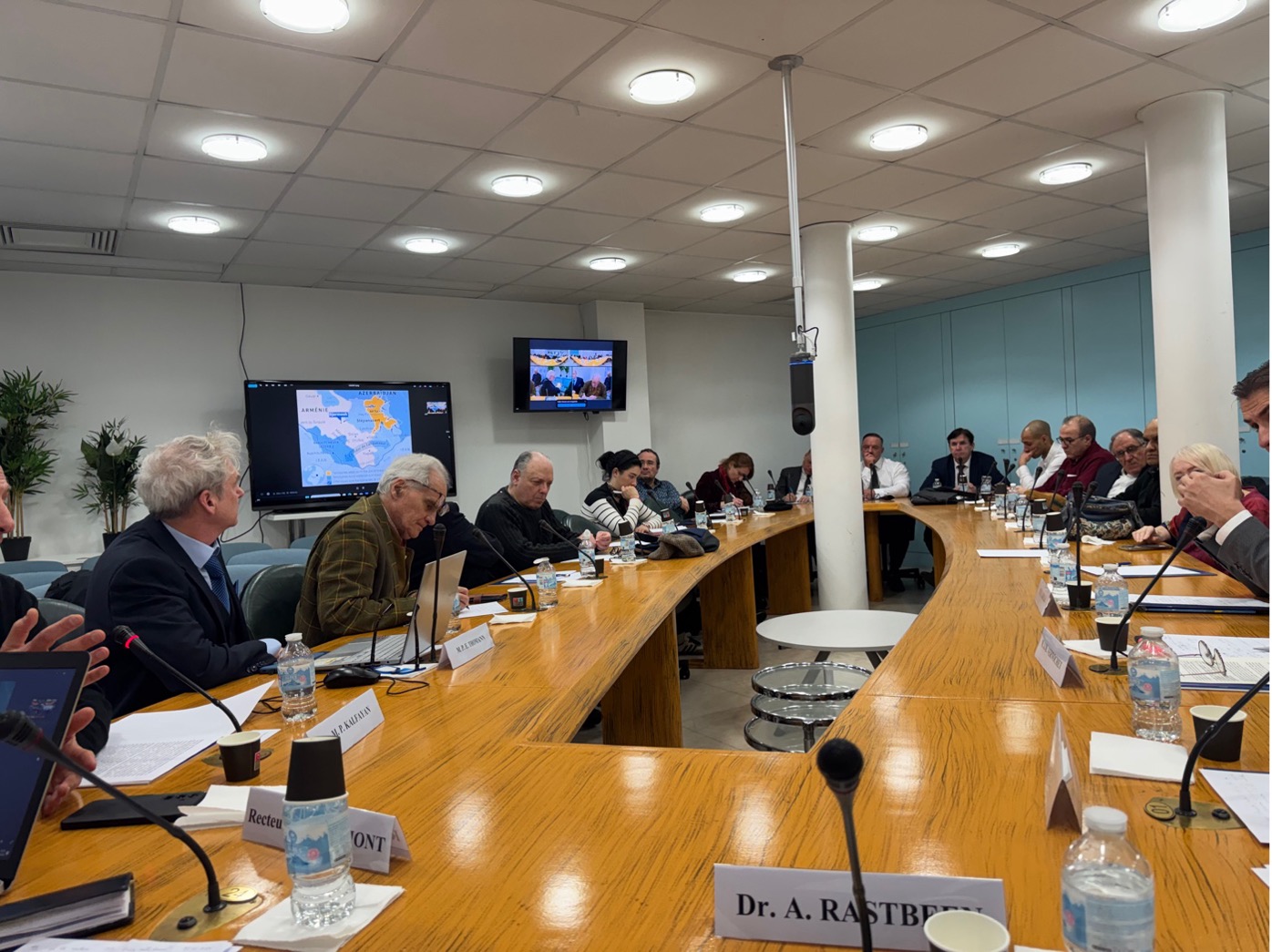
The Scientific Council of the Academy of Geopolitics of Paris organized Tuesday 27 January 2026 a symposium entitled “Where is Armenia going?” at 5 rue Conté in Paris.
A historic and strategic hub between the Black Sea and the Caspian Sea, the South Caucasus remains a region where imperial heritage, energy ambitions, military rivalries and the identity aspirations of the peoples are intertwined and confronted. The successive conflicts between Armenia and Azerbaijan, the loss of Artsakh in Nagorno-Karabakh in September 2023, the forced exodus of 100,000 Armenians to Armenia, and the tensions around the Syunik region and strategic corridors highlighted a deep political, military and moral crisis, while accelerating a major recomposition of regional and international alliances.
What impact does strategic corridors have on regional balance? What role does the external powers (Russia, Iran, Turkey, Israel, Europe, the United States) play in redefining South Caucasus balance? What political and strategic future for Armenia and the region? Participants are invited to reflect on these issues and explore Armenia’s possible trajectories in a new regional order marked by the primacy of force over international law and diplomacy, the rapid evolution of strategic partnerships, and the moral divides left by war.
This symposium is intended as a space for rigorous, pluralistic and committed reflection on the future of a country whose trajectory will have a lasting impact on the geopolitical architecture of the South Caucasus and, beyond that, on the balance between Europe, the East and the Middle East.
REPORT OF THE COLLOQUE
Dr. Ali RASTBEENPresident of the Académie de Géopolitique de Paris,
« The South Caucasus after 2020: end of conflict, emergence of a new order? ».
The South Caucasus is one of the most strategic and tormented regions in the contemporary world. Located between the Black Sea and the Caspian Sea, at the hinge of Europe and the East, North and South, Christianity and Islam, this space has always been a crossroads of civilizations, but also a battlefield where empires and regional powers have clashed. Since ancient times, Romans, Persians, Ottomans and Russians have sought to impose their domination, while indigenous peoples struggled to preserve their identity, autonomy and dignity. This long history of rivalries and fractures largely explains the current political and security fragility of the South Caucasus, where geopolitical, religious and ethnic fault lines continue to structure relations between States.
At the heart of this instability is the conflict in Nagorny Karabakh, a mountainous territory enclaved within Azerbaijan but mostly Armenian historically and demographically. This enclave has become the symbol of a much wider confrontation, far beyond the local context to be part of regional and international dynamics. On the one hand, Azerbaijan, a predominantly Shiite country, has moved closer to Sunni Turkey and received significant military support, notably through the acquisition of modern weapons, including drones provided by Ankara and Israel. On the other hand, Armenia, a Christian nation, has long relied on Russia’s strategic support and has complex relations with Iran, also Shia, but concerned about the regional consequences of the conflict. Behind these sometimes paradoxical alliances are deep existential fears: Armenia fears panturism, which it perceives as a threat of encircling and erasing, while Iran fears that the rise of Azeri nationalism will revive separatist aspirations among its own large Azeri minority.
To understand the current crisis, it is necessary to go back to the decision taken in 1921 by Stalin, who, in an imperial logic of division and control, caught up with Nagorny Karabakh – then inhabited by more than 90% Armenians – in the Soviet Republic of Azerbaijan rather than Armenia. This decision, perceived as arbitrary and unjust, sowed the seeds of the future conflict. In the late 1980s, as the USSR began to waver, the Armenians of Karabakh demanded their attachment to Armenia, reviving the underlying inter-ethnic tensions. The collapse of the Soviet Union in 1991 precipitated the region into an open war between Armenians and Azerbaijanis for control of the territory. The first Nagorny Karabakh war, which lasted from 1991 to 1994, was particularly deadly, killing approximately 30,000 people and displacing hundreds of thousands of civilians. It ended with an Armenian military victory: not only did Armenian forces consolidate their control over Karabakh, which proclaimed its independence as the Republic of Artsakh, but they also seized seven neighbouring Azerbaijani territories, creating a “security zone” around the enclave. A ceasefire was signed in 1994, but no lasting peace treaty followed. For almost 30 years, the conflict remained frozen, under the aegis of the Minsk Group (co-chaired by Russia, France and the United States), without a viable political solution, punctuated by sporadic tensions and limited military escalation.
In 2020, this situation statu quo precarious fly in bursts. After years of rearmament and modernization of its forces, Azerbaijan launched a major military offensive on 27 September to regain control of Karabakh. For 44 days, intense fighting opposed technologically superior Azerbaijani troops with drones and advanced missiles to less well-equipped and strategically difficult Armenian forces. The fall of the strategic city of Chouchi, which dominates the Karabakh capital Stepanakert, marked a decisive turning point in the conflict. Faced with an imminent defeat, Armenia accepted a ceasefire negotiated by Russia on 9 November 2020. This agreement was extremely costly for Yerevan: Azerbaijan recovered all the areas lost in the 1990s and part of Nagorny Karabakh, while the rest of the territory remained under Armenian control but isolated. Russia deployed approximately 2,000 peacekeepers to secure the Lachin corridor, the only route between Karabakh and Armenia. In addition, Yerevan undertook to open transit roads to the Azerbaijani exclave of Nakhichevan, opening the prospect of the controversial “Zanguezour corridor”. However, this cease-fire did not bring true peace. Between 2021 and 2023, the situation remained extremely tense. Azerbaijan exerted constant military and political pressure on Armenia and the Armenian population of Karabakh. By the end of 2022 Baku had put in place a blockade of the Lachin corridor under the pretext of ecological demonstrations, gradually cutting off the supply of food, medicine and fuel to more than 120,000 Armenians living in the enclave. This major humanitarian crisis, largely hidden by the war in Ukraine, further weakened the situation of Armenians in Karabakh.
In September 2022, Azerbaijan entered a new stage by directly attacking the sovereign territory of Armenia, particularly in Syunik province. The offensive, which killed several dozen people, was aimed at forcing Yerevan to accept the Azerbaijani conditions concerning the corridor to Nakhichevan. The international reaction was weak, and Russia, allied with Armenia within the Collective Security Treaty Organization (CSTO), remained virtually inactive, deeply undermining Armenian confidence in Moscow. The conclusion of this process proved tragic in September 2023, when Azerbaijan launched a flash offensive against the Armenian authorities in Karabakh. In less than 24 hours, faced with overwhelming military superiority and without external support, Armenian forces capitulated. This defeat led to a mass exodus: more than 100,000 Armenians left Nagorny Karabakh in a few days, ending more than thirty years of significant Armenian presence in the region. The Armenian Prime Minister called this event ” Ethnic cleansing Underlining the dramatic nature of this forced displacement.
These events have profoundly disrupted the geopolitical balance of the South Caucasus.
Russia, once the dominant and protective power of Armenia, now appears weakened and marginalized. Engaged in the war in Ukraine, Moscow has neither the means nor the will to oppose frontally the Turkish-Azerbaijani alliance. Many observers believe that the Kremlin deliberately allowed Baku to do so, either through strategic pragmatism or to punish the Armenian government deemed too close to the West. In any case, the relationship of trust between Yerevan and Moscow is permanently under way.
As a result, Armenia has undertaken a strategic repositioning. Since 2022, Yerevan has gradually turned to the West, hosting a European Union civilian border monitoring mission, organizing joint military exercises with the United States and ratifying the Rome Statute of the International Criminal Court (ICC). In 2024, Armenia even suspended its participation in the CSTO, marking a clear distance from the Russian-dominated alliance. However, this pivot towards the West remains fragile, as it is not yet accompanied by strong security guarantees.
On the Azerbaijani side, the 2020 victory strengthened the alliance with Turkey. The slogan ” Two countries, one nation It has been achieved through effective military cooperation and increasing strategic convergence. Ankara sees in these developments the partial realization of its pan-Turkish ambition: linking Turkey to Central Asia via a land corridor across the Caucasus. This perspective is worrying Iran, which fears geopolitical marginalization and destabilization of its own borders, as well as China, concerned about the implications for its Uighur minority and infrastructure projects in Central Asia.
In the face of these developments, the Western Powers have intensified their diplomatic engagement. France has clearly positioned itself in support of Armenia, while the United States and the European Union have multiplied mediation initiatives. In August 2025, these efforts culminated in a joint declaration in which the Armenian and Azerbaijani leaders undertook to finalize a peace treaty and normalize their relations.
Today Armenia is at a decisive moment in its history. After the loss of Karabakh, it must first and foremost guarantee its security and sovereignty. A future peace agreement with Azerbaijan would be based on mutual recognition of territorial integrity, clear demarcation of borders and the opening of regional communications. While such a peace would offer economic and diplomatic opportunities, it also raises deep concerns in Armenian society, marked by the trauma of Karabakh.
In this context, several conditions appear essential for lasting peace in the South Caucasus. First, this peace must be based on law and justice, not on the domination of the strongest. The protection of Armenian cultural heritage in Karabakh and the right of displaced persons to return must be guaranteed. Secondly, the international community must play an active role as guarantor of the peace process, through the United Nations (UN), the Organization for Security and Cooperation in Europe (OSCE) or the European Union (EU). Thirdly, peace must be accompanied by regional economic integration, including through infrastructure projects promoting interdependence and cooperation. Finally, true reconciliation will require long-term work on perceptions, historical accounts and relations between civil societies.
In conclusion, the South Caucasus is at a crossroads. Armenia legitimately aspires to a just and lasting peace, but that peace can only be stable if it is part of a balanced regional order that respects international law and the rights of peoples. As Cicero recalled, ” peace is peace of order ” The future of the South Caucasus will therefore depend on the ability of regional and international actors to focus on dialogue, moderation and cooperation rather than strength and revenge. It is only on this condition that this region, so long marked by war, can become a real bridge between civilizations rather than a permanent battlefield.
Rector Gérard-François DUMONT, Professor at Sorbonne University, President of the journal Population & Avenir, Vice President of the Académie de Géopolitique de Paris, « Armenia and the geopolitical law of number ».
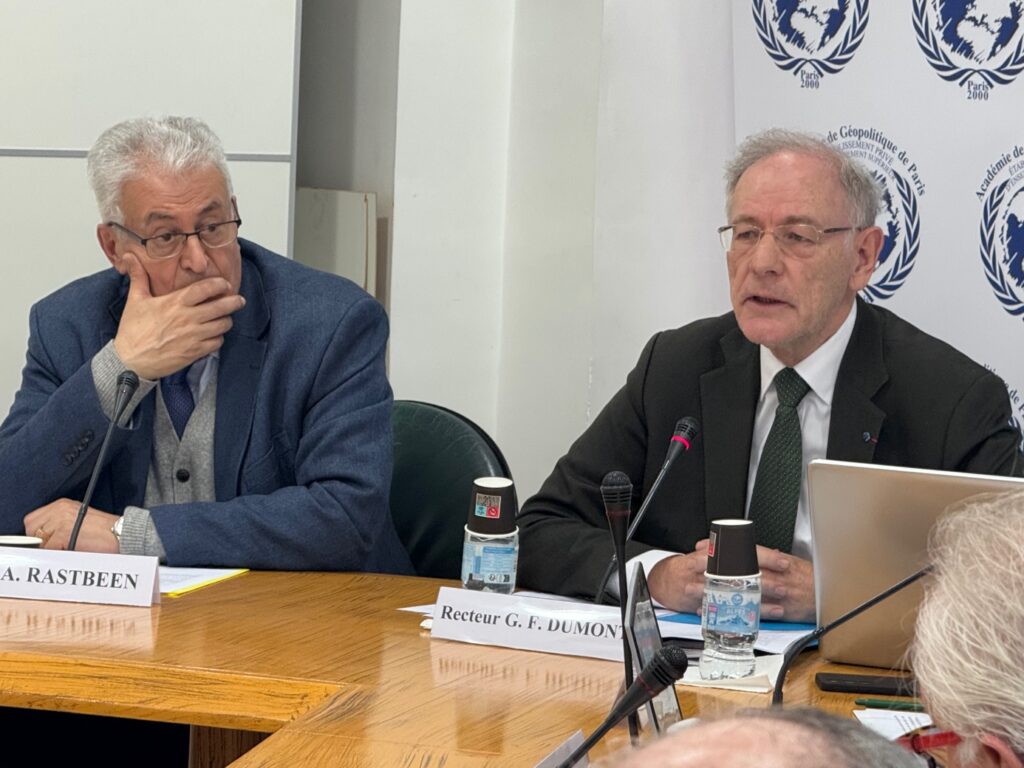
Thank you very much, Mr President. Before going into the substance of my communication, I would first like to thank you for your communication and perhaps just add a little personal testimony, having had the opportunity to go to Karabakh, especially in areas that are very close to Azerbaijan. I was able to see that the Armenian presence in this region was multi-year, since archaeological research had shown the existence of an extremely old city of considerable importance. In addition to this, there are many other heritage elements, but I quote this example because we were 200 metres from the border with Azerbaijan, so really, you see, somewhere else where it was a bit risky. Here, I wanted to bring this element point, this testimony, and there would be many things, other testimonies on this subject. But I come to the theme that you wanted me to take, which is therefore that of Armenia and the law of the number in geopolitical populations.
Knowing that we are in a context where this Caucasus is actually stuck in the midst of three great powers, Russian or Soviet, Ottoman Empire or Turkey, between Persia and Iran, and therefore is obviously in difficulty in securing its sovereignty in this difficult context, and all the history of this region bears witness to this. What makes the borders as we know them today are essentially the borders of the 1920s, which were both imposed by the outside world, and more precisely by the USSR, and by the nature of the conflicts that took place on the one hand between Russia and Persia, on the other between Russia and Turkey, and also within the framework of the internal conflicts in the Caucasus, since I would remind you that the Transcaucasian Federal Republic, which was created in 1918 to bring together the three countries that we know today, quickly imploded a disagreement over the territories of sovereignty of each other. And so we have to wait in fact for Soviet implosion to ensure that, indeed, three former republics of the USSR become independent in 1981. In this context, I wanted to show you a small figure that allows you to understand the situation at the time of independence.
I am simply proposing a two-part plan, i.e. on the one hand we will examine the situation at the time of independence, and the situation today.
So the situation at the time of independence, both in this South Caucasus and in the two neighbouring countries Iran and Turkey, is characterized by the fact that Armenia is by far the least populated country in the region. It is the “small” of the region, and as always when small, there are other solutions to preserve its sovereignty and independence than to deploy a strategy of alliance, which is absolutely necessary for all countries regardless of their level of development. Whether you consider Andorra, the United Arab Emirates or Singapore, all these countries have been able to maintain their sovereignty only through strategies deployed around the world to have relations with much larger powers that enable them to ensure their security, because it is in the interests of these powers in question. East Timor, etc., there are very many examples.
So when we are in 1991, at the time of Armenia’s independence, the problem arises for Armenia: who to turn to for a secure network? And the first idea would of course be to try to have proximity networks to ensure this sovereignty. And the proximity networks, they are mostly closed, and more closed than one might think. That is to say that it is obvious to everyone in 1991 that there is no possible relationship between Armenia and Turkey, since the negationist Turkey refuses to recognize the Armenian genocide, which is one of the reasons, moreover, of the low population of Armenia, it must be recalled, and in addition Armenia obviously has a very special look at Russia, since Armenia itself and many territories of Armenia see Mount Ararat, which is the symbol of Armenia and which is on the other side of the Turkish border. And it is a permanent pain that Armenians feel when they see this mythical and parareligious place that was part of Armenia for many centuries. And so in this context, as the President recalled, the first Nagorny Karabakh war will also take place, which I would like to remind you that it is also a war of partisans, that is to say that it is really in fact civilians who have won the war more than military, even if it is civilians who have trained. And in this context, Russia will decide in 1993 simply to close the border between Armenia and Turkey. And so no relationship is possible, of course, with Turkey.
As far as Azerbaijan is concerned, the situation is obviously delicate since relations begin with this war, which will therefore be won by Armenians, in a context where Azerbaijan itself has a real identity problem. That is to say that the Armenian population plunges into a long history, as much, especially the Azeris of Azerbaijan, have a difficult identity, since very often in the history books elsewhere they were called the “Turks of the Mountains”, i.e. that the Azerbaijani character was little in the texts, that it is a State that was somewhat created from the outside by Moscow who wanted to secure oil in the Caspian, and that therefore there is this geographical division of the Azeri ethnic populations, between those, as the President recalled, which are a large minority in the north-west of Iran, and those in that Azerbaijan created by Russia, in a context in which Russia, which became Soviet in 1921, wanted for this region to apply the method of “divide to rule”, which explains this situation largely that the Armenian population has a long history. previous you showed you.
So, of course, we find ourselves in a situation where Armenia has no point of support for Azerbaijan, all the more so since the war has resulted in a double ethnic cleansing, that is, on the one hand Azerbaijanis, mainly Azeris, who had to leave the territories controlled by the Armenian population during the 1991-1994 war, and on the other hand, and a little before, the Armenians of Azerbaijan who were forced to leave the country, in particular because of the pogroms, including that of Sumgait in 1988, and in an absolutely important context, that is, we are in a region where we have become aware that Moscow no longer controlled its populations. Since it is still the first time that nationalities within the USSR enter into a violent conflict, which proves, I would say, the weak signal that the USSR was going to implode.
From afar, it might have been thought that Armenia could have had very good relations with Georgia. Finally, they are countries with roughly the same population, both of which were republics of the USSR, and so perhaps there, for Armenia, there was a means of understanding that allowed these two countries to progress in their mutual interest. Except that relations quickly proved extremely bad, I would say for three reasons. The first reason is the 1920 borders, which are borders that absolutely do not correspond to the ethnic geography of this region. The second reason, which is obviously linked to the first, is that we have in Georgia, in the south-west of Georgia, a territory which is predominantly Armenian, which is called Javakheti (or Djavakhetia), and which is a highly landlocked territory of Georgia. And Georgia, seen from here, is still in fact afraid that this Armenian minority will have a secessionist will within Georgia, and the result is that this territory is relatively undeveloped, because there is no special effort by Georgia to facilitate its development, and in particular there is an effort by Georgia to minimize relations between Georgians of Armenian ethnicity and Armenians of Armenia. The third element is a religious conflict. It is a phenomenon that can be recognized by the situation prevailing in the 1990s, in the 2000s, in the countries of the former USSR. You had an absolutely major difference between a country like Ukraine, which respected religious freedom, and a country like Georgia, which did not respect it. In other words, the Georgian Orthodox Church considered that it should have a religious monopoly, and never made any special efforts to enable the Armenian Church of Georgia to regain the heritage it had before the Soviet period. And this religious conflict was even violent, with Georgians closing Armenian churches, putting locks on them, watching them day and night so that Armenians could not go back to their church. So you see that relations were extremely bad, and little effort was made either to ensure that there were easy traffic networks, apart from one of the roads, which is still not a very high quality road, between Georgia and Armenia.
It is therefore in this context that Armenia has found itself in difficulty of partnership, I would say, in its own region, and there is no longer really any more than a riparian country with which it could possibly have relations: it is obviously Iran. As far as Iran is concerned, it must first be remembered that historically Iran, which was then called Persia, had never ignored the interest of the Caucasus, and that for decades elsewhere it was Iran which, I would say, was sovereign in the Yerevan region. And so, if only for historical reasons, Persia and Armenians had had extremely close relations. The second element of course to be taken into consideration is that Iran also wanted to have a partnership in its close foreigner, as relations with Turkey were extremely difficult and, as the President recalled, they were not very good with Azerbaijan for the ethnic reasons already explained. So Iran saw an interest in having a foot in the Caucasus, and therefore greatly helping Armenia, especially in the 1990s, when Armenia was in extreme poverty. And on the other hand, Armenia could consider Iran to be behaved properly vis-à-vis Armenians, since the Armenian minority living in Iran was respected, and had the right to have its own churches, its own organization, and more importantly, the Iranian constitution, that of the Islamic regime of Iran, has foreseen, and is indeed the case, to reserve two seats in the Iranian Parliament for the Armenians of Iran. So all this did justify that close relations could develop. The result is that throughout this period of the 1990s and 2000s and 2010, and still today, Iran is the only neighbouring country with which Armenia has continued relations – and when we travel Armenia we see it very well because there are many trucks coming from Iran through southwestern Armenia. And it is in this context that Armenia has had to look beyond its foreigner close to other possibilities in the context of an external strategy, and the other possibility has of course been the former imperial bond, I mean Moscow, hence the maintenance, in particular, of this military base in Gyumri to which I will return.
Moreover, Armenia has tried as much as possible to mobilize its diasporas, even though the nature of these diasporas is extremely different. So, in this context, Armenia has, I would say, been able to survive with its support for Karabakh for about 30 years, until the time we are right now. And so, I suggest you look now at what has happened since.
What has happened since then is that we are in a situation where the population of Azerbaijan has increased, that of Georgia has declined, but we must take into account the fact that Georgia has lost Abkhazia and Ossetia, and so this obviously changed its population, and especially the population of Armenia has declined. In other words, under the law of number, Armenia, which was already the lowest in 1991, is today even more the weakest country in the South Caucasus. More precisely, the population has evolved over the past 30 years: Turkey’s population has increased by more than half, Iran’s by 43 per cent, and Armenia has lost 18 per cent of its population.
What happened? On the one hand, Armenia suffered from a very high emigration, i.e. the Armenians have largely left Armenia for various reasons. The first reason is simply economic, i.e. Armenia has suffered from its economic enclave which I recalled earlier, and therefore the hopes of improving its economic situation by remaining in Armenia were weak, so that many Armenians have left Armenia since 1991, and of course, in this kind of economic migration it is often the young active ones who leave, and therefore are no longer there to contribute to the development of the territory, even if they send discounts, as everyone knows. Part of this population has also benefited, in order to facilitate this emigration, from the existence of Armenian diasporas outside the country, which were likely to help them integrate economically into the country where they were going, such as Russia, the United States or Europe. It is true that the geopolitical context of instability, including, of course, prolonged military service due to the situation in Nagorny Karabakh, was not of any nature to wish to remain in this geopolitical instability, which gave little visibility to the hopes of improving the situation. So, on the one hand, we have had this extremely large emigration which explains this population decline, which is above all a departure of young people. And this population decline has logically been accompanied by a very large drop in the birth rate, which is now extremely high, on the one hand because of the departure of all these young people who were of reproductive age, on the other hand because today, in 2026, reach the reproductive age of few generations, but 25-30 years later, and therefore you see how the process of depopulation of Armenia continues to unfold, between emigration and fertility which has declined, so much so that for two years, in 2020 and 2021, Armenia has been in depopulation, i.e. in a situation where there have been more deaths than births.
What were the geopolitical consequences of this depopulation? It may be recalled that one of the consequences that is forgotten is also the ageing, not only of the population, but also the ageing of the electoral corps. So, difficult to measure to what extent this ageing electoral corps explains, in part, the very important political alternation that occurred in May 2018 with, since then, new governments that are constantly seeking other points of support than the support of previous decades that were therefore Russia and Iran.
In this context, the points of support that have been sought, starting with the United States, is necessarily a point of support that does not correspond to the deep history, since we are still seeing at this moment, with what is happening in Syria that, clearly, the United States has not ceased to show its support for Turkey, it is sufficient to recall all the declarations of the heads of State of the United States, if I may say, calling on the European Union (EU) to bring Turkey into the EU. Secondly, the idea was developed, as the President recalled, to approach the European Union. This approach to the EU has been carried out, but it is clear that it is associated with a geopolitical whole whose congenital weakness has been shown repeatedly. And the best example we can find, moreover, is that in May 2025, the President of the European Commission, Mrs Ursula Von Der Leyen, went to Baku to shake hands with the leaders of Azerbaijan, without any compensation! For example, she could have said, “I’m doing this gesture, which is still a strong gesture that is actually erased the ethnic cleansing of Nagorny Karabakh that would not have existed, but at least you could still free the inhabitants of Nagorny Karabakh that you took hostage in September 2023”. And nothing at all: a total alignment of the European Commission with Azerbaijan.
Concerning Russia, I will not recall all the elements, there is a point of information that I do not have but perhaps some have it in the room, that is: where is really the Russian base in Gyumri? I say that because it happened to me in the 2010s to visit a Russian base that was in Georgia. And at the time in the maps – you know, we were shown the Russian bases that were in Georgia – it gave the impression that Russia was still very much present in Georgia. I saw this Russian base, it was almost in ruins, the windows were broken, it existed on paper but in fact it was not in working order. So I don’t know what about Gyumri’s today, if she’s in working order, and if, however, Russia has shown that she doesn’t want to make it work. Anyway, it’s a support that’s a little limited.
As for the partner of the last thirty years, i.e. Iran, I do not need to recall that it is a country that is still weakened after the war of the 12 days, and probably after the demonstrations that we saw in January 2026. The other point that should be noted, since I did mention the strategy of aid desired by the previous Armenian governments with the diasporas, even if there were ups and downs but I do not have time to detail them, it is certain that a whole part of the diasporas have experienced and are experiencing difficulties in understanding the strategy of the current governments, of the army. To the extent that this diaspora is a diaspora that wants history not to be erased, that is opposed to any negationist attitude and that has some difficulty in considering that they could swallow the colours of negationism. Then we can also imagine that part of this diaspora has found itself somewhat demoralized since the ethnic cleansing in Karabakh and therefore less motivated by geopolitical actions in Karabakh.
In conclusion, what do we see? First, what happened in Armenia since 1991, is the failure of de-Sovietization. Indeed, the borders of the 1920s were Soviet borders, de-Sovietization should indeed have called into question, for example, the fact of leaving Nagorny Karabakh in Azerbaijan, which had been a purely Soviet measure of “divide to rule”. This failure, however, must be seen. And behind this failure there is a fundamental reason, which is that the international community has refused the right of peoples to self-determination. It is normally a principle of international law that is often emphasized and which, in this case, has not been respected at all. So the question that has been implemented in recent months, in recent years, so since 2023, is: 1) The burial of the principle of the right of peoples to self-determination in this region, and now: 2) the question of the inviolability of borders. In other words, some may have thought that by agreeing to the burial of the right of peoples to self-determination, the principles of the inviolability of borders, as they existed since the Soviet era, would be allowed to remain in place: this is not what happened, since you know that there has already been, as a result of the Azerbaijan attacks, changes in the borders between Azerbaijan and Armenia. I am talking about border changes outside the Nagorny Karabakh problem, and we are all in agreement on that.
So, in fact, one wonders whether the international community is not accepting to abandon the principle of the intangibility of borders, after agreeing to rule out the principle of the right of peoples to self-determination. I conclude with this question, and it is the future that will enlighten us to answer it. Thank you for your attention.
Philippe KALFAYAN, Doctor in Public International Law, Professor-Researcher at the University of Paris Panthéon-Assas, Analyst and Advisor in Geopolitics, author, « Pax Americana in the South Caucasus? Realities and consequences for the region and Armenia ».

Thank you, President, thank you too for inviting me. You have already discussed many topics on which we could spend whole afternoons, especially on this war in Nagorno-Karabagh, which has not really been lost, but it is because we forget to explain it, I think indeed Pashinian has voluntarily given up the Nagorno-Karabagh. Moreover, this war was not lost since the loss of life in each camp was exactly the same. And unfortunately the Armenian Prime Minister confessed at the end of the war that, indeed, he could have avoided this war, but for that it was necessary to return a number of territories, and therefore he said to his people: “If I had told you that you would have to return these territories you would have said no, well I went to war,” that is to say that he actually sent 5,000 people to death, that’s the first point. And the second element is that shortly after the beginning of the war, so ten days after September 27, 2020, the Minsk group had reached an agreement, which Azerbaijan had accepted, which was indeed the return of those 5 territories that surrounded the Nagorno-Karabagh, and they had actually left (…) Armenians. They were ready to do so, Pashinian refused, so war… And so all these elements have been recognized by the Armenian Prime Minister himself, which makes it absolutely ridiculous to see him still in place.
This is part of another subject that I will not discuss here, it was a first parenthesis on this war. The second parenthesis, however, is the policy of this government.
Another asset of this small country that has no resources, is its diaspora. This government, in any case this Prime Minister, has decided that it has designed a new model called “Real Armenia”. Real Armenia is Armenia which is within internationally recognized borders. This means that he has adopted, that he is at odds with all the evolution of international relations for a century, that is, he abandons the idea of the nation-state. That is, the diaspora is no longer part of Armenia in this new concept. This means that the diaspora is totally lost, in addition to feeling powerless, since it is not a resident or citizen of this country. And so there is a strong opposition in the diaspora, but also within Armenia, because since the loss of Karabakh, negotiations are not without (…), i.e. it is a series of unilateral concessions made by Armenia to Azerbaijan. All this because Pashinian considers, indeed this is what he had just said for a (…), that peace, i.e. the protection of Armenia, necessarily required these unilateral concessions to Azerbaijan. We’ll see what’s going on now.
Indeed, there is a peace treaty that was initialled but not signed, I explained why. But before that, this peace treaty, which was initialled by American pressure, came together in Washington on 8 August 2025. To understand why the Americans imposed this peace, I think it is necessary to know – I’m going to be very fast because I obviously think that everyone today understands perfectly – what US foreign policy is today and what its new doctrine is. We’ve completely dropped everything I call Kissinger doctrine, it’s the realpolitik which was based on multilateralism and the balance of forces in the world for, indeed, an undivided dominance of the United States over the rest of the world, with of course in line with an enemy, China. That is, everything revolves around this hegemony battle against China.
I have three parts: 1. What is the purpose of this American policy? 2. How does it translate into reality in the South Caucasus? 3. What is the state of this peace? Does this peace really exist between Armenia and Azerbaijan? What are the forces and assets involved?
This American policy, you understand, has been very violent lately. International law no longer exists. It is the law of the strongest, that is, the economic and military power that prevails and, in the interests, of course, national, of the United States. Then the interest it is primarily economic, but it is also safe. Behind this national interest – it has been well understood and known since John Mearsheimer and Stephen Walt wrote their book in 2006-2007 on US foreign policy and Israeli control[1] –, Israel is indeed decisive in American foreign policy, not only in the Middle East but also in the Caucasus. And so it is the conjunction of this new American hegemonic will and Israel’s will to destroy the military power now which is Israel’s main enemy in the region, i.e. Iran. In fact, Iran is the only country, now, that remains, since according to US foreign policy one has managed to destroy Libya, Tunisia, Syria, Iraq, by various means, so today only Iran is a state capable of resisting this Israeli hegemony in the region. Knowing that probably later – we’ll see how it will happen – I think Turkey can also become an embarrassing country for Israel, since Turkey effectively challenges Israel’s control over the rest of the Ottoman Empire.
How does American power translate into the Caucasus?
Well, as Trump wants to do in Greenland (i.e. avoid another power being able to take foot in Greenland and in particular have strategic control over the passage of the Arctic Sea), in the Caucasus, American peace is therefore to take control of all the flows of goods or natural resources that will transit from Central Asia to Europe, and further to the United States. So not only do they want to ensure that they have total control of these flows, but it is, of course, a way to weaken Russia’s influence in this region, the influence of China in this region and the natural passage that was taking place, which was passing through Iran, so all the flows of North-South or South-North goods passed through the Iran-Armenia-Georgia-Russia road.
Now the plan that has been put in place makes that – if you see the Zanguezour corridor – there are several thousand hours. There we don’t see the level of km, but this corridor is 43 km long. And the agreement, which was concluded on 8 August 2025 and which has just had a new stage on 14 January, so more details, is that the United States has 49 years of sovereignty over this whole band of territories. Officially Armenia would retain sovereignty over this territory, but it is clear that in the agreement that was detailed on 14 January it is indeed the society that will be established – which is a US-Armenia joint company controlled by 74 per cent by the United States and 26 per cent for Armenia – that has the freedom to develop all the infrastructure they want on this band of territories. And so control is mostly American, and we don’t know what they’re going to build. What’s safe is that maybe we’ll make a road, a railway, maybe new pipelines or pipelines. But it is also possible, and most likely, that it is also – if Iran never fell (…) and was not more docile with the United States – a way to install military and surveillance means, but really at the border. So here we are no longer in the Mediterranean, but really on the Iranian border. So that means that today they actually have free hands to create all the means of surveillance, in any case Iran on this band of territories. So, in this strategy, we not only take control of all the flows, and that at the expense of the European Union, the EU which has rushed – as was recalled earlier – to sign a Central Asia-EU agreement to bring these natural resources in, now the Americans have taken control of all this access path. So it’s well played on their part, at least, and how Asia will react, we don’t know yet, we think we should actually wait for the Treaty on Ukraine.
Nevertheless, in all this, this agreement, this famous “Trump Road” which is entitled here “Zanguezour Corridor” in today’s agreement, it is still indicated that the success of this project depends on several factors. First, the continuation of the institutional establishment of peace between Armenia and Azerbaijan, which means that this peace is not yet achieved. Secondly, progress towards full normalization of relations between Armenia and Turkey, another thorny issue. Thirdly, a sustained commitment by the United States. And then it’s very surprising to see it in the conditions, that would mean that actually this commitment is not guaranteed, so it’s quite surprising.
And from the point of view of the benefits for Armenians, in fact it is limited to employment opportunities, joint-ventures with American companies, technology transfer and training. Things that still remain of the order of accessory because in all this we are not talking about defence capacity building, we are not talking about creating heavy industries, it still remains something very light, whereas of course for the United States the benefits are clearly indicated, it is the transport of raw materials, critical minerals and rare earths to the American markets. More opening up new markets for U.S. business investment. So Armenia, in any case in this agreement, emerges with very little economic and political benefit, and a lot of geopolitical uncertainty because there is absolutely no mention of their security.
How, then, is this hypothetical peace seen on Baku’s side?
This third point, I can clearly label “Aliyev, master of the game”, because they really have all the cards in hand. In addition to that, President Aliyev was softened by President Trump. He considers him a remarkable man, a strong man, who has managed to restore all his power to Azerbaijan. Well, of course we’re not talking about Aliyev’s human rights record… It is certainly not Trump who is going to raise this subject, and as it was more or less recalled earlier, today the United States has closed the door to speeches on democratic values. At the same time as in July 2025, the State Department produced a circular for embassies in which it asked ambassadors not to mention violations of democratic freedoms. Thus, among partner countries, no longer mention electoral fraud in partner countries. And I think we’re actually in the reign of autocracies.
There is an article I recommend in Foreign Affairs which was published in December where actually it is clearly explained that we are in the domain now of the reign of autocracies, directly promoted by the American government[2].
So what does Aliyev say? He had so far adopted a rather remarkable policy because he had adopted an equidistance between Moscow and Washington. Since Trump showed his teeth, he actually now tends to get closer to Washington without really breaking bridges with Moscow. But in Davos last week, he recalled what this peace and agreements with Armenia mean, and in particular this famous road. First, he presents himself as a peacemaker between Armenia and Azerbaijan. After violating international law by storming Karabakh, it is now the peacemaker, which is partly true, but it persists on additional conditions to the peace treaty, which was signed in 18 points, of 8 August 2025. There are two conditions.
The first is that Armenia must change its constitution, because in the Armenian constitution there is a reminder about the connection of Karabakh with Armenia. It was part of Armenia’s declaration of independence, which was enshrined in this constitution. Armenia is ready to do so, just as it has abandoned the symbol of the Ararat on its emblems. So in return, the Armenian government does not repugnate it, but says “you yourself have a constitution that does not respect our territorial integrity”, because the Azerbaijani constitution is based on the recognized borders of the Republic of Azerbaijan of 1908-1920, not the Soviet Republic of Azerbaijan. That is, in the Constitution of the Independent Republic of Azerbaijan of 1908-20, part of the Armenian territories belong to Azerbaijan.
The second element that Aliyev will constantly remind, is that the agreement on this Trump road previews that the traffic will be made ” sans entrave and ” without contact with Armenians ” It is rather mysterious, because it is not clear how Armenia will be able to control customs at the border, without having contact with all the trucks, all the railways, and finally all the flows that will pass through these borders. Again, it is an ambiguity that persists today, in the agreements, which makes me say that for now this peace is only on paper, it is not yet consecrated.
And the third condition that is in the process of developing, and there is a clear danger to this so-called “real” Armenia of Pashinian, is that there is an organisation in Azerbaijan, which is called “Western Azerbaijan”, which is therefore working on the return of Azerbaijanis to Armenia. It is true that in 1991 there were 300,000 Azerbaijanis living in Armenia who returned to Azerbaijan. Today, Azerbaijan is demanding the return of these Azerbaijanis. Similarly, there is no reciprocity, i.e. Armenia does not demand the return of Armenians to Karabakh or the return of Armenians to Baku, Sumgait and Kirovabad, hence places from which they were expelled in 1991. And here, for the moment, there is the Foreign Intelligence Service – I would say the Armenian DGSE – which has just produced a report last week in which it presents – it is quite surprising to have this statement because the Director is a close relative of Pashinian – the report states that this is a real risk to Armenia’s security. It may seem paradoxical, but this presence, this return of Azerbaijanis, is actually dangerous not ethically, humanly, but it is purely economic and financially dangerous. That is to say that Azerbaijan has such an investment power, that Armenia does not, that very quickly the entire Armenian economy can fall under Azerbaijan’s yoke, not to mention that when borders with Turkey open, it will be exactly the same. That is to say, Turkey will rush for massive investment. So this is actually becoming a security issue, and even a survival issue for Armenia, because there is actually a demographic decline via immigration, and this new immigration, which is also adding to Indian immigration – you have to know that the Indians, now, are less than 15,000 in Armenia – there is a significant influx of Indians – so that Armenia risks being a territory populated by many populations, but more Armenians, within 20 years. All this, indeed, becomes problematic for Armenia.
Another thing Aliyev has rightly said is that “we control things, and we are unavoidable. In reality, we are the main communication hub between Central Asia and Europe.” It explains things very well, it is that, first of all, there is already a flow – which is not seen on this map – but which bypasses Armenia and which passes through Georgia, that is the BTC, Baku-Tbilisi-Ceyhan pipeline in Turkey. And so there is a road that is developed but not yet finalized, and that passes on the Iranian side along the border. In reality, that’s why I say thatAliyev is the master of the game. It is that if Armenia does not accept all the concessions, in reality there are two other routes for transiting goods and trade from East to West.
Armenia, in all this, is actually very lonely… And so all the stakes for Armenia will be in the coming months, it will depend on whether the Armenian Prime Minister can be re-elected. In any case, Americans and Europeans are doing everything they can to ensure that he is re-elected, even if they close their eyes to violations of rights and freedoms – Europe has clearly given EUR 15 million to counter the so-called Russian “hybrid” threats to these elections. But it is a total impasse for Armenia because today it must be known that statistically this rapprochement between Armenia and the United States and Europe is totally contradictory to the economic reality of that country: that is, Armenia’s main trading partners are 35-40% Russia, 12-14% China, 8-12% the United Arab Emirates, 4-5% Iran, but that’s all. So it means that Armenia’s centre of gravity is not in the West, it is in the region, and so there is clearly a wrong choice or a non-choice because contrary to what I’m telling you, Armenia has no strategy. We have an illuminated head of the Armenian government who is now seeking re-election, but who does not really understand where he is embarking this country. Here, I will answer your questions later.
Just one more element, in this case and this vassality of Armenia compared to the United States: Pashinian made a monumental mistake. There is a true friendship between Armenia and Iran, which has been built over the last thirty years, and even before (…) historical, this friendship has turned its back on it. And secondly, he also betrayed somewhere this friendship which he was very proud of with France, particularly with President Macron. France is totally forgotten in this game. Well, this is not the only theatre on which France is forgotten, but in any case in this specific Franco-Armenian relationship, France is totally forgotten.
Pierre-Emmanuel THOMANN, Doctor in Geopolitics, « Geopolitical issues in the Zanguezour corridor ».
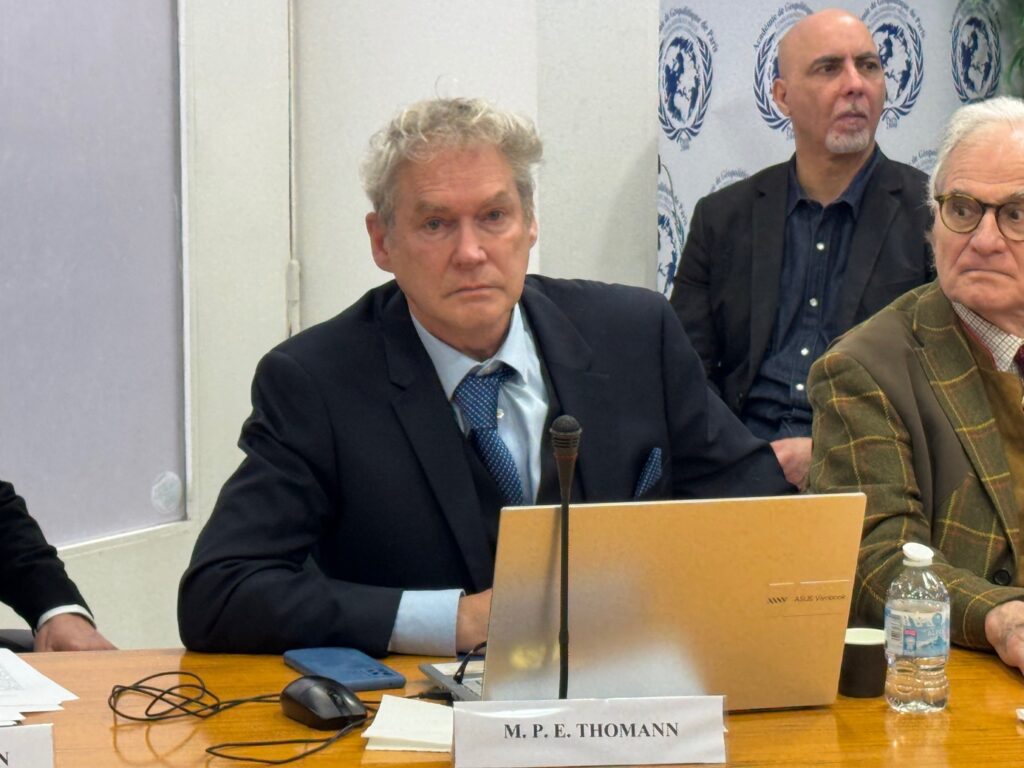
Thank you for this invitation, I am very honoured to be able to intervene in your Academy, this is the first time. I am going to carry out my reasoning with a geopolitical approach. I would remind you that geopolitics, as I understand it, is the study of the rivalries of power in the territory, and the people who live in it. So the rivalries of power on the territory in different spaces, on different scales. And so, the angle that I’m going to prefer to try to understand what the geopolitical stakes around the Zanguezour corridor are, I’m going to show you geopolitical maps. I have my website called “Eurocontinent”, there are a number of these cards elsewhere, which are published.
So I will focus on the implicit geopolitical strategies of the great powers that count, and that instrumentalize this Zanguezour corridor in their geopolitical strategies, in obviously rivalry with their opponents or allies. I will not concentrate, because I will not have time, on defining and identifying geopolitical interests and geopolitical visions of all actors, because there are a lot of actors involved in this issue from the Zangezour corridor, from the United States to China and all the regional actors, but I will focus on Western strategies, especially the United States, in relation to this corridor, to understand what the implicit strategies are. Because geopolitics is the interpretation in time T, currently, of implicit geopolitical strategies that are generally not explicitly stated. Except that, since Donald Trump, the world has changed, because previously the United States, which has always had geopolitical strategies on the territory coated in the kind of international moralism and in the export of democracy, today they explicitly state what their interests are, while other actors do not yet dare to do so as the European Union, which are largely lagging behind in this field. And so things are starting to get clear. But of course, within the Zanguezour corridor, there are still different interpretations that I will set out and that remain geopolitical interpretations because there will be no official declaration on these issues, but that is my hypothesis.
So, the first map, I illustrated this Zangezour corridor. So geopolitics is also the analysis on different scales of a rivalry between different actors, and obviously there is the question of the Zanguezour corridor with the rivalry between Azerbaijan and Armenia, because Azerbaijan wants to link its enclave, the Nakhichevan, through this corridor, and therefore it is a purely regional issue. But in reality, this corridor takes on its geopolitical significance on a global scale, because this corridor in reality is a corridor that is supposed to connect Europe through the Caucasus, crossing the Caspian to Central Asia. What is called, beyond the Zanguezour corridor, the Transcaspal corridor, and in the context of the war in Ukraine, the American-Russian rivalry and the instrumentalization of regional conflicts and the neo-Turkish geopolitical strategy that takes them into account, will be highlighted in my presentation.
I will return to this slide, because now I will show you my interpretation of the United States’ position in the world, which will allow us to interpret the importance of the Zanguezour corridor in this regional strategy, which will have a global impact.
The position of the United States in the world
The United States, since I would say World War I, has a strategy of encircling Eurasia. Following the Anglo-Saxon geopolitical doctrines known to us (Macinder)[3], Spykman[4], more recently Brzezinski[5]), with Donald Trump, they reintroduced the Monroe doctrine (1823) but in my view they opened a new Arctic front. So far, the United States, in order to prevent a rival power from emerging in Eurasia, whether Russian, Chinese, German, European, or whatever it is – this is what is called the “Wollowitz doctrine” (1991) in the famous document that was published and that has been scaffolded in fact, because it is the New York Times who published the first document[6] and then the real goal of the United States (to prevent any rival power from emerging on the Eurasian continent) was stated in the first document and then disappeared. That’s his main objective. This domination of Eurasia, especially during the Cold War – I will not go back to the First or Second World War, but this strategy was already in place – is the encirclement of Eurasia, mainly on the Rimland and more recently the Rimland Indopacific, which had already begun during the cold war but which continued. And today it is about containing and even expanding this Rimland in Europe and the Middle East against Russia, and in Asia-Pacific against China. And more recently, the Pan American control of the United States and the opening of the Arctic front make it possible to close the encirclement of Eurasia by opening the Arctic front, because this zone becomes strategic. So we’re talking about Central Asia, the Caucasus, Eastern Europe, the Indo-Pacific, all these areas in fact I think are strategically important areas, more or less equal depending on the period, and I find it difficult to make a hierarchy between them. Because it is claimed that the United States is above all, and explicitly it announces, to position itself vis-à-vis China, but I think the United States is as interested in containing Russia as China, I will show you why.
The new US doctrine of “geo-political outsourcing” of their Eurasian interests
I now turn to the second diagram. There, I interpret from the US national security strategy that they published in 2025 [7], the new American doctrine of “geo-political outsourcing” of their own interests. While during the Cold War and the unipolar period, the Americans were on the front. On the Rimland, in particular in Europe, they were acting to broaden the Rimland and repel Russia in its continental lands, and fragment and destroy all states that could constitute an obstacle to their passage (Yugoslavia), repel Russia. The wars in Yugoslavia have also been the field of manoeuvre for the implementation of the American unipolar world, which is really located in the Rimland, which helped to broaden the Rimland, obviously, and we went to Georgia, Ukraine, and there seemed to be no more limits, except that Russia reacted. Russia, starting with the 2008 intervention in Georgia, stopped the US advance, i.e. with NATO enlargement in Georgia, it was already a message to Ukraine, which they did not understand or did not want to hear, and Georgia paid the price by being divided, having lost a third of its territory. And Ukraine, the same, will be totally depopulated, that is, any state that positions itself as a substitute for the strategy of encircling Eurasia, Russia, by the United States, by reaction of Russia to prevent its encirclement, will eventually depopulate. It’s a suicide.
From the moment the Russians intervened, first in Georgia and then in Ukraine, in reality – this may not yet be clear on the military ground – according to me from the geopolitical point of view Russia has already won. Why? Because the enlargement of NATO will no longer be possible in Ukraine. Nor in Georgia elsewhere. That is, the United States, in its strategy of encircling Russia, can no longer structure Eurasia by imposing organisations such as NATO, the subsequent enlargement of the European Union, and then Westernizing these regions. It’s over. And that’s why Donald Trump, in a very timely and malignant way, in fact, when he was part of his entire life, especially in his first mandate, he gave lethal weapons in support of Ukraine against Russia, but there he understood that the United States had lost this geopolitical battle in Ukraine and therefore he is re-focusing on the Monroe doctrine because in the multipolar world that actually emerges they are losing power, even if they want to stay as I show on the diagram the first power, at the top of the global geopolitical hierarchy, but exerting pressure in Eurasia, in the filiation of geopolitical doctrines, but being no longer on the front but pushing their allies to make geopolitical subcontracting in their own interests. In other words, they have expressed it very clearly in Asia, the arch of the islands with Taiwan, South Korea, it is to them that the front is entrusted, and the United States obviously sells them arms but will gradually withdraw their soldiers. And in Europe, it’s even more obvious, they push the European Union and NATO to be taken over by Europeans, not by France. France made a huge mistake in believing that it could take the leadership European military by supporting Ukraine against Russia, and in fact the United States will entrust it to Germany! NATO is going to be entrusted to Germany, and besides we got angry with Russia, so we’ve lost on every picture. And so push the EU to subcontract geopolitically against Russia while the United States retains its position as a world power by eventually negotiating, including with Russia and China, agreements beneficial to its own interests, a sort of triad at the top of the world hierarchy, and all others are instrumentalized and destined for full vassalization. And all states that have the misfortune of wanting to play a position, I would say “multi-vectorial”, will be crushed. And that’s where Georgia and Armenia, unfortunately, who tried to play vector diplomacy by believing that the West was going to help them because the West, and finally the United States, mainly, were instrumentalizing them to get to Russia, but would never come to their aid when there was a return from Russia or if they were eaten by their vassals to whom they entrusted geopolitical subcontracting if they wanted to rid themselves of and absorb them, especially Turkey.
The role of Turkey
Turkey resumes a role as important as during the Cold War, because in the rivalry between the United States and Russia, and in the doctrine of geopolitical subcontracting of encirclement and hybrid conflict against Russia by allies, Turkey plays a fundamental role, but with other states, such as Poland, the United Kingdom, all NATO members, Israel obviously vis-à-vis Iran, all these countries are of the same size as in the Cold War. Rimland Europe, which is intended to be stabilised because there will be no more enlargement. There are only Europeans who still believe that they will expand, but they can expand when NATO expands, but NATO will no longer expand… The EU, moreover, if it takes Ukraine within it, it will commit suicide. That’s why I think they’re going to try to make it look like enlargement by perhaps integrating Ukraine into a kind of privileged partnership with the EU, but without the right to vote and without a common policy, so that doesn’t mean anything.
But Turkey plays a crucial role, and all we could say is that Turkey is approaching Russia… In fact, Turkey plays under the wing of this great Anglo-Saxon strategy to push Turkey and support neo-Tottoman politics in its area of geo-historical influence. Turkey is here to counter and weaken Russia and China. So the United States is pushing for Turkey and Azerbaijan – from where the corridor – to have a direct link for their economic, energy and subsequently military exchanges, to cross the Caspian, to take Central Asia and to detach it from Russia and China. And so, Turkey plays in a very timely way this double game of making believe that when it arranges them at regional level they can negotiate with Russia, but in fact they are largely in this great geopolitics of Anglo-Saxons, moreover that reminds me of the Crimean War (1853-56) in XIXe century when the Ottoman Empire is there against Russia, instrumentalized by the Anglo-Saxons because they seek to turn Turkey against Russia, in the same way as the Anglo-Saxons had sought to appease Hitler to attack the USSR. Hence the Munich Accords (29 September 1938) and then the German-Soviet Pact (23 August 1939) where Stalin tried to delay the German attack, but finally it occurred ( Barbarossa, 22 juin 1941).
In this strategy of geopolitical subcontracting, the EU, which believes itself to be positioned, in particular through the French discourse on strategic autonomy, flows into the great geopolitics of the Anglo-Saxons by making believe in strategic autonomy, by positioning itself against Russia, and by saying “we will defend Europe”… in fact, they defend the Rimland which is only one sub-element of the great Anglo-Saxon strategy… And besides, we cut off Russia. They support the Zanguezour corridor in order to gain access to Central Asia because since we have cut off energy resources from Russia we are forced to import from Central Asia oil, gas, uranium, and then increasingly try to bypass Russia, but this will strengthen the complete vassalization of Europeans. And here again, the role of Georgia and Armenia, which, in my view, made the mistake of believing that they could remain independent in this game of the great powers, obviously it is becoming increasingly savannacious, Georgia understood it very late, after having lost more than a third of its territory.
Little anecdote, I was last year an observer in Abkhazia, and here what is very interesting is that the Abkhaz are obviously very anti-Georgian, they absolutely want the Russian presence to not fall back under the Georgian cup, but at the same time they do not want the Russians to control Abkhazia, but at the same time they can only survive by Russian tourists and Russia’s investments. So there is a huge hypocrisy, and in addition in the elections there is a Russian-Turkish rivalry game where the Turks were funding, in fact trying to create trouble in the local elections, precisely to threaten the Armenian minority who is voting in favour of the pro-Russian candidates. And so there’s this whole game. Of course, behind this whole game, the Anglo-Saxons are there and the British, who have not lost the goal of dismantling, weakening Russia and using panturquism to eventually fragment Russia, even in the craziest plans, with Kazan Tatars. But it won’t happen because Russia is still in control, and in addition to Ukraine they won’t be able to invest. Moreover, since the Anglo-Saxons have seen that on Ukrainian territory in reality it is a defeat, a retreat of the Euro-Atlantic space, because they will no longer be able to expand, they are trying to open new fronts. And the Zanguezour corridor allows us to try to continue the enlargement, the continuation of the encirclement of Russia, trying to bypass Russia on the flows, and try to take Central Asia.
The problem with this strategy is that Russia, in its geopolitical vision, which has its perception of the NATO bases around Eurasia and the pressure on the Rimland, its strategy obviously is to de-encircle, and as a matter of priority it has therefore acted first in Georgia, then in Ukraine, which allowed it to place – this is the Russian perception where NATO gradually bypasses Russia to perhaps circle it, it was the previous plans, up to Central Asia – but the Russian intervention in Georgia and Ukraine stops NATO, and that is why the United States, in compensation, supports Turkish imperialism, panturk, to try to continue this encirclement in a more distant horizon.
Why the Russian position on this Zangezur corridor? Of course, which is promoted by the United States, then to promote the Trans-Caspian corridor and attract Central Asia to the American-dominated Euro-Atlantic space, because it must be seen that the United States will never accept a strategic autonomy of Europeans, never. Moreover, this is clearly reflected in the US national security strategy.[8] They promote the enlargement of the EU to Ukraine, but keep their hands on all investments. So they would be present in the rest of Ukraine and would torpedo any continental Paris-Berlin-Moscow agreement, so that would be the end, for Europeans, of the possibilities of having a Gaully strategy. That’s the plan.
But there are some grains of sand that could become very interesting and important.
Beyond Russia advancing in Ukraine, which is increasingly humiliating NATO and the EU in reality, which the United States is seeking to swindle. Trump, by positioning himself on Greenland, by opening a new front on the Arctic, we can see that this is actually no longer the same speech as before with Bush or Biden to go consider Russia and China as opponents or enemies. Russia and China are no longer even mentioned in the national security strategy. They remain implicit enemies, but they will no longer go to the front because they are no longer capable. But it remains no less dangerous because they push their allies, their vassals, to do the job in their place by giving them weapons.
And that’s where this strategy can be complicated in the long run, because from the moment we send vassals to do our own work and we don’t stand at the front any more, when the chief sends his soldiers and keeps him hidden in the bunker, he starts to lose his leadership. So in the long run it may weaken the United States. That’s my question.
On the other hand, there is one element that is forgotten: why does Russia have an ambiguous position in relation to the Zanguezur corridor? It could be said that Russia is fully aware of the American game, the pursuit of encirclement, support for pan-Turkishism and the attempt at detachment from Central Asia. But the Russians have another map. That is, they are promoting another corridor, the North-South corridor, the corridor they are negotiating: Russia, Azerbaijan, Iran and India. And my assumption is that the Russians support the Zangezur corridor, officially, but provided that this corridor remains an economic corridor, and that it does not involve an American military presence, they are opposed to that. And why are they supporting this corridor? Because – this is my hypothesis – in the negotiations in South Korea at the moment, the content of which is not known, Ukraine is only one element of the negotiation, and they are actually negotiating on all the ground: the Arctic, the Caucasus, Central Asia… They make a distribution of geopolitical spaces. And so Russia could very well accept the implementation of the Zanguezour corridor if the United States push Azerbaijan and Turkey to accept the North-South corridor, where Azerbaijan obviously reinforces its position of hub between the East-West and North-South corridor.
But what will the Russians do if they connect in Azerbaijan with the East-West corridor? Well, they’re going to feed all their products, they’re already doing it, putting Russian gas in the Azeri cargoes, so it’s a very clever way to bypass sanctions too. And they know very well that crossing the Caspian, for the time being, is an illusion, because the countries of Central Asia, even if they promote two corridors – through Afghanistan for the South, and the Trans-Caspian – and so they want a rapprochement with Azerbaijan and Turkey but they are wary of Turkey. They do not want Turkey to dominate Central Asia, they will always remain in balance with the Russians and Chinese. And also there are not enough boats and infrastructure to cross the Caspian today. We can, by a few boats, and the Russians, with their alliance with Iran, plan to prevent this corridor from becoming too important.
So in fact, by accepting this corridor that would be limited to Azerbaijan-Nakhitchevan-Turkey, they connect, they balance their products, and in the negotiations they actually re-integrate into all the global corridors and bypass the sanctions, and I think there is a negotiation between Americans and Russians on this point. There’s still a lot to say, but I think I’m gonna stop there.
Emmanuel LEROY, President of the Collective France for Peace,
“Zanguezour: vital territory or geopolitical fracture line of the XXIe Century? »
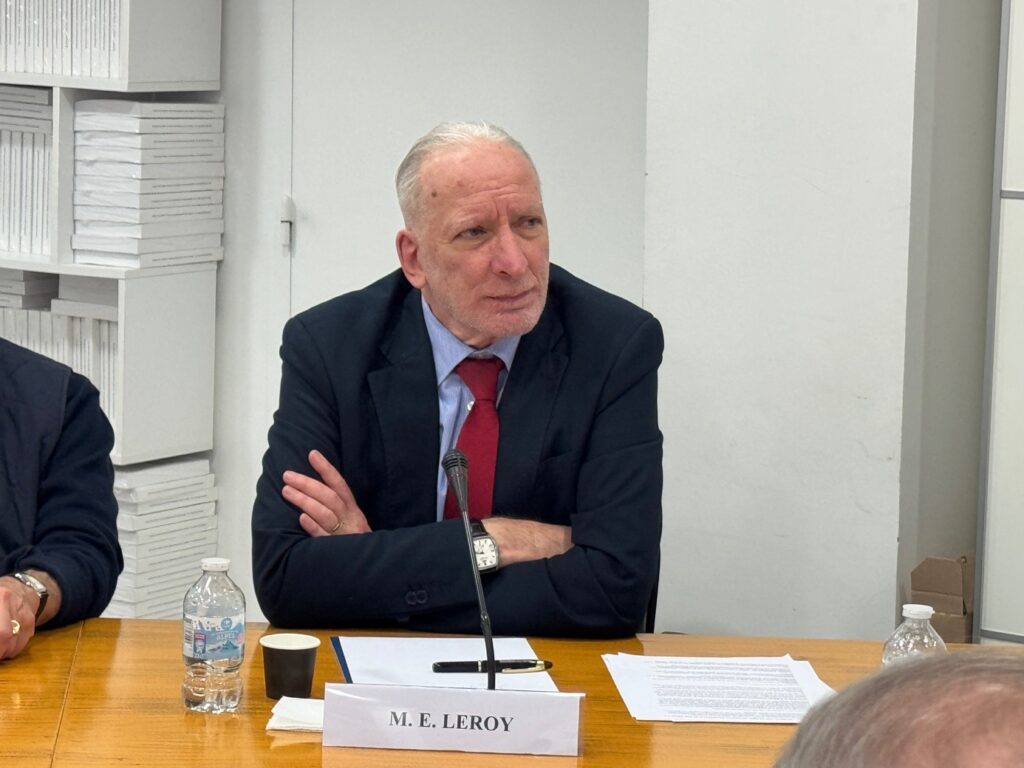
Thank you, Mr President. It is difficult at this stage of the colloquium to address the issue, which has already been remarkably addressed by all my predecessors, from different angles, I believe that many things, if not essential, have already been said, so I will try to focus on a few points that have been set aside or insufficiently in depth to try to draw the quintessence.
Like some of my colleagues, I will also recall the reason for my commitment to Armenia. It is also a journey that I made there in 2018, and where I discovered this very old country, this very old culture, in which Christianity as a state was established for the first time in the history of humanity. And that, it doesn’t forget, and I really remember this peregrination from Yerevan until Stepanakert – at the time it was still called Stepanakert – and especially the descent into the valley, at night, where there was at the time – so it had not yet been shot down – a huge cross that dominated the capital of Artsakh. And I can tell you that it’s impressive, because in 2023 I saw this cross dynamited by the victors, so I confess I cried. But that was a personal anecdote.
I would also like to come back to the (…) in Armenia to remind you – it is not anecdotal – that it is in this city of Yerevan that is the largest American embassy in the world. For those who have already made the trip to Yerevan, when you come from the airport and head towards the city centre, you walk along to the right the American embassy for, I think, more than a kilometre. I don’t know what hundreds of meters of width is in the embassy’s grip, but it’s much more an American base than an embassy, strictly speaking, and it’s not for nothing, it’s only actually long since, since 1981 at least, for the United States, Armenia is a key territory for destabilising Eurasia. So this is also a point to remember.
I would have wanted to bounce back also on Dr. Thomann’s comments on history, and always to try to go back to the long story because this is how we understand the evolution of things, of course American hegemony manifests itself from the beginning of the XXe Thus, around the war of 1914. But I always insist, so that one understands the situation for this small territory of Zanguezour and in general for all the conflicts that Europe or the world has experienced for centuries, that this goes back from my point of view to – most probably – the end of the XVIe in the British aristocracy, where was born this irrepressible will to conquer the world, what they call, what Kipling (1865-1936) called the XIXe century the “great game” (the great game), and that the commentators a little fast considered it to be the mere rivalry between two empires, between the British Empire and the Tsar Empire. But I am firmly convinced that this British oligarchy, from the 17th century onwards,e and I am pretty much convinced that most of the wars that the world has experienced since that time almost always have an Anglo-Saxon protagonist, in any case British during the first centuries and now “anglo-Saxon” since the end of the XIX century.e-start of XXe century. It really seems to me to be an essential point. I want proof, because this could be a free assertion, the reminder of a character that the English love very much, which is little known outside England but that the English have perfectly erected as heroes of their long history, and which is a certain Walter Raleigh (1552 or 1554-1618), so the captain of the guards of Queen Elizabeth Iera, a lover of the queen too – it doesn’t eat bread – who was also a bit pirated, adventurer, businessman, trader, etc., not quite British if you want, and this man finished his life at the Tower of London, before being beheaded, and so shortly before his death he had written a book that is called immodesty World History (1614)[9], and it is in this book that we find for the first time stated this will to conquer the world, since it is Mr. Raleigh who is at the origin of this aphorism subsequently taken up by authors who are more or more close to us and known as Spykmann or Mackinder, and therefore this Raleigh was the first to write black on white in his book ” Who holds the sea holds the trade. Who holds the trade, holds the wealth of the world. Who holds the wealth of the world, holds the world itself ” And this is really the quintessence of what I call Anglo-Saxon ideology, that is, the certainty that by financial power – and this for centuries, from generation to generation – British elites, then Anglo-Saxons with their multiplication in the XIXe century, passed on this will to take over the world. And as long as we do not have this vision of the world, we cannot understand how it works, including the aberrations of European policy today, it all stems from this. And I want for proof also (it seems to us far from Zangezour but yet we are in the middle of it), i.e. to see that since the XVIe When England, at the time a small country of 4 million inhabitants according to the demographers – I speak under the control of the respected and well-known authors – France had almost 20 million inhabitants, almost five times more. In spite of this, on this small British island, having focused its strategy on the conquest of financial power and its island protection, obviously, which has secured its strength, and sometimes comes, from century to century, to break the Spanish all-power, then the French all-power, then the Austro-Hungarian all-power, then the German all-power, and, to take over Dr. Thomann’s cards, it remains on the immense Eurasian continent only the Russian all-power, which remains their last obstacle.
And the crisis in Armenia, like the crisis in Georgia you were referring to earlier, is still, indeed, this work of encircling Eurasia, which continues and will not stop until one of the two protagonists has acknowledged its defeat. And I am firmly convinced that there will be peace… So of course there can be partial peace, I think that in the coming months we should have, if not peace, at least the cessation of hostilities in Ukraine, for lack of combatants, if I may say, given the extreme exhaustion in which this poor country fell. But the war will not stop and will be able to return to Georgia, it will be able to return to Armenia, it will be able to return to any territory where the Anglo-Saxons have decided to carry the iron.
I’ll try to get back to our subject anyway. We talked about the “Trump Road” sufficiently and completely so as not to have to come back on it in an essential way. There is just one point that I would have liked to draw your attention to, which is the synchronicity of the signature of this document (which Professor Kalfayan saw just now, so on January 14th) with the events that have just taken place in Syria, where the Kurds who had spent considerable energy in the years 2015-2018 to conquer the city of Kobane (in Kurdish, and which the Arabs call Tain al-Arab), this city fell in a few days, even a few hours, almost without a hit, into the hands of the official Syrian army with the help of Turkey. Similarly, further east, in the territories where Syrian oil flows, especially the city of Deir ez-Zor, it seems the Kurds and the Syrian Democratic Forces (SDF) have abandoned the game and left their hands in Ankara rather surprisingly. And the Americans, supposedly defending the Kurds, did not lift their finger. I would add that not only did they not raise their finger, but the French there too were therefore somewhat forgotten, since the French defenders of the Kurds both in Iraq and in Syria were not even warned of the extremely rapid advance of the Damascus troops, and therefore a company of French special forces would have been very surprised to be with the people who were “doing a good job”, as Mr Fabius said a few years ago. So this is for this event that coincides with the signing of the Trump-Erevan agreement, or Trump-Pashinian should be said rather.
And then another element that happened and which did not fail to cover up the chronicle is the events in Iran. If everything had passed as Tel Aviv and Washington hoped, Iran would have been dismantled at that time. And one can very well imagine in a somewhat plotting way (and I beg you to apologize) in the negotiations between Mr Pashinian and Trump, which took place on January 14 in Washington, which the Americans offered Mr Pashinian to feed on the beast once Iran dismantled. This is a hypothesis that cannot be excluded. Similarly, it was also mentioned to me, for the Kurds of Syria, that the territory of north-western Iran could be assigned to them for the creation of an Iranian Kurdistan. It was just a hypothesis that I wanted to submit to you because in my opinion it does not seem unthinkable, and in this kind of adventure there are always concomitances that may not be…
I would also have liked to go back to one of the remarks made by the Rector Dumont earlier about Armenian churches, and especially when he quoted Armenian churches that had some difficulties in Georgia, if I remember correctly.
Rector Gérard-François DUMONT
It’s more than “some difficulties” it’s beyond!
Emmanuel LEROY
I understood, I spoke to you by euphemism. I would like to point out that in the events that have just developed in Iran, among the hundreds of public or private buildings that have been set on fire are two Armenian churches, and that is also not by chance in my opinion.
So I would really have liked to expose, trying to adapt to what has already been said and not to allow redundancy, try to take back the positive and negative elements that affect the main protagonists of this project to build the “Trump Road”.
As far as Armenia is concerned, Professor Kalfayan spoke of it more broadly, it is a major strategic and geopolitical defeat, even if Mr Pashinian tries to convince us that there will be financial benefits. I don’t see how, when the balance of this project is already distributed between 74% on one side and 26% on the other for Armenia, this (…) should make any money, especially if the unhindered passage actually involves non-contact between Azerbaijanis and Armenians. So I’m very skeptical about the commercial advantages Yerevan has mentioned. On the other hand, I am sure that Armenia not only lost its unpredictability in the years leading up to Nagorny Karabakh. I remember, on this journey in Artsakh, having seen these long cables that had been stretched south of the valleys and were intended to prevent Azerbaijani helicopters from coming to bomb Armenian positions. And I remember the pride with which our Armenian guide showed us this tactical example of Armenia’s defence against Azerbaijan, and imagine today that this country was completely divided, knowing, as it was actually recalled earlier, that it is not a territory lost for 30 years or 40 years, but it is a territory lost after thousands of years of presence. So for Armenia this is obviously a totally negative point.
As far as Azerbaijan is concerned, of course a total counterpart, it is clear that for them it is an absolute strategic victory. Military victory first, economic victory And, I fear, in any case for the future of this part of the world, it is also, in my opinion, an area of re-armed conflict that will never cease, because we are in existence, it is a matter of life and death for Armenia which has already for centuries lost a great deal over its history. And I’m very afraid thathubris which hit Azerbaijan after their victories of 2020 and 2023 does encourage them to go further, beyond the claim of a north line in the north-east or some villages on the contact line, and I fear that there will be, when we read the chains Telegram Azeri, maximalists that grow to take Yerevan. And I would like to remind you that the Berdzor road is now open, so I would not like to stress the memories that it can remind the Armenian people. That’s for Azerbaijan.
As far as Turkey is concerned, my predecessors have, of course, rightly spoken of the development of pan-Turkishism. Turkey has always played, always (…) this part of the world to try to print its mark there, to maintain contacts, whether in Moldova, in (…), whether it is over the whole area of Central Asia, it is the game of the Turks actually to maintain the link – sometimes a hair-drawn one – or to create a link with Turkish-speaking countries, through an ideology that has not been mentioned, which is beyond panturism: pantouranism. It is this kind of ideology that is of particular concern to the Chinese, because therefore the Turks have already, without this Zanguezour corridor, largely interfered with Xinjiang politics and tried to influence the Uighurs in the direction of their return to Turkish roots. So I think I can assure you that if there really is a country that will be hostile to the creation of this corridor, with its cultural and political implications, it is the Chinese who in my opinion will not agree to lend to it.
As far as Iran is concerned, it is almost a casus belli. It was also mentioned earlier, but there are two free zones in this area of Syunik (or Sionia) – one called Meghri which is 2-3 km from the Iranian border, and which is opposite the other free zone, Iran, which is called Aras – and which are attempts to improve North-South trade between Iran and Armenia. The question that has not been asked is how these two free zones will continue to exist if there is a corridor, a road that is leaking – if we believe the first fruits of what is going on – how this continuation of the North-South axis on the Armenian and Iranian horizon can continue. So this is an important question to me. Another issue, which I believe has not been addressed in the previous comments, is normal because there is nothing informal about it, it is the security of this Zangezour corridor that would be based on sources provided by a private military company (SMP). We talked about the company, we changed the name again because it changes name almost every six months, it’s the old one. Academi, l’ancienne Blackwater, by Mr. Erik Prince, who would be approached to be security operators of the Zanguezour corridor, which means that: 1. Armenian sovereignty would therefore be wiped out in favour of American sovereignty, even if it were private; 2. From this point of view, therefore, in the north of the Iranian border, military or militarized elements would not, of course, be in an alliance with Iran.
As far as Russia is concerned, it has also been mentioned, it is obvious that it will have a loss of prestige rather than a truly geopolitical loss. In the immediate future, it is clear that all the protagonists of the Caucasus, and indeed those who manipulate them, are taking advantage of the situation in Ukraine where Russia is to say the least seized, to continue the “great game” in the Caucasus area and in the area of Central Asia. It’s a good war, if I may say so, but for the moment so we’re basically having a slight loss of prestige, the situation is not catastrophic for Russia today.
To answer the question of the Rector Dumont earlier concerning the Gyumri base (Armenia), to my knowledge it is not in ruins, far from there, and I think it is even a large Russian base that remains, it is the remains of the Soviet Union, but to my knowledge I believe that there is a staff of about 5000 on this base, so I believe it is a fairly important base.
The question was raised, particularly by Mr Pashinian, as to why Russia had not intervened in the first conflict in 2020, but I would point out that Armenia officially did not intervene either, so in what way the Russians could have, should have been involved in a conflict in which the motherland in Yerevan was radically refusing to serve? From this point of view, Dr. Thomann’s hypothesis on the economic interest of the Zanguezour corridor (…) almost nothing to do to oppose it, so it is rather the acceptance of a situation that they do not control (so “feasts of being the authors” as we say in the famous play !). This is not strategically interesting for Russia, because therefore it is an additional East-West corridor (…).
(…) Unfortunately, the transcription of the end of this speech could not be reproduced because of a technical problem of sound during the conference.
Jean-Michel VERNOCHET, Geopolitician, writer and political scientist, “Armenia, Iran, Azerbaijan: geopolitical borders ».
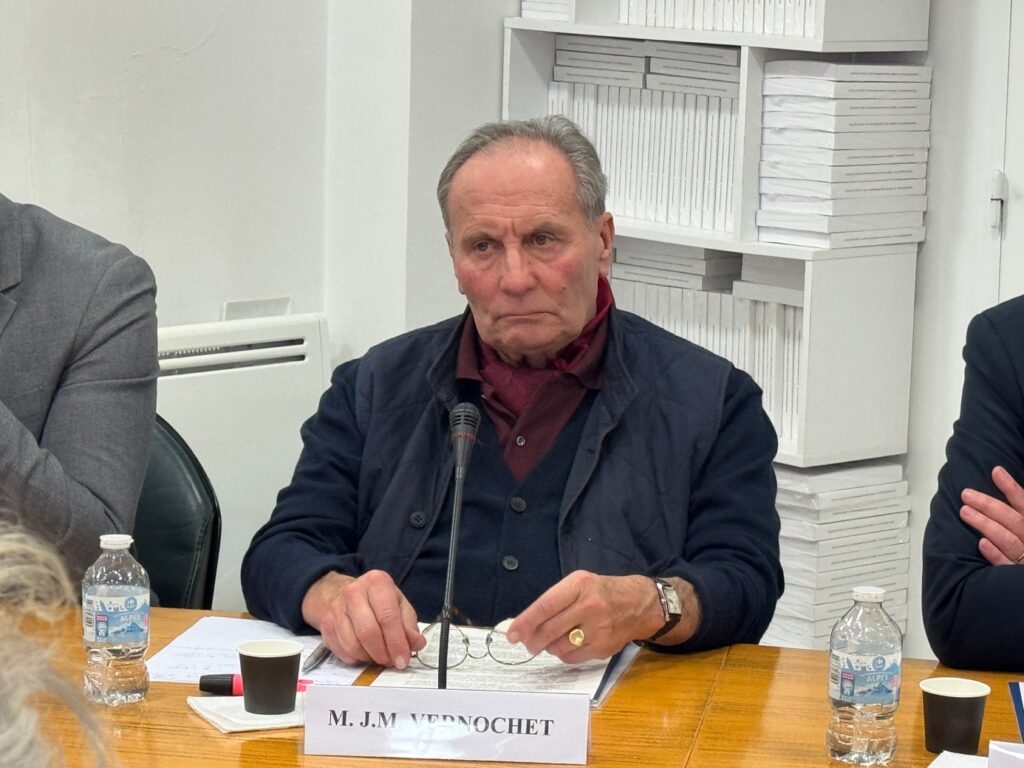
My point will be infinitely more academic or even prosaic, we must go down the Himalayas of the thought that preceded me and I pay tribute to the speakers, starting with Professor Dumont, who were particularly brilliant and interested deeply. We did a general survey. If I haven’t learned everything, I’ve put in place a number of notions, ideas that I used to have, but I think it’s important to go back to a point, since this is not a retrospective, it’s at the moment, it’s a cliché, but we may have to try to make some foresight in the very short term.
You know, like me, that the aircraft carrier Abraham Lincoln is on the way to the area, that is to say, the CENTCOM area, the US central command (there is not yet), and that a number of countries, such as Jordan, Abu Dhabi, have just joined in a possible operation against Iran, not actively but in a logistical way and committing notably for the protection of the State of Israel. So if we have to do a little bit of foresight in the very short term, we don’t know where we’ll be by the end of the week, which means that all cards can be recast, starting with the agreement, parafé but not ratified.
Similarly, if we extend our scope a little further, we must know that there will be elections in Armenia at the end of May-June, and that there is still a fairly strong opposition to Mr. Pashinian. So its policy I don’t know if it would be called into question, but in any case this opposition is characterized by its opposition to the famous Zanguezour corridor. If I heard correctly, here we are nice to Mr. Pashinian, we are talking about mistakes, mistakes, mistakes. Well, Mr. Pashinian, like Mr. Macron, Mr. Starmer, like Mr. Merz, do not make mistakes: they are people who betray. Like Mr Sarkozy, they’re traitors. I’m not saying that they’re sold to that or that power, maybe it’s ideological allegiance, but we shouldn’t talk about taking them for fools and saying they’re making mistakes… They don’t make mistakes, they know exactly what they’re doing.
It must be believed that the fate of Armenia, its future, does not interest Mr Pashinian much, like the fate of France, French peasants also do not interest Mr Macron. We were talking about the possible association, if this has entered Ukraine into the European Union (EU), but if this is done then it is a coup de grace to our last farmers, which are 400 000, but it is expected that there will be more than 200 000 within a decade, instead of the 17 million in 1950… So France was a self-sufficient country, but we wanted to play the big ones, buy (…), (…), I’m talking about tractors, and sell for export, that is to say have what is called an economy (…) and then a subsistence economy. Well, we will pay even more with Ukraine if it, for the misfortune of our country, enters the EU.
So now Armenia. If tomorrow morning there is a concerted, joint attack, which is very likely: we do not concentrate… I want the dogs that bark not to bite, but if the Americans have concentrated such forces – and it costs hundreds of millions of dollars, even billions of dollars to manage to build up this encirclement of Iran – it’s not really for snails. Will Iran go to bed? I don’t think so. I don’t think so, because I think Mr Trump is putting the bar too high. I don’t know what they want: is this the resignation of the Supreme Leader? Elections organized, etc.?
Armenia, and especially what is called the Zanguezour, appear today in this geopolitical, geostrategic, very particular, very specific context, it was said earlier: as a key territory, I would see it even more as a kind of knot, rather, a kind of geostrategic epicentre. An epicentre. If it goes far, it’ll go far on its borders too. So I don’t know if Armenia will be swept away by the wind of the storm, but it must be understood that the stakes are considerable. So I don’t know what Russia will do or can do, apparently a number of cargo planes arrive from China to Iran, but it’s clear that if we want to blow up the Iranian geostrategic lock, Armenia is on the way to tanks, if you want, that want to crush Iran. And the Iranian geostrategic lock also locks this famous Eurasian space, it’s a lock that it can blow up to attract the People’s Republic of China, especially oil deliveries: 17% of the hydrocarbons consumed by China come from Iran.
Today, which holds the northern border – this small 44 km northern border – will have a position… There are already observation posts in Nakhitchevan imagining, at least in Azerbaijan, on Iran. Information, you know, is collected by satellites, it also requires ground relays to collect data. Still it is that there is a place of intervention, of compression of Iran from the North, and eventually playing on the Azeri minority. So that’s – I don’t have the exact figures – from what I saw from 12 million to almost 20 million, but who have 12 million Azeri who are patriots, who are patriotic Iranians, but who are there immediately, so the junction could be made with this community. I wrote about 15 years ago, perhaps more, a very important article on minorities in Iran. The minorities are the Kurds, they are the Azeri, they are the Arabistan, but here I am in the western part, the Arabistan, the Khūzestān if you prefer, the Arabs who live in Iran, there are also the Lur, if I remember correctly, there are also Kurds also near Afghanistan, there have been displacements of people on the marches of the Persian Empire once to contain precisely the Arab thrusts, and Baluchistan is an eminently turbulent area, where Iranian border guards lose a lot of people to contain – we could say thanks to them – the great drug trafficking that is arriving precisely from the tribal areas of Pakistan, from Baluchistan, who arrive and transit, go as well to Russia as to Europe. That’s to sweep the landscape. So there are all these minorities.
We know that in the famous riots, which actually lasted 72 hours I don’t know, a lot of weapons came in by Iranian Kurdistan. There is a Kurdish movement – what is it already called? – which has its headquarters in Washington and which has transported weapons. We know very well, at last we have never seen patriots wanting to overthrow the Mollah regime burning mosques – a little common sense, damn it! – nor Armenian churches, hospitals, schools: finally it is clear that all this is an attempt to overthrow Iranian power with the hands of foreigners and people who can really be described as terrorists. They were armed, they were shooting at the police and they were shooting at the crowd, that’s the scenario we saw in 2014 in Maidan.
The day the platforms Starlink have become silent – but have been spotted at the same time, several thousand, since internet was cut – so (…) but a platform Starlink It’s a platform you get out of your kitchen, you communicate, you get the information, you send it out, and you get it in as dry. But the systems apparently provided by Russia, which would therefore not be totally passive from this point of view, have made it possible to identify transmitters or receivers and to make arrests. Once again, you will find that these riots, which allegedly set Iran on fire, at the very minute, stopped exactly like a candle that was blown. From day to day, the device Starlink Having become silent, more demonstrations, more killings, more of this, more of that. It must be said, but this is not our subject, that in recent years Iran has been subjected to attempts to destabilize, to repeated subversive manoeuvres, there has been the history of the ladies and the scarf, as if it were a motive to make the revolution.
Inflation has had much more. It may also be necessary to remember that inflation, if there is one, and there is one obviously, is the result of the economic and financial blockade by the countries of the deep West, which I like to call “Westernists”. Today, that’s why Israel is put forward, Israel plays a significant role, far from it, that the declared enemy is the only geopolitical lock in the East there too for Israel, that is Iran, before Israel can spread, a form of hegemony, in any case of prepotence over the entire region, to blow up Iran. But Iran is about to lock China, you can see it from a new perspective Rimland, but locking and encircling, and the continental blockade of China is extremely important since there is a stake in the natural resources of Central Asia. And, the Zanguezour corridor appears as one of these alternative routes – There are others, it has been said, those that pass through Georgia, that bypass Armenia – which are there to cut the progression towards the West of China through its New Silk Roads. It’s extremely important.
What else can I say? May Israel work towards the creation of an axis from Baku to Ankara through Nakhichevan. That’s undeniable. The largest supplier of weapons in Azerbaijan is Israel – statistics go back a year or two – 69 per cent of its weapons were supplied by Israel, even more so than the famous Bayraktar drones that have been operating in Artsakh.
I can give you, it’s interesting, a detail of the supplies of Israeli weapons that determined Baku’s victory, particularly in terms of aerial superiority, the famous Harop suicide drones – so there is not only the Bayraktar –, reconnaissance drones also, Spike anti-tank missiles, missiles (…), Barak anti-aircraft system, ATMOS self-propelled gun, 120 mm mortars, advanced radar system, latest generation communication equipment, military tracking and coordination, etc.
Azerbaijan, I believe for $120 million, has acquired two military satellites from Israel, so you see these are huge markets, several billion dollars – I do not have the number, sorry – which have been delivered from Israel, by cargo planes in particular, which are constantly delivered from the Israeli base of Ovda. So don’t forget that Israel is a major player who has its own geopolitical or geostrategic goals, but who is registering, who really and very well includes within the programmes and projects and planning of the globalist headquarters. I’m stopping here.
Dr. Ali RASTBEEN
Thank you for your intervention. I make a little remark, you mentioned Arabic, in Iran we have no Arabistan region in Iran.
Jean-Michel VERNOCHET
Yes, the Khūzestān, I know. It’s a word, an English terminology.
Dr. Ali RASTBEEN
No, it’s a wish of (…), an Arab-speaking region, in this case itself that wanted Arabic, it’s an Arab-speaking region, in this case we have Arabic-speaking. Thank you very much for your intervention.
Jean-Michel VERNOCHET
I wouldn’t say Arabistan anymore, I promise!
Dr. Ali RASTBEEN
We have received here the Ambassador of Iran, and you have really completed his speech. You have indicated that this is an additional intervention.
Jean-Michel VERNOCHET
In any case, let us fear what can happen at the end of the week, fear… The cards will be recast and everything we said today will remain valid, but in another configuration.
Bassem LAREDJ, Geo-political and geo-security consultant, Middle East and North Africa specialist, founding director of Amane Risk Consulting, « Armenia-Turkey-Israel: an asymmetric triangular relationship at the heart of the geopolitical recompositions of the South Caucasus ».
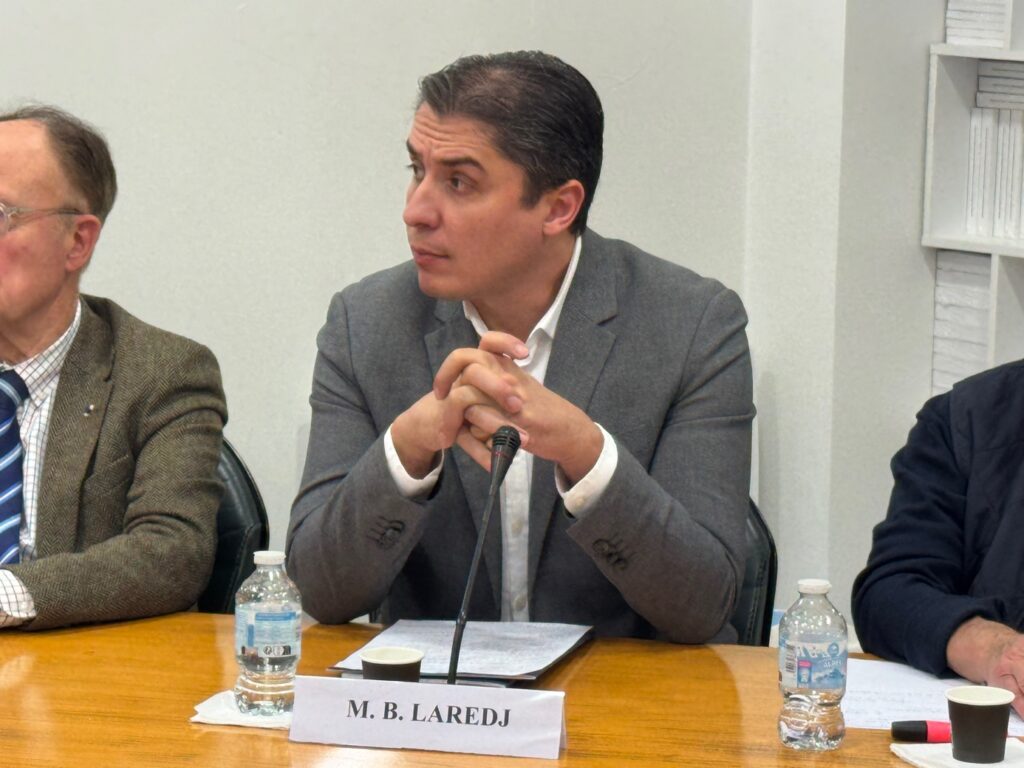
Thank you Mr President, thank you for the invitation, for my happiness or my misfortune I don’t know so I will try to be honest, and to integrate as much as possible the rehearsals.
As part of my presentation, I will also talk about Iran, because it seems essential to me in the current context, and to better understand the interferences that may exist between these three central states of the Middle East and Armenia, and therefore as a reminder – it has already been said – to consider the misfortune of historic Armenia or modern Armenia (…) to find in areas, a space of geostrategic confrontation, it is a “geostrategic node” that directly impacts trade routes, and today the energy corridors in the South Caucasus, and generates lusts from the great powers surrounding this State. Moreover, parts of the territory of historic Armenia have been held in turn by the Russian Empire, the Ottoman Empire, and the Persian Empire, and modern Armenia today, which accounts for more than 10% of this historical Armenia, is ultimately confronted with structural problems related to the fact that it is an enclaved state, with a limited population, geographical space and also very limited military power, This also raises the question of survival. That’s a real question.
And in relation to my analysis, I will analyze Armenia’s geopolitics through a triangular reading, which involves both its relations with Turkey, Iran, and Israel. We will see that its relations with these three States bring us out of the classical patterns, which are sometimes very limited, which are used to explain the various conflicts in the Middle East where we rely on the religious factor: we see this, in reality in these relations, this religious factor hardly plays in these different ones, because we have Iran, the great Shiite power of the region which is allied with Christian Armenia; the majority of Shiite Azerbaijan is allied to Sunni Turkey; And on the other side there is Israel who represents itself as a Jewish state which is allied with Azerbaijan which is Sunni but at the same time enemy with Shiite Iran.
So I will start with Turkey, so recalling that this bilateral relationship is marked by structural and lasting conflict, linked to a painful common passive, what is called the Armenian genocide. It is the qualifier that is used by Armenia, and a large part of the states, more than 30 states have recognized this genocide, because Turkey contests on its side, and therefore this genocide in reality is a marker that actually understands the geopolitical and relations between Turkey and Armenia, today it is a structural factor of this relationship today that goes beyond even the memory trauma of the Armenian population and that structures relations until today. As long as Turkey rejects and does not recognize this genocide, it will be difficult to achieve normalization of relations between these two nations, even if Turkey recognized in 1991 the existence of the Armenian State, its sovereignty, so far there is no official diplomatic relations between these two States, even if we see today attempts at normalization between the two States, which have recently been marked by the visit of the Armenian Prime Minister to Turkey and measures to simplify the obtaining of visas on both sides, but the relationship remains strongly marked by this genocide and Turkey’s refusal to recognize it.
And so we have seen for about 15 years, more precisely since 2020, an increasing Turkish presence in this South Caucasus, linked both to the weakening of Russia, but at the same time to the means that Turkey has since been able to acquire, especially geopolitically, to position itself in this space that is traditionally marked by a strong Russian presence. And so since 2020 with the recent Nagorny Karabakh conflict, and then in 2023, which marked the “end” of the conflict, there has been a direct involvement of Turkey in this conflict with massive support for Azerbaijan, especially in the military but not only in the political sphere, which obviously complicates relations with Armenia. Today, with, as I said, the end of this Nagorny Karabakh conflict, one can perhaps move towards normalization of relations between Armenia and Turkey, but this is not something that is yet acquired in advance, especially since Turkey still sees in Armenia today a geopolitical problem because it finds itself (…) its ambitions related to this panturquism or to this desire to connect Anatolia with Central Asia, and therefore to this Turkish-speaking world.
And as you can see on the map, we have Armenia that comes in the middle to cut Azerbaijan in half, and thus to cut off this territorial continuity with this Turkish-speaking world that Turkey in any case wants, which it considers with its strategic and historical depth, so it is a real problem for Turkey. It uses this border band of about 40 km that blocks this strategy, as a tool of pressure on Armenia to try to have this corridor desired by Azerbaijan, which will link Azerbaijan with the Nakhichevan, the other part that finds itself on the other side and is linked to the Turkish border. So we have the rhetoric developed by Turkey of the community, to develop trade, etc., but there is this reality that we cannot hide: that there is this will of Turkey to broaden its influence in the area and also to position itself as a hub through the various pipelines and pipelines which could eventually come from Central Asia, cross this corridor, and go to Turkey. And, in reality, this could put Armenia’s sovereignty over this border band in full jeopardy, since Azerbaijan is calling for control of this corridor.
That is the part with Turkey, I am not going to go back to what has already been recalled.
Concerning the relationship with Iran, it is a strategic relationship for both states, whether for Armenia or Iran, first of all economically. Since Armenia is a landlocked state, it needs this relationship with Iran in order not to be dependent, in the end, on Georgia, Russia, since it considers Azerbaijan and Turkey as potential historical enemies who can still have expansionist ambitions that will impact Armenia’s sovereignty. And on the other hand, Iran needs an independent Armenia because it allows it to have a direct connection with Russia, land, through Armenian territory and Georgia, especially in the context of international sanctions imposed by the United States and Western countries on Iran, we see the real importance of preserving Armenia’s sovereignty over this border band. And also on the other hand, Armenia needs to have, a strong Iran, I would say, in the region, because it allows it to preserve its sovereignty over this area of Syunik, about 40 km, which cuts Azerbaijan in half, and it also blocks the expansionist ambitions of Azerbaijan and Turkey on the other side, because Iran does not have any interest in seeing this Turkish will to have a unified Turkish-speaking world because it could go against its own interests in Central Asia, in reality.
And in this context, it is also important to note that with the arrival of the Trump administration (January 2025) there is a paradigm shift. As has already been pointed out, there is a rapprochement that is being made between Armenia and the United States through this peace agreement signed between Armenia and Azerbaijan, which provides for a corridor, what is known as the “Trump Road”, to link the two parts of Azerbaijan that have to cross Armenian territory, including the border area with Iran, and Iran has already made clear its opposition to this corridor, and so we also see all the potential tensions that could arise if this project were to materialize.
Already, this could lead to tensions between Iran and Armenia, while they have historical relations: Iran will find itself in a situation in which the Americans ultimately control this corridor. We talked earlier about the low economic interest in Armenia, in reality, of this corridor, but in my opinion Armenia is seeking, in this context where it cannot actually cope with American pressure, to have another ally that could guarantee its security vis-à-vis Azerbaijan and Turkey, even though it may lose Iranian support. And so in any case in this context, Armenia finds itself in a rather complex situation and as long as the Trump administration is in power it will have to reconcile its historical ties with Iran and the new reality imposed today by the US administration. It is also important to note that Armenia sees with fear the attempts to destabilize Iran, because this as I said can impact its own security because with a collapse of Iran we are going to have an upsurge in Azerbaijan and Turkey, which are therefore considered a vital threat by Armenia to its own security.
Here I come to my last point, linked to the relations between Israel and Armenia, so according to several analysts what is called the “relationship of missed opportunities”: there are many elements that could have brought Israel and Armenia closer together. Both were marked by the so-called Armenian genocide in the First World War, which is fundamental in the Armenian nation today, a constituent element of its modern life, and in parallel there is the genocide of the Jewish population, especially European, during the Second World War, which was one of the justifications for the creation of Israel, and therefore there was this aspect. There is also the other aspect that often highlights the power of the diaspora, whether it be the Armenian or the Jewish or Israeli diaspora abroad, including the Armenian diaspora in France (often referred to in Western Europe) and the pro-Israeli diaspora in the United States, notably with AIPAC (American Israel Public Affairs Committee). Another element which could also have brought the two nations closer is linked to the fact of their geography, a small territory, with a fairly limited population and with an environment it is said hostile: for Armenia, Azerbaijan, Turkey, mainly; and compared to Israel (especially historically, this is no longer entirely true today) with a very hostile Arab neighbourhood.
In any case, the reality has finally been quite different since relations between Armenia and Israel are complex and very difficult relations, and we cannot understand this relationship without linking, in parallel, Israel’s relationship with Azerbaijan, which was mentioned earlier, because we have a strategic relationship that links Israel with Azerbaijan, particularly geopolitical, security, economic and energy. Israel is now one of the main suppliers of weapons to Azerbaijan, which has enabled Azerbaijan to make a difference in the recent Nagorny Karabakh conflict with Turkish armaments. And on the other hand, for Israel, having strong ties with Azerbaijan allows it to play in Iran’s backyard in reality, since Azerbaijan has tensions with Iran, and Israel considers Iran as a deadly enemy. Moreover, in the so-called Twelve Day War between Iran and Israel and the United States (13 June-24 June 2025), according to several experts Israeli agents, who were already in Iranian territory before the conflict and who attacked Iranian strategic solutions, whether military officials, military installations or even Iranian nuclear scientists, from Iranian territory, reportedly infiltrated from Azerbaijan’s territory. So we see how important it is for Israel to have good relations with this state, to the detriment of Armenia. Moreover, Armenia considers this alliance a strategic threat, of course, to its own security, and does not fail to say so regularly.
There are also other problems: here I will return to the Armenian Church, which is one of the oldest, in reality, in Jerusalem – it has been present since the VI.e century – and which is confronted with the rise in power of the Israeli religious extreme right (…) the expropriation of its property, so there is also another source of tension between Armenia and Israel. And today we also have Armenia’s recognition of the Palestinian state in 2024, which was also another source of tension between the two states. Moreover, Israel had summoned the Armenian ambassador on that occasion.
But despite all this context, we can see today perhaps what could be moderate attempts at rapprochement, through recent recognition by the Israeli Prime Minister of the Armenian genocide in a statement, but which remains very limited because it is not a law, it is just a declaration…
Philippe KALFAYAN
It’s not even a direct statement, I’ll come back. These are verbal words…
Autre intervenant
Not even!
Bassem LAREDJ
So we had these “words” from the Israeli Prime Minister, who actually seem more like opportunism I would say political from Netanyahu to attack Turkey, since Turkey had described Israeli operations in Gaza and the victims it caused in Palestine as crimes against humanity and genocide. And so now we have to see how these “words” of the Israeli Prime Minister will be realized. Will a real law be passed in the Knesset who will call the victims that were committed during the First World War and even beyond (…) Armenians, genocide or not? So these are elements that will make it possible to see if we are going to sort of calm down the situation.
In conclusion, I would say that, finally, with its geopolitical and strategic position, Armenia finds itself today in the midst of conflicts, the lusts not only in connection with Central Asia, but indirectly also with the tensions linked to the Middle East. Armenia is playing its survival on the long-term, which ultimately requires it to review and try to broaden its strategic alliances in the area and strengthen its internal resilience. Thanks.
DISCUSSION / ROOM QUESTIONS
OLLIVIER Agnes, Work of Prof. Jean-Paul Charnay
I was just thinking about the Armenian civilian population. In Armenia, five months of sunshine a year ago, it heats… from its rays to fifty degrees. So what about bioenergy adaptations and climate change? It could, indeed, be part of a number of programmes, so sustainable development criteria for the forthcoming elections, for example in June. So I would still like to talk to you about corridors, the transport of energy products, etc. So, I would still like to talk to you about corridors, the transport of energy products, etc., but what about this teaching for solar panels, for example, to diversify energy sources? Because I don’t have any information about this but I think there is a civilian nuclear power plant that has been reopened, have they closed it down that I don’t know, but that would in any case reduce the purchases of kilowatts made outside, which is also done as the first rule when there are inadequacies and maintain millennial trade relations, especially with Iran, and China too, could constitute real solar panel farms, nobody expected, and who has real know-how in this regard. There could be technology transfers. There are also political possibilities for archaeological research. I recall the studies in XIXe century of an archaeologist, Jacques de Morgan, and diplomatic, therefore close to France. Could we remember all this?
Public question
Hello, you asked a question that is of the order of utopia or of the chronology. I listened to him, and I listened a little bit to your interventions about the type of government you have in Armenia, which exists in Armenia. Could it be that this type of government cannot continue, and that Armenia, having been a kingdom, can be found a type of royal government in Armenia? Would the Armenian people be susceptible and sensitive to this kind of change?
Public question
I’m going back to Nagorno-Karabakh. So isn’t this ethnic conflict due to Soviet politics, especially Stalinism? Stalin at the time still had the monopoly of all that was the management of ethnicities and minorities at the Soviet level, and it was he who badly cut the Caucasus, not to mention Chechnya, Dagestan, Ingushetia, etc., and it is still a scandal, when one looks at Nagorno-Karabakh, still, is in the middle of Azerbaijan… It’s a curiosity.
Philippe KALFAYAN
It was said.
Continuation of the question
No, but I still think the origin of the conflict that we find today comes from there: geography.
Stakeholders
Yes! That’s already been said.
Continuation of the question
Such as Russia today could help make efforts to compensate, help what, because… Otherwise I’ll just complete Emmanuel Leroy’s words, it was very interesting. I recommend a book that is relatively recent from Tariq Ali (he is a trade unionist, anticommunist activist from British Pakistan) that is called Churchill, sa vie, ses crimes It’s amazing. He is often presented as a superhero of the First, Second World Wars, but frankly (…).
Philippe KALFAYAN
I’m just gonna bring some facts. The relationship between Israel and Armenia, it will have been understood, in fact Israel reproaches the relationship, precisely, friendly, which is very close, with Iran. To the point that Trump recently asked the government a little bit: Why does Armenia facilitate the contours of sanctions against Iran? There is already evidence of criticism of Armenia on this point. So that’s clear that there’s a concomitance between American and Israeli interests in this case. A factual element, but it is not important because it is not related to the subject, but Netanyahu did not recognize anything at all. There is a journalist who asked him, “But why don’t you recognize genocide?” He replied, “But I believe that Parliament has acknowledged genocide.” That’s all he said, but in fact, it’s not true, Parliament…
Jean-Michel VERNOCHET
Because there is genocide in the world, it is well known, there are not two, it is not possible!
Philippe KALFAYAN ?
That’s exactly the term, and it’s back to the Armenia-Turkey relationship. That’s kind of the problem, this genocide story. First, Turkey does not deny what happened.
Bassem LAREDJ
She recognizes the massacres.
Philippe KALFAYAN
She recognizes massacres and deportations. She even justifies them…
S.E.M. Jean-Pierre VETTOVAGLIA, Former Swiss Ambassador in Vienna, Bucharest and Paris (1988-2007), former representative of the Swiss President for the Francophonie in Paris (2000-2007), administrator of an international trade finance bank in Geneva (Trade Finance, BIC-BRED), essayist, collector and lecturer
She convicted thousands of people for that.
Philippe KALFAYAN
On the other hand, they refute the legal characterization, unfortunately, in fact neither the genocide of Armenians nor the genocide of Jews can be legally “genocide”. There is no retroactivity of… Another thing, I am not going to go about the policy-fiction on ecology, but there is actually a factory – at last it is not a factory but a very large field of solar panels that is financed by the United Arab Emirates, which are built on the Armenian plains. The nuclear power plant was never stopped. She’s still active, and we’re even prolonging her life. There are Americans who now want to build a new reactor, still civilian in nature, to replace its old power plants, which are technology-based, and which are still managed by Russia. And on the last question, I have never heard of the will to restore an Armenian kingdom, and I would be very curious to know who might claim to be the king, if this is the last king of Armenia, who was French, who was a friend of the factory.
Rector Gérard-François DUMONT
Beyond the questions, perhaps I wanted to make just three comments to open the debate. The first, as far as Nagorny Karabakh is concerned, it is likely (…), perhaps an element that also explains Azerbaijan’s position, even if it is not the essential element.
The second point, I find it very interesting from a geopolitical point of view, is therefore the famous BTC (Bakou-Tbilisi-Ceyhan). So the BTC, of course, was built carefully to avoid Armenia, it is the first obvious element for everyone. The second element is that the BTC, for me, too, is also proof that Georgians of Armenian ethnicity are not much appreciated in Georgia. Because, in fact, when I wanted to find a place where I could photograph the BTC, I was therefore in the Georgian region populated by Armenians: nobody was able to tell me where it was. In other words, the only explanation was that no Armenian Georgian had been hired to build the BTC. They had either hired Georgians who were not Armenians, or, above all, Turkish labour, which was still very large, I found it in all Georgian infrastructure. And above all, the BTC, its geopolitical role, we saw it well in the 2008 war, that is to say that the Russian military troops who entered Georgia did everything they needed to avoid damaging the BTC, because there it would have been a casus belli Turkey, and it was not about expanding the military field.
Finally, one last point, perhaps a word of heritage in relation to the rather optimistic elements of conclusion of our President, who had already presented the conditions, and among the conditions, there was respect for heritage. It is already necessary to remember the history of Nakhichevan, which is still a history of territory, without knowing the percentage unless you have one, it was a population that included both Azeri, both Armenians, and probably other ethnic groups as well. We know very well what has happened since 1990: well, the entire Armenian heritage has been systematically destroyed, including of course all the cemeteries of this Armenian population, which was very large in this region. It is therefore to be feared, and it is probably already begun, that the same phenomenon will occur in Nagorny Karabakh. It’s probably already done, we’re gonna say I couldn’t go to the spot. It has always been written to me that the photos you or I took from Nagorny Karabakh, which proved, indeed, the seniority of Armenian heritage, today we could not see them anymore. This whole thing was destroyed.
So these are a few quick remarks, even if I did not answer exactly the questions that were asked because, concerning Mr, I had pronounced the fact that normally after the Soviet implosion, in this region one should have made a “de-Sovietization”, since it was the Soviets who had organized these borders within the framework of the principle “divide to reign”.
Colonel Alain CORVEZ, Colonel (er) and International Strategy Advisor (Office Corvez)
It’s not a question, but we talked about Iran. I just want to say, since we talked about it earlier, and Jean-Michel Vernochet in particular talked about what actually happened in Iran. I returned on January 6 from Iran and had discussions with Iranian strategists, and for them Armenia is a country that counts enormously. And then they questioned me, not this year but in 2023, it was the last war between Armenia and Azerbaijan, it was a few months after the end of the war, and they asked me, they were very interested in military operations on the ground, how it had happened. And they asked me for my opinion on the fact that, according to them, America and Russia had agreed, i.e. the United States security adviser with the Russian security adviser had agreed that the attack on Azerbaijan would stop at a precise point, I forgot the city, but they asked me for my opinion on this matter. I told them it seemed a little big, I didn’t believe it, but they were at the time convinced that there had been an agreement in 2023. Somewhere, Iranians were very interested in this, and they asked me for my opinion on the subject, as I told you.
Philippe KALFAYAN
I’m going to do an analysis rather than a question. The French, Americans and Russians agreed to settle the Karabakh issue, since the collapse of the Minsk Group talks, with Azerbaijan remaining in a tough position. After the 2020 war, it was clear that it was over, so that in 2023 there was an attack that was not massive, and in fact the number of deaths is 200, at the end of 2023, and half of which are linked to the explosion of an oil depot in which Azerbaijanis have nothing to do with it. So in fact this mass exodus that was mentioned at the very beginning, it was perfectly orchestrated and that’s why there were very few deaths during this mass exodus, it was prepared in advance, and it was the secret services of the different countries that organized this. And the French secret services, besides, were involved in this operation.
Colonel Alain CORVEZ
So the Iranians were right.
Philippe KALFAYAN
Oui.
Pierre-Emmanuel THOMANN
A little provocative question in fact, because with this new geopolitical recomposition and new empires, in fact, de facto, in fact there are many countries that will disappear in the future, I think, when we see what is happening with Greenland: Greenland no longer exists, does not exist. Denmark has no sovereignty, the European countries themselves have lost their sovereignty, they are vassalized. I’d say Bosnia, Kosovo, all this is going to disappear. If we go to the Caucasus, does the Russian position in fact not: That is to say that from the moment Georgia and Armenia played with fire, and Ukraine elsewhere, in position in this circle, played the game of Americans for encirclement, have already paid – at last Georgia paid for a loss of its territory, Armenia does not have support because of Pashinian until Armenia in the long term aligns with Russian positions, and Ukraine will disappear, it will be either Russian, or colonized by the Americans or the European Union. Do not Georgia and Armenia actually have a vocation, to really survive, as ancient history has shown, to reintegrate a form of Russian empire, otherwise they will disappear drowned in panturquoism? I think there is no other solution, it is provocative as I say, but the sovereignty of these two countries did not exist in the future. That’s the question I’m asking.
Philippe KALFAYAN
Look, relations for Armenia and Russia are much more subtle than that. Even Pashinian and his entourage did not break strategic relations with Russia. So you still expect to have some surprises because (…).
[1] John J. Mearsheimer, Stephen M. Walt, The pro-Israeli lobby and US foreign policy Paris, La Découverte, 2007, 504 p.
[2] Steven Levitsky, Lucan A. Way, Daniel Ziblatt, « The Price of American Authoritarianism », Foreign Affairs, 11 December 2025, link : https://www.foreignaffairs.com/united-states/american-authoritarianism-levitsky-way-ziblatt (accessed 9 March 2026).
[3] Halford John Mackinder, “The geographic pivot of history”, in The Geographical Journal, Vol. 23, N°4, Avril 1904, pp. 421-437 (17 p.).
[4] Nicholas J. Spykman, America’s Strategy in World Politics. The United States and the Balance of Power, New York, Harcourt, Brace and Company Inc., 1942, 500 p.
[5] Zbigniew Brzezinski, The big chessboard. America and the rest of the world1997 reed. Paris, Fayard/Pluriel, 2023, 288 pp.; See, more recently: id. , Strategic Vision. America and the Crisis of Global Power, New York, Basic Books, 2012, 224 p.
[6] Patrick E. Tyler, « U.S. Strategy Plan calls for insuring no rivals develop », New York Times, 8 mars 1992, Section 1, p. 1, lien : https://www.nytimes.com/1992/03/08/world/us-strategy-plan-calls-for-insuring-no-rivals-develop.html (accessed 10 March 2026).
[7] National Security Strategy of the United States of America, The White House, November 2025, 33 p., lien : https://www.whitehouse.gov/wp-content/uploads/2025/12/2025-National-Security-Strategy.pdf (accessed 10 March 2026).
[8] Ibidem.
[9] Walter Raleigh, The History of the World. In five books, R. White, T. Basset, 1614.
Leave a comment