
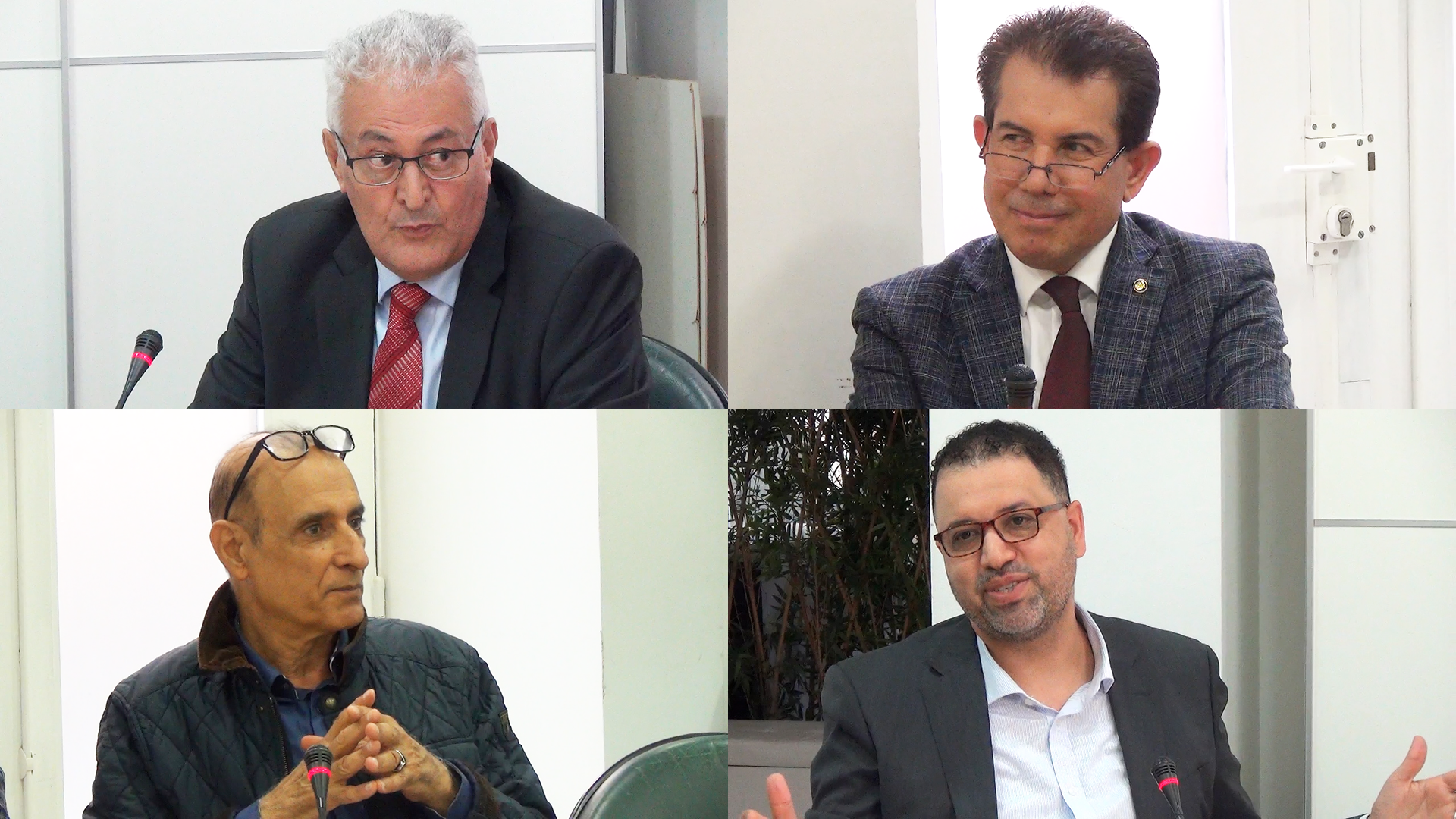
The Académie de Géopolitique de Paris (AGP) organized a conference on Monday, September 8, 2025, entitled ” The landscape of genocide in Iraq: its political and social repercussions At 5 rue Conté in Paris, in the presence of Iraqi researchers.
The Académie de Géopolitique de Paris (AGP) invited academics, officials and other experts from Iraq and the issue of genocide to reflect and discuss the profound consequences of genocide on Iraqi society, as well as on the country’s political and regional balance. The symposium served as a space for reflection and dialogue on key topics: collective memory and its transmission, challenges related to transitional justice and reparation mechanisms, and prospects for the political and social reconstruction of Iraq. The discussions highlighted the impact of these tragedies on stability, both regional and international, and stressed the importance of a multidisciplinary and comparative approach to better understand current issues.
SUMMARY RECORD
Dr. Ali RASTBEEN, President of the Académie de Géopolitique de Paris (AGP),
« Iraq: Between Fractures and Reconciliation ».
Ladies and gentlemen, we are gathered today to speak of a tragic reality that has marked Iraq and continues to shape its present: genocide. This word, heavy with meaning and pain, refers not only to a memory of the past, but to a still alive wound, a phenomenon that has profoundly affected national identity, fragmented the social fabric and compromised the very foundations of coexistence.
Through the trials endured by Kurds, Assyrians, Shiites, Yezidis and many other communities, it is a whole country that bears the weight of a bruised memory. Yet, by confronting this past with lucidity and working for justice and reconciliation, Iraq can chart the way for a future based on dignity, tolerance and peace.
Genocide in Iraq cannot be understood as a mere one-off event. On the contrary, it is a recurring phenomenon in the history of this country, a political instrument used throughout the centuries to impose domination and eliminate ethnic and religious groups. In its broadest definition, genocide includes mass massacres, physical and psychological attacks, forced displacement, cultural destruction, but also more contemporary forms such as ethnocide and ecocide. The drying of the marshes of southern Iraq in the 1990s was a striking example: it destroyed the ecosystem, destroyed the multi-year culture of the marsh Arabs and dispersed their community.
Iraqi history tragically illustrates this reality. As early as the 19th century, Wahhabi attacks on Kerbala and Nadjaf led to appalling massacres. In the 20th century, several bloody episodes confirmed the political use of genocide: the massacre of Simel in 1933 against the Assyrians, the expulsion of Shiites and Kurds Faylis in 1980, the Anfal campaign and the chemical bombing of Halabja in 1988, not to mention the discovery of mass graves after 2003. More recently, Daesh’s crimes against the Yezidis in 2014 – involving murder, sexual slavery and destruction of heritage – reveal the horror of genocide in its physical and cultural dimensions.
The case of the Anfal campaign, carried out between 1986 and 1989 under Saddam Hussein’s regime, illustrates the extent of this violence. Tens of thousands of Kurds were executed, thousands of villages destroyed and chemical weapons used, particularly during the Halabja massacre. This mass crime, recognized as genocide, has profoundly marked Kurdish collective memory and reinforced distrust of central power. Politically, it has nurtured the quest for autonomy and even independence of the Kurdistan region, accentuating the fragmentation of the Iraqi state. Socially, forced displacement and the destruction of rural communities have left lasting consequences, reinforcing feelings of injustice and marginalization.
Iraqi Shiites have also suffered heavy persecution. After the Gulf War in 1991, their uprisings were brutally crushed by Saddam Hussein’s army, causing thousands of deaths and a climate of terror. These repressive policies have deepened a confessional divide that worsened after 2003, when the fall of the regime led to a highly denominational political system. The trauma inherited from the past continues to fuel rivalries and exclusions, and the memory of these persecutions remains a source of mistrust that complicates the construction of an inclusive national project.
The August 2014 attack on Sinjar by Daesh opened a new dark page in Iraqi history. The Jezidis, an ancestral religious community, were victims of massacres, mass deportations, sexual slavery and forced conversions. This genocide highlighted the extreme vulnerability of minorities to extremist ideologies and the collapse of institutions. The trauma remains immense: a large part of the community still lives in camps for internally displaced persons, while others have joined the diaspora. At the international level, this drama has revived the debates on the responsibility to protect and the relative inaction of the Iraqi State and the world community in the face of a catastrophe yet announced.
The consequences of these genocides are multiple and profound. They result in fragmentation of the social fabric, lasting mistrust between communities, intergenerational trauma and a weakening of national identity. The loss of an invaluable cultural heritage, through the destruction of sites, villages and traditions, further exacerbates the disaster. The absence of a genuine process of transitional justice and reconciliation has left wounds open. Crimes have not always been tried or fully recognized, and victims’ memory is sometimes used for political purposes. Added to this is the growing importance of the Kurdish, Assyrian and Yezidi diasporas, who, as a result of forced exile, exert external influence on Iraqi policy and international debates related to minority rights and the recognition of crimes.
In the face of these tragedies, it is imperative to chart a path towards the future. Education and academic research on genocide must be strengthened to understand, prevent and report such crimes. International law must evolve in order to integrate modern forms such as ecocide and ethnocide. The promotion of pluralism and tolerance remains essential to counter extremist ideologies. Iraq, in order to move forward, cannot do without the support of the international community. UNESCO’s role is crucial in protecting heritage, preserving cultural diversity and contributing to national reconciliation.
Ladies and gentlemen, genocide in Iraq is not just a legacy of the past: it is a reality that continues to shape the present and influence the future. The wounds left by Halabja, Simel, Sinjar and so many other tragedies do not fade over time. They challenge our collective conscience and remind us of the urgency of action.
In the face of these dramas, our responsibility is twofold: that of memory and that of action. Memory, to do justice to the victims, recognize their suffering and preserve the truth. Action to build a more just society, to protect diversity, and to ensure that Iraq never again is the scene of mass destruction.
It is by looking at the past with courage, facing its shadows without denying them, that Iraq will be able to pave the way for genuine national reconciliation and assert itself in dignity among nations. The path is difficult, but it carries hope: the hope of a future based on coexistence, peace and justice. Thank you for your attention.
Dr. Salah AL JABRI, UNESCO Chair in Studies on the Prevention of Genocide in the Islamic World, Professor of Philosophy at Baghdad University (Iraq),
“The landscape of genocide in Iraq: its repercussions policies and social ».
Thank you very much for this invitation, it’s an opportunity to meet intellectuals and thinkers, here, for dialogue, exchange, and it’s a pleasure for me to be here.
There is a relationship between memory and the future, and that is why the University of Baghdad has launched the UNESCO Chair project that specializes in memory. Its object is to archive, memorize, keep, actually make a database of events, to prevent the future.
We’re used to talking about war, our success in wars, victories, but we don’t usually talk about failures. We are not talking about our dark events in history, and therefore we cannot also take advantage of these events to correct the future. So there is an academic consciousness that was born in Iraq to focus attention on failure, and exceptionally the case concerning genocide, and also to avoid falling into cycles of violence and failure. The objective of our UNESCO Chair is to teach young people how to reflect on new mechanisms of dialogue, understanding of others, and respect for diversity, and also to remember to learn from the past, to say in fact that genocides are negative cases in society, which must be taken into account for the future.
Genocide is a social phenomenon, nourished by the culture of society and also by relations between people. To deal with such violence, we must also look at the culture of society, dealing with culture. Genocide is a social disease, which must also be studied, examined by the sciences that concern society, science and also multidisciplinary mechanisms to see the problem on several sides. So also have different visions to find suitable solutions.
But that does not prevent us from examining the current situation, studying the context, and also distinguishing tragic events, both in the past and in the present, and finding the appropriate solutions and programmes for this situation. And we also take into account the context of the past, and also the context of the present and the context of the near period.
Looking at the various types of genocide that existed in Iraq, we are trying to apply the definition recognized by the United Nations (UN), we find that there will be a debate on certain genocides, because it does not meet the criteria in this situation, which also causes problems in this area. This challenge of defining genocide comes from the definition that was established following the Second World War, which is applied to a given problem and which also concerns conditions and consequences, but there are many things that have changed subsequently, which prompts us to broaden the definition of genocide.
Therefore, this definition does not take into account the political factor that aims to eliminate or cause genocide or a problem of violence, which targets a particular group, and also cultural genocide, which aims to destroy the culture of a social group. Therefore, the current definition takes into account ethnic and religious genocide only.
Some researchers find that the absence of the political factor is a challenge in the UN Convention to recognize genocide. There’s a black dot in there. There is also another point of view, which concerns the legal aspect. So we focus on the legal aspect, but the social aspect is important, and requires social analysis, which itself requires tools from the social sciences and philosophy.
There are several types of genocide, which go beyond the social aspect of the target group and do not fall within the definition of the United Nations. This concerns urban or ecological genocide, such as the drying up of marshes in southern Iraq, or the cultural aspect, when Daesh, for example, entered northern Iraq and they broke the monuments. There are also political genocides. So we propose to include new concepts of genocide in the definition. Also, climate change has led to changes in the lives of social groups.
So I will quickly expose the archaeological aspect of genocide. There is a book – the title and name of the author are projected on the screen during the intervention – which speaks on page 4 of the genocides that are not recent, which have centuries, especially in the days of the Assyrians where the skeletons and heads of the victims were gathered in the form of mountains. But he speaks of it as an introduction to his book, without criticism, without deepening the phenomenon. In fact, this text we have just discussed has been reviewed by two Canadian researchers who have deepened the research and found some scientific observations.
He presented three testimonies of that time. The time of the kings of Akkad, who used violence against the rebels of the cities who rebelled against the regime of the time, Sumer and Elam. The other testimony: they found in the literature of the time poetry texts that recite the genocides and past events. The third testimony is the examination of Assur’s texts, 1000 years B.C., which explains how the bodies of the deceased were gathered as mountains.
First of all, these acts do not target social groups, ethnic groups, we have not found in the texts any concrete things on this, so we cannot incorporate these acts into the classic definition of genocide. In this case, there is a special case, it is that in fact the violence targets the cities. It’s because at the time, in their culture, they put a lot of emphasis on cities, and to target the city, and it’s also targeting people. So, it poses a problem here of distinction: does violence concern the city, or the people who are in the city? So in fact there are two options, either the city or the inhabitants of the city. So some of the researchers look at the inhabitant aspect. If the inhabitants are targeted and the inhabitants form a social unit or group, then we can integrate it into genocide, because it is a social group that has been targeted, with development, traditions, a common culture, so we can integrate it into the definition. So if we expand the damage aspect, that the damage exceeds the social group towards the city, then we can say that the two groups or the two victims, the city plus the inhabitants, form a single unit. So we can also say that destroying the city is also genocide. So the definition of the United Nations takes into account the intention of the power to carry out genocide, but how can we know if at the time the decision-maker really targeted or thought about genocide against the inhabitants? The work ended up saying that the situation is unclear, and that we cannot include it in the definition of the United Nations.
In the light of what he talked about and returning to Iraq, we can look at recent history. In 1801 there was an attack by Saudi tribes on Karbala, with a Wahhabi ideology, which caused between 3,000 and 6,000 victims, there were also looting, many destructions, of the city (destroyed) and people. This was also repeated in 1802 and 1806 in Najaf, who was the victim of waves of looting and destruction (a current estimate says that 8,000 people were killed). And if we also want to look at these waves of violence in the light of the UN definition, is there a real intention to assassinate people, to do a lot of damage to social groups, or not and only on the city? It’s the university work we do.
At the academic level, if we want to examine the genocides, or the events of 1801, 1802, 1806, carried out by Wahhabi groups against the holy cities in Iraq, we apply the UN definition which contains five criteria. First, the murder of a part of the population. This is not necessarily the whole group, but a part of the population. Secondly, to cause material or mental damage to the genocide site. Third, to target a group by preventing births, the multiplication of people, the increase in the population in the city, the transfer of children, etc. If these criteria are applied, most were met, but the United Nations does not require the entire package of the five criteria. One or two criteria are sufficient to apply the definition.
In 1933, the Assyrians were the target of a massacre of central power in Baghdad, when at the time they demanded independence, separation. The English abandoned them and 3,000 people were massacred. So we don’t know if we can apply the United Nations definition to this event, because the factor was political, but the victim was a well-defined group, culturally and religiously. Some Iraqi researchers regard this as genocide because it is the state that targets a social group. Looking at the recent period, in the 1980s there was also an attack by the Baghdad regime on this very rich and varied region in terms of resources (water, fish, agriculture, Sumerians representing an ancient people with its traditions and rites), with also the Iraqi opposition that was based there. So the regime started bombing this area from 1981 and it continued. So the Iraqi regime of the time diverted the course of the Euphrates River to the desert, to such a degree that there was more water in the agricultural areas. The water passed from the river to the agricultural areas and then to the marshes, which had no water. The inhabitants were forcibly evicted from the place (bombings, arrests), which thus lost its inhabitants (exmigration of the population as a result of this event, including the animals that died).
Another aspect of the genocide, after 2003, we found mass graves that gather many victims, but from different sources: political reasons, also families fully executed, with children, their bottles, etc., and the children are not shot, but as they accompanied the parents they were thrown into these mass graves. In fact, in these mass graves there are several types of victims, Kurds, Shiites, Sunni too, which actually cover the entire population but the majority are Kurdish and Shiite, and we also found a lot of traces of the rebels who rebelled against the regime in these mass graves.
We’re showing you on screen the map of Iraq. Red zones represent mass graves. The majority are in southern Iraq, but in the part of the desert, in Samawa (South-East Iraq) many Kurds were placed in this area after having transferred them from the north.
The cycle of violence continued, even after 1988. There are also two waves of violence: Halabja, the Kurdish city that was gassed by Saddam’s regime, and also Anfal, the exodus of Kurdish people following this event; After 2003 we also experienced a civil war in which there were many victims and Iraq suffered a very severe period of violence during that period; And then we went through the case of the Speicher base (or massacre of Tikrit), which killed 2,150 young people in a few hours; and after the massacre of the Yezidis during the period of occupation of Daesh, where women and children were sold in the markets, murdered the population.
In conclusion, the Iraqi situation is rich in violence, in fact genocide, but the challenge is how to examine, clarify all this, and how to find a solution. It’s a sensitive context, because we can’t go very far sometimes, we can hit the sensitivities of some groups, and it’s a problem right now. Thank you very much for your attention.
Dr. Mohammed AL KARAISHI, University of Koufa, Iraq,
« The role of interreligious dialogue and memory in social peace: the Iraqi example ».
I will talk about the role of interreligious dialogue and also memory in social peace, focusing my attention on the Iraqi case. These remarks are based on my experience in dialogue, which I spent at the University of Baghdad in my capacity as advisor for the UNESCO Chair in the area of dialogue.
In fact, interreligious dialogue offers us the opportunity to have a space for exchange. And this space of exchange is important in multi-ethnic, multi-group societies, because it allows us to control tensions if they exist, we can, if you want, go straight to the table and talk. One can also predict the future problem and deepen understanding between groups. And the second thing is that we must deconstruct the negative image of the other, the stereotypes, the negative image of the other, to such a degree that in our Iraqi society, we say that the Shiites are pro-Iranians, of course. That the Shiites are not Arab, ex officio. That the Sunnis are Baasist, are pro-Saddam Hussein. It’s a pre-made image. And the Kurds are separatists, rebelling. And the Yezidis are even worse, they worship the devil, they are unclean… So the Yezidis can’t have a general feeding shop, because it would be unclean. They can’t touch the product to sell to Muslims or Christians… So people don’t buy it. They can’t sell meat because they can’t touch it. And that happens for several professions. And these moving images feed people’s consciousness to such a degree that, when they enter the city, the Yezidis, sometimes, are forced to wear an Arab outfit to hide themselves in the mass because to buy vegetables they are forced to touch… So interreligious dialogue is very important to deal with problems like this.
Then I will tell you about the limitations of this dialogue in society. Because that’s the theory, but can we really talk about this? That’s something else. Also, dialogue between religions helps us to prevent the use of the political factor, prevent politics from manipulating the ethnic group, so if we have a good dialogue between people. Strengthening society, social cohesion, between people. So based on common values, on mixed marriage – I say that it was raised before 2003 and that it fell after the civil war had passed
But can we really talk about this? It’s something else. Thus, interreligious dialogue helps us to prevent the use of political factors, prevent policies from manipulating the ethnic group.
So, if we have a good dialogue between people, here we are, strengthening society, social cohesion between people, so, based on common values, on mixed marriage. I note that mixed marriage was raised before 2003. After 2003, it fell. But after the civil war has passed, it starts to rise again but I don’t have an exact figure. Maybe after the civil code it’ll change again. These are Sunni-Shiite marriages, for example. It’s very important.
According to my experience at the University of Koufa, what are the dialogue activities? When I entered, I had to prepare the UNESCO Chair project. I was actually asking the faculties of the University: what do you have as dialogue activities? And I was taken out – I’m not talking about religious organizations – pictures and I was told: There, there’s a gentleman who came by, we drank coffee together, we talked, he left. And I was telling them, but did you treat the problem? And they said no, but we’re together, that’s already…
So we’ve always been on the surface and we’re working on protocol things, academic things. And also, meetings between religious, for example Christians and Muslims, take place, but they remain protocolary. Each one keeps his sacred texts, one cannot discuss the text of the other because each one has its own literature, its history, its culture, and one does not touch the other. So we’re not moving forward.
There is a third axis which is very important: civil society is moving forward in dialogue much more than others. In fact, the university has no impact on society, religious authorities always remain protocolary, they cannot go any further. Moreover, the religious do not know where they have the problem: it is often the politicians who use religious texts. But the young people, especially after 2019, after the events, the demonstrations of 2019, there were many rapprochements between the south and the north. Why are young people now making much more progress on dialogue with others? That’s because they have common values, because they put one after. They did not live in Saddam Hussein’s regime. They don’t have a complex of the old regime. In addition, young people, Sunnis and Shiites suffer from the mismanagement of the present state. So, the whole, in fact, both sides, revolt against the same regime. So, there, after 2019, there are many meetings in Baghdad, many meetings in Najaf, many meetings, that is, the Shiites go to Mosul, they come to Najaf, Karbala. They are liberal, in fact, the majority of these young people, they are not attached to the religious system.
So I also have comments on the constraints on interreligious dialogue. We have a weak culture of dialogue, but we have a culture of coexistence. We can live together without mentioning things that sometimes shock us. In Saddam Hussein’s day, we work, we live together, but we don’t talk about politics. We’re not talking about you Sunnis, you have power, but we have no power. We’re not talking. After 2003, too, the Sunnis undergo the same cycle, in fact. So, it’s still protocol things and you can’t see. Also, we don’t have transparency. We’re talking, but we’re not going deep. We’re not talking. That is, when I pass, I find a hate speech, I dare not discuss with the other. I can’t argue. Also, I can’t file a complaint because I know the state is sometimes complacent. Also, I don’t trust each other. I can’t. Actually, it’s still a problem to talk about contentious things. And also, the political actor plays an important role in sabotaging dialogue.
A practical case, especially on this and also on the negative image of the other, which is rooted in the memory of each person, even in the heads of politicians: recently the governor of Mosul made a speech for the citizens of his city. And you know that we have a tradition, that at every lecture or speech we start with a Koranic verse in which we curse Satan. And then the governor apologized to the Yezidis and said to them, “Apologise us, in fact we started with a verse that cursed Satan, which is important to you.” Yet this is a distorted image of the Yezidis! It is a false image that circulates in society. But when it is pronounced by a symbol, a state representative, it is very serious. And there comes the political factor, which is an important factor, sometimes out of ignorance, sometimes in a voluntary way.
As Dr. I mentioned earlier, we have a weak memory culture. That is, we don’t remember our events before, we don’t look at the past, we don’t care, and that’s why history often repeats itself at home. Because we don’t take lessons, we move on. So hate speech, we can’t stop them, we can’t look at the consequences, etc.
A practical case: the civil war that took place at our home in Iraq after 2003, and also the Speicher event. I’m working on the memoirs, and I wanted to do some research on it, but I couldn’t, because, in fact, when there were massacres in Baghdad and other cities, there were Shiite families who saved Sunni families, hosted them, hidden them. I think that happened also in France, when Jewish families were hosted by some residents, so it is part of the national memory, but these experiences have not been studied, and have not been taken into account by universities and other bodies. So we do not have a culture of memory, and we are weak in organization and work, institutions are weak, and there is no political will to focus on it.
There is another phenomenon, in the problem of the civil war, is that in fact the Sunnis have left the Sunni areas, they have gone to the safest areas. The Shiites, they went to Najaf, Karbala, Hillah, the Sunnis left, but the Baghdads have a different way of life from other cities. So they brought with them their market techniques, their fashion of clothing, the accent of Baghdad. When you go for example to Najaf and Baghdad, you will find that before Najaf was the traditional religious center, next to the Mausoleum of Imam. Now you find areas of Bagdadies, it’s Baghdad in Najaf. So it brings a lot of changes, economic consequences, and these consequences have not been studied by the university and other agencies.
I have expressed all my remarks, thank you very much.
Dr. Ali AL YAQOOBI, Professor, Faculty of Law, Al-Nahrain University (Bagdad),
« International efforts to protect minorities in Iraq: UNITAD experience as a model ».
First, I thank you for this invitation, by which you have honoured me, as usual. Thank you very much for your presence. Today, I will speak on a somewhat sensitive subject, on international protection for minorities in Iraq. And I really took UNITAD as an example, especially after 2014. My plan is organized into two questions and two parts. In the first part I will talk about minorities in Iraq, about the protection of minorities in Iraq; and the second part will be devoted to the example of UNITAD; And finally I will make a conclusion on all these ideas.
For the question, there are two points here.
The first point. We do not have a very clear and well-defined definition for the term “minority”. All the international treaties, among the human rights declarations, and the treaties against genocide (1948), and the International Charter, etc., did not speak clearly and clearly about minorities, have really spoken for equality, discrimination, etc., but the minorities did not define this. But international jurisprudence, by university, by professors, etc., has tried to find a definition for the term minority. It can be said that there are 4 very important elements to know what minorities are. First thing is the number. Normally, they are less numerous than other communities. For example, in Iraq there are Yezidis, Christians, Kurds: they are fewer than other ethnic groups or religions, such as Shiites. Second, they are different from others (linguistic, religious, political). The third thing is that they are citizens, like the others, of this country. The fourth thing is more important: this minority always seeks a particular identity, that is, a desire to preserve this particular identity in this country. It can be said that these 4 clear and clear elements form the definition of what minorities are.
The second point raised is that the 2005 Iraqi Constitution is really the most open constitution in Iraq. If we were to define this constitution, it seems that it really recognized the differences, the multi-ethnic, multi-religious character, it kept all the differences. We always talk about the diversity recognized and assumed by this constitution. But she also did not mention the term minority. We don’t use it much because we think maybe it would hurt others, because we can say: you are less important than others. But we often use the term “component” in the Iraqi legal system, especially in the electoral system where we say: Iraq, a multi-ethnic, multi-religious country, “composed” by Christians, Shiites, Sunnis, Kurds, Yezidis, etc. So we can say, with the experience of the 2005 constitution, that it recognized this diversity for the first time.
The first part. Here I may not talk much about minority issues in Iraq because Dr. Al Jabri really quoted history, etc., what genocide really is, and the diversities in Iraq, and rather focus on the most important part, that is after 2014, after Daesh’s attack in Iraq. That is, really, the most important period. But the most important thing about international protection is that we always have competition, conflicts, between international law and domestic laws. We still have international laws made by UN Security Council decisions, by international treaties, but there is also an internal law. The Iraqi government still wants to keep this file in hand. We have to keep this in the national court. He does not really accept the quotation of all crimes by the International Sortbunal. And that, in fact, is still not settled, especially after the opening of the political system after 2003, after the 2005 elections really: it is true that the political system is very open to international society, but it always seeks questions of sovereignty, and it keeps this issue in the national domain, not in the international field.
Thus, it can be said that the international mechanism on the protection of minorities is going through several stages. I’m still talking after 2014. The first step is that the Security Council has created a special international mission to assist Iraq. It’s called UNAMI. For UNAMI, we are talking about a very large presence in Iraq, there is a report every three months on human rights cases, the state of prisons, and various other subjects. It can be said that these are the international eyes on Iraq. Secondly, the UN Human Rights Council, which has a lot of reports in Iraq. But the most important experience in Iraq, it can be said that it is 2017, with the decision of the Council of Ministers 2379 that created an international investigation team to investigate Daesh’s crimes. It’s called UNITAD: The international team investigating Daesh’s international crimes in Iraq and Syria. And international crimes, you know that there are usually three: genocides, crimes against humanity, war crimes.
UNITAD has also fallen into these problems: is it a mission that follows international law, or Iraqi national law? This problem is not resolved, but it can be said that the UNITAD team is a protection that is not military, not security, but legal. UNITAD’s work is a very important protection for minorities in Iraq. What did UNITAD do during their activity? It is well known that the Iraqi government requested the cancellation of UNITAD’s mandate in September 2024, so they worked almost seven years. And what did they do? Very important things. There are 19 reports of analysis, and really, this is the first time in Iraq that we find a report like that. If we look at the reports made by UNITAD on crimes against the Yezidis, the Shiites (Speicher), the Shiite Turcomans, the chemical attack, etc., we find reports written by well-defined international experts, clear, and giving in addition international recognition for these crimes.
This is quite different from the Iraqi reports. Why? Because normally there is no (legal) code in Iraq that recognizes international crimes. We have the code to work against terrorism, so we will try, or have already tried, all those involved in the activities of the Daesh group, based on the code against terrorism, and the death penalty, etc. So we don’t do the analysis on memories, on ideology: is it a crime against humanity? Did he attack these people because they are different? On a religious basis, etc.? No, we’re not doing all this. So we can say that UNITAD quickly filled a very important vacuum area in Iraq. So we have 19 important, comprehensive and broad reports, and I think it is a definition, or an international recognition for crimes in Iraq.
There are 12 reports to the UN Security Council. So 19 reports were presented in Iraq for the Iraqi Supreme Court of Justice, 12 presented to the Security Council. What did UNITAD do for protection and its legal role in this area, i.e. the protection of minorities? First UNITAD gathered all the criminal evidence. And I’m talking about more than 8 million documents, made by a well-protected and highly developed electronic system. These are the same systems used by the International Criminal Court (ICC). These documents are classified, scanned, analyzed, 8 million documents, videos, etc., which is a very important basis for the future, the memoirs, the researchers, the national and international court. When I talk about reports, it’s very important, it’s still secret, it’s not published, especially for Daesh’s finances. This is a report of almost 200 pages, which deals with all the financial networks, all the states involved, the names of people, all the bank accounts, telephone numbers used, etc. against minorities. It is not yet published but UNITAD has sent this to the Council and to the Iraqi jurists.
Second thing We are talking about the support of the national and international court. This is a role Iraq cannot play. UNITAD has really created a unit, which makes the exchanges, cooperation with other states, such as Austria, France, Germany, the Netherlands, because there are many refugees who have left, especially from Daesh and who are hidden, etc. So there’s a lot of finance going through this state, network, so UNITAD has created a contact between all these countries and for Iraq it has sent a lot of documents, information for all these foreign countries.
Third thing very important made by UNITAD, psychological support for society, those who are affected, for their ideas, Christians, Shiites… There are many victims, many have psychological problems. And so there are information, hospitals that work, specialists working, especially for children, for example those whose parents are killed or beheaded in front of them, etc., there are really a lot of people who are not in their normal psychological state.
Fourth thinghistorical documents and protection of national memory. UNITAD, from its electronic system, has really provided a basis for all museums, researchers, university, to keep this memory.
Fifth thing UNITAD has worked very hard – and I personally participated very much in this dialogue with all Iraqi experts – to amend the anti-terrorism code. It is not normal that Iraq so far does not recognize international crimes in its national legal system, whereas, as Dr. Al Jabri and Dr. Al Karaishi say, it is the country most affected by these crimes. I personally saw in the national court that for example when someone comes from Daesh, that he raped 40 women Yezidis, he will be tried according to the same articles as someone who used weapons with Daesh. We make no difference: terrorism or terrorism… If I’m a judge, I have to follow the text, we don’t make any difference. So what do we need right now? The reform of the law for this code, where all these international crimes must be mentioned in the Iraqi internal code, in order to recognize these crimes and try the perpetrators.
Last pointI think this is the most important point of what UNITAD has done, it is contact with other countries. It is often said that international relations, for Iraq, and especially now, are very important. Sometimes European countries do not really cooperate fully with the Iraqi legal system because of the death penalty. One complains that the death penalty is used, it is said that there is torture, etc., that they do not respect international rules in this area. So there are still problems of cooperation between the international system and the Iraqi internal system. UNITAD took on this role, that is, if you had any problems contacting the Iraqi government it could play that role, and I do that myself.
It can be said that for seven years UNITAD has played, as I described very briefly in several points, a very important role, but I say that unfortunately the Iraqi government has asked for the end of this mission, when I find that this mission is not political, it is financed by the Security Council, the United Nations, we must leave the international society, because it is an international subject and really not national. And there is an international alliance that participates in the wars against Daesh. And so all these countries have the right to know what is happening, etc. We may not have used the principles of sovereignty very well. So finally, it was the Iraqi government that asked the Secretary General of the United Nations, it was given another year, 12 months to complete this mission, and in these 12 months UNITAD has tried to transmit all these documents, all this work, for the Iraqi centers linked with the Iraqi Supreme Court of Justice. The Centre currently plays an important role in cooperation with other States, such as the role played by UNITAD but to a lesser extent.
Secondly, UNITAD sent an electronic copy to the United Nations archives. So far, we have not solved the problem: do other states have the right to read all these documents used in their internal system, such as European countries, or not? Iraq refuses, saying that it is an Iraqi document, that it must be asked for permission, and the UN Security Council has said that no, that it has now entered the archives of the United Nations. So we can use it, so far it’s an unpublished discussion, but secret and very sensitive to settle so far.
Finally, the impact of the cancellation of UNITAD’s mission. We referred to the fact that all evidence was sent to the Iraqi government and the United Nations. There is an impact on minorities because previously UNITAD was an international voice for minorities. We lost that. The most important thing is that Iraq has lost contact with the Security Council. Before, when Iraq wanted something, it went through UNITAD, it entered into the report that was then published with the name of the United Nations. So before the end of UNITAD, many Iraqi ideas passed through these reports. Now, unfortunately, we can’t, if we want to talk about things nationally, we’ve lost international voice. I also think that the cancellation of this mission weakens international contacts with Iraq, we have mentioned the reasons, and therefore there is currently a vacuum, the contact between Iraq and international society is really not as before, and it also weakens history and memories, documents and work on these areas.
That’s what I wanted to tell you. Thank you very much.
Dr. Ali RASTBEEN
Do you ever find traces of terrorist financing in the analyses or archives at your disposal at Iraq’s disposal? Which countries have participated in the financing of terrorism?
Dr. Ali AL YAQOOBI
Yes, of course. It is written very clearly in the financial report made by UNITAD and the (…) US federal that also participated in these documents. But they did not target the States in question, they spoke of “group in that State” so as not to create problems with the States. So it’s not published, it’s still secret, but anyway there are three centres for the financing of terrorism, country, really neighbouring Iraq and a neighbouring step, in the Arab countries. There is a person currently in Belgium against whom there are many legal procedures, but in any case it is from these three states which became the financial centres that money arrived during the control during these 4 years of control by Daesh of Iraq and Syria.
Dr. Ali RASTBEEN
Most are Arab countries?
Dr. Ali AL YAQOOBI
The report did not say “country”. The term “group in these states” was used. So we talked about groups really in Turkey, Jordan, and in (…) Arabs. All finances flow from three banks.
Dr. Ali RASTBEEN
You quoted Daesh. Is there a package ? Because we know that terrorist groups were not just Daesh. There were so many terrorist movements inside the targeted country. Do you possibly have information about these groups?
Dr. Ali AL YAQOOBI
I speak for UNITAD and its mandate, which only works on the Daesh group. And they consider that other groups, such as al-Qaeda or others, are outside their mandate. So we’re really talking here about crimes within the limits of 2014 until practically 2017, and on Iraqi and Syrian territories, and committed by Daesh.
DEBATE / QUESTIONS TO INTERVENANTS
M. Majed NEHME, Franco-Syrian researcher and journalist
To continue on the same subject, the same question you have just asked, we do not have to go far away. There is the director of all U.S. intelligence services, Tulsi Gabbard, who acknowledged that the U.S. has financed terrorism. And then she criticized, before she was put back in her place, the fact that in Syria Al-Julani was still considered a terrorist, there was a $10 or $15 million bonus for those who would help capture him, and now they are friends with him! It’s still…
Dr. Ali RASTBEEN
Yes, but Al-Julani was not a terrorist, he was a member of Al-Qaeda.
M. Majed NEHME
Prior to the invasion of Iraq in 2003, there was a group, the core of the Al-Zarqaoui group, which is the nucleus of Daesh, which had taken up residence in northern Iraq. And the Iraqi government at the time could not fight it because it was a no fly zone, i.e. the Iraqi army could not intervene to dislodge them. And when the Americans occupied Iraq, they went down to the plain and we saw what they did! They attacked Shia mausoleums, Christians, etc. It’s just a remark.
Dr. Ali RASTBEEN
They were treated as liberation movements…
M. Majed NEHME
Yeah, and we saw that in Afghanistan too.
Dr. Fayçal JALLOUL, Writer and journalist, Middle East specialist
Thank you, Mr. President. I wanted to go back to the definition of genocide mentioned by Professor Al-Jabri. I felt that Mr. Al-Jabri liked to broaden this definition to include massacres, criminal acts or military equipment against certain ethnic or religious groups. In my view, the UN definition of genocide must be distinguished from massacres or barbaric acts, or from other things like that, because, if not, that fact could undermine the phenomenon of genocide, such as destroying and decimating Indians in the United States of America, decimating Armenians by Turks, the Holocaust in Europe and other phenomena like that. So, in my opinion, we really have to keep this genocidal side, especially in Gaza today, nowadays, we have to keep that side, that definition, these areas there so that we can distinguish between the general horror, the horror planned, executed, and the massacres. It doesn’t mean massacres are nice or barbaric acts are to be tolerated. I will give you three examples mentioned by our friend Al-Jabri.
Premier exempleHe talked about the Shiites attacked by the Wahhabites. It is true that these attacks were carried out barbaricly and atrociously by these movements, but these movements did not only attack the Shiites. I myself visited Al-Madina al-Munawwara (Medina) in Saudi Arabia, and I discovered that the Wahhabites destroyed Saqifa Bani Sa`ida, that is, the place where Muslims gathered to talk about Muhammad. It was a historic place. They destroyed sites such as this one, they destroyed the Prophet’s house, and they massacred everywhere. The reason why Ibrahim Pasha, the son of Mehemet (Muhammad) Ali, master of Egypt, destroyed this Wahhabi state (expedition of 1816-1818).
Second exampleDr. Al Jabri spoke of the Iraqi marshes. It is true that Saddam Hussein dried up the Iraqi marshes, but Gamal Abdel Nasser eliminated the place where the Nubians lived in Egypt, because Nasser wanted to build the Aswan dam. The Nubians were not displaced, but their presence at that place, mentioned on the Iraqi side by our friend, this place is today underwater and no longer exists. Can we call it genocide, urban genocide, as mentioned? I don’t think so. Nasser almost left the temples of Abu Simbel and other Pharaohic temples under water. The Aswan Dam has done much good for Egypt and the Egyptians until today. He even saved the Egyptians several times. So to say that drying the Iraqi marshes is a genocidal fact, I don’t think so, because the French did the same thing in Algeria: they killed Algerians by chemical means in the caves, and the Americans used chemical weapons against Vietnamese in places that were not accessible to their armies.
So, to call this kind of massacre and abominable act by terms such as “murder” or “atrocious act of war,” yes, but we must make a sort of hierarchy of abominable acts. If we put everyone, all the acts, at the same level, it will be a little difficult after dealing with this kind of problem fairly, and we will enter into a chaos that, in my opinion, is not very good for the cause defended by our friend, and he is right to defend the causes that have been raised, but let us leave the hierarchy in his place, which does not change anything to the abominable nature of the acts that have been carried out. Thank you.
Mme. Patricia LALONDE, Vice-President of Géopragma, former European MP
I just wanted to raise a point about Daesh and Al-Charaa, as Mr Majed Nehme said earlier. I read that Al-Charaa had been number 2 of Daesh – I don’t know if it’s true or not – before going through Al-Qaeda. But, you know, it’s a whole circus to go from Daesh to Al-Qaeda, then to Ahrar al-Sham, and then… In fact they are the same, but they are renamed one way or another. That is the first question I wanted to ask.
The second concerns women. I have worked a lot on women’s rights, unfortunately, in Afghanistan, and here I am struck by the fact that this law that has just passed into Iraq, which allows the marriage of 9-year-old girls, is not classified as genocide. We’re talking about the Yezidi rape, but you can imagine a little girl at nine? Well, in Iraq, the law was passed. Reform of the Civil Code.
Dr. Ali AL YAQOOBI
Non, ce n’est pas vrai.
Mme. Patricia LALONDE
Ah, then explain to me, because when I was there – last February – I was told that it was not yet voted, but that it was a bill. And when I came back I was told it was voted. So it’s not voted?
Dr. Ali AL YAQOOBI
No, it’s not voted. In Iraq, there is a law called “personal status”. Currently, the possibility has been given, for questions of respect for religious differences, i.e. each person who returns for their law, but with the consent of the judge. And for the questions of marriage age, we quoted this in the second article, clear and clear, that we have no right to exceed 18 years, for women, and 15 years, exceptionally, with the consent of the judge and parents. So we can say 18 years for the rule, and 15 years with two conditions: the judge must accept the doctor’s report that the woman has the abilities, etc., as well as his father’s agreement. It was in the project that we talked about this, but it’s not recognized.
Mme. Patricia LALONDE
Je vous remercie.
Dr. Ali AL YAQOOBI
It is cancelled, it is not recognised by Parliament, it has not voted.
M. Bernard CORNUT, Engineer X68, director, Middle East expert, energy, environment
Good evening. On one point: the Convention for the Prevention of Genocide, it speaks of a national, ethnic, religious or other group. So, in the “other” you can put city, environment, everything you want, so it’s pretty flexible.
Second point, on the history of Iraq. I believe that until we put in a public site the presidential archives stolen by the American occupier and placed at Georgetown University, we cannot make history in Iraq. And also, we will not be able to make history in Iraq if we do not have a list of all the Israeli agents who were Jews in Baghdad or Syria, Yemen or Libya, and they and their sons or children, who were trained, selected, to be spies, to make a mess, I apologize for the word, in Arab countries, by manipulations. You can’t make history without that. Thanks.
Dr. Ali AL YAQOOBI
All archives have returned to Iraq. The Iraqi government has requested the archives, in the United States there is a copy, it is scanned, but the original was returned. Currently, the Prime Minister has really made decisions to make museums, right in front of the Council of Ministers statue, and there are particular groups that make museums for all these archives.
M. Bernard CORNUT
Did they return the archives of Saddam and Tarek Aziz’s trial?
Dr. Ali AL YAQOOBI
Yes, that’s right, all the archives of Saddam Hussein’s period and all the recordings of the presidency, of the meetings of the presidency, have really returned to Iraq, but the United States, to be clear, takes all this by copy, scanning, in the university, there, but the originals have returned to Iraq.
M. Bernard CORNUT
Well, that’s good news.
M. Imad EL OUDI, President of Solidarity & Harmony
Mr President, thank you for choosing this subject, genocide – and we are in the midst of genocide in Gaza – and choosing Iraq. I would like to thank Professor Al Jabri, Professor Al Karaishi, and Professor Al Yakoobi for showing us the historical, social, and legal perspectives.
Premier point, me, what is attributing is the geopolitics of genocide, because we notice that genocides have been a human act since Man existed. So we have the impression that genocide is a purely human phenomenon, because we do not see it in animals for example. It is therefore a human phenomenon and based on a political act, since a Shiite will not go to kill a Sunni because Sunni, a Sunni kill a Shiite because Shiite, a Christian does not kill a non-Christian because he is Jewish, or the genocides of Protestants by Catholics, etc. In fact, genocide is a political act. And we see that the imperialists, whether they are today the white imperialists, that is, Americans and Europeans, but also the Chinese, since they took 200 years to pacify China, so there were 200 years of genocidal acts, and also others, in Australia. So all populations, and even Arabs, have practiced genocidal acts. It is therefore a human act to bring about power, so it is bound, in the sense that if we are going to study genocide culturally, sociologically, as an act based on arguments or socio-economic consequences, we are distorting the subject. Genocide has been a human act since history, and based on a political act.
Second thingThe importance of Iraq, and especially in our modern world, why? Because today we have the social networks, the new technologies, and therefore all these acts that took place on the Iraqi ground. Because it is favorable: in the Iraqi field, we have this so-called “minority” pattern, Professor Al Yaqoobi has made it clear that in Iraqi legal language we use “components” and that we do not use the term “minorities”. And that is true, because we, as Maghrebs or as Europeans or French for example, have difficulty understanding the dynamics of minorities. And today, as citizens for example, we are trying to bring the same image of minorities back into the European population. So we’re going to divide the French between Muslims and others, between practicing and non-practising Christians, so here we’re trying to impose this minority view of the citizen populations. That is, you are a citizen or you are not a citizen. And so the fact that this land was favorable – So there were a lot of minorities – we bring the genocidal act. In fact, with social networks, we will bring it back to the planet itself, we will find the axis of globalism, that is, the axis that fights all populations, all countries, against their cultures, against their energy independence, against their intellectual and scientific independence. And so we’re going to demonstrate, on Iraqi ground, to all other peoples, saying: if you’re not subject to the law of globalist imperialism, then we’re going to create what we call genocide.
So the genocidal act today is a purely political act. We chose Iraq because there is real ground to activate, if you want, this notion of genocide, and not just for Iraqis because the Iraqi people very much resemble the French people, except that the regimes are different. So it is the political regime that brings genocide, and it is also it that stops genocide.
M. Mohamed AMIMOUSSA, Inspector of Finance (DGFIP)
I wanted to know the answers, through the different definitions of genocide. I wonder how the genocide helped shape today’s Iraqi state.
M. Majed NEHME
About the presentations we’ve heard, there’s never an external responsibility… When we saw American Secretary of State Madeleine Albright, when asked about the 500,000 women and children who had died as a result of the blockade, she said: This is the price to be paid “… What is it called, if not genocide? The blockade, which affects women and children alike, what is it? It’s not genocide when there are 1.5 million dead?
And then, just a little remark on the water. The fact that it was Turkey that held water for Syria and Iraq has been evacuated, so part of the responsibility for what happened in the marshes is because there was no more water coming.
Dr. Ali RASTBEEN
Thank you so much, that’s a natural question. But as far as Iraq is concerned from 2003, Iraq was occupied by the Americans: those responsible are Americans.
M. Jaafar BOUZOMITA, Docteur (UPEC)
A small question addressed to our dear guest, Mr. Al Jabri: who is able to define, or redefine, the term genocide, or the five points defining it, for example at the United Nations. Between countries, who actually has the power to define or redefine words? This is the definition, the classic term, since 1956 and so on, the five criteria have in fact never been redefined. For example, if we talk about what is happening in Gaza today, from how many dead can we say that it is or is not genocide? Today we are at 60,000 people.
S.E.M. Maximilian GORKE, First Secretary at the Austrian Embassy in France
Depends on intent, not numbers.
M. Jaafar BOUZOMITA
Yes, exactly, because we already have an example with Bosnia. So we have examples. And my question is: Did you rely more or less on Rwanda’s example? In Rwanda almost a million victims are spoken of, and genocide is a clear word. So, in Rwanda they managed to overcome that, to reconcile themselves, to develop their country more or less. Maybe some people don’t agree with me, but at least after what we can see. And my question is: is it the work of historians, or are we, in fact, able to define itself today, to say whether or not it is genocide, or should we wait, as Macron had said, that we cannot and that it is the work of historians, later, to confirm it, while we are living this genocide.
Dr. Salah AL JABRI
So the United Nations is concerned to consider redefining, but it may not be that it defines. There is a difference between drafting and adopting definitions. So originally, the UN was based on the work of a legal expert, a Jew who experienced the experience, who actually developed the definition of genocide (Raphaël Lemkin). So the UN adopted an aspect of the definition, physical genocide, and neglected the cultural genocide aspect, both of which were mentioned by the specialist, because it did not want to lose the votes of the members of the United Nations, and also many countries were involved in the massacres, so we did not want to fail this approach.
Dr. Mohammed AL KARAISHI
I have a comment. I’m going back to Dr. Fayçal Jalloul’s intervention. I agree: in fact, the United Nations definition must be respected. Why? In fact, because there is the industrial aspect, in the destruction of the group, that is, we have the technique, and also the will, so there is a discourse that targets the group that we do not find in the waves… For example, the Wahhabites, when they entered, they were like an army that shaves in the passage, but they were not meant to eliminate a group, but they were in fact aiming at all things. So we have to take this into account.
I come back to Dr. Al Jabri’s intervention and I’m done. I remember a speech by Saddam Hussein. At the time, he analysed the Iranian revolution against the Shah. After the overthrow of the Shah regime, he said: if the Shah of Iran had asked me what he should do, I would have advised him to shave the city of Tehran, to rebuild another city further, with 5 million Iranians, life will start again. And after Halabja, his cousin, says “Ali Al-Kimawiiyy” (Ali Al-Kimawiiyy), who was Saddam Hussein’s defense minister, said: “It is not a problem for us to shave the population. We can relive with a few million Iraqis, and we make another nation instead.” So the will aspect already exists. Thank you.
Someone in the room
The weapons sold by Donald Rumsfeld…
M. Mohamed AMIMOUSSA
My question was not answered: how did the Iraqi genocide shape the Iraqi state today?
M. Bernard CORNUT
With a constitution based on the components. In France, Corsicans in the Corsican Assembly are not allowed to speak Corsican.
Dr. Ali AL YAQOOBI
Truly, as far as the Iraqi government is concerned, it has recognized two crimes as genocide: the crimes against the Yezidis (I am talking after 2014) and the crimes of Speicher, which are legally recognized by UNITAD and the Iraqi government, for all the elements of genocide that exist. But crimes against Christians, against Shabak, chemical attacks, were counted as “crimes against humanity”. The Iraqi State has adopted a special law to settle the consequences. As they really gave a salary and medical insurance, a special way to study, psychological support, etc. And there is really, at the moment, a project to make museums, a great museum for young people and I am thinking with a French company that is studying this, and so here we are trying to settle the consequences.
M. Raphaël BERLAND, Journalist, founder of the Circle of Volunteers, and the Citizen Channel
This is a very small remark since the Rwandan genocide was mentioned. There is also an attempt to politically instrumentalize certain genocides, or to call genocide. We have described this as a genocide between the Tutsis and the Hutus, from one ethnic group to another, while it is much more complicated. The current Rwandan dictator, who has been in power for 25 years, has in fact prepared the destabilization of Rwanda from Burundi, so it is an international problem, and in both sides, among the decision-makers, there were both Tutsis and Hutus. He then teased a lot about his people, his people were victims, and things are much more complex – minimally (I’m nice saying that…). And so since Bernard Kouchner’s passage to the Ministry of Foreign Affairs in France, well his vision of what he calls genocide has been imposed in France and intellectuals are very combated here in France, notably Charles Onana, who is a French-Cameronian writer of great talent having written a lot of books about what happened in Rwanda. And the same thing in France compared to Palestine, when Macroists tried to ban the use of the terms “holocaust” or “genocide” (I don’t know which one was) to talk about what was happening in Palestine. They have not been successful, but there is a political temptation to exploit what is or is not a genocide.
Leave a comment