
Executive Summary: This article examines the ambivalence of humanitarian aid under the prism of the Israeli-Palestinian and Russian-Ukrainian conflicts. It questions the tribulations of humanitarian aid in this increasingly conflicting world in the light of the principles of humanity, neutrality, impartiality and independence inherent in international humanitarian law (IHL). This text addresses, of course, the mobilization of material and human resources through the international community. Far from seeing an end to humanitarianism in the near future, the author calls upon the humanitarian community to achieve greater global solidarity far from any political or geostrategic background.
Key words: Humanitarian Aid, Israeli-Palestinian Conflict, Russian-Ukrainian Conflict, Humanity, International Humanitarian Law, International Community.
Abstract : This article analyzes the ambivalences of humanitarian aid through the prism of the Israeli-Palestinian and Russian-Ukrainian conflicts. It questions the tribulations of humanitarian aid in this increasingly conflictual world with regard to the principles of humanity, neutrality, impartiality, and independence inherent in international humanitarian law (IHL). This text naturally addresses the mobilization of material and human resources carried out through the international community. Far from seeing an imminent end to humanitarianism, the author calls on the humanitarian community to demonstrate greater solidarity at the global level, far from any ulterior political or geostrategic motives.
Key words : Humanitarian aid, Israeli-Palestinian conflict, Russian-Ukrainian conflict, Humanity, International humanitarian law, International community.
Introduction
SINTERING ON HUMANITARIAN ASSISTANCE has become a necessity in this disenchanted time where, according to Hannah Arendt: ” the death of human empathy is one of the first signs and the most revealing of a culture about to sink into barbarism ” The false seductions of ” company closed »[2] have led to the proliferation of more cruel than ever before conflicts, which explicitly aim at the destruction of solidarity and the crushing of the most vulnerable. Every day, the chronicle of refugees, displaced persons, deaths, injuries and natural disasters, broadcast through the media and social networks, demands us all together at the bedside of suffering humanity and requires us to make ourselves our ultimate moral of this time. At the same time, however, we must recognize that the number, scale and nature of disasters that demand this moral responsibility are increasingly exceeding the response capabilities of humanitarian emergency organizations and updating the ambiguities of their impatient strategies.[3].
There is therefore a humanitarian crisis, an open crisis, which is evidenced, among other things, by the public questions raised by the leaders of these organizations, even though any questioning of humanitarian aid seemed indecent less than ten years ago.[4]. Since the early 1970s, humanitarian aid has been at the centre of international life and is the subject of public and academic debate. Conflicts Israeli-Palestinian and Russian-Ukrainian questioned the motives and principles of the humanitarian movement. According to Tony Vaux, the cold war represented the “old age” of the humanitarian movement, as the space for humanitarian manoeuvre was wider at that time.[5]. The post-cold-war era saw the new world order create an environment in which the humanitarian mandate has become a difficult, ambiguous and much more political task than before. It must be said that humanitarian aid has long been seen as what is right to do. It was an indispensable decree for the victims and seemed obvious to those who had been spared. Its motto was to be impartial and free from any political background within the meaning of the fundamental principles elaborated by the International Committee of the Red Cross (ICRC) in the XXème century.
Humanitarian aid does not appear to be apolitical because it acts in the presence of parties to conflict and military forces that expose it to the interests of local and international political actors, donors and the media. It thus finds itself confronted with political dilemmas, which often place it in the face of impossible choices and ungrateful decisions taken by States, while humanitarianism establishes as a “fundamental normative principle” the fact that all human lives deserve to be protected, thereby justifying the “transnational intervention practices” resulting from it.[6]. The current conflicts, beginning with Ukraine and the Gaza Strip, undoubtedly crystallize these shortcomings, but we can think of other conflicts forgotten or erased by the current prominence of these two conflicts, where these gaps are significant. This situation, which has persisted for decades, calls, awakens and shakes questions, even if trying to understand this distance is not easy.
It seems that there are “selection” criteria which, in fact, seem to be applied to ensure that a conflict is echoed by the international community or that some States would have particular importance on the international scene over others. This confusion of humanitarian aid with respect to the most traditional principles of humanitarian action raises a problem of consistency with the fundamental obligations and beliefs of the humanitarian tradition. While a fundamental crisis requires fundamental countermeasures. It appears as a burning question to our humanity and recalls that, as such, humanity as a whole, beyond all borders, is concerned when a massacre is committed on a point of the globe. That is why it is important to reduce the incoherence of humanitarian aid and to restore its credibility in order to end the crisis of confidence of the humanitarian movement.
The ambiguities l’aide humanitaire internationale
In his analysis of the history of humanitarianism, Alain Destexhe, former secretary general of Médecins Sans Frontières (MSF) International, notes that ” If one word were to be characterized as humanitarian action, it would be unambiguous. »[7]. In short, ambiguity is a structural element of humanitarian action that is part of the history of modern humanitarianism. In fact, ambiguity is part of humanitarian work as humanitarian organizations do not have the means to determine their working conditions. On the other hand, for their freedom of action and respect for the principles of their work (“humanitarian space”), humanitarian organizations are dependent on the decisions and interests of political actors. In other words, humanitarian agencies cannot independently determine the conditions and therefore the effects of their actions. They act within a framework defined in particular by the interests of the political leaders of the country or region in crisis. Also, political institutions in donor countries that finance humanitarian activities have means to influence humanitarian work.
In addition, humanitarian agencies face the danger of manipulation or diversion of aid[8]. Lindenberg and Bryant summarize that ” the greatest dilemmas for non-governmental organizations (NGOs) working in the most complex forms of emergency concern whether life-saving actions contribute to the perpetuation of the conflict »[9]. The authors mention as “dilemmas” of humanitarian action indirect assistance to the deportation of populations, the diversion of aid, the perpetuation of a war economy, the escalation of conflict and competition between several groups (by assisting refugees but not residents, for example), and the weakening of local capacities needed to cope with a crisis[10]. Another aspect concerns human rights in that the protection of human rights has become a humanitarian task and is even part of the mandate of certain organisations such as Médecins Sans Frontières (MSF). Thus, according to Rony Brauman: ” Beyond care, humanitarian action makes it possible to point the finger at injustice, to designate the unacceptable »[11].
A dilemma arises at a time when an organization faces the choice between the moral obligation to save lives and the obligation not to support a regime responsible for massive and systematic violations of human rights. Generally, the humanitarian obligation to assist persons in need and the obligation to protect and promote human rights are seen as different obligations, as objectives of the same value which, in certain circumstances, exclude one from the other. The structural ambiguity of humanitarian work is obvious, for example, in North Korea or Burma, as freedom of action is very limited. Aid agencies cannot themselves identify the needs of the population, they cannot define the institutions or individuals who are beneficiaries independently, and they cannot assess the effects of their projects on the health and nutritional status of the population.[12]much less moving easily in the country without the risk of being punished or punished.
At the same time, since the 2016 Humanitarian Action Summit in Istanbul, everyone seems to agree that humanitarian aid cannot be limited to emergency aid, which is insufficient to enable certain countries in crisis to get their heads out of the water. It should also be noted that this assistance is mainly Western and that this assistance is perceived by some recipient States as paternalistic or as a form of soft power neocolonial. China, which pays almost nothing for humanitarian aid, seduces southern states through its development aid policy. But it is also seen as another form of neocolonialism. The global South demands something else: fair trade agreements, fair market access conditions. Many humanitarians consider it imperative to empower local non-governmental organizations (NGOs) and civil societies to develop a meaningful strategy themselves. Reforming the humanitarian system remains a huge challenge as aid mechanics remain extraordinarily rigid, because they are politicized by major powers of the international community.
The politicization of international humanitarian assistance by States
In the myriad actors that influence aid geopolitics, states play a unique role.[13] as legal actors. They provide direct support to other countries in distress by means of equipment or basic necessities or by engaging their armies in emergency situations, such as natural disasters or serious attacks on humanity (genocide, war crimes or crimes against humanity, etc.). They also act indirectly by financing some UN agencies and non-governmental organizations (NGOs), whether local or international. However, the question of the politicization of aid now arises. The latter, far from being virtuous, has become moralizing and political, attached to strategic interests that do not only meet the basic needs of the people. To this end, there are situations of uncomplicated instrumentalization of humanitarian reasons for non-humanitarian purposes. This was observed in the aftermath of the Russian invasion of Ukraine, when Westerners mobilized massive financing and aid never made for some states that had been trapped in decades-long crises, such as the Israeli-Palestinian conflict.
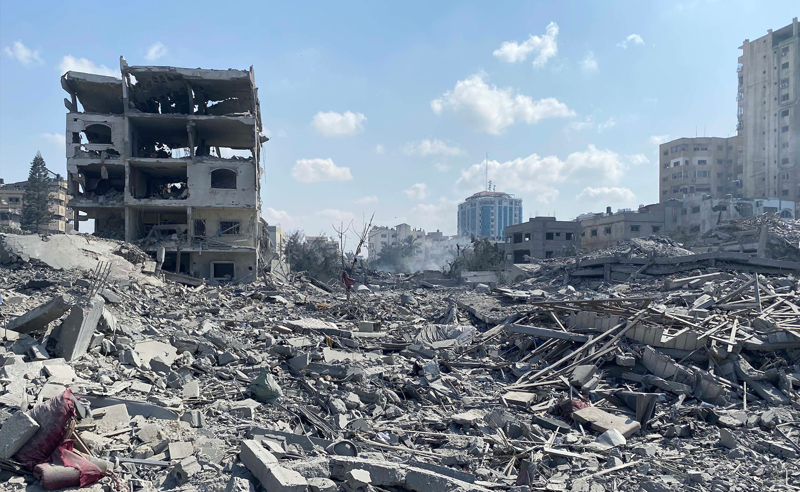
Since the Russian army invaded Ukraine on 24 February 2022, humanitarian aid has been sent by the United States, NATO, the European Union (EU), international organisations and other non-State actors to meet the needs of the most vulnerable in Ukraine. This aid is in several forms: the sending of equipment, humanitarian and refugee aid, the sending of cash, but also essential products. At the same time, it is not unconditional and the Ukrainian government must fulfil a number of commitments in order to benefit from it. On the other hand, such a commitment has never been seen alongside the Palestinians in the face of the Israeli neighbour, who enjoys the visible support of these countries. The lack of humanitarian aid to the Gaza Strip is even censored by the Israeli authorities. They do not ensure that vital goods and services reach a population threatened by genocide and starvation as a result of the continued bombing of its army and the tightening of the illegal blockade in place for 16 years. They also did not open new access and access points for aid or provide effective protection for humanitarian personnel from attacks.
Heba Morayef, Regional Director for the Middle East and North Africa Amnesty International states: ” Israel has promoted a very serious humanitarian crisis and has shown a cold indifference to the fate of the people of Gaza by creating conditions that, according to the International Court of Justice (ICJ), expose them to an imminent risk of genocide. Israel has repeatedly refrained from taking the minimum measures that humanitarian organizations demand and that are clearly in its power to alleviate the suffering of Palestinian civilians in Gaza. ».
Other major crises are silent, with very low coverage of the international media, little interest in political debates and a great disinterest in the international community. Nearly 300 million people worldwide need humanitarian assistance and protection, 735 million people face severe food insecurity and 108.4 million people were forcibly displaced in 2022 as a result of persecution, conflict, violence, human rights violations and the effects of climate change[14]. Figures that demonstrate a “double standard” in dealing with crises.
Whether it is development projects or emergency operations, international assistance continues to be seen as a lever of influence. It is used by major powers such as France and the United States to punish defectors, pariahs; reward friends or allies. Yemeni populations[15] or Gazaouies do not receive assistance or substantial assistance from the “North” states and major international organizations because, unfortunately, of the political orientations of their governments, allied with the Mullah regime of Iran. In Africa, the situation of the populations of the eastern Democratic Republic of the Congo (DRC), torn by endless political and security conflicts for more than two decades[16] or in Sudan, never occupied the entire media space and debates in international forums to find solutions. It is therefore not anomalous to see these great Western powers, international non-governmental organizations or developmentists of the “North” be subjected to sharp criticism, accused of letting people perish, or to let weak states fall bankrupt according to their strategies of power or influence on the international scene.
The humanitarian posture questioned in the face of the instrumentalisation of aid
The depoliticization of humanitarian aid represents an important challenge for the treatment of crises. It calls on humanitarian actors to break the shadow of the risk of instrumentalisation through better management of crises. Since the intervention, the “just wars” and humanitarian aid instrumentalised to justify and legitimize the political agenda of the states in the late 1990s and especially after the attacks of 11 September 2001, many humanitarian organisations seem to refuse to take a position and cross this line of policy.[17]. Thus, in September 2021, Pierre Micheletti opposed the words of Antonio Guterres, Secretary General of the United Nations, who wanted to use humanitarian aid as a lever to encourage the Afghan Taliban to respect human rights: ” humanitarian aid should not serve the political agenda of states »[18]. Already in 2014, Action Against Hunger had produced a press release in response to François Hollande’s presidential displacement in Iraq, arguing that ” humanitarian is not a tool for managing political crisis, the confusion of roles and responsibilities between political and humanitarian does not help or even worsen the situation of people in need »[19].
Indeed, witness to so much impunity or the ambiguous role of certain States, should humanitarian actors not also highlight their control strategies? Should humanitarian aid not come out of silence and put policies in line with their obligations?[20] instead of being legitimate representatives of general interests embedded in control strategies of the receiving States? Should they not challenge policies, mobilize for greater social justice and equitable development, while ensuring that they are not politically recovered? In order not to repeat the failures of instrumentalisation of aid with Afghanistan and the Sahel, States must take responsibility for managing the root causes and cyclical dynamics of political and societal problems. While it is important to recall that humanitarian actors are neither crisis managers nor peace-building actors, nor a response to political problems, they must a minima ensure a reasoned approach that respects humanitarian principles.
That is why it is necessary to depoliticize humanitarian aid in order to avoid any use for political, diplomatic, economic or commercial purposes. This depoliticisation in the sense of Patrick Hasenteufel may involve the production of a political consensus based on principles presented as neutral or the use of discrete and/or automatic instruments.[21]. The literature on international organizations reveals three main forms of depoliticization. The first relates to the use of normes a universalist ethical vocation, aimed at forging an international consensus and de-conflicting the issues facing international organizations. This normative dimension of their action is observed in the promotion of “good practices”, with the addition of “recommendations”, “instructions”, “guidelines”, “codes of conduct”, all instruments of public action which ” free from ideological debates deemed cumbersome »[22]. Le discours through a “political discourse depoliticized” in the sense of Pierre Bourdieu is a second way of neutralizing the political stakes for them. As can be seen from their reports, official publications, statements by their representatives and websites.
Expertise (whether scientific, economic, financial, statistical, technical or legal) is the third lever of depoliticisation[23]. This aspect had the merit of being noted by Corinne Delmas who believes that ” The internationalisation of the debates contributes to the depoliticisation of the public arena because international organisations use expertise by transversalizing the political issues of the moment into technical, rational questions that can transcend any political divide »[24]. Sociologists of international organizations Michael Barnett and Martha Finnemore confirm that ” the expert authority gives (…) to international organizations the power appears as depoliticized. By focusing on the objective nature of their knowledge, the staff of international organisations are able to present themselves as technocrats whose advice is not affected by partisan quarrels »[25]. The significant growth in the discourse of humanitarian law and humanitarian organizations in international relations, as well as in the numerous “military-humanitarian” interventions, today impose a new governance of humanitarian aid in this world in crisis.
What future for humanitarian aid in the face of the evolution of conflict?
Far from announcing the coming end of humanitarian aid, it is important for humanitarian workers to look ahead. Even though it is true that this multi-billion dollar activity will not disappear overnight[26]. Despite the upheavals in the global environment in which the humanitarian ecosystem operates, the humanitarian sector must continue to assist people at risk while continuously improving its relationship with politics. Changes are needed to soften the rise in the supremacy of State sovereignty. Humanitarian aid must emerge from the tragic impotence of double standards and return to the fundamentals desired by Henry Dunant. It is not at all understandable to the international community that on one side, a country like Ukraine receives great humanitarian attention while on the other, other States that have been trapped for decades in conflicts or situations of distress remain abandoned to themselves.
The humanitarian situation in the Gaza Strip with its share of deaths and its impact on the lives of the Palestinians also requires the same attention from the same international community as the Russian-Ukrainian conflict. Under no circumstances is it a matter of throwing reproach at the State of Israel or of finding it guilty of systematically violating international law by committing war crimes or even crimes against humanity against Palestinians, but of urging all families of humanitarian aid providers to break out of partisan logic. If humanitarian aid was needed today to be consistent with the principles of good governance, democracy and human rights, victims could be further penalized because often the most acute needs lie precisely in the worst-governed and multi-faceted countries. To condition or moralize humanitarian aid is therefore to make victims, to save a source of human capital that is part of a market logic[27] and not in the paradigm of giving[28]. It is indeed difficult to choose between continuing humanitarian actions under unacceptable conditions and stopping all programmes or activities and leaving.
Purists perceive the task of humanitarian aid only as direct assistance to people in distress: care for the wounded, food, care and shelter for those in need of protection[29]. All this does not mean that purists reject the struggle for human rights, peace and development. For them, humanitarian aid must simply remain outside of these things. The supporters of the new humanitarianism, on the other hand, try to act beyond the relief of distress and to defend the cause of human rights, good governance and the rule of law, to work for peace and development policy and to denounce injustices.[30]. To this end, humanitarian engagement must also aim at political objectives, such as ending armed conflict and improving security, improving the human rights situation and strengthening the rule of law, promoting the principles of good governance, democratizing society and strengthening equality, strengthening the resilience of a society to environmental crises, and continuously improving the economic situation of those affected.
For sustainable humanitarian assistance, it is important to soften the power of States in order to facilitate their access to all without conditions, far from political and geostrategic considerations. At the same time, this aid must be long-term. This is not a lasting aid, but rather an aid that can evolve and give people the conditions to regain their autonomy. Sustainable humanitarian aid therefore revolves around five pillars: coordination of actions during the crisis; participatory approach; assistance for socio-economic rehabilitation; maintenance of local traditions; prevention. It would have a global vision, linking emergency response to reconstruction, restoration of the autonomy of the affected people and prevention of new humanitarian disasters. What is certain, in any case, is that as long as the international community and the great powers within it do not play their role as guardian of world peace, uncertainties will always characterize humanitarian aid with serious consequences for the recipients. It is the price to pay for sustainable humanitarian aid that can meet the many challenges of this century. This is all the more important today, when today’s globalization is characterized by antagonisms to the detriment of the culture of peace and human progress at the international level. n
2 juillet 2025.
Bibliographie :
– Barnett Michael, Finnemore Martha, Rules for the World : International Organizations in Global Politics, Ithaca, Cornell University Press, 2004, p. 24 (277 p.).
– Brauman Rony, Humanitarian: The Dilemma, Paris, ed. Textuel, 1996, p. 39 (106 p.).
– Bréqueville Bertrand, Humanitarianism under the grip of neoliberalism, Paris, ed. Charles Léopold Mayer, 2021, 135 pp.
– Corty Jean-François, “politicization of aid and depoliticization of beneficiaries: the limits of the State humanitarian”, in International and Strategic Review (RIS), Vol. 2, No. 134, Summer 2024, p. 75, link: https://www.iris-france.org/ris/politisation-de-laide-et-depolitisation-des-ayants-droit-les-limites-de-lhumanitaire-detat/ (accessed 4 July 2025).
– Delmas Corinne, Political sociology of expertise, Paris, PUF, 2010, pp. 81-83 (128 p.).
– “Presidential displacement: humanitarianism is not a tool for managing political crisis” (press release), Action against hunger, September 12, 2014, updated on April 7, 2025, link: https://www.actioncontrelafaim.org/presse/irak-deplacement-presidentiel-l-humanitaire-n-est-pas-un-outil-de-gestion-de-crise-politique/ (accessed 4 July 2025).
– Destexhe Alain, Impossible humanitarian or two centuries of ambiguity, Paris, Armand Colin, 1993, p. 7 (236 p.).
– Fatou Élise Ba, “The forgotten crises, the invisible challenge of international aid”, in International and Strategic Review, Vol. 2, No. 134, Summer 2024, pp. 95-103, link: https://www.iris-france.org/ris/les-crises-oubliees-le-defi-invisible-de-laide-internationale/ (accessed 4 July 2025).
– Frédéric Thomas, « Haiti : The Fatigue of Humanity ? ” CETRI, 12 septembre 2022, lien : https://www.cetri.be/Haiti-la-fatigue-de-l-humanitaire (accessed 4 July 2025).
– Hassenteufel Patrick, Sociologie politique : l’action publique, Paris, Armand Colin, 2011, pp. 182-183 (320 p.).
– Petiteville Franck, “the resilient politicization of international organizations”, in Critique International, Vol. 3, N° 76, 2017/3, pp. 9-19, lien : https://shs.cairn.info/revue-critique-internationale-2017-3-page-9?lang=fr (accessed 4 July 2025).
– Popper Karl, Open society and its enemies, 2 vol., Paris, Seuil, 1979.
– Klein Asmara, Laporte Camille, Saiget Marie (dir.), Good practices of international organizations, Paris, Presses de Sciences Po, 2015, p. 29 (244 p.).
– Lindenberg Marc, Coralie Bryant, Going Global. Transforming Relief and Development NGOs, Bloomfield (USA), Kumarian Press, 2001, p. 76 (288 p.).
– Macrae Joanna, Leader Nicholas (et al.), Shifting sands. The search for ‘coherence’ between Political and Humanitarian Responses to Complex Emergencies (rapport), Londres, Humanitarian Policy Group (HPG), rapport N°8, Août 2000, 84 p., lien : https://www.files.ethz.ch/isn/35570/hpgreport8.pdf (accessed 4 July 2025).
– Mahé Pauline, De Geoffroy Véronique, “Humanitarian aid and political relations: historical return, current reflections and future prospects”, Groupe URD, 5 octobre 2023, lien : https://www.urd.org/fr/revue_humanitaires/aide-humanitaire-et-relation-au-politique-retour-historique-reflexions-actuelles-et-perspectives-davenir/ (accessed 4 July 2025).
– McLean Duncan, Hofman Michiel, “International humanitarian law, state sovereignty and erosion of humanitarian consensus: the end of humanitarianism?”, in Alternative Humanitaire, N°23 (“International Humanitarian Law: The Great Return… back ?”), July 2023, link: https://www.alternatives-humanitaires.org/fr/2023/07/22/droit-international-humanitaire-souverainete-des-etats-et-erosion-du-consensus-humanitaire-la-fin-de-lhumanitarisme/ (accessed 4 July 2025).
– Ngassam Rodrigue Nana, “Failed State, Calvary of Congolese Populations”, in The Diplomatic World,N° 842, Mai 2024, pp. 6-7, lien : https://www.monde-diplomatique.fr/2024/05/NANA_NGASSAM/66823 (accessed 4 July 2025).
– Ngassam Rodrigue Nana, “Yemen, a torn and divided country”, in Revue des Deux Mondes, December 2018-January 2019, pp. 133-139, link: https://www.revuedesdeuxmondes.fr/yemen-un-pays-dechire-et-divise/ (accessed 4 July 2025).
– Rich David, “Afghanistan: ‘Humanitarian aid must not serve the political agenda of the states'”, France 24, 14 septembre 2021, lien : https://www.france24.com/fr/asie-pacifique/20210914-afghanistan-l-aide-humanitaire-ne-doit-pas-servir-l-agenda-politique-des-%C3%A9tats (accessed 4 July 2025).
– Schloms Michael, “The inevitable dilemma of humanitarian action”, in Cultures & Conflits, N°60, Hiver 2005, pp. 85-102, lien : https://doi.org/10.4000/conflits.1924 (accessed 27 June 2024).
– Schloms Michael, North Korea and the Timeless Dilemma of Aid : A Study of Humanitarian Action in Famines (Thesis), Münster, Lit Verlag, 2004, 305 p.
– Schroeder Romain, Varga Christian, Van Dok Geert, Humanitarian challenges, political dilemmas of emergency aid, Caritas Luxembourg and Caritas Switzerland, November 2005, 164 pp.
– Stephen Hopgood, “When the music stops: Humanitarianism in a Post-Liberal World Order”, in Journal of Humanitarian Affairs, Vol. 1, N°1, Janvier 2019, pp. 4-14, lien : https://doi.org/10.7227/JHA.002 (accessed 4 July 2025).
– TTab René, “Ambiguities of humanitarian aid”, Revue Quart Monde, N°196, 2005/4, lien : https://www.revue-quartmonde.org/194 (accessed 4 July 2025).
– Vaux Tony, The Selfish Altruist. Relief Work in Famine and War, Londres, Earthscan, 2001, p. 43 (230 p.).
[1] Docteur (Ph.D) in Political Science (University of Douala-Cameroon), member of the Académie de Géopolitique de Paris and expert of the Réseau d’expertise et de formation francophone pour les opérations de paix (REFFOP).
[2] Popper Karl, Open society and its enemies, 2 vol., Paris, Seuil, 1979.
[3] TTab René, “Ambiguities of humanitarian aid”, Revue Quart Monde, N°196, 2005/4, lien : https://www.revue-quartmonde.org/194 (accessed 4 July 2025).
[4] Ibidem.
[5] Vaux Tony, The Selfish Altruist. Relief Work in Famine and War, Londres, Earthscan, 2001, p. 43.
[6] Stephen Hopgood, “When the music stops: Humanitarianism in a Post-Liberal World Order”, in Journal of Humanitarian Affairs, Vol. 1, N°1, Janvier 2019, pp. 4-14, lien : https://doi.org/10.7227/JHA.002 (accessed 4 July 2025).
[7] Destexhe Alain, Impossible humanitarian or two centuries of ambiguity, Paris, Armand Colin, 1993, p. 7.
[8] Schloms Michael, “The Inevitable Dilemma of Humanitarian Action”, in Cultures & Conflits, N°60, Hiver 2005, pp. 85-102, lien : https://doi.org/10.4000/conflits.1924 (accessed 27 June 2024).
[9] Lindenberg Marc, Coralie Bryant, Going Global. Transforming Relief and Development NGOs, Bloomfield (USA), Kumarian Press, 2001, p. 76.
[10] Ibidem.
[11] Brauman Rony, Humanitarian: The Dilemma, Paris, ed. Textuel, 1996, p. 39.
[12] Schloms Michael, North Korea and the Timeless Dilemma of Aid : A Study of Humanitarian Action in Famines (Thesis), Münster, Lit Verlag, 2004, 305 p.
[13] Corty Jean-François, “Politization of aid and depoliticization of right holders: the limits of the State humanitarian”, in International and Strategic Review (RIS), Vol. 2, No. 134, Summer 2024, p. 75, lien : https://www.iris-france.org/ris/politisation-de-laide-et-depolitisation-des-ayants-droit-les-limites-de-lhumanitaire-detat/ (accessed 4 July 2025).
[14] Fatou Élise Ba, “The forgotten crises, the invisible challenge of international aid”, in International and Strategic Review, Vol. 2, No. 134, Summer 2024, pp. 95-103, link: https://www.iris-france.org/ris/les-crises-oubliees-le-defi-invisible-de-laide-internationale/ (accessed 4 July 2025).
[15] Ngassam Rodrigue Nana, “Yemen, a torn and divided country”, in Revue des Deux Mondes, December 2018-January 2019, pp. 133-139, link: https://www.revuedesdeuxmondes.fr/yemen-un-pays-dechire-et-divise/ (accessed 4 July 2025).
[16] Ngassam Rodrigue Nana, “Failed State, Calvary of Congolese Populations”, in The Diplomatic World,N° 842, Mai 2024, pp. 6-7, lien : https://www.monde-diplomatique.fr/2024/05/NANA_NGASSAM/66823 (accessed 4 July 2025).
[17] Mahé Pauline, De Geoffroy Véronique, “Humanitarian aid and political relations: historical return, current reflections and future prospects”, Groupe URD, 5 octobre 2023, lien : https://www.urd.org/fr/revue_humanitaires/aide-humanitaire-et-relation-au-politique-retour-historique-reflexions-actuelles-et-perspectives-davenir/ (accessed 4 July 2025).
[18] Rich David, “Afghanistan: ‘Humanitarian aid must not serve the political agenda of states'”, France 24, 14 septembre 2021, lien : https://www.france24.com/fr/asie-pacifique/20210914-afghanistan-l-aide-humanitaire-ne-doit-pas-servir-l-agenda-politique-des-%C3%A9tats (accessed 4 July 2025).
[19] ” Presidential displacement: humanitarianism is not a tool for managing political crisis” (press release), Action against hunger, September 12, 2014, updated on April 7, 2025, link: https://www.actioncontrelafaim.org/presse/irak-deplacement-presidentiel-l-humanitaire-n-est-pas-un-outil-de-gestion-de-crise-politique/ (accessed 4 July 2025).
[20] Op. Cit.Mahé Pauline, De Geoffroy Véronique…
[21] Hassenteufel Patrick, Sociologie politique : l’action publique, Paris, Armand Colin, 2011, pp. 182-183.
[22] Klein Asmara, Laporte Camille, Saiget Marie (dir.), Good practices of international organizations, Paris, Presses de Sciences Po, 2015, p. 29.
[23] Petiteville Franck, “the resilient politicization of international organizations”, in Critique International, Vol. 3, N° 76, 2017/3, pp. 9-19, lien : https://shs.cairn.info/revue-critique-internationale-2017-3-page-9?lang=fr (accessed 4 July 2025).
[24] Delmas Corinne, Political sociology of expertise, Paris, PUF, 2010, pp. 81-83.
[25] Barnett Michael, Finnemore Martha, Rules for the World : International Organizations in Global Politics, Ithaca, Cornell University Press, 2004, p. 24.
[26] McLean Duncan, Hofman Michiel, “International humanitarian law, state sovereignty and erosion of humanitarian consensus: the end of humanitarianism?”, in Alternative Humanitaire, N°23 (“International Humanitarian Law: The Great Return… back ?”), July 2023, link: https://www.alternatives-humanitaires.org/fr/2023/07/22/droit-international-humanitaire-souverainete-des-etats-et-erosion-du-consensus-humanitaire-la-fin-de-lhumanitarisme/ (accessed 4 July 2025).
[27] Frédéric Thomas, « Haiti: The Fatigue of Humanity ? ” CETRI, 12 septembre 2022, lien : https://www.cetri.be/Haiti-la-fatigue-de-l-humanitaire (accessed 4 July 2025).
[28] Bréqueville Bertrand, Humanitarianism under the grip of neoliberalism, Paris, ed. Charles Léopold Mayer, 2021, 135 pp.
[29] Schroeder Romain, Varga Christian, Van Dok Geert, Humanitarian challenges, political dilemmas of emergency aid, Caritas Luxembourg and Caritas Switzerland, November 2005, 164 pp.
[30] Macrae Joanna, Leader Nicholas (et al.), Shifting sands. The search for ‘coherence’ between Political and Humanitarian Responses to Complex Emergencies (rapport), Londres, Humanitarian Policy Group (HPG), rapport N°8, Août 2000, 84 p., lien : https://www.files.ethz.ch/isn/35570/hpgreport8.pdf (accessed 4 July 2025).
Leave a comment