
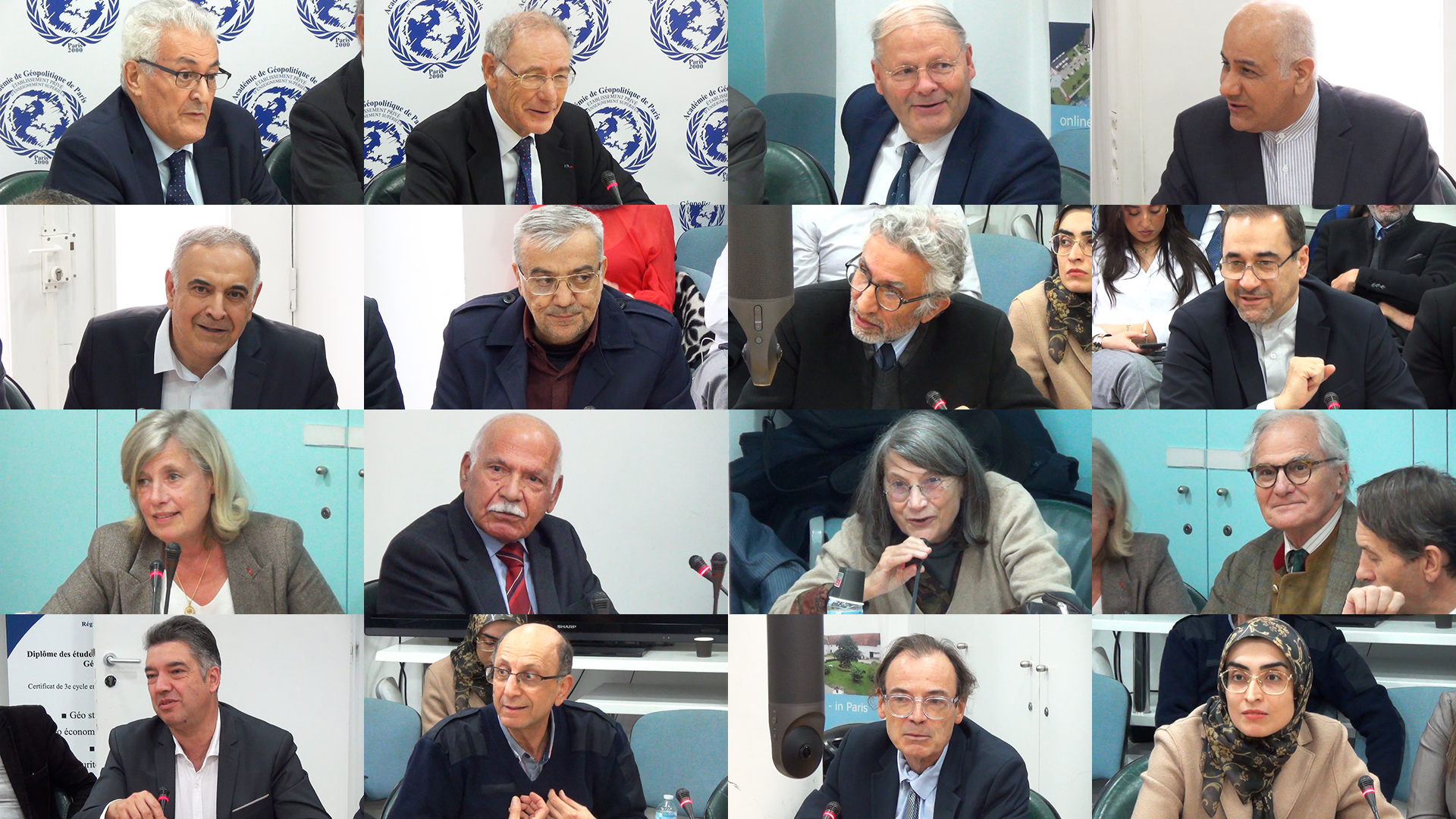
FRANCO-IRANIAN ACADEMIC MEETING ON UNIVERSIT AND SCIENTIFIC COOPERATION
On 21 October 2025, the Académie de Géopolitique de Paris (AGP) organized an unprecedented international meeting in the presence of Iranian officials of the highest academic level, in order to open the debate on university development in Iran, the possibilities of exchange with France, and the state of relations between the higher education institutions of the two countries.
This meeting allowed us to discuss the richness of the existing long-standing and uninterrupted scientific dialogue between France and Iran on a wide range of research topics. It has also provided an opportunity to discuss the difficult international context facing our capitals, as well as the prospects for change in view of the considerable opportunities offered by the intellectual and cultural proximity between our two nations.
The previous summer, a delegation of representatives of the Academy had visited Tehran where she had been able to meet prominent figures of Iranian higher education and research and to establish academic and scientific cooperation agreements with several high-level institutions. In return, our establishment had the pleasure of welcoming in Paris several eminent personalities, including:
Prof. Mohammad Reza DEHSHIRIDean of the Faculty of International Relations of the Ministry of Foreign Affairs of the Islamic Republic of Iran;
Prof. Amir Reza SHERKATVice-Dean for International Cooperation and Specialized Training at the Faculty of International Relations of the Ministry of Foreign Affairs of the Islamic Republic of Iran;
Prof. Seyed Mohammad TABATABAEIMember of the faculty of Allameh Tabatabaei University;
Dr. Seyed Mohammad HOSSEINI, Expert en relations internationales.
In the continuity of the academic dialogue between the Iranian and French institutions, these professors will participate in a series of meetings and exchanges with French university centres, research institutes and higher education institutions. These activities are integral to a sustainable strengthening of Franco-Iranian cultural, academic and scientific cooperation.
SUMMARY RECORD OF THE MEETING
Dr. Ali RASTBEEN, President of the Paris Academy of Geopolitics
Ladies and gentlemen, hello. Well, thank you very much for your patience. On the screen, here’s an image we had to present at the end of the session, but apparently you were more hasty! This is our future institution, on which we have been working for two years, and soon we will begin our educational activities.
First of all, thank you for your presence, and I would like to take this opportunity to thank Mr. Dean of the Faculty of International Relations of the Ministry of Foreign Affairs of Iran, Professor Dehshiri, also his Vice Dean, and Professor Tabababei. Their presence is a flight from our trip to Tehran last June by a delegation from the Académie de Géopolitique de Paris composed by Rector Gérard-François Dumont, Professor Christophe Réveillard and myself.
We were invited by the Faculty of International Relations of the Ministry of Foreign Affairs of Iran, by the University of Tehran, Shahid Beheshti University, Allameh Tabatabaei University, and also Imam Sadiq University. This relationship gave us visions to have academic and academic relations between France and Iran. Our meeting today is therefore the result, and we have the honour to receive a high-level delegation, as well as the presence of the diplomatic cadres of the Iranian embassy here.
We wanted to do an analysis of the situation of our trip, an analysis of the current situation between you and the delegation regarding the future of cultural activity and, perhaps, the future of diplomacy between France and Iran. First of all, thank you, Mr. Dean, and I will ask Mr. Rector Dumont to do a little analysis of our journey, his estimate as an expert, of the situation, and then we will also ask Professor Reveillard to do an analysis. You are free to ask your questions, according to your desire and appreciation, they are able to answer you on the cultural, political, technical aspect, and in the dimensions you consider necessary. You have the floor, Mr. Rector.
President Gérard-François DUMONT, Demographer, Vice President of the Académie de Géopolitique de Paris, Professor at the Sorbonne University, and President of the journal Population & Avenir
Thank you, Mr. President. Perhaps by thanking our colleagues for coming to us today, I will start perhaps with elements that can be considered anecdotal before addressing more fundamental issues.
The academic I came back from Iran with a considerable sense of jealousy. Because indeed, we have seen universities whose working conditions and urban conditions were quite remarkable, whose multiplicity of publications was also impressive. And so, if we could have in France universities with the best quality, is as good as that of Iranian universities, we would be very happy. But this would obviously require an effort by our public authorities to settle in conditions as good as those we have seen in Iran.
The second small remark that may seem so anecdotal is extreme civility, which explains that we came back alive from Iran. I’ll explain. At least in Tehran, we are in an extraordinary situation where to cross a street, there is only one solution, we have to cross it. Without taking into account all the cars that might crush you. I called it the Russian roulette at first! In fact, it’s not the Russian roulette because Iranians are extremely high and when they see a pedestrian crossing a street, they stop. This would not necessarily be the case in France.
Thirdly, a little anecdotal, if I may, President, it is indeed the fact that we have an extremely hardworking population. Extremely hardworking. And we do see all those Iranians who have ardour at work, which is exceptional and which we do not see in all the countries of the world, that is the least we can say.
I was also surprised in the road we travelled outside Tehran by the Iranians’ willingness to attach the importance it deserves to the industrial sector. In France, we tend to hide our areas of industrial activity, not to indicate through signs how to get there and how they are organised, and I was indeed fortunately surprised by the number of indications that there is an industrial sector, or that we are selling industrial products. You have advertising signs to buy forklifts. And so, it proves a willingness to highlight the importance of industry. We also had the chance to visit an absolutely beautiful shopping mall, which is, I believe, the largest in the world, outside 35 km or so of Tehran, which I found quite wonderful because I have always been disappointed by the famous shopping malls in Dubai or Abu Dhabi, in which I do not feel very well, and there is a quality that is quite amazing.
So, of course, our journey has been a little reduced because you know that there is someone who phoned the Israeli Prime Minister saying, “Mr. Rastbeen is in Tehran, it is time to start the war” (laughs)! And so we could not, as was planned in the programme, go to Ispahan and Shiraz, for which we had prepared conferences.
So, beyond these anecdotal questions, it is true that we have been able to have a lot of substantive discussions as we have been led to give lectures, on Europe, on geopolitics, I necessarily forget other topics, human rights, etc., and then also academic exchanges a little spontaneous, i.e. in each meeting, either at the Faculty of International Relations or at universities, we have had exchanges with both academics and often, elsewhere, with doctoral students, which also allowed us to judge the quality of your doctoral students, who were quite remarkable.
It is clear that we have seen a desire to improve scientific knowledge, a desire to spread this scientific knowledge also through a large number of publications, and therefore, in fact, a desire to raise, to rise up, and not to have a certain retraction of the scientific appetite that we see, excuse me for saying, sometimes, in our country. Where, moreover, there is, of course, no ideological discussion like we receive it every day in our mailbox from our dear university colleagues. And so, to the extent that Iranian academics are anxious to teach their students scientific realities, on the one hand, and to improve scientific knowledge, on the other hand, that means that they do not waste time in unnecessary ideological disputes or even in syndicate-union discussions, as we are doing in our country, unfortunately.
So it is clear that developing academic relations between France and Iran can only be profitable, knowing, moreover, that when we look at the long history of our two countries, there are still a number of points that show that we have some old historical foundations, starting with the national spirit. Of course, Iranians defend Iran’s interests and, normally, the French should defend France’s interests… But all this is part of a very, very long history, which is not the case of much newer countries where the state was only recently established, especially in other countries in the Middle East.
So, here are some things, dear President, that I could mention. I could go back to that, of course, in terms of your questions, because there would be a lot more to clarify in this regard. I think it may be best for Christophe Réveillard to share some thoughts, and then we will be at your disposal to answer your questions.
Prof. Christophe REVEILLARD, Secretary General of the Académie de Géopolitique de Paris and IRCOM of the Université Paris Sorbonne
Yes, so I’m not going to add a lot of things because, as usual, the rector was exhaustive, I don’t see much important elements to add. I would say a great intellectual curiosity, a listening to different scientific experiences, that’s one thing that marked the delegation, that is, our experiences, however different, are grounds for satisfying the intellectual curiosity of our next partners.
So, in order to be a little concrete about the possibility of exchanges, we were not born of the last rain, of the year’s losers, as they say, and therefore we know what the blockages in the major French institutions with regard to potential or possible exchanges with Iran are. Things are changing, of course, but we can consider that our academy, like other French institutions, can be a first time of exchange in which students can come, exchanges of teachers, exchanges of courses, exchanges or common curricula, the whole range is open, I do not see what could not be used on both sides, for, in a second step, possibly to see a maieutics being created and dispensed in other institutions.
We have at the academy a fairly comprehensive network of professors who are in institutions, who are in universities, starting with the rector, starting with myself, our connecting university is a public university, and why, in a second step, not to hang up students, or the intervention of professors from Tehran, or from the major university centers in Iran, within the framework of our respective universities? It means that we need to be a little patient, that things have to be done gradually, through progressivity, that we are smart on both sides to know what we can do and what we cannot do. But I am really very optimistic, much more optimistic after the trip than I was before the trip, about this possibility of exchange between us. That’s all I wanted to add, Mr. President.
Prof. Mohammad Reza DEHSHIRI, Dean, Faculty of International Relations, Ministry of Foreign Affairs, Islamic Republic of Iran
Thank you very much, Mr President. I am very pleased to be here, as well as the delegation present here: Dr. Tabababeei, who is a professor at Allameh Tabababei University, Dr. Hosseini, who had obtained his doctorate at the University of Lyon and is now among the highest diplomats in Iran and also teaches at the Faculty of International Relations and the Faculty of World Studies. He was Iran’s ambassador to Saudi Arabia, Senegal and the United Arab Emirates. Also, Dr. Sherkat, my dean, who was the Consul General of Iran in Munich and who is now vice-dean for international cooperation and specialized training. We also have the two PhD students from the Iranian embassy here.
I think the essential is said. What is important is that we should think about what we can do for the future. Unfortunately, there is some kind of mistrust and sometimes ignorance on both sides. And so we should overcome this problem. What is important is to get to know each other, and this kind of activity to, of course, give a good knowledge of the problems that exist, and also the solutions that we can envisage. That is what I can say as a starting point, but we can of course enter into the depth of the subjects later. Thank you, Mr. President.
Prof. Seyed Mohammad TABATABAEI, Member of the faculty at Allameh Tabatabaei University
One comment, since by modesty Mr Dehshiri did not present himself well. He himself was Iran’s ambassador to Senegal. This means that we are a mixed delegation, i.e. there are diplomats and academics. That’s for the little remark I wanted to make.
We are open to various questions that you want to ask us about Iran, about universities, even about politics, since we are professors of international relations, of political science, about the current situation in Iran. Either we will answer, or our French colleagues who had come to Iran, who had a good experience there. And that I didn’t know: during the war, you were in Iran?
President Gérard-François DUMONT
Yes, absolutely, yes. Not throughout the war.
Prof. Seyed Mohammad TABATABAEI
I didn’t know!
President Gérard-François DUMONT
So we didn’t sleep very well, because there was noise at night. We had both the sound of Israeli missiles and the sound of Iranian missile defence. It stopped around four or five in the morning.
Prof. Christophe REVEILLARD
Nightstorm was still pretty strong, huh?
Prof. Seyed Mohammad TABATABAEI
War, the most important geopolitical experience!
President Gérard-François DUMONT
I would just like to add a word, President, which I have forgotten, which is still very important, is that we were surprised by the number of Iranian academics who, like you yourself, studied in France and speak French perfectly. So Toulouse, Lyon, Nantes, Paris… That’s pretty amazing. It was not expected to find so many Francophone academics in all disciplines.
Dr. Ali RASTBEEN
Yes, especially the Faculty of Law. Most of the people were Francophones.
With your permission, since for the most part they are scientists, academics, some foreign diplomats too are among us, I will ask the delegation a question: how do you estimate, what is your estimate of the relations between France and Iran?
Prof. Mohammad Reza DEHSHIRI
Thank you, Mr. President. So let me tell you what Iran thinks of France. And then we can consider what we can do for the future.
So, in the history of Iran’s international relations, since Iran was still seeking balance between competing powers, so at the time Qadjar was between Russia and England, Iran had recourse to a third power. The first third power Iran had used was France in 1807. So we had the treaty of Finkenstein (1807) between Iran and France, but shortly afterwards there was some reconciliation between France and Russia by the treaty of Tilsit in 1808. Therefore, Iran sought to resort to other third powers. Then there was the United States, and even at the time of Bismarck, Iran sought recourse to Germany.
But after World War I, Iran sought to resort to the United States because the United States was at that time a country that did not have colonial greed. And so, even during the cold war, even if there was the bipolar international system, Iran was still trying to use France and even Germany to play between the two major powers, the Soviet Union and the United States. And even the Eurodif affair is significant of what Iran thought would have to develop a policy of diversification in order to balance the game, what is currently called in English regime policy. Then you know that France was the first country to have a good attitude towards the Islamic Revolution, you know that Ayatollah Khomeini was well housed in Neauphle-le-Château, and after there was the victory of the Islamic Revolution (1979).
Iran, in its history, was among the only countries, one can say the only country, which had a kind of attachment to the French language, the only country that was not colonized. But to have some special attachment, Iranian elites wanted to learn French. However, during the Iran-Iraq war (1980-1988), France had some sort of support for Saddam Hussein’s regime during the war. So by giving the Super-Stendard planes and all that to the Iraqi regime, Mirage also. From that time on, there was a kind of mistrust: why France, which had such a favourable attitude, changed its attitude towards Iran by supporting the one who had attacked Iran, i.e. Saddam Hussein.
Then there was the time of Mr. Hachemi Rafsanjani (1989-1997), who wanted to play calm, and so there was some kind of talks between Iran and France. At that time, about 110 students were sent to France, and among them, I and Dr. Hosseini, so to learn the French language and also study in the university.
Moreover, this generation, after its return, had posts, especially with the arrival of President Mohammad Khatami in power, so you see that there was a kind of development of relations between Iran and France in the Khatami era (1997-2005) because of what was said about dialogue between civilizations. But after the nuclear affair (that was in 2003), we see that France, Germany and England wanted to play their part between Iran and the United States, because at that time the United States of George W. Bush wanted to fuel the war, and because they had attacked Iraq (2003), and we see that the nuclear affair was a kind of test for relations between Iran and France. And so at that time, we saw that France did not keep its promises, that is, that in exchange for the clarification of Iran’s nuclear situation, France must make the necessary gestures for the development of Iran’s economic system.
After, at the time of Mahmoud Ahmadinejad (2005-2013), the affairs between Iran and France were not so good, above all, the presidents did not hear, President Sarkozy and President Ahmadinejad had an uncompromising attitude towards one another.
At the time of Mr. Hassan Rohani (2013-2021), Iran tried to reach an agreement on nuclear power, which was called the JCPOA (Joint Comprehensive Plan of Action, Global Plan of Joint Action), and at this time an important French delegation came to Ian to discuss what was possible for economic relations. But after Donald Trump’s release from this agreement (2018) we saw that relations between Iran and France were deteriorated, tarnished, and we see that the situation is therefore not so good.
Iran believes that what we could do was have some sort of transparency in the nuclear affair, but France did not do what we wanted to have economic cooperation with Iran. You know that Peugeot and Renault came to Iran, but after the withdrawal of the United States from the nuclear affair they left Iran, and came back, so you see that there is an outcry in relations between Iran and France. This is the story of how it happened.
So what we think in Iran is that first, there is a kind of misunderstanding in France, especially after the war in Ukraine. It is believed that Iran has turned to Russia, while Iran is still seeking a policy of balance between East and West. It was only a kind of American and European policy that pushed Iran towards Russia and also China, despite Iran’s tendency to have a balanced policy towards both sides.
Secondly, we believe that France is likely to distance itself from the policy of monitoring against the Americans and therefore adopt a more independent policy towards Iran, so that we can consider what we can do for the future. But what is important is to compare the political affair of the economy, and also of scientific and cultural affairs. For the moment, since there is a certain blockage of political and even economic relations between Iran and France, which is regrettable, we believe that we can have privileged relations, especially in the economic field. But we believe that relations between academics can lead the way and that, therefore, this could be a sort of solution to these differences between Iran and France, so that the attendance of students and teachers can open the way to a more balanced and cooperative relationship between the two countries. That’s what I wanted to tell you right now. I am of course open to receiving your suggestions and also your questions, if my friends too want to add something.
Prof. Seyed Mohammad TABATABAEI, Member of the faculty at Allameh Tabatabaei University
We are therefore an Iranian delegation, currently invited to France, I am very honoured to be in the presence of scientists and colleagues. Almost everything has already been said by my colleague Mr Dehshiri, I will add a few remarks. Mr. Dehshiri made a directory of Iran’s history. I’m gonna go back a little bit.
The first Europeans who had come to Iran were at the XVIe century. The English were merchants, businessmen, and the French were who? The missionaries. So the English came to the region, to Iran, to trade, there were silk roads, but the French had come for, I don’t know, maybe there was a world Christianity mission to convert Iranians or Arabs to Christianity. Then the king of France offered the title of ambassador to the missionaries. Similarly, the King of England offered English merchants the title of ambassador to trade. As a professor of international relations, it is said that foreign policy is based on a line between two ends: one is ideology, morality, law; The other is national interest, national security, the reason for the state. And when we want to take the example, we say that on the other side, it is always France, on that side always England.
There was a very good opportunity for the French to supplant the English, since, as my colleague said, on the scale of Iran, in the north it was the Russians who penetrated, infiltrated Iran, and in the south it was the English, who had entered the Persian Gulf. Before, in the Persian Gulf, there was a Pax Persicana, the Persian order and security, the Iranian order and law, just as at the time the Mediterranean was the Pax Romana, Roman order and security. For the two great empires, the sea below was considered an inner lake. Moreover, in the time of Cyrus the Great, we always had, to protect the canal, the entrance of the Persian Gulf, the Strait of Ormuz, we still had an imperial army that was still present to the south and north. Moreover, one of the names of the principalities of the United Arab Emirates – made up of seven principalities – is called Ras el Khaimah. Ras al-Khaimah means “where there were the imperial tents of Iranian soldiers”. This is a good reflection of Iran’s presence on both sides.
As I told you, from the XVIe The English merchants had come to Iran. They didn’t just trade. They began to infiltrate, to mingle with politics, to create discord, and began the uprising of Arab entities south of the Persian Gulf. So, at that time, Cheikhs, the Arab tribes, were all suzerans, I would say, dependent on the King of Persia (feudal vassals). First Cheikh Arab who rebelled against the Iranian King, it was the Sheikh of Muscat (Oman).
I wanted to recall this whole story to this point. At the very beginning of the XVIIIe He was the last King of the Sefevid dynasty, Shah Soltan Hossein (1694-1722). In France, it was the “King Sun”, Louis XIV (1643-1715). So there was an eminent Iranian delegation that came to France, and then we made a contract, which is called the Treaty of Muscat (1708). There were 31 articles. For the time, it was really something exceptional from the point of view of international law. The first treaty or contract, to speak with modern norms: there was not yet the discipline of international law, but the legal norms that were developed in the world, was the Muscat Treaty between Iran and France. An Iranian delegation had come to France, and in exchange a French delegation had come to Iran. There was a preamble, 31 very detailed articles, and then what were they saying? The French were asked to help us supplant the English in the Persian Gulf. They were offered that if they helped us, that we could supplant the English who started to walk south of the Persian Gulf, that we would offer them all the advantages. Even there was the detail, if you trade, since as you know, all the trade in Asia came into the Persian Gulf, and through it there were the roads that went to Europe. In one of the articles we put the franchise, the tax, at 3%. So we told the French, “if you help us, we’ll lower it.” It was a very, very detailed and, as I say, typical treaty of current international law.
But we had the treaty signed, exchanged documents in both countries, but finally the French left us in front of the English in the war. That was our first political contact with the French, it was at the time of Louis XIV. So I found a term, which I learned when I was studying, I was analyzing this treaty: the Sun King, who had grown old, had a sentence: “After me the Flood”. “While I’m in power, I’m going to do everything now that I’ve grown old…” If this treaty were implemented, then the situation in Western Asia or the Middle East was quite different.
And the second time was the treaty of Finkenstein (1807). As my friend said, we made an alliance with Napoleon, but Napoleon left us in front of the Russians. So, third-power politics. Why? Because there were Russians and English on Iran’s chessboard. We were suspicious of both. Still, we keep this mistrust, although we currently have good relations with Russia, but there is always mistrust, because it is the Russians who have abducted at least 17 Iranian cities to the north, the northern parts of the country, which means that we have kept all this in memory. So we came to get a third power. It was France. We welcomed the French, come, French culture, and even “the West”, in Iran they say ” Farang (it comes from “franc”, “French”), to say “who is Europe”, “from the West”.
Next to France, it was Austria, Bismarckian Germany, I remember, it was at the time of Amir Kabir (1807-1852), he was a great Iranian chancellor, comparable to Meiji’s time in Japan (1868-1912), who made the restoration in Iran. We launched the Dar-ol-Fonoun, which was like the French Sorbonne, the first Iranian university, polytechnic but secular. There was no religion in there. So the English came, “we can send you teachers,” the Russians said “no, we can send you teachers too,” but we asked the French, the Austrians, the Germans. Unfortunately, the plot in the royal court led to the assassination of Amir Kabir, who was unable to follow up on these cases, there were conspiracys… But we compare the period with that of Meiji in Japan, which means that at the same time we have begun a scientific, cultural, industrial renaissance towards the future.
As my dear friend said, when Ayatollah Khomeini came during the Revolution, he was outside Iran, so he was welcomed by the French in Neauphle-le-Château. To see the difference, and our point of view, currently the Embassy of France in Iran is located on Neauphle-le-Château Street. And where is the embassy of England in Iran? Babi Sandez Street (farsi for Bobby Sands)[1])! It was in Ireland. So you see… No comment! When one puts the name Neauphle-le-Château, it means opening up to France, when one puts the other name, you imagine the trouble for the English each time to write the address… They have to put “Therheran, Bobby Sands Avenue,” that’s the official name. And there are Irish tourists coming to Iran, still taking pictures on this street.
I conclude my speech with this point I have just mentioned. Neauphle-le-Château means opening up to France, and Babi Sandez means distrust of the English. Beyond political affairs where there are always ups, downs, tensions, we Iranian academics are all in favour of having academic relations, scientific relations. This, we can implement it, do cotutelle theses, and then before it was only in face-to-face, but now with technology it is possible remotely to do classes, speeches… Our presence here in France is this scientific openness beyond political affairs, endless, with always ups and downs and all that, but we, academics, scientists, can keep our relationship, develop it and set an example for others. Thanks for listening.
Dr. Seyed Mohammad HOSSEINI, Expert en Relations internationales
It is with great honour and pleasure that I am here among the professors of the university and, indeed, the French intellectuals. Why do I insist on “as an intellectual”? I’ll explain it then. But since the subject is very large and the time is very limited, let me read some of the text I just wrote today, on the intellectual and cultural basis that we have forgotten. It was mentioned by teachers Dehsheri and Tababaei. Iran and France have had intellectual relations for centuries and centuries. And among the great Iranian intellectuals, if you look, they were well influenced by the great French philosophers, the great French intellectuals. I will read my text quickly and we can go into the details later with the questions.
A shared historical heritage : Cultural relations between Iran and France go back more than four centuries. In XVIIe During the reign of Louis XIV (1643-1715), mentioned by Professor Tababaei, and of the Sefevid King Shah Abbas II (1642-1666), diplomatic and artistic exchanges began. In XVIIIe and XIXe France has become a source of intellectual and scientific inspiration for many Iranian intellectuals. The French language, considered as a language of culture and modernity, has profoundly influenced literature, philosophy and the humanities in Iran. Similarly, Persian art, whether poetry, miniature and architecture, or music, has always fascinated French artists and orientalists. Figures such as André Malraux, Henry Corbin, Jean Chardin, have helped to raise awareness of the richness of Iranian civilization in Europe.
Cultural and spiritual affinities Iran and France share the same passion for the thought, beauty and culture of dialogue. Our two peoples attach great importance to literature, philosophy, poetry and the arts. From Rûmî to Molière, from Saadi to Victor Hugo, from Hafez to Baudelaire, the echoes of human and universal sensitivity respond. Today, exchanges between our universities, museums, filmmakers and cultural institutions continue to enrich this friendship. And in the end, the cultural relations between Iran and France are based on mutual respect and mutual admiration. In a often divided world, culture remains a lasting bridge between peoples. I am convinced that thanks to our common values, love of knowledge, beauty and freedom of mind, our two nations will continue to write together new pages of this dialogue.
I add two things, before concluding. After the Revolution, as Professor Dehshiri noted, we were the first Iranian generation to open the door to the French university. We were a hundred, maybe 200 students, who “infiltrated” in universities, in Toulouse, Rennes, Nancy, Montpellier, Lyon, Paris… It was a wealth for France, which did not use it, did not benefit.
And second, was mentioned the warm welcome of Imam Khomeini in Neauphle-le-Château. It was a great opportunity for France, which could have a very decisive role in Iran’s foreign policy, but unfortunately… because we have not paid attention to the base, which is literature, which is culture, thought, philosophy… Even today, after 70 years, the role that Henry Corbin (1903-1978) played in building a bridge between Shia Islam and French philosophy, there is always this role that remains in the head and mindset of Iranians. When we talk about Iranian philosophers, immediately comes the name of Henry Corbin. His history played a very decisive role, and also in literature. If you look at the great Iranian writers, for example Sadegh Hedayat (1903-1952) or the great literature, Jalal Al-e-Ahmad (1923-1969) and the others, they were writers who were influenced by French writers. And notions, surrealism, or existentialism, had a very decisive role in Iranian literature and philosophy.
Why am I mentioning this? Because you have a lot of capabilities, but have not been used to establish a lasting and deep relationship between Iran and France, while this wealth does not exist between Iran and the English, between Iran and the Americans, and with other countries. I hope that this meeting and this kind of intellectual reflection can lead to a wealth of thought for the intellectuals, both of them, to establish a lasting relationship between the two countries. Thank you.
M. Ismaël PAIENDA, Co-founder and member of the Executive Committee of the Afghan Assembly of Specialists and Experts, consultant in Tourism, Sustainable Development, Investment and International Relations, Chairman of the Afghan Entraide Committee
Hello, my name is Ishmaël Paienda, I’m actually in the Grand National Coalition of Afghanistan who works for peace, to solve problems through constructive negotiation and not through destructive war, and also through the Assembly of Experts and Specialists of Afghanistan, as well as Chairman of the Afghan Mutual Assistance Committee. And I thank you, Mr. Rastbeen, for organizing the conferences, which allow us to inform each other by bringing together experts so that we can better understand the geopolitical situation in the world. My question to my Iranian friends, my Iranian brothers (we had very common stories, the same language, etc.): in the regional and international geopolitical contexts where each country seeks its interests, how do you see the establishment of good relations, and in what way, between Iran and Afghanistan? Thanks.
Prof. Amir Reza SHERKAT, Vice-Dean of International Cooperation and Applied Specialized Training of the Faculty of International Relations of the Ministry of Foreign Affairs of the Islamic Republic of Iran
I am very honoured to be here, thank you very much Mr President, Mr Rector. Not being able to risk sleeping with my French, I will answer in English, if possible.
I was thinking about France and Iran, and all of a sudden, the question of Iran and Afghanistan is raised. But the answer I was preparing for myself maybe works for the two. So, I think we can, after knowing the history and understanding each other very well, which I think it is established here already, I think three words which relate to our heart in Iran and France will explain very well what we can do for the future of understanding and cooperation between countries, nations. And these are “Freedom, Equality, Fraternity”. So, I’m going to translate this into real terms in our external affairs.
By Liberty, I think if we can tolerate each other better… I will put it very simply, if you allow me : if Iranians want to be religious, let them be. If the French want to be, you know, like… let them be. We do not interfere with your intentions about how to run a country or a society, and let’s do the same in Iran or Afghanistan. People in Afghanistan, nowadays, they seem to be more religious, much more religious than us, they may think of us in Iran like unbelievers or disbelievers. OK, let them be. Let us be. So, if we accept the principle of liberty in how we think and how we see the world, and we limit the relations to the fruitfulness and to the results that can serve people in both, or three, or more countries, I think it will be good.
Secondly, Equality. I will be a little bit blunt, ok? What we perceive in Iran from many European countries, let alone United States, is that they are used to talk to us from above, you know? And to take the higher moral ground all the time. And we do not see the equality. As a nation, maybe one of the most ancient nations in the world, it’s hard to take, simply put, you know? Especially after the Revolution, after we have so many young generations, one after another, with very high-quality university education, and who have gone outside, they see the world, they know each other, other countries, and themselves much better. It’s very difficult to establish relationships not based on reciprocity, not based on equality. So, if we see each other as equal parties, especially states, it works. If not, it won’t. You maybe all remember the famous word, Minister Mohammad Djavad Zarif once said : « Never threaten an Iranian! ». It became very famous in Iran. He said, I don’t know, to the Americans during the nuclear talks. « Don’t threaten us » means « Ok, let’s just be the same. Don’t think that you have more power or resources and that you can tell us what to do. Let’s work and build our relations between relationships based on equality ».
Fraternity, or brotherhood. It’s very similar. We do not expect France to support our enemies. And we won’t do the same. It’s very simple, we do not help, I don’t know, any country to give independence to the little islands to the south, and we do not expect France to help some minorities in Iran to disintegrate the country. They talked about support for Saddam Hussein or Israel in attacking Iran. Of course. We do not want to control your relationship with Israel, it’s your affairs, but when it comes to Iran, we expect a king of guarantee that we do not show animosity towards one another. This is pretty much what I have in mind. And it applies to Afghanistan as well. Thank you.
ISSUES AND GENERAL DEBATE
[1] Bobby Sands (1954-1981) was an Irish armed activist, who died in prison on a hunger strike, considered by many Irish to be a hero of the independenceist and republican cause.
Mme Patricia LALONDE, Vice-President of Geopragma, former European MP
Hello. First, I wanted to congratulate the Iranian delegation. I know, I’m not going to say well, your country, but I’ve had the opportunity to go there twice. The last time was two years ago. Alain Corvez was part of the delegation. And I must say that I agree with everything that has been said, I was completely surprised by what Iran was, and the imagination we have in France has nothing to do with the reality of what Iran is. And I, as a woman, fought for years in Afghanistan for Afghan women. I was going to say I keep going, it’s getting really complicated… But my story is to tell that women in Iran have nothing to do with women in Afghanistan. And we try all the time in France to push us into this story where Afghan women under the Taliban are the same as Iranian women, which has absolutely nothing to do with it.
Besides, what I also wanted to share with you is that in relation to university, I am part of a think-tankFinally, I am vice-president of a think-tank which is called Geopragma, and we have been received as Geopragma in Tehran, and we have organized video-conference meetings with Iranian academics in Geopragma. And it was absolutely exciting, and I confirm that they spoke French. I had intervened, I had prepared everything in English, well no, everything happened in French. So it was to go in your direction, and we were all about thirty people in the room at Geopragma, we were all sloppy. So it was to give you my testimony about my resentment and I love your country very much.
Finally, I wanted to know what you thought about this possible prisoner exchange. Currently, you know that we have two Frenchmen who have recently been tried for large sentences, who have been accused of spying, that is Cécile Kohler and Jacques Paris. And we have an Iranian woman, whose name I no longer know, who is imprisoned herself. I wanted you to give me your feeling about that. Will an exchange possibly be possible? Thanks.
Prof. Seyed Mohammad TABATABAEI
So, thank you very much, really. So we are very pleased that we can also have for the future exchanges and also the participation of Iranian universities in television conferences or online, so there is availability for Iranian intellectuals. And also, we will be very pleased to have the presence of French teachers online to understand their vision of the current situation in the world.
So, as far as prisoners are concerned, you know that their crime was photographing Iran’s nuclear sites. You know, in this situation, it was very delicate, and so that’s why they were convicted of spying. But then, nevertheless, there was consular access for these two French nationals, so you know that the case is in the hands of Iran’s judiciary, and the Ministry of Foreign Affairs is Iran’s executive power, you know, the separation of powers in Iran. But the Foreign Ministry, for humanitarian reasons, did what it could do. In the negotiations between President Masoud Pezeshkshian and President Macron, there has been some sort of negotiation talks in this regard, I think the case is being resolved, so you will have the result later, but we must give the Iranian courts time to take the necessary steps to resolve this case. And we also hope that this case of Mahdieh Esfandiari will be resolved. We believe that it is in a country where there should be freedom of expression, so what she said about the Palestinian cause was not something that would put her in prison. We thought it was a kind of instrumentalisation of this case by the French government, but still we are going to do what is necessary for it to be released. So the negotiation is under way. Thank you.
M. Nasrollah NEJATBAKHSHE, Researcher at the Sorbonne
Thank you, Mr President, thank you, colleagues, and thank everyone for this conference. I very much appreciate this conference because I see a way to really open a path to freedom of thought, freedom to write, freedom of scientific relationship. I have a question to a colleague, Professor Tababaei, who has studied the history of the Iran-France relationship well. And so, yes, Iran is a great country, with a great historical civilization, like France. That’s right. You mentioned Henry Corbin and others. I have a little paradoxical question, excuse me for speaking like that, at the time of Henry Corbin, it wasn’t like that life: there was freedom of expression. I ask the professor: How do you want to have a good scientific relationship between the two countries, or between all the countries of the world, but not have any freedom of expression? I see a problem, and it’s a good thing we’re doing a conference like that to think, to think, to talk to everyone to find a way. As a trade, I was a teacher at the University of Ispahan, and now a researcher at the Sorbonne, but my country is there. Although I live here in France, my head is in Iran, and I always think about that question. How can we break the door of silence, of censorship, to have a normal relationship?
Mrs. OLLIVIER Agnes, Work by Professor Jean-Paul Charnay
Hello, I represent here the work of Professor Jean-Paul Charnay, who obviously visited Iran in the late 1960s, in the 1970s, for various university exchanges, already, in Tehran, in Tabriz, and also for a military history symposium, it was in 1976. Time has passed since, of course, but it still reflects the permanence of exchanges and deepening between our nations. Since the professor has spoken well of Henry Corbin, Chardin, etc., all these great traditions that have existed for many years and the mutual interests that exist between our countries., I would like to know if there exists, like the Jacques Berque centre which exists in Morocco and which has deepened much Islam and religious sciences, etc., I would like to know if in Iran there is also this type of centre, for example there could be a Henry Corbin center. There is a Henry Corbin fund elsewhere, I believe, at the French Institute in Tehran. Could there therefore be a centre of this kind, with the possibility not only of the existence of a library or other fund, but also of exchange, of exchange of knowledge, of double diplomas between doctoral students of cotutelle, and also perhaps even in terms of art history, or perhaps even to revive our knowledge in terms of archaeology, perhaps schools-workshops where, therefore, especially in matters of art, there could be exchanges and apprenticeships that would be fruitful. Thank you very much.
Prof. Seyed Mohammad TABATABAEI
Thanks. I have twice been Iran’s cultural adviser in France. Unfortunately, I must say that cultural relations are still a little bit under the umbrella of politics. This umbrella prevents the sun from making the two civilizations shine, the two cultures, which are very rooted, very ancient indeed. Besides, the university I come to call Allameh Tababaei: it was Henry Corbin’s interlocutor in Iran. At university perhaps there has not yet been an opportunity. As the Rector said very well, these are relatively elegant universities and there is even a museum right next to the university, where there was the mosque, I don’t know if you could visit it, there is a small museum. And then there is the statue of Henry Corbin and Allameh Tababaei who are talking, negotiating, as my colleague said. Henry Corbin He is a scientist who had a great reputation in Iran, we know him very well. When I was director of the Iranian cultural centre. We launched a symposium on Henry Corbin, even two symposia. As regards joint research, as we have said, we are all in favour of this openness, of having cotutelles at the doctoral level, and even of promoting for the theses that will make in-depth studies on Henry Corbin, or we could put bonuses for students who want to support a doctoral thesis on this topic of cultural rapprochement. It’s quite feasible. Essentially, it’s the will. I think there’s this will on both sides, I hope we can do it.
Prof. Christophe REVEILLARD
I take the opportunity, just thirty seconds, to say that we have already started at the Academy of Geopolitics in Paris, with you, because at the University of Shiraz we have a thesis currently in progress, in cotutelle. He is our cotutelle doctor with Shiraz University. And so we started here at the Academy, and I hope we can continue.
M. Alain CORVEZ, Colonel (er) and International Strategy Advisor (Office Corvez)
I just wanted to add a comment on what Mr. Dean said about prisoner exchanges, that the accusations faced by Mrs. Esfiandari in France, having supported Palestine, some around this table but many in France in general could be accused of the same grievances to support Palestine, so you see, we are in a very blurred fringe, on which we can very well, tomorrow, me or another, see people who land at home to see if I don’t have weapons to blow up the country, I don’t know!
M. Pierre BERTHELOT, Dean and Professor of Horizons University, specialist in water geopolitics
Mr dean, one comment and two questions, the first comment on scientific cooperation. It still exists, even if we know that it is limited. I have an example that I know quite well, since I also have the pleasure of being a member of another academy called the Académie de l’eau, which was also presided over by Mr Brice Lalonde, a few years ago, former Minister of the Environment, and we set up last year, so the Embassy is aware of this, a series of conferences and symposia, also with the Académie des Sciences d’Outre-mer, so another great French institution, on the question of water, especially in Iran. So there were Iranian academics present, there were some attempts to sabotage this cycle of conferences a little, even though there was no political connotation. And I think that in this specific area, which was halfway between academic and scientific collaboration, we have a common interest, since indeed France has an expertise in the field of water that is recognized through actors, including international companies, Degrémont, ex-Lyonnaise des Eaux, Suez, Engie was the world leader at one time, and Iran can also teach us things. Moreover, I was asked to preface a book on qanats In Iran, therefore, I will look at the subject, because I know a little about the region, but less Iran, I admit, than the Arab countries. But at least it’s interesting. So this was a first remark.
Then, first question, you, as Iranians and especially specialists in international policy, foreign policy, I think that we are a lot, here, around the table, to be for a sovereignist, not to say Gaullist, foreign policy, the power of balance, unaligned, and we see that we have convergences because that is what you want, finally. Well, for now we are still very far from it, we know that for several years or decades we have had a decline in our foreign policy, which is actually rather aligned with other interests, perhaps, than those of France. Do you think, through your experience of history and international relations, that one day France can regain that sovereignist dimension of unaligned foreign policy that goes back to the Capetian king? Do you think it is possible or do you think that France is destined to be only a province of Europe? That’s a first question.
And then the second question, more purely academic, are there characters or ideas of French foreign policy that have marked you or inspire you, which may be studied in universities, for example Iranians? Since Richelieu, for example, was admired by the greatest, even Kissinger, who was presented as the diplomat of the century, he himself said that he had been inspired in part by Richelieu, whom he regarded as an eminent stateman and active in foreign policy. So these are my two questions. Thank you.
M. Ebrahim AYANI
We must ask the French. Iranians have been hoping, ever since. That is, we did not have an Iranian president who did not ask for a good relationship with France, with Europe, even with America. But Europe, unfortunately, follows American dictatorial policy, and they are every time… Even in the last negotiation between the Iranian President or the Iranian Ministry of Foreign Affairs with Europeans, they said “First, you will discuss with the Americans”… That is, “We have no decision”…
Second thing, we’re gonna mix things up. About your question about the two people in jail in Iran. A young girl, as the professor recalled, is in prison for having discussed the Palestinian subject, but two people who have photographed the Iranian nuclear centre must be released? It’s unfair. This request, asking this question is unfair, because from the moment when Europeans look up to Iran, it does nothing. One day, Pierre Lafrance, in a meeting, who was Ambassador of France to Iran for thirteen years, said before the nuclear negotiations: “If you go to Iran and hit the table, you come back because you get nothing at all. Iranians have enough pride in their culture and civilization. But if you go in front of them in equals, then they are kind, and even they give you advantages.” But that’s it! Because the French politicians, I’m sorry to say, I’m Franco-Iranian, but I see that our French politicians look at the way of pressure, no negotiation, or they don’t know where their selfishness ends up like that, and they wait for the Americans to attack, kill, bomb, and then say “Bravo, bravo, bravo”.
Can we solve the problem? Look at the Korean war, the Iraq-Iran war, always resolved at table, never in (…), never after bombardment. There was one gentleman, whom I saw here, who said, “We can have peace after the war.” I said, on the other hand, it creates hatred, it never ends in peace. It stays. If one day my parents kill your parents, there’s still hatred in our head forever. French politicians must think of accepting the world, as has been said, with different decisions, different cultures, not obeying the Americans.
President Gérard-François DUMONT
Maybe I’ll start with a crossroad first. For at least 15 years I have explained that the situation in Italy is better than in France. For 14 and a half years, I was laughed at, while my argument was quite objective. The big difference between Italy and France is that Italy has a positive external trade balance and that France has had a negative external trade balance for years. And then in recent months, oddly, the media have realized that indeed there was at least one indicator where there was a huge difference between France and Italy.
Unfortunately, the situation in France, everyone here knows it. It is a country that is heavily indebted, and therefore it is a country that is not in a position to exercise its own sovereignty. Very many figures show that. For example, we have 73,000 people in the army. So when you have 73,000 people in the army, that actually means that you have only 25,000 soldiers who can be in the field, because it takes three soldiers for a post, you have one who is at rest and one who is in training. So what do you want to do to defend a country like France with an army of 73,000 people? It’s no longer possible.
I would add, of course, this lack of sovereignty because of our structural deficits. Today, if France does not reform, its situation cannot improve, of course, and therefore it is not in a position to assume its own interests. I remind you, since General de Gaulle was quoted, that when General de Gaulle came to power, he had only one objective, the sovereignty of France. France’s sovereignty through, among other things, its productive sector, that is, France is independent in energy, chemical, agricultural, etc. In all these areas, we have retreated. I don’t need to remind you that we shut down a nuclear power plant when we needed it. Today, if we had not had this policy of shutting down nuclear power plants, the cost of our electricity would be three times less than what it is today, which is obviously a cost in global competitiveness.
So we’re here. Indeed, we very much hope that we have other political directions in France that allow this country to regain sovereignty, when today we are dependent on the means of financing which the European Union wishes to grant us or not. We are no longer in a position to do enough of this. soft power. You mentioned earlier, for example, the 110 Iranian students who came to France. Assuming we are renewing this kind of decision today, which would be desirable, do we have the means to accommodate them? We are in this situation in our country. So let us hope that the scenario of the heavy trends, as we say in the foresight, will not continue, and that France will find the means for its recovery. And it needs it if, indeed, as we wish, we want to develop our own relations with other countries, particularly between France and Iran.
Prof. Seyed Mohammad TABATABAEI
I will answer Mr Berthelot’s second question. We’re gonna get a little bit into scientific jargon. So you asked if in Iran there is a French theory or a French theorist that we teach. Personally, as a professor of international relations, I always refer to Marcel Merle. There is a theory that was put forward by Michel Merle, who was called “Old State”. The theory of older states is countries like Iran, like France, which have a seniority, which have a great civilization. When there are crises in these states, we see that the population unites, that they are well welded. Conversely, a country like Yugoslavia, created after World War I, saw its collapse as soon as there was a crisis.
So, Marcel Merle’s theory, it was seen several times in Iran, and especially recently, during the 12-day war, when the professors were in Iran. In Iran, like all the democracies in the world, there are people on the left, on the right, on the centre, reformers, conservatives, who are fighting. When there was the Israeli surprise attack on Thursday morning, we had talks in progress, and the Americans told us that the next meeting would take place on Sunday. But on Thursday night they attacked us by surprise. We weren’t expecting that. You know, in a war we get attacks, in strategy. But the main thing is to fight back. For 24 hours we were really shocked. Some of Iran’s great high-graders were killed in the attack, but we were able to retaliate. And in that period, we saw Iranian solidarity. In Israel, there were people fleeing from Israel, taking the plane ticket, even at 20,000 euros, to travel to Europe. But on the contrary, there were Iranians from outside who wanted to return to Iran, although they were dissatisfied with many things, to defend the country. So this is the theory of Marcel Merle, the elderly state, we saw.
Moreover, I would like to refer to the fact that Saddam Hussein, when he attacked Iran, said something very interesting. He said that he was given the green light, that Iran after the Revolution there were internal problems, etc. When there was Saddam Hussein’s court, he said a very interesting sentence, he said that he was given the green light: “you can go, we will supply you arms, on both sides”, at the time it was the Soviet Union, then there were tanks, tanks T-72 of the Soviet Union, and on the other hand it was American, French, (…), all that. He said, “I, the first week of the war, understood that I had lost the war. When the Iraqi divisions, at first, advanced, entered Iran, when I saw that the Arab tribes of Khuzestan, who speak the Arabic language, whose even we were sure they were listening to the radio (…), resisted with their simple shotguns in front of the Iraqi tanks,” he said, “I understood well that I had lost the war.” Here again, it is Marcel Merle’s elderly state. There are several communities, there are in the north Gilaks, or Turks, Arabs, Balochs, but when there is a crisis, one unites, one becomes like a cement. And the 12-day war was the war between Iran and nuclear powers, that is, America, Israel, with nuclear weapons.
And that’s what we always study: the futility of nuclear weapons. I was a student here in France thirty years ago, in the 1990s, and it was then said that within a year Iran will have two atomic bombs… Thirty years have passed and it hasn’t happened. This means that there is no will on the part of Iran to possess the atomic bomb. In Iran’s strategy, we know very well that obtaining the atomic bomb is insecurity for Iran. In a war with the atomic powers, how was this weapon useful to the Israelis and the Americans? It’s a futile weapon right now. That means it’s obsolete. So that’s another answer. Although there are inspections on Iran, although they know that there are no deviations from nuclear weapons, there have been IAEA inspectors present in Iran for 25 years. There are cameras installed at Iranian nuclear sites, all movements are transmitted, and despite that, I have even heard recently, that in a year, perhaps 2026, Iran will have its two atomic bombs. And it always continues. That’s what Marcel Merle’s theory about the elderly state is about. Thank you.
Dr. Seyed Mohammad HOSSEINI
Thank you, Mr. President. Let us go back to the question posed by our friends with a little concrete look. As Iranians, as I have just said, as I have just explained, we were expecting from France this nostalgia, from De Gaulle, who had a very independent foreign policy. I give you two examples, just to analyze what’s happening.
First, look at the region where we are, the Persian Gulf. For years, you see that there has been a radical change in the region. All countries, including Saudi Arabia, the Emirates and other countries, are seeking stability, prosperity and wealth in the region. And there are powers outside the region that have come, that are well received, I say: a positive intervention, if I may say so. For example, China. China played a very decisive and peaceful role in this agreement of 10 March. And everyone, all the states in the Persian Gulf welcomed him. We also waited for France to play a role. We were not waiting for England and others. But France… Where is France?
Secondly, Lebanon and Syria. These are two countries that were always considered as in your field… (d) influence, but where is France? In these radical changes, France is absent. This question does not wait for a concrete answer, it is just to think. Why does France look at the region through the American window? The Americans are looking for their interests, that’s true, but France… Where’s France? That’s what I’m saying. The bridge between Iran and France must be re-established, also and again, to understand well. I think France is studying Iran through the American media… And if I may say so, by the Zionist media… We have to think. You, as intellectuals, are thinking about why France is absent. Even China and the other countries, they infiltrated, but France…? Look, in the Gaza massacre, where is France? That is what needs to be considered. This type of conference must lead to concrete reflection, lead to action, be passed on to French politicians. Thank you.
M. Thierry COVILLE, Researcher at IRIS, Doctor of Economics, Iran Specialist
I thank Mr. Rastbeen and the Iranian delegation for this conference. Just for accuracy, it turns out that I had been invited also, so I was in Iran at the conference of the Faculty of the World, of the University of Tehran, just before the war too, and so I met the three French who were there.
I just wanted to go back to relationships. One important point, in my opinion, is that during these two days of conference, it is certain that Europe has taken full advantage of it. Honestly, I found the conference very good, but the Iranians would say (…): there was not a subject where Europe was zero, absent, etc. I wanted to make it clear, however, and it was said by the president of the Faculty of International Relations, that the question must also be asked on the Iranian side: Why did France, which in the early 2000s played a positive role, remembering the visit of Jack Straw, Joschka Fischer and Dominique de Villepin to Tehran, to obtain the suspension of uranium enrichment from Tehran, it was an act of positive independence and it gave a way, why this same Europe, today, and you have said very well, has completely changed its policy towards Iran and indeed seems to lack independence from the United States? I still think that, without wanting to, I find myself a little in the middle, and it’s always difficult when you’re in the middle, between: when I’m with the French, I defend Iran, and when I’m with the Iranians, I defend the French, so it’s always a little complicated.
I think the Ukrainian case, however, is, as you said, a reflection for both countries. Because we must understand well, and I think the Iranians know that, on the European side, we can discuss it etc. But there is still an attack by Russia on Ukraine and it is seen as an attack on Europe. So the perception in Europe that Iran, and I understand the reasons, that Iran helps, however, sells weapons, is on the side of the aggressor, may have been a factor, as you have said very well, which explained the complete change in Europe’s strategy towards Iran. And so I think there may be explanations. I am not a politician, fortunately, but I think that is perhaps where there can be diplomatic efforts, clarification on both sides, because I do not believe there is a white country and a black country. I mean, everyone has to look, as they say in French, a little bit at his door.
There. I spend my time defending Iran, so here, for once, I defend Europe a little bit, because it may not be that simple.
Prof. Mohammad Reza DEHSHIRI
I’ll give you the explanation. So, in the drone case, Iran sold the drones well before the Ukrainian crisis. So we didn’t know this crisis was going to start. And our condition was that it should not be used against a third country. To our surprise, this war was triggered later. It wasn’t us who disclosed it, it was the Russians who disclosed it, saying that “here it is the Iranian drones we use,” to put ourselves in this crisis too. This was then repeated by Europeans. At that time, we asked the Europeans to come and negotiate with us to explain what had happened. We have documents that explain that we are not involved. But since Europeans wanted to find a pretext to embarrass us, because they wanted to follow the United States at that time, they said, “No, we know that you sold and that you will continue to sell to the Russians.” This drone case has been expanded. There was some sort of enlargement of this case. Later, the Russians copied what Iran sold them. Now it is explained that every drone falling on Europe is an Iranian drone, in order to say “you have entered the safe area of Europe, it is up to us to face Iran”, which is perceived as a threat in this regard, while Iran has nothing to do with this matter. We have already expressed our willingness to provide explanations and comments in this regard. To tell you this is really absurd, but they have the temptation to expand the case.
Dr. Seyed Mohammad HOSSEINI
I remember twice that a former Iranian Foreign Minister, Dr. Abdollahian, asked his Ukrainian counterpart to provide all the documents to justify the allegation and discuss it with the Iranians, because the Iranians, as the professor always said, said it was before the outbreak of the war. But unfortunately, the Ukrainians did not come to negotiate. It is certain that Iran did not give drones after the war. But the Ukrainians are launching the allegation…
Prof. Amir Reza SHERKAT
What is your feeling about when France gave the French Mirage, with pilots, to Saddam Hussein? You were defending Iran back then, I think?
M. Thierry COVILLE
As I explained, I’ve been trying to explain Iran’s position for 20 years, and it’s not easy for the media, politicians, etc. I’m just trying to make it clear and ask the question. I still think, historically, we have a change, that’s what I’m trying to explain, complete – and I think Iran admits this – a European strategy. Because it must be recognised, European foreign policy has been built with Iran. And there is a very good knowledge of Iran in European diplomacy. The question we can ask ourselves, as Iranians or as French, is why we have this complete change of strategy? It doesn’t happen by chance. And that’s why I ask that question, there’s a perception problem. You know, perceptions are complicated to change, because politicians are very strong at using perceptions, feeling threatened, and then it becomes difficult to say that you have been lied to. So I am not the one who will defend French policy towards Iraq in the 1980s, but here I was just asking this question. I do not justify: I know very well that France sells a lot of weapons, etc., that I am aware of. But I was asking that question. It is often used as an argument by French diplomacy, to explain the change in European and French policy towards Iran. This kind of meeting is also to explain why we perceive things like this… Often problems start with a different perception. If we don’t talk about it, and if we say, “I know everything and you suck,” this may not be the best way to move things forward.
Prof. Amir Reza SHERKAT
All I mean is that French politics explains Iranian politics. Equality, Fraternity.
M. Bassem LAREDJ, Geo-political and geo-security consultant, Middle East and North Africa (MENA) specialist, founding director of Amane Risk Consulting, and Doctor of Public International Law
I would point out that I am not an Iranian, I just have a small comment, to answer your question indirectly in relation to the Iranian perception of Europeans. And I’m talking under your control. I think we should also take into account the disappointment with the nuclear agreement signed with the 5+1. I mean, in 2015, the Iranians fully implemented this agreement. In reality, there is no criticism of Iran’s implementation from 2015. But after the withdrawal of the Americans during President Trump’s first term (2016-2020), we saw that Europeans were unable to deliver on their commitments contained in this agreement, in relation to Iranians. Finally, we saw that it was Americans who actually indirectly controlled the implementation of this agreement. In the face of the threat of US sanctions against European companies in particular, Peugeot and Renault were mentioned at the time, Europeans were unable to implement this agreement in concrete terms, and Iranians were unable to benefit from the economic contribution they could expect from it. And I think that this is really very important because it has shown, I think, at some point for Iranians at any rate, the inability of Europeans to act independently against the Americans.
Mme. Maryam SHAFIEE, Diplomate iranienne
I have an explanation and a question, please for Mr. Dumont.
It’s a pleasure to be here as an Iranian diplomat, and I want to share some views with you about the Iranian women, as mentioned Madame Lalonde, and our freedom in Iran. Actually, women in Iran are active, and I think they are educated, they are strong, more than 60 % of Iranian education, Iranian educators in the universities, are women. They are doctors, diplomats, ambassadors, engineers, and, you know, I think that Iranians, Iranian women, are really strong, and in many ways, I know that there are so many challenges, legal, cultural, but I think that Iranian diplomats change society from within, step by step, actually. And what is important, I think, is that Iranians change, Iranian women change society. The image of Iranians in the mainstream media of western society is unidimensional, I think. They show them as their victims, but I think the reality of Iranians is more complex. I think that we have to see that the Iranian women are not victims, they are resilient, courageous. It is important for us to be mentioned in the media in the right way, and I believe progress for women in Iran and all over the world doesn’t come from judgement, it comes from dialogue and mutual respect. This is important for us, and Iranian women are making their own way of living, their own path, with the way that is due to their culture and their value. It is a unique model for us, and not a model that we copy from other countries, for example from other western countries. At the end, I think today in Iran women are writing their own story.
Mr. Dumont, as you have gone to Iran, I wanted to ask you to explain us what you have seen in the universities and the society, of the Iranian women ?
President Gérard-François DUMONT
What we have actually seen in Iran are working students. So obviously, we did not see, as Mrs Lalonde said very well earlier, that we did not see a difference between the way women are considered and men. But both women and boys have the right to higher education, the right to a doctorate, etc. So this is still a very important element in relation to what we can see in other countries. And since, President, if I may, since I have the floor, I would like to make two points. The first is that I would still like to answer the most important question asked of us. Where’s France? She’s been posed to us several times. Secondly, I would like, if you may, to refer to another very important element of collaboration on publications.
On the first point, read the French newspapers of the last ten days. Where’s France? Well, she’s retired! Since the great subject in France is the retirement age. Must he be 62, 64, 60? It’s still a company that is interested in non-work, and work stoppage, as soon as possible. And so, I will correct a little bit what Thierry Coville said earlier. He talked about change in strategy. It’s not exactly my feeling: it’s the lack of strategy. So, I like to tell my students that we always have to read Sun Tzu, the great Chinese strategy specialist 25 centuries ago. “He who has no goals is not likely to achieve them.” So the problem with the current French leaders is that they have no strategy. They make short-term communication, hour after hour, by multiplying messages on social networks. And if we consider that the global geopolitical context is a kind of ocean, France is like a cap that is tied by the ocean. So, here, France, today, does not exist from a geopolitical point of view, even if it has beautiful remains, even if it still has an identity, which is favorable to it. But even see what happens with France in Africa. So we are in a situation today which is unfortunately “to the absent subscribers”, as we say in French.
The second point, which is perhaps more important, is that it is a question of setting targets. We talked about it, moreover, during your warm welcome in Iran. We talked about cotutelle, etc. We also talked about the problems of publications. We had found, moreover, that there is a wealth of publications in your universities that is quite extraordinary. And on the other hand, even if we did not have your wealth of publications, we have our publications, the publication Geostrategic, and I also publish two magazines. So, in the case of our academic exchanges, we would be very happy to welcome your articles. I mentioned it, I think, with Mrs. Vice-Dean, right? I don’t know his name anymore. An extraordinary woman that you have made us present, and so indeed the population problems were discussed, so indeed if you send me an article of 15,000 signs with some graphs on the demographic evolution of Iran, I will publish it to you right away. And of course, all geostrategic themes, etc. So here, concretely, I think we can do something quite fast, which is actually to welcome your feathers and your academic skills, and on our side as far as possible. If you would like us to collaborate on this or that, on your academic journals, our friends, Thierry Coville, etc., Bruno Drweski, who is here, all the members of our Scientific Council are ready to collaborate. So it seems very concrete to me, and here it actually improves our interrelationships.
M. Raphaël BERLAND, Journalist and director, founder of the citizen media Circle of Volunteers
Raphaël Berland, I am a journalist and director, I created a media in 2012, a citizen and francophone media, and I had the chance to be invited to Tehran in 2014 for an international conference. I wanted to make a little remark and after a very small question. The question will concern potential economic cooperation between Iran and France.
The small point is that we have talked about the loss of influence of France and sovereignty, particularly under the influence of the European Union and the United States, but Israel has not been mentioned. However, during the signing of the JCPOA agreement, excuse me for my English accent, it seems to me that Laurent Fabius, the French Minister of Foreign Affairs, was nicknamed “the little telegraph of Tel Aviv” because he was a bit the relay of the demands and the desiderata Tel Aviv. And to quote academic sources, there is the book by John Mearsheimer and Stephen Walt[1], which speaks of American foreign policy in the Middle East and which is largely under the influence of the pro-Israeli lobby, or Zionist as it is called, and that it was not at all in the interest, for example of the United States, to wage war in Iraq in 2003. The other source I would like to mention is Yakov M. Rabkin, who is a Canadian academic who wrote in Pascal Boniface’s publication, for a think-tank in France, called IRIS, and a publication called RIS (the International and Strategic Review). And in N°70, in the summer of 2008, dedicated to Iran, entitled “Iran, a sensitive plaque of international relations”, there was an article by Yakov Mr. Rabkin very interesting that traced a little bit from where the accusation that Iran wanted to remove Israel from the map, especially at the time of Mahmoud Ahmadinejad’s presidency. And in fact, there are three Zionist lobbyists: a Canadian, an Israeli and an American, who distributed tens of thousands of press kits around the world to journalists, with the false translation of the words, because it seems to me that the Iranian president paraphrased sentences from the former Ayatollah, who himself spoke about the USSR by saying that Sovietism had disappeared from the pages of time without any Russian being killed. And so it’s a very interesting article that actually demonstrated propaganda. And that’s also the misunderstanding, it’s that propaganda, it’s tenacious. Today in France many people of good faith repeat this false translation, these lies that Iran wants to remove Israel from the map. You understand me. That’s my little remark.
But once this is said, my question is going to be very concrete on how to evolve and develop the economic relations between Iran and France, with what was mentioned earlier, that is to say the context of the US extraterritorial sanctions, which prevent large companies, especially French companies, from trading with Iran until today. So apart from perhaps the development of trade with the SMEs, which they may have less to fear from the United States, and again, perhaps I don’t know enough about it, how do you see the possibility of developing economic exchanges between Iran and France, in the light of US extraterritorial sanctions? Thank you.
M. Thierry COVILLE
I think one of the problems is that it is difficult to talk about it in 30 seconds, you are absolutely right, that is to say that in these changes of strategy there is also Europe’s inability to project itself as a power. And it was mentioned by Europe’s inability to react following Trump’s withdrawal from the JCPOA agreement, the nuclear agreement. And indeed, there is a problem of power, that is to say that Europe did not want or could not oppose the extraterritorial nature of American sanctions, that is a truth. But that’s why I prefer, as a pro-European, to see the glass half full, as they say. Yes, it is, and it explains the ridiculousness now of France’s market share in Iran, and it is China that has taken the place of Europeans, because they have set up what Europe should have set up. In fact, what the Chinese are doing is a Chinese INSTEX, since Iranians have an account in Yuans, their oil is paid in Yuans, and with Yuan they bring Chinese products, so that China, now, has 26% market share in Iran, or even more. And Europeans, why didn’t they do that? The question is, therefore, one of Europe’s inability to project itself as a power, even as an economic and military power. But, you know, Europe, we are progressing, we are always saying that Europeans are progressing by crisis, that’s why on the Iranian side, I might call, I’m not a politician, I’m not a diplomat, to a little bit of patience, even if times are tough. Europe learns from its mistakes, and I think many Europeans, diplomats, have realized that simply having a speech on human rights, etc., about the importance of international law, without logic of power, in my opinion, does not work. And this, I think, is getting into the mind, but it’s also complicated, I’m talking to lawyers, it’s not obvious. A whole European legal arsenal must be put in place to combat the extraterritorial nature of US sanctions. It requires political will first, but it is not impossible. So it is to be hoped that Europe will learn from its mistakes. And indeed, it is also, in this change in Europe’s strategy, that there is also Europe’s inability to project itself as a power, we will already say economic power.
Dr. Seyed Mohammad HOSSEINI
Did it just “wan” or “power”? It’s essential.
M. Thierry COVILLE
Some politicians, especially in France, whom I will not mention, I think they have this will. I say that behind there is will.
Bostjan JERMAN, Minister Plenipotentiary at the Embassy of Slovenia
Thank you, Mr. President. I am Mr. Jerman from the Embassy of Slovenia. I am honoured to be here, thank you very much for your invitation. I would just like to say, if I can add my stone to the building, the crucial question, as my colleague said on my left, is it possible to reconcile Europe with Iran? I’m positive, I think it’s possible today, but in the global geopolitical context and as explained by my colleague (and I’m not a professor here, I’m just a diplomat), it’s complicated and today I don’t see many possibilities. But so in medium term, comme on dit en anglais, je crois que c’est possible.
I see that, among the European elites, there is some respect for Iran. We know it’s an old civilization, a rich civilization. We have a tradition, my country, Slovenia, in the past, especially during the time of Yugoslavia, we had rich economic and even political cooperation, sometimes. That is to say, we have to ask a question, which is important to me, which counts: what can we do together? First, we Europeans, but also on the Iranian side? And we are a very small European country. For me, what matters is the JCPOA, the acronym for the treaty on Iran’s military nuclear programme. When one day, I am convinced, we will renew these negotiations, it will be Day 1 of our rapprochement. But we have to do it on both sides. In the end, the professor said France is absent. This reminds me of General de Gaulle and the Appeal of June 18. I do not agree entirely. France is here, it is a strong part of the EU. When we have consultations together, the voice of France is always respected, always heavy, with weight. It’s hard for me to agree. We have a strategy, but not so visible. But I think we have to make the rapprochement on both sides, and that’s possible. One day it will happen, I hope that I will still be on duty (I am ten years before my retirement) and that I could see that day. Thank you very much.
Prof. Mohammad Reza DEHSHIRI
First of all, I would like to thank you and tell you how struck I was by the quality of the expressions and also the positivity of what was expressed by the speakers. Really, it was a very rich debate. I think that for the future of relations between Iran and Europe, and of course with France first, we can de-secure or de-politicize the matter. We will start with what is apolitical at the moment, that is with scientific and cultural cooperation. Secondly, compartmentalizing political affairs in economic affairs, for example. This requires economic and trade relations between the two countries, if there is will and ease on both sides. the solution to activate SMEs is a solution, it would be very good to do so, if both sides, especially France, make an effort in this regard to encourage French companies to come to Iran. Iran is always open for cooperation with France. You have been told that there is a very positive approach to France in Iran’s thinking and mentality.
What I can tell you, first of all: welcome to Iran. We would like to have you and welcome you with great pleasure in Iranian universities. Through Dr. Rastbeen we can do a lot for the future. And of course, Mr Dumont’s proposal for publications is welcomed with great pleasure in Iran, as well as the cotutelle. So I think the will exists: so we have to operationalize for the future.
I hope we can see all of you in Iran in an international conference, it will be with great pleasure. Thank you very much.
[1] Mearsheimer John, Walt Stephen, Pro-Israeli Lobby and US Foreign Policy, Paris, La Découverte, 2007, reed. 2009, 504 p.
Leave a comment