
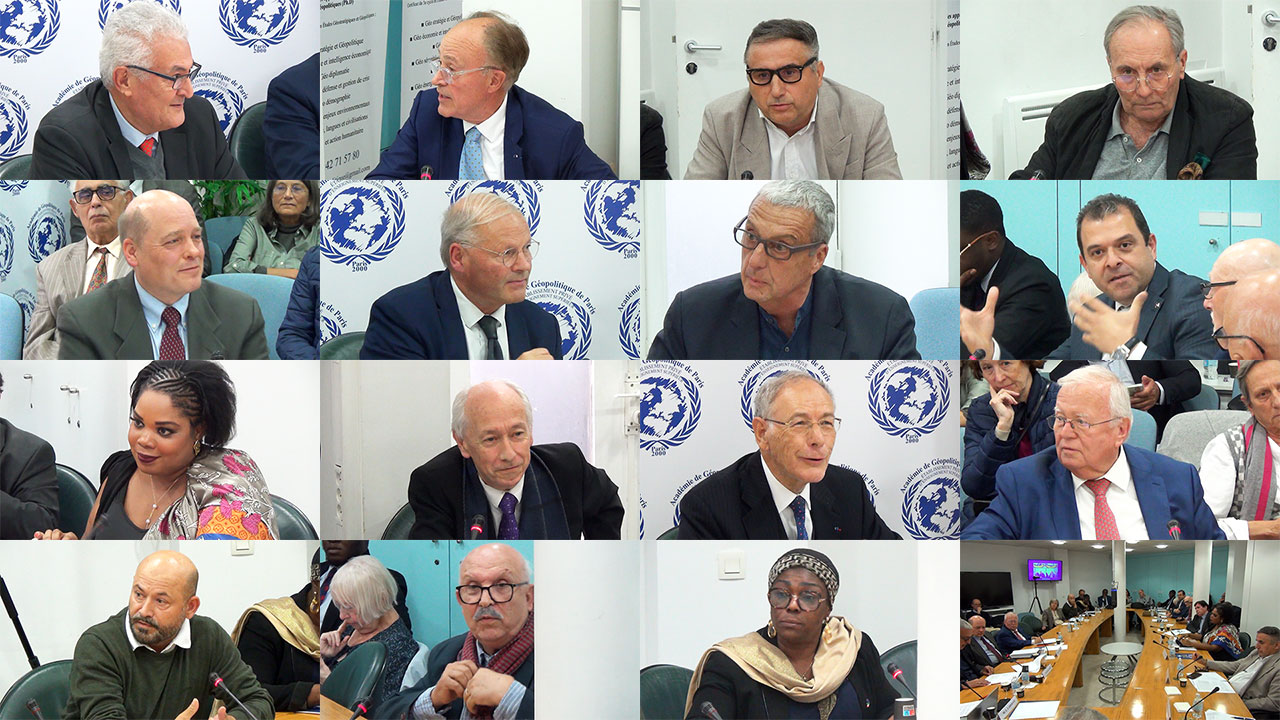
The Scientific Council of the Académie de Géopolitique de Paris (AGP) held on Tuesday 23 September 2025, at 5 rue Conté in Paris, a conference entitled ” What panorama of state-religion relations in the world? ».
The religious question and its involvement in the internal order as well as in the external order of states directly influence the geostrategy of the powers and their role in the global geopolitical game. The aim of this symposium is to offer a panorama of state-religion relations, by confronting the different cultural and spiritual areas: the Orthodox worlds of schism and non-orthodox worlds, the divide between Sunism and Shiism, the evangelical dynamic within Protestantism, and the underground processes of cross-conversion between Muslim and Catholic worlds.
Bringing together specialists and practitioners, this meeting will analyse in depth the fundamental changes in what is increasingly emerging as one of the most critical identity factors in contemporary community reconfiguration. If the permanence of power issues related to the religious strategies of States and institutions were studied, the main focus would be on analysing the substantive developments and their impact on the international scene.
COMPTE-RENDU
Dr. Ali RASTBEEN, President of the Académie de Géopolitique de Paris (AGP),
“The State and religion in a pluralistic world: tensions and recompositions”.
Ladies and gentlemen, the relationship between the state and religion is one of the great sons of the political and social history of humanity. From antiquity, where political power was confused with the sacred, until the contemporary era marked by secularization and debates on secularism, the forms of regulation of the religious have constantly changed. Today, in a world traversed by globalization, migration, the rise of new spirituality and a revival of radicalism, these models inherited from the past are subject to profound recompositions. The central question then is: how to reconcile religious freedom, state neutrality and social cohesion in pluralistic and fragmented societies? To answer this question, the question must first be placed in its historical context.
In ancient times, power was inseparable from the religious: in Egypt, Pharaoh embodied a living divinity and guaranteed cosmic balance; in Rome, the emperor combined political and religious functions as Pontifex Maximus. This fusion of authority and sacrality ensured the legitimacy of the institutions.
The Western Middle Ages developed an organization more nuanced but equally marked by religion. The theory of “two swords”, developed by medieval Christendom, distinguished the spiritual sword of the pope and the temporal sword of the emperor. This distribution reflected a permanent tension between spiritual power and political power, a tension that went through the entire medieval period and fueled many conflicts.
Protestant Reformation in XVIe and the accompanying religious wars constituted a major rupture. Confessional violence highlighted the need for religious tolerance, theorized by John Locke in his famous Tolerance letter (1689). This thought opened the way for a new political organization based on freedom of conscience. The French Revolution completed this evolution by affirming national sovereignty and laying the foundations of modern secularism. The 1905 law, which legally enshrines the separation of churches and the state, becomes a pillar of republican identity. These heritages, far from belonging to the past, continue to structure national identities and fuel contemporary debates on the place of religious in public space.
Looking at contemporary institutional models, three major configurations dominate:
The first is the religious model, embodied by states such as Saudi Arabia or Iran, which base their legitimacy on an official religion. This system ensures symbolic cohesion, but it faces the challenges of internal pluralism and international criticism of human rights.
The second model is that of separation, represented by France and the United States. In France, secularism imposes strict state neutrality, while in the United States, the First Amendment prohibits any state religion but allows a perennial public spirituality.
Finally, the cooperative model, practised in Germany or the United Kingdom, establishes an institutional partnership between the state and the churches. This pragmatic model, which allows for the financing or official recognition of religions, nevertheless raises the question of equity for religious minorities.
Europe is a laboratory revealing this institutional diversity. In Italy, Spain or Portugal, ties with the Catholic Church remain strong despite legal separation. In France and Belgium, secularism is a structural principle, with certain adjustments such as indirect subsidies. In Germany, Austria or Luxembourg, several cults are officially recognized and financed by religious contributions. The United Kingdom and Greece maintain established churches playing a symbolic and political role. Poland and Hungary, for their part, are experiencing a reaffirmation of religious in a political context marked by nationalism. This plurality shows that the regulation of the religious always depends on the historical, cultural and identity trajectories of each society.
But beyond these institutional legacies, new contemporary challenges are emerging. The first challenge is to increase religious diversity, especially in Europe where Islam has become the second religion. This is a reality where there is intense debate about the integration, identity symbols and visibility of Muslim practices in public space. The second challenge relates to the international role of religions. The Vatican, the Organization of Islamic Cooperation and the American Evangelical Churches have a growing influence on world diplomacy. Finally, the third and perhaps most worrying challenge is the politicization and radicalization of the religious. The instrumentalization of fundamentalism – whether Islamist, Christian or Hindu – is a major security threat. Globalization, by promoting “religious relocation”, makes regulation by states even more difficult.
At the same time, Europe is undergoing a profound spiritual transformation. Secularization is widespread but uneven. Catholicism is experiencing a crisis of vocations and a marked decline, traditional Protestantism declines, while the evangelical churches are growing rapidly. Orthodoxy remains important in the eastern part of the continent. Islam is the first non-Christian religion and raises issues of integration. Finally, there is the growing spread of oriental spirituality and individualized forms of religiosity, reflecting a shift from an institutional religion to a plural spirituality, often lived “à la carte”.
Conversely, in regions such as the Middle East, religion remains at the heart of political dynamics. The Iranian revolution of 1979 established an original model where legitimacy rests on the religious. The Israeli-Palestinian conflicts, the Gulf wars and the rise of transnational terrorism – from Al-Qaeda to Daesh – have disrupted regional balance. Radical Islamism, by diverting Islam from its peaceful vocation, has imposed a violent political ideology that has profoundly influenced collective imaginations. The fight against this extremism requires a comprehensive approach combining security, education and intercultural dialogue, in order to avoid the reductive logic of ” clash of civilizations ».
Ultimately, the examination of the relationship between the State and religion in a pluralistic world reveals a complex and ambivalent dynamic. No institutional model – denominational, secular or cooperative – can boast of universality or perfection.
The real challenge of the XXIe It is the management of religious pluralism: guaranteeing freedom of conscience, ensuring political neutrality and preserving social cohesion. In a globalized context marked by mobility, interdependence and radicalization, religion remains an influential transnational actor, carrying collective values and identities. Tocqueville, already in XIXe the century, stressed that religion remains ” the first of the political institutions ” Even today, the way societies can articulate religious freedom and national cohesion will not only determine civil peace but also democratic stability and international balance.
Me Patrick BRUNOT, Advocate at the Court of Appeal of Paris, Auditor of the Institute of Higher Studies of Religious Movements, Member of the Scientific Council of the Academy of Geopolitics of Paris (AGP), « Panorama of religion-state relations in Europe ».
Each country manages the religious according to its culture and identity. Situations remained very diverse in the world except in Europe where Christianity remained very present. It is different in Asia, Africa and America where the history of the religious fact remains very variable. Over the past few decades, religions have become more widespread in Europe, and new relationships between society, State and religion have emerged as a result of profound changes in religion and the growth of certain religious and secular movements.
I – Radioscopy of Church-State reports in Europe:
1 – States or Christianity remains predominant:
a – L’Italie
The Church and the State are separated, but there is strong cooperation and recognition of Catholicism in accordance with the Lateran Accords (1922), which recognized the independence of the State and Vatican City by establishing the Vatican as a state religion. The Concordat was modified in 1984 by removing the mention of Catholicism as a state religion and creating a clearer separation but the State continues to recognize the role of the Catholic Church with indirect funding through a small percentage of income tax allocated to a religious denomination or state for social and cultural actions. Agreements have been signed with other denominations (protesters, Muslims) granting them certain rights, but the Catholic Church enjoys a privileged status.
b – L’Espagne
Relations are based on a principle of secularism but the Catholic Church retains significant influence because of its historical and cultural importance. The 1978 Constitution established a confessional state: the state recognizes the role of the Catholic Church and undertakes to cooperate with it and other denominations. The 1979 agreement with the Holy Siege allows for religious teaching in public schools. The State supports the Catholic Church through a system of financing comparable to the Italian system. The church retains its tax privileges, including tax exemptions for property.
c – Portugal
The regime is that of separation and equality between all religions. The 2004 agreement recognizes the legal personality of the Episcopal Conference and allows the Catholic Church to receive 0.5% of the taxes on the income of its faithful. Registered religions have the right to teach, religion and morals in public schools.
d – L’Allemagne
Both Catholic and Protestant religions are considered to be corporations under public law in the same way as universities. They are financed by a compulsory tax levy. Judaism is also concerned. Islam has no status. There is no official religion, but it is not a secular state. The Leers have relative autonomy in the management of religions and their financing. There is a place of worship in the Bundestag. The ECHR considered the presence of the crucifix in schools to be a religious sign, but there remains a margin of appreciation to the State.
2- Lay States
a – France
The separation between the State and religions is governed by the Law of 1905 which establishes secularism as the fundamental principle of the Republic. The Act guarantees freedom of conscience and ensures the state’s neutrality with regard to religions that prohibit, including public funding of religious denominations and religious display in public places. This secularism has constitutional value but is of variable geometry. Corsica is an illustration of this during the Pope’s journey in 2023, with local elected representatives who participated in the reading of the texts during the Pontifical Mass. The regime of religious chaplains allows the main beliefs to be present in hospitals, high schools, prisons and barracks. The leaders of the major religions are consulted in the social debates (conflict in New Caledonia, Jospin initiative of revision in the Ministry of Interior). The State maintains its main religious buildings. Cultural associations are exempt from taxes, free secondary education is supported.
b – Belgique
The Church and the State are separated, but there is cooperation despite the principle of state neutrality and official recognition of cults. Ministers of recognized religions are paid by the State (Catholic, Protestant, Anglican, Orthodox, Buddhist, Jewish, Muslim, organized lay). Students can choose between religious and non-denominational moral classes.
3 – States without separation of state and churches
a – l’Autriche
The state is neutral, but there is still institutional cooperation. Religious communities are officially recognized and gain legal personality under public law. The 1933 agreement for the Catholic Church provides for special agreements with other religious communities. The Catholic Church provides much of the public services delegated by the State, including education with religious instruction.
b – Luxembourg
The separation between the State and religious communities is effective although several conventions govern cooperation with religious, Israelite, Anglican, Orthodox and Muslim communities. It is a “cooperative secularism”. Financial assistance to religious communities and ministers of worship is steadily decreasing. A value education course replaces in secondary education religious and moral instruction.
c – Royaume-Uni
There is no formal separation because the Anglican Church remains the established church. The monarch is the supreme governor. Bishops (26) sit in the House of Lords. The Prime Minister plays an important role in the appointment of church officials. Other religions enjoy the right of recognition to adapt to religious diversity. Diversity-sensitive religious education is compulsory in public schools. Parents can withdraw their children from this education.
d – Country-Bas
The principle of separation between the State and the churches is respected. The Constitution guarantees freedom of religion and non-discrimination. Freedom of education allows for State-funded schools.
e – Danemark
The Evangelical Church of Luter enjoys state support according to the Constitution. The monarch is required to be a member of this church. The Ministry of Worship manages religions. The faithful have a tax to pay to the State which participates in this financing. Tax advantages are granted to other religions. The teaching of religious diversity is provided for in public secondary schools. Parents may exempt their children from such education, provided that they themselves engage in such education.
f – Hongri
The state must not be associated with any ideology, religious or secular, nor should it be included in the affairs of churches. But there is cooperation with religious communities, particularly in education, health and social services. Only legally recognised churches benefit from public financial assistance.
g – Irlande
The Catholic religion remains predominant despite a separation between the state and the churches. Relations with the State are governed by the principle of neutrality, which does not exclude cooperation in the fields of health education and social services. The churches recognised by the parliament benefit from funding and participation in public interest events.
h – Pologne
Cooperation between the State and the churches is based on mutual respect for autonomy and independence. The Catholic Church has a significant influence in the fields of education and politics. The Constitution guarantees freedom of conscience and religion, allowing religious education in public schools. Relations with other religions are defined by laws based on agreements between the government and representatives of each denomination.
i – Czech Republic
After the spring of Prague (1968) the principle of secularism established relations between the state and the churches. An agreement with the Holy See (2024) strengthens the collaboration between the Catholic Church and the State as conscientious objection, health, confessional secrecy and the civil value of religious marriage.
j – Slovaquie
The 1993 Constitution stipulates that the State is neutral in matters of religion. The financing of churches and religious communities is based on state payments based on the number of church registrations during censuses. A dozen religions are registered in order to guarantee equality of worship vis-à-vis the Catholic Church.
k – Slovenia
The Constitution ensures the separation and neutrality of the State, while recognizing the role of religious communities in society. In addition to the prevailing religion, the Serbian Orthodox Church, the Evangelical Church of Germany and the Church of Norway and the Church of England are present. Religious dialogue is promoted by the State.
l – Lituanie
Separation and religious freedom characterize the relations between the churches and the state with the recognition of tradition. Traditional religions (Roman and Greek Catholic, Protestant, Orthodox, Russian, Jewish, Muslim), recognized religions with a seniority of more than 25 years and recognized religious associations benefit from legal and tax advantages (Law of 1995). The Catholic community accounts for more than two thirds of the population. The teaching of religions at school is provided for, unless the parents object.
m – Suisse
Religions between churches and the state are governed by the cantons. Some recognize the (Berne) and others practice separation (Fribourg) but all cantons maintain relations with the churches, some cantons (Geneva, Neuchâtel) apply strict separation without recognition or funding.
n – Malte
Relations between the State and the Church are closely intertwined according to the constitution. The Catholic church has a duty of moral teaching. Religious education is compulsory. Citizens can practice the religion of their choice. The Catholic Church plays a central role in the life of the country, including the economy.
o – Sweden
The Lutheran church was a state religion until 1990. The separation has been official since 2001. The Church is run by civilians and religious. The Ministry of Culture is responsible for directing religious activities. There are no regulations on wearing veils or religious signs. It is one of the countries in the world with the highest proportion of non-believers. The Muslim presence is relatively large.
p – Turquie
Secularism is a legal mention that is not practical because religion is closely controlled by the State that pays for the imams of official mosques. The state has been a layman since 1923 and Catholicism is considered a foreigner while the country was Christianized very early. There are still only 5,000 Catholics of Latin rite of national origin and all Christians are about 50,000 faithful. Religious education is integrated into the education system in the form of compulsory courses. The content of this teaching focuses mainly on Islam, but it also addresses the historical and doctrinal foundations of other religions.
q – Greece
Relations between the State and the Orthodox Church are characterized by strong historical and institutional proximity. Priests are paid by the State which intervenes in political and social debates. Religious education is compulsory in schools.
II – Spiritual changes in European societies: widespread secularization and wide pluralism:
While the Christian religion remains in the majority in Europe as a whole, other religious and secular movements have been required in recent years. Religious affiliations are decreasing considerably, ways of believing are diversifying and there is a return of religious to the map in extreme forms. Birth, marriage and death continue to mark the stages in the lives of Europeans who respect religious rites without asserting their belief in God. These cultural practices are sometimes secularized, given requests for Republican baptisms, civil marriages, mortuary ceremonies with readings and music.
In recent years there has been a collapse of Christian religions and a rise in strength of Islam, Buddhism and various secular movements. Although it persists to remain an important cultural background, Catholicism is at a severe loss of speed in most European states as well as other Christian religions in general, this situation is accompanied by a clear loss of influence of religions on the state in most European countries with the appearance of new cults.
1: Christianity Seeks New Governance
Catholics
They seek to adapt to contemporary challenges and the expectations of the faithful. The search for more inclusive and participatory participation and wider participation has become a priority in the face of the collapse of religious practice. The integration of lay people, including women, in the management of decision-making processes and at all levels has become widespread both with regard to pastoral needs and the roles of listening and accompaniment. Research for a reform of the priesthood, including the maintenance of celibacy, with increased openness of women in ministries to better adapt governance to the aspirations of the faithful and to the realities of the modern world.
Catholics are most affected by the decline in religious practice, which is limited to baptism to marriage and burials that are also rarer, especially since 1975, or the baptism rate has been halved from 80 to 40% today (see IFOP poll of 2024 for the association of religious journalists AJIR). While 80% of Americans say they believe in God, 50% of Europeans go to Mass.
According to a study by the University of Texas, the 10 countries, in the next few years, which will experience the largest increase in the number of Catholics are in descending order, the Democratic Republic of the Congo, the Philippines, Mexico, Brazil, the United States, Nigeria, Colombia, Argentina, Angola, France is in the 25th century.ème rang.
Various factors explain this change: the deconfessionalisation of the education system, urbanization, the empowerment of morals, the disappearance of the peasantry, social networks, the scandals of paedophilia in the Church, the state ownership of civil society, the disqualification of religion as a source of common values
- Protestantism has different dynamics depending on regions and currents. In the northern countries, a majority of the population identifies traditional Protestantism. But in the countries of the south-central Europe, the world of practitioners is growing well, for example in France from 50,000 in 2010, to 75,000 in 2024 and the number of evangelical places has increased from 2000 to 3000. Immigration and an evangelical approach help explain this trend among Protestants who have self-secularized.
L’orthodoxie
Outside Europe, the East and the South East, which have a high proportion of Orthodox Christians, the countries of Western Europe have a relatively low presence of faithful (about 2%) mainly from countries of Orthodox traditions.
2: Islam became the first non-Christian religion:
The rise of non-Christian religions must be noted. Islam became the second religion in France and the first non-Christian religion in most European countries. The presence of Islam in Europe has seen strong growth in recent decades and projections for 2050 envisage a proportion of Muslims of about 12% of the total European population. This growth results from a young population with a high fertility rate. These populations raise a variety of major challenges that obviously need to be addressed as they progress. First of all, an increasing proportion of Muslims face racism and discrimination in work, housing, education and clothing. To combat these various discriminations, several public and private cultural initiatives have been taken in the field of art and interreligious dialogue, but the integration of Muslim communities into European societies is far from obvious in both the school and the workplace. Although there is no direct link between Islamism and delinquency in Europe, it appears that social exclusion and lack of educational opportunities often lead offenders to Islamism.
3: New religions are growing
Although Buddhism dates back to the sixth century, B.C.E. and Hinduism 2,500 years before Jesus Christ these two religions appeared in Europe only at the beginning of the XXe century.
Buddhism
The interest of several Western intellectuals contributed to the spread of Buddhism in Europe from the middle of the early twentieth century. This religion is practised by about 20 million people in Europe, with significant communities in Italy, Germany, France and the United Kingdom. This religion is characterized by a great adaptation to the European cultural context and to the most diverse personalities, even if there is more “intellectual” than in other religions. It is true that membership in other religions is accepted simultaneously. It is probably this flexibility of membership that allowed Georges Clémenceau, father of secularism, to assert himself Buddhist. Despite the difficulties to recognize, the religious and philosophical depth of this religion, Buddhism continues to grow and adapt.
L’hindouisme
Although present in Europe for several centuries, Hinduism only developed from the twentieth century onwards, mainly because of trade. Hindu communities culminate in almost 1.5 million followers in Europe, the bulk (about 1 million followers) is in the UK. The community is estimated in France at about 40,000 people. This community is well integrated into Europe, despite some anti-Muslim tensions in the UK.
Conclusion
These religions clearly raise issues that have not yet been resolved by Europeans who, for many of them, think they are fighting against Islam by securing Christianity. Some States try to affirm the Christian preponderance and religious freedom of other religions, without achieving it entirely. Europe has never invoked “values” so much, while refusing to reintroduce the religious into public space. The defence of places of worship has become a simple issue of heritage protection. Rural Catholic parishes have become very rare and are often animated by African priests. A consensus on values is difficult to build even though “manife for all” initially appealed to Jews and Muslims, Islamophobia remains the only common point between secularized Catholics and populists.
Bibliographie :
– Jean BAUBEROT, Religions and secularism in the Europe of the Twelve, Paris, Syros 1994.
– Brangère MASSIGNON, Virginie RIVA, Europe with or without God?, Paris, Éd. de l’Atelier, 2010.
– Olivier ROY, Is Europe Christian?, Paris, Le Seuil, 2017.
M. Jure Georges VUJIC, Geopolitician, Director of the Institute of Geopolitics and Strategic Research in Zagreb, Associate Researcher at the Academy of Geopolitics in Paris (AGP), “The Aronian dilemma of the West in the face of the return of secular religions”.
It was in his 1944 article entitled “The Future of Secular Religions”, that Raymond Aron described the various forms and variations of the totalitarianism of modernity as “secular religions”, as dogmatic ideologies and doctrines, which promised the “salvation of humanity”. In the context of increasing instability and the disruption of the liberal international order and the recomposition of neo- empires, there is now a return of the religious in the political sphere throughout the world. Within states as well as on the international scene, this is very well illustrated by the political instrumentalization of Poutinian Russia of an anti-Western Messianic orthodox narrative and by the neo-Trumpian imperial discourse, which is massively supported by the evangelical fundamentalist movements, where the border between political action and religious faith is effaced. Raymond Aron, on the other hand, was concerned in the early 1980s about the weakness of the Western position vis-à-vis the hegemonist ambitions of the Soviet Union, while evoking the “suicidal inclination” of Western Europe, which out of fear and lack of self-confidence, refusing to confront reality, chose to leave history. After about 40 years, these remarks remain relevant in the context of the Russian-Ukrainian war, but also with Trump’s neo-imperial US discourse and China’s will for global power. Secular religions, which return as a boomerang in response to a secularization and disenchantment of the world that the West itself had borne, today constitute powerful levers for both moral and ideological mobilization for political purposes. The West would then face the dilemma of choosing between a desire to revive its narrative identity and civilization, or to disappear, without this moral rearmament.
M. Jean-Michel VERNOCHET, Journalist, writer, political scientist,
” In France, secularism (atheism disguised) is considered the “religion” of the Republic (Vincent Peillon & Cie) ».
Article 18 of the 1948 Universal Declaration of Human Rights can or could constitute the matrix of what we call secularism. In other words, respect for freedom of thought and belief for everyone. Quote: “Everyone has the right to freedom of thought, conscience and religion; This right implies the freedom to change religion or belief and the freedom to manifest one’s religion or belief alone or in common, both in public and in private, through teaching, practices, worship and the fulfilment of rites.”
As for the Constitution of the Fifth Republic adopted in 1958, the first paragraph of Article 1 provides that “France is an indivisible Republic, laïque, democratic and social. It ensures equality before the law of all citizens, regardless of origin, race or religion. It respects all beliefs.” It should be noted that it was not until the Fourth Republic that the mention “secular” appeared in the 1946 Constitution in its “Article 1. France is an indivisible, secular, democratic and social Republic.” Definition used word for word in the 1958 Constitution. All elements of this secularism which the State in principle guarantees.
A principle which thus appears through the founding texts of modern democracy as a guarantee of the freedom of all in their beliefs, ideas and representation of the world. This principle has rightly been interpreted as a duty of the State to maintain the balance between the diversity of opinions, confessions and beliefs that may be contradictory or even antagonistic between them.
It is quite naturally that this duty of impartiality has been translated into collective consciousness by the notion of neutrality : the State in the interests of equality between citizens and the different groups which make up it must maintain equality – we could talk today about parity – between all the components of the social and de facto body place themselves far above differences, differences or even partisan quarrels.
But is this ideal neutrality in fact either effective or respected? Perhaps not quite when the Minister of the Interior, Republican Retailleau, banned the display of Palestinian flags at the very time when France, after forty-three years of procrastination, recognized their existence. Note that Ukrainian or Israeli flags during the hostage crisis had not been the subject of any discussion.
Let us take another example among a hundred in the current events marking the permanence in France of the question of secularism and the intrinsic difficulty of avoiding drifting from theory to practice. Thus, the draft law tabled on the Bureau of the National Assembly by Laurent Wauquiez, president of the Republican Group, aims to ban all speeches and criticisms directed against “the fundamental republican principles” in the first place, including “secularity” and “republican universalism”, or to have any programme that is favourable to “the establishment of a religious order substitute for the secular State” condemned.
We will not discuss the usefulness or opportunity of such a project, however, we note that it seems to be already on the sidelines with the preamble of the present Constitution, namely the Declaration of Human and Citizen Rights of 1789, which states that “No one can be disturbed for his opinions… Articles 10 and 11 “Free communication of thoughts and opinions is one of man’s most precious rights… “
In fact, if such a bill were adopted, the autonomy of consentt of the sovereign people – the principal freedom of an enlightened choice – would be strongly undermined by depriving the national community of access to alternative views or opinions other than those proposed or imposed by the official doxa.
Because the intention of this legislative project illustrates the difficult path when it comes to creating full secularism, and not to prevent possible subversive movements, but to format the minds through censorship and prohibitions… Some even go so far as to speak of cancel culture !
Let us now, in order to better define a concept at the same time precise and vague, a brief return to the historical sources of secularism, i.e. the principle of separation of the Church and the State: the divorce between religious and temporal power, becomes effective in 1905 but in reality is born with the French Revolution…
Moses Dobruška, an ideologist and agitator from Mitteleuropa, arrived in France in 1792 and was immediately naturalized as Junius Frey. Despite or because of his revolutionary ardour he was guillotined on 5 April 1794 with his brother Emmanuel and Danton. Before experiencing this unfortunate end, Frey intends to lay the foundations of the democratic regime by denouncing religious obscurantism faced with the rationalism of the “Enlightenment”. He expressed his ideas in 1793 in an essay entitled “Social philosophy dedicated to the French people”, the doctrinal cradle of the concept of secularism. There is no doubt that his analysis did not find a large audience, so the Jacobine revolution will include the destruction of Catholicism in its agenda.
For at the beginning this is what it is all about: to destroy Catholicism which should be distinguished from “deism”, that of a Robespierre for example with its Cult of Reason !
This objective will then be taken up by all the great theorists of secularism, in the nineteenth century Ferdinand Buisson and still today Jean Baubérot or François Baroin, Vincent Peillon. This Minister of National Education in Jean-Marc Ayrault’s first and second government from 16 May 2012 to 31 March 2014, seeing secularism as a religion in its own right, that of the Republic of…
Ferdinand Buisson, quotes in the strict continuity of revolutionary dogmatism: “To suffer the existence of a religion that shockes principles is also a freedom pushed too far, contrary to law, a licence. It usually slips into the state under the philanthropic mask of the Tolerance who, strictly considered, is herself only a tyrannie which, already stronger than the principles can allow what they would not have granted in their vigour … Religion teaches to die, but not to live: for it, heaven is the whole earth is nothing. Certainly there can be no more dangerous doctrine for society, no one hurts so much the principle of self conservation, in the state of nature and in the social order; yes this religion is a manifest usurpation on the rights of societyAn assassination of principle. The death penalty is, in his true understanding founded in law for such doctors, preachers and interpreters of the word of God”.
Echoing him, appointed minister of 2014 Vincent Peillon in « A religion for the Republic “It undermines the presupposition of neutrality guaranteeing to all freedom of conscience and religion… ” Secularity is positive, not neutral! The secular Republic is not neutral. She’s offensive, conquering. It is all the more so since it is situated in a historical and political field where it knows that it has enemies, that it is contested and fragile, that it is always possible to go back, that neutrality does not exist and is therefore impossible. Secularism, taken in all its facets, is not a confessional neutrality or a juridism, not even a mere tolerance, but a affirmation religieuse, philosophy, politics of great coherence and strength, of great precision too ».
Thus, paradoxically, secularism as such is intended to exclude anything that might contradict it, presented by its religious and dogmatic status, as the expression of a new intolerance.
Going further Minister Peillon will theorize a “secular Theology” joining in this Jean Jaurès – Founder of the newspaper Humanity – for whom, according to him, “secularity was a religion”! From this angle, stinging at Ferdinand Buisson, Peillon considers that “the secular school is not the school from which God has been expelled… Rather, it is an institution where God is everywhere. We must consider students as the bearers of a consciousness that communicates with infinity. Where need for moral instruction in the form of religious education. This expression of secular religion is found in the first report requested by Jules Ferry to set up moral instruction in the school of the Republic.”
To hear these theoreticians who have done and are authoritative, secularism in French lies at the opposite ends of the idea of neutrality, even to define it as a religion in the full meaning of the term. A kind of pantheism with hints New AgeA transcendent atheism if we can risk this oxymore! A religion intended to drive away the Faith historically inherited and cemented from the nation’s identity until the silent contemporary revolution in what is still called there is little public instruction, which has become compulsory since Jules Ferry and officially secular since 1946.
Should we assume that Vincent Peillon’s heterodox vision is totally personal and that hasty conclusions should be avoided? Well, considering the means used today by National Education to disseminate the basic elements of wokism such as the theory of gender under the guise of promoting gender equality – a theory which Mrs Belkacem, appointed in May 2012 Minister of Women’s Rights and spokesman of the government under the presidency of Mr Hollande before in August 2014, to succeed Vincent Peillon in the strict ideological continuity to the post of Minister of National Education, Higher Education and Research in the cabinet of Mr. Valls, posts in which she will work in the name of secularism with a good constancy for the promotion of this new universalist confession that is wokism… While fiercely denying the existence in the media and in the National Assembly of any theory of the genre yet well present at the very heart of the new Indifferent religion !
On the occasion of these brief reminders, we see that the neutrality of the institutions in particular Education It is only a myth that promotes, with billions of euros, an ideology that has all the characteristics of a religion while being an instrument of power and social control in and through the massification/homogenization of opinion. But in no way protect the freedom of thought and conscience that this principle is supposed to protect.
Pr. Ilya PLATOV, Professor of Universities, Director of the Russian Department at INALCO, Member of the Scientific Council of the Academy of Geopolitics of Paris (AGP),
“Secularization and Church-State Relations in Russia”.
This intervention proposes a contextualised reading of a Western concept, “secularisation”, born from the saeculum Augustinian, and discuss its portability in the Russian case. The Russian trajectory is characterized by a Byzantine legacy of “symphony of powers” and, in the 18th century, by the Petrine subordination of the Church (St. Synode), more than a Western separation. In the 20th century, state atheism liquidates the institution without dispelling the sacred: communism functions as a political religion; after 1991, a symbolic reenchantment with the Perestroïka. Today, the State-Church axis often comes under a ” mythe utile (N. Mitrokhine): Religious visibility increases the legitimacy of power, while the Church gains in symbolic capital (restitutions, teaching, chaplaincy). The legislative arsenal remains officially secular but devoting increased visibility/priority to the Orthodox Church while strengthening state control. In the public space, we observe a scenography rather than a catechesis: television series, visibility of temples, monumental projects (Ekaterinburg), etc. Is there a phenomenon of “de-ecularization”, as some researchers seem to suggest? It is clear at the political level that it is much less so in society. At the level of the forms of belief, coexist ” religion minimale (Epstein) – stripped faith, extra-ecclesial – and very committed “virtuoso” minorities; The personal faith of a Navalny, for example, illustrates the existential use of the religious. Thus, Russia does not follow a linear differentiation of spheres, but alternates subordination of the Church and transpositions of the sacred; It remains “sacralisable” in its signs.
Prof. Christophe REVEILLARD, Professor-Researcher in History and International Law (Université Paris IV-Sorbonne), Director of Seminar at the Collège Interarmées de Défense (CID) at the Military School, General Secretary of the AGP,
“The Protestant world, the evangelical dynamic. The Catholic world in the face of its profound changes ».
State religious and political factor
The Protestant world. The Gospel Dynamics
C. Awakening
Religion is with language one of the fundamental components of identity. Religion can be an element of cohesion of national identity (internal geopolitics that most often condition external geopolitics, the flagship work is that of François Thual, Geopolitics of religions. The fragmented god, Paris, Ellipses, 2004). With the end of the cold war and the bipolar order and the erasure of the ideological confrontations of the century, religion becomes again a crucial reading grid in geopolitical analysis, because religion can be used as an instrument of the Realpolitik States for foreign policy purposes.
1/ We are looking at the current of evangelical Protestants. Despite the nuances in the various evangelical movements, there is a similar set of beliefs for movements adhering to the doctrine of the Church of professers (the so-called “new birth”, the personal encounter with Christ and the externality of a profession of faith). Adherence to this doctrine is a common feature in defining an evangelical church, the main ones being anabaptism, baptism and Pentecostalism within a charismatic framework.
They are approaching 700 million members worldwide. They would represent one in four Christians and 3/4 of world Protestantism.
The Evangelicals are an extremely diverse current; inspired by the Protestant Reform movements of the XVIe The evangelical churches make up a varied religious landscape with marked theological and cultural differences. “Mega Churches” (mega churches 2000 members) or even giga Churches (10,000 members), in the independent Churches, evangelical Protestantism offers a multitude of faces.
The foundation of common principles is personal conversion, the centrality of the Bible, the theme of the Cross and the spread of the Gospel message. These doctrines will shape the life of the evangelical Protestant who is one “Newborn” committed. Personal conversion is necessary to become a Christian. Church membership is the result of a profession of faith that follows a personal encounter with Jesus Christ, not an affiliation through birth. The evangelical Protestant is therefore above all a “newborn” who has made in full consciousness the choice to join his Church.
The important element is that the evangelical Protestant must also be a witness who commits himself to spreading the Gospel message. Organized and promoted by the congregation, this voluntarism is reflected in an energetic proselytism that is particularly present in the social field, both locally and internationally. Finally, the evangelical doctrine naturally pushes the believer to conservatisme social which preserves traditional morality. The vast majority of evangelical Protestants therefore adopt a conservative approach to public executives and work on its application using their very rich media system and lobbying among politicians (while organizing its conservative tendency ever better), so voted massively for the Republicans.
As early as 1980, the influence of conservative teleevangelists became a first-rate phenomenon in election campaigns; The most active of them were obviously Bill Graham, Jerry Falwell, Pat Robertson, founder of Christian television channel CBN (CBN) Christian Broadcasting Network, which is an American evangelical Christian television channel whose programmes far exceed the American audience. The head office and the station’s premises are based in the state of Virginia).
But also Jim Bakker, James Robison, or Bill Bright, founder of the Cru missionary organization (Cru, for example, is a Protestant missionary organization, whose purpose is to evangelize and train disciples, but this action and influence is international; Cru is also called Agape in certain European countries, Campus Crusade for Christ ou Campus for Christ in certain Asian and European countries, Great Commission Movements in some African countries, Vida estudiantil in Latin America, Power to change Australia and Canada (Power to Change in Francophone regions). Cru targets students, athletes, and also adult professionals. Its international headquarters are in Orlando, Florida, United States.
2/ What is their distribution?
– Latin America: Approximately 140 million (including 50 in Brazil, 12 in Mexico, 8 in Argentina and 7 in Guatemala)
– North America: 100 million (including 94 United States and 6 in Canada). The traditional Protestant churches are being competed with new churches such as the Evangelicals, Baptists, Pentecostals and those that are increasingly established in Africa and Latin America.
– In Africa 190 million (including 60 in Nigeria, 22 in Kenya, 20 in Ethiopia, 17 in the Congo DRC and Africa). They are mainly charismatic and Pentecostal (and certain prophetic groups from Evangelism);
– Asia 220 million (including 69 in China, 31 in India, 18 in Indonesia, 15 in the Philippines and 11 in South Korea);
Oceania 10 million (including 5 in Australia, 3 in Papua and 2 in New Zealand);
– In Europe 25 million (including 6 in the United Kingdom, 3 in Russia, 3 in Ukraine, 3 in Romania, 3 in Germany) In France (1 million), evangelical Protestantism has been able to attract the disappointments of Catholicism for several years: 72% of neo-protesters were previously Catholics, and 22% were without religion. There is a surge of evangelicals: in France there is a new evangelical church that opens every ten days. Not all will survive, but this reflects the dynamism of the implementation The cult is rather contemporary with a participatory and warm practice, rather multicultural churches, socio-professional categories, generations, provenances. The approval of evangelical sensitivity is 51% among Protestants under the age of 35. (53% of those under 35 say they are “evangelicals”, while 47% say they are Protestants). The evangelical name becomes an identity marker to signify a committed Protestantism, therefore, which shares a number of traits with young culture. It is a personal choice with a less doctrinal practice.
This commitment is accompanied by a high practice, with 49% of evangelicals attending worship at least once a month (and 33% for all Protestants). In the Gospels there is a fit for a form of religious need of the moment, which is to find forms of collective, dynamic expressions.
The influence and geopolitical action of the Evangelists
Evangelicals are experiencing an increase in the number of the most dynamic practitioners in the world today. There is a power of attraction and influence of evangelical Protestantism in the contemporary world in a society that is very critical of the religious. Thus, a quarter of the current Protestants were not at birth; Thus a dynamic of religious growth from the evangelical circles is confirmed.
This multipolar “conversion Christianity” has considerable geopolitical weight, A dynamic of fervent and solidarity-based communities whose Lutheran-reformed churches cannot withstand comparison and consequently suffer a decrease in their proportion and number of Protestants.
The Evangelical Churches are therefore a Church of confessors of deterritorialized churches where there is no parish logic; There are so-called national Protestant churches directly linked to the state a few years ago, as in Switzerland, state churches and the so-called free evangelical movement, free of state ties, like evangelists everywhere other than in the United States. Previously Protestantism appeared since the creation of the U.S., as an authentic factor of American identity, because being the exclusive preserve of white, Anglo-Saxon, Protestant settlers until the middle of the XXe century. But in the U.S., what turned the evangelical church is a cultural issue, the impression that culture escapes it. The evangelical movement has turned into a political commitment to defend the Christian cultural identity that is at the foundation of the United States. The latest US election since Jimmy Carter first president to declare himself Christian trend ” Renaissance » (« born again ) and Baptist deacon, up to Donald Trump’s, highlighted the decisive role of evangelicals in the American political landscape. Since the 1980s, this group, which represents a solid basis for the Republican Party, has been strongly mobilized in favour of conservative candidates. In 2024, more than 80% of white evangelicals voted for Trump, despite controversy over topics such as abortion. This religious bloc, historically influenced by the “moral majority” (” moral majority It considers that preserving family and moral values in an increasingly fragmented society is a priority. The politicization of the Evangelicals in the US is both the fear of losing cultural control and therefore they try by law and policy to impose a number of values, mainly moral, and on the other hand the concern to keep the homogeneity of the group, notably through the political fight over education, cultural war (Cultureworld) ; This climax of cultural war is linked with the progression of their influence on the political environment. Moral majority, Christian right, fundamental evangelism; conservatives for the dissemination of values but without taxation and conservatives for the imposition of these values through institutionalization. The changeover began in the 1970s. It is a religious movement that played a role in regulating moral norms in American society that will radicalize itself; relationship of cultural domination, hegemony on the basis of theological motif (common grace created order participating in individual grace; articulation of creation and grace). From neo-reformed political theology to a kind of charismatic Messianization, a spiritual fight rather Pentecostal or neo-Pentecostalist. This trend will project internationally with an obvious strike force.
D’abord, lEvangelical Christian churches and the NGOs they support are developing an international humanitarian entrepreneurship whose policies increasingly take into account, and in particular successive American administrations by integrating them into their policy of more or less discreet influence within their mix of organs and NGOs.
In order for the force of strike in terms of influence to be the most powerful, a certain grouping of structures has been carried out and allows for standardization not of rites but of methods of infiltration of the most important institutions, of influence, of lobbying etc. There is thus the Global Evangelical Alliance or AEM (World Evangelical Alliance (WEA), which is an inter-named worldwide organization of evangelical and Protestant Christian churches, comprising 143 national alliances of churches, 104 member associations and 6 commissions. It is the largest international organization of evangelical and Protestant churches. It is based in Deerfield, Illinois, United States. Despite the great ability to give coherence to its action, to standardize a strategy of influence at the international level, this organization obviously does not include all evangelical Christian churches; There is also the World Baptist Alliance, etc.
This has led to the development of joint themes for the construction of a set of strategic themes of the Atlantic institutions such as the promotion of
– Christian Zionism, i.e. a Christian Messianist interpretation of Zionism;
– economic liberalism as the most natural system of trade organization
– etc.
The reverse is indicative of today’s dynamics for tomorrow. While the promotion of more and more politicians around the world to declare themselves evangelical Christians, such as examples taken by continent to follow, highlights the focus of the past thirty years on the part of American tutors, particularly in Africa, the current conversion trends mentioned above reveal the targets for the future (China, India, Indonesia, etc.).
* in the United States for example, former Secretary of State Mike Pompeo, former Vice President Mike Pence,
* In Canada, Baptist pastor William Aberhart, former Premier of Alberta, and Baptist pastor Tommy Douglas, Premier of Saskatchewan, then first federal leader of the New Democratic Party,
* in Haiti, Baptist pastor Jean Chavannes Jeune, vice-president from 1988 to 1989.
* In Latin America, since the 1990s, parliamentary groups and political parties have been founded by evangelicals. The support of the evangelical churches is particularly sought by the aspirants of conservative parties for the presidency of countries that increasingly rely on the evangelical electorate to win the elections. In Brazil, there is an Evangelical Parliamentary Front to bring together the evangelical parliamentarians of any Brazilian political party. Many pastors have invested in the political field ranging from town hall, to parliament, to the Senate.
* In Africa, the Baptist deacon Faustin-Archange Touadera, Prime Minister of the Central African Republic, then President of the Republic from 2016, also founder of the United Hearts Movement. Pentecostal theologian Lazarus Chakwera President of Malawi in 2020; Baptist pastor William Richard Tolbert, vice-president of Liberia, then president; Baptist deacon Joseph Boakai, candidate of the Unity Party, former vice-president of Liberia and then president in 2024;
* In Korea, Baptist evangelist Hwang Kyo-ahn, Prime Minister of South Korea, then Acting President in 2017.
This network, which is very incompletely mentioned and far from exhaustive, demonstrates the remarkable capacity of the evangelist phenomenon to impose cultural and strategic themes and programmes of which origin is found in Washington.
S.E.M. Emmanuel GOÛT, Ambassador (*), international consultant and strategist (*), personal intervention: « Spirituality and Temporality in the face of geopolitical challenges ».
The central theme states and religions led me to present a reflection on “Spirituality and Temporality in the face of geopolitical challenges”
But before I begin, I would like to make a clarification now usual as far as I am concerned, with those who quickly stick labels to you while you are participating in a seminar or on a TV radio set etc….participation is not always an adherence to an editorial line, it is a contribution to an adversarial debate, too often excluded from mainstream environments, with good hearers salvation!
Spirituality and Temporality in the face of geopolitical challenges…, I said, yesterday and today.
As a first step, I will start by looking at Pope Francis’ gaze on two major contemporary crises, crises seen, lived, suffered in order to highlight an ununderstood spirituality that is imposed on temporality, then we will go over some examples of prevailing temporalities in geopoliticals before seeing how they try to impose themselves in the texts or analyses of experts of all kinds to return to the interpretation, in this context, of the succession of Leon XIV to Francis.
Introduction
As an introduction, an introduction under the tone of the lightness of the stakes, I will quote the author of the Rabbi’s Cat, Joann Sfar, who made his own, adapting it in our time a declaration by Clemenceau: ” It’s the one with the longest beard »!
This is indeed a first interpretation of the world around us, we observe Orthodox Jews, Russian or Ukrainian Orthodox, Islamist Muslims, evangelists, Protestants… in relation to the main conflicts in progress.
The Gott mit uns, In God we trust, God save the QueenPresident Trump recently spoke of the “return of God” … are to the liking of the day, he goes there first of all of a grip of the religious by politics and institutions, but where the damage is caused, is when the religious authorities associate themselves with politics, conditions it out of measure, doubtless thinking their approach in the name of a concept of temporality, of belonging to a world, to its reality.
The drifts rely on identifiable human components in all monotheistic or similar religions, which come to theorize extremism as well as the development of Pierre Conesa in his book With God we don’t argue ? No monotheistic religion, any continent, escapes from this indifferent percentage of believers convinced to hold a truth and to have to impose it or defend it in all circumstances and by all means, often in radical contradiction with the nature of the texts and traditions that serve each of these religious communities.
But let us return to what I do not hesitate to describe as a rupture of Pope Francis with the temporal dominance of his predecessors.
Very quickly, with the writing of this presentation, the images of Roland Joffé’s film were combined ” the Mission In 1986, an example of a confrontation between a repentant guided spiritually by a group of Jesuits in front of a Catholic church as temporal as cynical.
As we will see, this spiritual dimension of Pope Francis was not always easy to metabolize for the faithful of a church conditioned by the challenges of everyday life. But let us address the two issues raised: the war in Ukraine and the question of migrants.
Let us clarify the origins of today’s conversation but also and above all the questions that I found myself asking myself; to the origins of the privileged links and works of Pope Francis with the president of the association of old believers, Leonid Sevastianov, quickly presented as the pope’s personal ambassador to Russia, whom I attended as a personal friend.
I was gradually discovering the importance of a pope from and representing a multipolar world. Very quickly the dimension and spiritual approach of the Pope were affirmed in the eyes of papalities who suffered or chose not to take over the temporality: Benedict XVI, great theologian, John Paul II, historico-political pope, John Paul the first victim of temporality, and Paul VI, the pope of the Council.
Pope Francis
Pope Francis has regularly spoken on international issues such as war in Ukraine or migration flows. I took these two examples even though the pope was obviously spiritually on all the fronts and stakes of our world, but these two examples illustrate the divisions within the Catholic community, generated by the failure to understand its spiritual dimension.
a) Ukraine
Let us take Ukraine, too often the positions taken in favour of peace were interpreted as a allegiance to the Russians, yet, let us recall, during a period when the only mention of peace was associated on both sides with a form of traitorry. Let us also remember the outcry raised by the evocation of a white flag whose interpretation was that of the Hollywood capitulation while its original meaning was an invitation to dialogue, to talk! (Remember the movie Joyeux Noel Christian Carrion in 2005)
On various occasions Francis was able to draw the lightnings of the Ukrainian and Russian Orthodox churches, which by their respective positions seem to have resolutely forgotten the spiritual foundations of their existence implicating themselves in an exacerbated bellicose temporality. As such, the old believers born of a “Raskol” schism with the Orthodox Church in 1666, promoted by Avvakum (Pierre Pascal Avvakum and the beginnings of the Raskol) in rupture with the rapprochement between the Orthodox Patriarch Nikon and the Tsar Peter the Great, have never been confused, never showing themselves side by side or in support of the belligerents. This is probably what could also have irritated Patriarch Kirill, beyond the personal ties between the Pope and the president of the association of old believers.
b) Migrants
On the issue of migrants, those who saw this Jesuit pope as a salvation for the church could also tear themselves apart because, while it is undeniable that migration issues become cultural, geopolitical and civilizational stakes, it is equally true that spirituality must lead to respect for these populations, and their sufferings, without disregarding for example the fact that South American migration to the USA is predominantly Catholic while migration to Europe is predominantly Muslim. The message of the Gospels is unambiguous and it is the pope’s spiritual duty to express his understanding and support, while temporality and the decisions that can accompany it should be exclusively the responsibility of the political powers in place.
The angle of approach of Pope Francis rests much more on a perspective, it is resolutely to put at the center of reflection and prayers the dimension of the spiritual heritage of Christianity, which has constantly confronted itself over the centuries with conflicts, struggles, rivalries, war of powers up to the walls of the Vatican. And when all this could have started if not since the consecration of the temporality of the church that can be located in the IVe When Emperor Constantine granted Pope Sylvestre an independent territory over which he became sovereign, the future Vatican.
If Vatican II was able to reflect on the correlation between the notion of an independent sovereign pope and that of a patriarch, responsible for the values of the Catholic Church, it will be necessary to wait for Pope Francis to observe clearly the daily quest for spirituality, both in the organization of his daily life in the Vatican and in the struggles he will continue during his mission. Perhaps a little easily one could see two obediences of Spanish origin engaged in internal struggles of power: Opus Dei whose two predecessors were close, and he the Jesuit. If we were not afraid of falling into the temporality of the exercise, a settlement of accounts between Ignace de Loyola and Josémaria Escriva. A visit to the graves of these two spiritual masters, both in Rome, can serve as an indicator. Francis must have felt very alone in waging this fight against a dominant temporality within confessions with major, direct and indirect implications in many conflicts.
The temporality of the world’s stakes brings us back to Ukraine,
a) Russie Ukraine : We’ve already talked about it. Tensions between representatives of Ukrainian churches, already partly naturally in conflict with the Moscow Patriarchate for example Orthodox Church of Ukraine in 2019 or the Uniates (Greco-Catholic of Ukraine born after the Brest Union 1596) have only increased. Even recently the bishop of Kharkiv Pavlo Honcharuk declared ” Putin will not stop, we must stop him! and always with this paranoid dimension ” after that will be Romania and Moldova “… The Patriarch of Russia is sadly not left behind, having repeatedly associated himself with the conflict in the name of a supposed guerre sainte !
Personally, however, I do not grant any religious matrix to the conflict, contrary to what Boussois and Morin defend in “ Putin’s Holy War ” We are therefore in the very essence of warrior temporality, on both sides, where the respective churches are complicit, accentuating an ambient manicheism, leaving little room for discernment, listening, and diplomacy.
Mais aussi
(b) Israel, Palestine, Iran and the world: the quintessence of the religious geopolitical conflict, but here the risk is important to look at this region of the world as much as to the ambient manicheism is associated with the risk of being quickly called anti-Semitism in case of criticism to the State of Israel. Therefore, I will not go into this question more than just a few flashes, clues or lines of thought.
An Islamic State Iran denies the existence of an Israeli state (not its population, which is increasingly difficult to interpret) as Israel does everything to be a Hebrew state under pressure from an extreme religious right depending on a Palestine whose existence as a state, supported in the front line by Iran, is clearly undermined by Western hypocrisy for decades combined with a certain withdrawal from Arab countries, which the recent news does not really correct (but it would be improvised almost little prince: Draw me two states?). Many theologians and politicians, on the margins of Herzl’s Zionist movement, have considered the possible consequences of the birth of the State of Israel on the Jewish mysticism experienced by the Sefarad and Ashkenazi diasporas. For the birth of the state would eventually confront it with the realities of the world and its possible cynicism, as illustrated by the tragic news. From there to make a link between the birth of the Vatican and the birth of Israel, the resulting de-spiritualization, there is only one step, which I am taking.
c) Irak : We are witnessing for the autumn of this year, in the framework of the parliamentary elections, an extension of the war Iran Iraq, Shiites/Sunnis that lives the Americans first in support of the Sunnis of Saddam Hussein later turn against him and consequently also the Sunni population … but as a saying Arab, sIf two wolves fighting see a fox passing, they start to courir behind the fox… since the withdrawal of the Americans from Iraq, one of the few beliefs shared by the vast majority is a mistrust, to see hatred of the Americans. The elections will therefore enshrine the importance of the two currents which pass mainly through Islam in a balance of power conditioned by the role of the main Sunni and Shiite states.
d) Armenia: recently the Pashinyan government, as part of the game of influences on this region drawn for more than a century, between the overcoming of memory with its Turkish neighbour until the conflict with its other neighbour of Azerbaijan, attacked the church which represents a sovereignist and conservative political influence; This definition of the Armenian church alone is a capitulation to the temporal power of its church, maintained by a great deal of support in the Armenian diaspora.
e) Oltre Tevere :in France, this concept escapes us completely; you must have lived in Rome and have taken an interest in Italian politics to understand what ” oltre tevere, outre Tibre » peut vouloir signifier. Outre TibreIt is the Vatican and all its power in the conditioning of the great laws of Italian society such as divorce, abortion, today euthanasia but also more common laws. In Rome, the chambers and parliamentarians all the time question the thought of outre tevere on a particular law. Timeliness every day.
Spirituality therefore resolutely harmed
Even if it tries to equip itself with institutional instruments such as the community of Sant-Egidio or,
a) The Stockholm conference. But if the key moment of the ecumenical movement – the first conference in Stockholm – the Christian churches for peace – earned its initiator Nathan Söderblom the Nobel Peace Prize in 1930, it is clear that the recent Stockholm conference, in August 2025, is only under photographic appearances an observation of one-off and conceptual failure, because the Christian churches whose countries are in conflict simply did not take part.
(b) but the recovery work is permanent as in the use of the principle of Christian Judeo-Christian civilization:
Expression of the Reciprocal temporality, conjunction of politics and the religious, the desire to register the Jewish-Christian roots in the European Constitution. I saw there, from the beginning of this attempt to integrate into European fundamental texts, an omission, a denial, almost a negationism, let us not be afraid of the words, whole parts of our European history: the contribution of the pagan Celtic, Scandinavian, Etruscan, Greek, Roman and also Islam heritages that have been caught in the trap! A pure will illustrates the recovery of the religious by politics, in this cynical game of going and coming between these two major expressions of temporal power.
This not to mention Sophie Bessis’ interpretation in ” anatomie d’une imposture Who goes so far as to deny the very existence of a Christian Judeo civilization that would be only an arbitrary Western reduction, questioning what the author denounces as a geographical schism with Latin America, Africa, Catholic Asia? But also, she explains, an amalgam to veil a latent anti-semitism in the history of Europe, trying to overcome, by the “Judeo-Christian” syntax, a theological anti-Judaism, as Catholic as well as Orthodox as Lutheran! While paradoxically it reiterates the correlation between the Arab and Hebrew worlds, resolutely more natural.
Islam and Christianity were opposed in their universal vocation, the Greco-Latin world (I would enlarge into the pagan world) was exported only by political and non-religious motivations, and while Judaism presented itself as an elected people, Christianity associated with empires from the IV.e A century is much more in temporal power, imposing itself on a fundamentally European polytheism while monotheism is part of a more oriental matrix.
There is therefore the triumph of religious temporalism over geopolitics.
Geopolitics is therefore one of the major expressions of a temporality deprived of all spirituality; concerns are legitimate for non-believers because the recovery by humanity and states the component of religious repositories, not to say too often of blessings to fighting, or even justifications, can only bring to ever more manicene visions where resistance and terrorism, well and evil are only the two sides of the same medals.
We can also find in « Geopolitics of Christianity Chélini-Pont and Liogier recall the importance of religious fact in transnational geopolitics. Abraham’s recent agreements appear to be a topical extension of their analyses.
There we go back to the genesis of an emerging monotheistic world, indifferent to political questions and the founding remains of a polytheistic world, multiform in its essence, the evolutions of orthodoxy, a Protestantism “camped in a geopolitics of confessionsThe Holy See at the time of the collapse of communism, of the explosion of Christianity in Africa, Latin America and Asia, to question a return to the temporal religious paradoxically at the expense of the spiritual religious. In a more societal form the ability to respond ” the individual request of transcendence and the collective demand for social purpose today geopolitical. Aren’t schisms as many failures of the spiritual vis-à-vis the temporal?
First points of conclusion
Before addressing my conclusion, I would like to mention here that during meetings in Algeria with Sufist communities, in El Oued in particular, and while my Algerian interlocutor remembered, not without emotion, his French teacher Monsieur Cartier in 1954, we had the opportunity to evoke the reflection of Abd El Kader, in ” Spiritual Writings » on the One-sided and separative visions, which present structural analogies with the projections of spiritual (divine unity) and temporal (multiplicity of the world), far from the cartoons of Islam with which many of our leaders and media try to associate.
Time also prevails in the media construction of references: Jean François Colosimo, author of several books on contemporary changes of religious fact is now presented as an expert of Russia and international relations: what is recalled here is not a question of his competences, even if they are now dictated by his conclusions – which opposes him to the behavior that should be that of an analyst or researcher – but that the angle of approach upstream is the religious, which he claims in the title of his book ” the crucifixion of Ukraine, a thousand years of religious wars in Europe », paradoxically bringing solid arguments to the journey to which I am trying to invite you today through this reflection, hence the resulting need to return to the Word and the spiritual as Pope Francis also invited us in his ” Apostolic Letter on Pascal ».
Conclusion
In this XXIe century that Malraux anticipated as ” spirituel ou ne sera pas » to some reflections of Gilles Kepel « God’s revenge “, we see returns to religion, assimilable to the quest for lost or endangered identities, victims of decades The European Union’s contribution to the development of a global economy is logically associated with communitarian ambitions against weight.
It is in this context that prudence is required, because the identity found by religion automatically projects it into a temporal world, far from the revelation of faith which is a matter of spirituality. Francis, in his exchanges, in his texts, in his choices of pontificate, made very few concessions to the temporal and inscribed it as a will to offer the world the exemplaryness of the spiritual as a solution to the stakes of the world. Perhaps he matured this approach when he was confronted with the dictatorship in Argentina as evoked by the film The two Popes by Fernando Meirelles, who traces in fiction the exchanges between Benedict XVI and Francis.
His death seems written in line with his spirituality, an Easter Monday. So how to try to interpret the succession of Leo XIV to Francis.
Leon XIV a short vote, a historical majority: the plan of Francis? Francis repeated it several times, the universal Christian moral values are at stake. He had to ensure a Vatican more than ever to listen to a multipolar world, capable of being heard by the whole community and which better than an American pope to pursue and develop the mission designed by Francis…
Francis, Bishop of Rome, had a vision for Rome, making it a city of peace, an open city, undoubtedly in relation to the prayers of Our Lady of Fatima, who, among other things, recalled ” Russia is a particular country through which Christianity must be revived ” He knew that it would have been difficult to promote, in Catholic, peace between two Orthodox countries, but this passing of Rome could have created more favourable conditions; Did not Leo XIV as soon as he arrived put the Vatican at the center of possible exchanges, while giving reassuring signs to whom might appear antagonistic to Francis’ orientations, such as Opus Dei.
If I were to describe the link between the two bishops of Rome, I would say “scalable continuity” undoubtedly envisaged during his lifetime by Francis. How can we imagine another purpose when we know the spiritual matrices of each other: two of the main icons of Catholicism, Saint Augustine and Saint Francis. Both, seven centuries away, have personal journeys that lead them to the conversion and search of God. Then established a relationship centered on spirituality, for the first the love of God and neighbor are inseparable, for the second each creature is a reflection of divine love, and if the first theorizes it while remaining part of the world, the second lives it, opting for homelessness, but they unite in the forms given to prayer. These are extremely strong conditionings, but it is too early to appreciate how Leo will meet the challenges of the world, whether he will opt for the upstream spiritual vocation that dialogues or whether he will yield to the ambitions of temporal power by de facto betraying his spiritual guide. May the hypothesis of a journey on the lands of origin of Saint Augustine, Algeria, serve as a consolidation to his evangelical mission.
Truly, Lord, ” Your kingdom is definitely not of this world ».
S.E.M. Safwat IBRAGHITH, Ambassador of the Permanent Delegation of the State of Palestine to UNESCO, following the recognition of Palestine by France
Mr President, ladies and gentlemen, I am first of all and as usual fascinated by this magnificent garden of presentations and opinions on subjects that are always well-targeted and directly related to the current situation. I am quite impressed by the various interventions and the brilliant personalities who have fully defended their position, each with relevant arguments. Coming here for such a subject, since I am a politician at the base, but I also studied theology and I was part of the members and institutions of interreligious dialogue and it is necessary that we manage to deconstruct this knot that binds the earth to the divine, the problem of the state and religions.
There are many nuances. The religious state, believing, secular, atheist, liberal, modern, but also traditional, conservative… All these vocabularies occur in our daily lives, in our diverse societies, in our international relations, and I would like to join the opinion of His Excellency Ambassador Emmanuel Taste, whom I warmly greet, as well as his brilliant presentation. Indeed, geopolitics is dictated by the religious. This is my conviction, which I would like to share aloud here.
In our region, the Middle East, Palestine, Israel, all conflicts are due there. And unfortunately there is also a story of problems of recognition of the other. Before talking about the Israeli recognition of a state of Palestine, we also talk about problems of recognition of Judaism, on the part of the Jewish brothers, their Christian brothers, the Old Testament and the New Testament. For Jews, Jesus never came, and we do not speak of Islam, the prophet Muhammad is considered by each other as a reformer. So sacred quality is not necessarily egalitarian between the three monotheistic religions, which means that there is a monopoly of truth, on the one hand, a problem of interpreting religious texts, and that is in my view the reason why the problem is quickly exploited, and that the compass is quickly diverted from reality.
These are my very quick impressions of the content of this conference. It was believed that extremism was exclusively limited to Muslims, or to the Islamic world, but we have indeed understood very well, by Mr Dumont, how paradoxical changes are taking place and how much conflict exists between the drifts of the same religion.
So the question is who dominates who? Politicians dominate religions, or is it the religious who dominate, who decide for the world? Taking the American example, because in your summary you spoke of a secular state, and you gave the example of France, which is right, and also the United States of America which, in my view, are in another category. For me, the United States can be defined as a religious state. And we have understood very well the composition of this lobby which dominates the Congress in American elections, which dictates certain policies, even to the person of the President.
We were talking about Christian Zionism. Christian Zionism is no longer a secret phenomenon. It is something that perfectly illustrates the Judeo-Evangelist alliance. The Jew in the United States today does not represent more than 3% of the American electorate, but it is the evangelists, quite convinced of a precondition, for Jesus to return to Earth (since for them he has already come, and the Jews do not believe that Jesus has come), who is that Israel must be established as a purely Jewish state. Then, afterward, Jesus arrives and everyone converts to the religion of Jesus, for the master is there, has descended. So finally, the evangelists and the Jews do not necessarily recognize each other, it is not the same doctrine, but there is a doctrinal alliance around the same interests and purpose, which means that the Palestinians pay the price of this American vet, because this too is a demonstration of strength, while the whole world sees that everything that passes through the Security Council, of 14 members, which must nevertheless be the guarantor of international peace and security, everything that passes through this body is blocked, all the time, by the American veto. When it comes to Israel, there is nothing we can do, we must bypass the scenes to finally settle for a decision adopted by the General Assembly. This does not justify, but at least explains that the State of Palestine is still struggling to find its place, normally, sovereignly, in an egalitarian manner with all the other nations of the world.
Palestine is not a country that is a surplus of the map, but a country that lacks the map. It has been 77 years since the project of partition of Palestine, which was an unjust project, but which is the only reason on which Israel was proclaimed. This is the only legal reason Israel can become a member of the UN. And I must perhaps recall that Israel is the only country in the world, in this international community, which has acceded to a particular agreement, the Lausanne Agreement of 1949, which sets two conditions for Israel to be admitted as a member of the UN.
The first condition, its acceptance of the application of the division, i.e. within those borders proposed by Britain in its capacity as proxy power, i.e. about 56 per cent of historical Palestine in the Jewish State, and the rest (44 per cent) in the Palestinian Arab State, and less than 1 per cent under international tutelage, representing the Jerusalem-Bethleem region, a sacred Christian, Muslim, Jewish place, heritage for the three monotheistic religions.
The second condition was to accept the return of Palestinian refugees to their homeland (about 1 million deportees from the Nakba, first tragedy). And so I believe that when Mr. Truman was presented with the project of the recognition of Israel, he was offered the text and he barred the word “Jewish” (and the text we read, it is in the archives) and put “State of Israel”, not “Jewish”. The Americans are Israel’s first allies, but at that time they were not their first allies, although they were the first to recognize Israel as a member (and half an hour later it was the USSR), they did not want Israel to be admitted as a religious state, because normally in the international community the criteria of a state must conform to the ground criteria. No one recognizes Saudi Arabia as a Sunni country, or the Vatican as a Catholic country, or Germany as a Protestant state, or Iran as a Shiite state, or India as a Hindu state, etc. States therefore propose themselves according to the United Nations declaration and pact. One accepts or does not accept, and after each State is free to define itself with its criteria, with its identity, but this does not concern international relations. That is why Mr. Truman put this trait on the word “Jewish” from the beginning.
The problem has not changed much. The problem requires theologians, not politicians. Because international law is completely absent, unimplemented, because finally the master of the world, the world’s first power, allied to both Israel on a doctrinal basis, a purely religious but cynical alliance. So everyone today… and in the first place our Palestinian people in Gaza, destroyed, destroyed, in the face of this war, this genocidal machine. Why? Because the Americans didn’t put any pressure, at least, to stop this war. Trump leads the talks to free the hostages, he gives the Israeli army the green light to go to the end. All humanity is in one basket, Americans and Israel in another basket.
This is the complex, this is the reflection and the repercussions of this magnificent dialogue, but in taking the American case, we understand easily and directly the complexity and sensitivity of this conflict that is happening elsewhere, on a small piece of territory, but whose author is well supported, and that is why Israel and its policies act with impunity, because whatever happens, “we don’t care about others, we have the Americans”… They alone can have the last word about this region. The Middle East region has belonged to the Americans since 1945, the end of World War II. And it was one of the proper divisions between the five great powers. The Americans have this lot, China has its area of the China Sea, Russia (the USSR at the time) Eastern Europe and some plots, we try to intercept but finally there is a rule of the game between the five great ones, we also talk about France, with its former colonies in Africa, and Britain. So today Christian Zionism is the problem. The doctrinal alliance based on Bible accounts, is a problem, is our problem in Palestine. We are victims of this belief and conviction.
Finally, secularism is a mode of political-societal governance, but freedom is a universal value. We in Palestine cannot develop a tailor-made mode of governance, like the French model, or the German example. It is a believing people, but it is a pluralistic people, who also have in their genes the living-together, perfectly experienced between all the religious and racial components that make and forge the unity and character of this Palestinian people.
Mme. Julienne MORISSEAU, Regional Representative Africa Club Creator Committee, Zonta International, President Zonta Club Paris Port-Royal (2017-2022)
“Women, State and Religions: between freedom, equality and submission”.
Mr President, Ambassadors, ladies and gentlemen, I am Julienne Morisseau, I represent the Zonta International, which is an American service club, so like the Rotary club, like the Lions club, for the Africa zone. The subject I have chosen to address is women: ” Women, State and Religions: between freedom, equality and submission ».
If the constitutionality block lays down the principle of equality of human rights, since women’s rights are an integral part of human rights, the State guarantees the Constitution. Monotheistic religious traditions, imbued with a strong patriarchal culture, legitimize and normalize gender inequalities. Religious inheritances seal the principle of the inferiority of women, gender stereotypes, by valuing the virtues of godly, submissive women, while placing on a pedestal the first sex, the male sex. Monotheistic religions set out precepts that lock roles, control female bodies and behaviours. These religions rob women of all freedom. It is interesting to understand how the State, as a guarantor of freedoms, achieves a fair balance between respect for human rights and equal rights for women, as well as respect for religious freedom, while emphasizing the principle of secularism. As a reminder, as my neighbour had said, in France the separation of churches and the state was adopted on 9 December 1905, which establishes secularism, which guarantees freedom of conscience, while prohibiting public financing of cults.
Religion cannot under any circumstances be used as a pretext or justification for limiting human and universal rights, especially of women. In this context, women rogue between freedom, dearly claimed, constitutional equality, and often subconscious, internalized or imposed submission. The subject remains perplexed, complex, thorny, because submission can be the result of a voluntarily assumed choice, or the result of internalization of constraint, because State and religious system make two blocks, which (…) women’s daily life, sketches of freedom, equality, submission. It is also curious to see how the masculine interpretations of the so-called sacred religious texts govern the woman, the apparates, their toilet, I can take as an example the strict dress codes imposed by certain religions, the wearing of veils and others, the control of the woman’s body with the prohibition of the abortion in case of rape, the sacralization of the woman due to her status as a virgin, virginity, purity, marriage, these biased interpretations, gendered, sacred scriptures, lead to serious drifts at the expense of the woman, to the use of violence, sometimes, to establish male domination over the weak sex. In extreme cases, but not marginal, female genital mutilation, in some cultures, supported by religion, at least by male biased interpretation.
That said, it is important to clarify that religious sacred texts reflect their time, since it is only necessary to conceal the notion of equality between men and women is very recent. The first declaration of the rights of women citizens, thanks to Olympe de Gouges, dates from 1791, hence from the French Revolution. Today, we are witnessing a growing movement of female reinterpretation of sacred texts, what is called theological feminism, which seeks to restore meaning, a central and equal place for women in religious traditions. Certainly, attitudes are changing, but slowly, facing resistance to change. The place of women in religions is very different according to cultural context, interpretations of sacred texts and social and political evolution. There is therefore a constant tension between traditional values and modern demands on women’s rights, each religion has its internal dynamics.
With regard to the cultural context, we note that women occupy a central place, and are venerated in traditional indigenous religions, where they evoke fertility, land and ancestral wisdom. In Amazonia, South America, in several Amerindian cultures, women play a crucial role in community management and in rites of passage. They are often like holders of wisdom, and guardians of family, secrets and nature. In Africa, within traditional polytheistic African religions, women also have a key position in religious practices, and are often seen as mediators between the world of ancestors and that of the living. They are sometimes priests and healers.
Regardless of the state and religions, Zonta International, which is therefore the American service club after the Rotary club, has the peculiarity of being a mixed club, composed of male and female members who work together to advance the status of women, also women’s rights, for more than a century, since 1919. We are working together to ensure that women achieve self-reliance through entrepreneurship through trades in sectors of activity in which we are underrepresented, and we are working to ensure that equality of women’s rights is a reality, not a myth. We advocate respect for women’s rights, and give every girl in the world the opportunity to realize her dream by enabling women to take up positions of responsibility and power through a system of scholarships. More than $300,000 in scholarships each year that are provided for girls to have access to their dreams, including access to the highest spheres of influence at the state level. Today, we have Simone Veil, Helen Clark (the former Prime Minister of New Zealand), and all of this thanks to the Zonta mentoring system.
My only sentence of conclusion will be: neither the State, through its legislative system nor religion, through its precepts and beliefs imbued with patriarchal interpretations, should be a means of oppression for women. Women with messages of peace, for a better world, for our children, the future generation. Thanks.
M. Laurent LADOUCE, Researcher at the Federation for Universal Peace (FPU), ” A nation is a soul, a spiritual principle ».
How can we ask the question of the link between the spiritual fact and the national fact? Some spiritual currents have generated a desire for political incarnation, the quest for an ideal national community. For Pope Pius XI, politics was thus the highest form of charity. Where does this desire come from? What end does it pursue?
In the other direction, any political plan to build a nation has an ideology that bases its legitimacy. In some cases, the spiritual element constitutes the nucleus (explicit or implicit) of the national ideal. Why this invocation of the transcendent in the national life-set?
To answer these questions, start by studying the national phenomenon. 193 sovereign states are now recognized at the United Nations. A nation is defined by three elements:
- son territoire
- sa population
- its sovereignty.
In other words, a nation is a sovereign and recognized State, exercising political power over a defined population, which is vested in a given territory bounded by borders.
The population and territory are the constituent materials of a nation, which is done. The material element is partly quantifiable. A nation is a demographic mass that makes up a measurable territory, from which it derives numerical revenues. Thus the nations are classified according to the number of their inhabitants and the surface of their territory.
To simplify, the population and territory are largely the physics of a nation and its physiology. But the nation is driven by a nervous system that emanates from the very head of the country, that is, its sovereignty, its central decision-making power, relayed by the local authorities. The will and power of a nation derives from a vision, or from a master idea, expressed in its motto, hymn, constitution. De Gaulle said: ” All my life, I’ve had a certain idea of France ».
Here we refer to an immaterial value, not quantitative, but truly spiritual and qualitative. Each nation feels it has an almost sacred mission, a tacit alliance with some form of predestination or vocation. We are not in the physics of nations, but in their metaphysics, the why and also the ultimate purpose of their existence. Having a certain idea of her homeland is cherishing her not as she is now, but as she must be forever. In his famous text, Qu’est-ce qu’une nation ? Ernest Renan deplores: ” we have driven from politics metaphysical and theological abstractions ” But he asserts this with a resounding conviction: “la nation is a soul, a spiritual principle ».
We will return to Renan. We will also recall the Hebrew idea of a covenant between God and his people. This ideal evokes a triple blessing on the nations, namely a spiritual blessing, a political blessing and an economic blessing.
We will come back, but briefly mention two other models of vision of the relationship between the spiritual and the national in Asia.
The singular archipelago of Japan in the extreme east is so unique that Samuel Huntington, in The Shock of Civilizations, makes Japan a country-civilization by itself, like India, but for different reasons. So what was so unique about Japan, what was its role in becoming Asia’s locomotive for decades and occupying the place of N°2 in economic power, behind the United States? Japanese software is that of a homogeneous population, long isolated. She cultivated her territory carefully. Japan remains the last empire on earth, after the disappearance of the Ethiopian Empire and the Empire of Iran. Heir to the oldest dynasty in the world, which is 2600 years old, the Japanese Emperor, the Tenno, is the supreme leader of the Shinto, the non-dogmatic religion that is the most powerful marker of Japanese identity, and alone, despite the considerable contributions of Buddhism, then Western thought. Japan has rejected the Christian ideal, but believes in its election. In the shintoïsme, Amaterasu Omikami is the goddess of the Soleil. According to mythology, it gave birth to the lineage of all the empereurs japonais. She would have introduced the riziculture, culture wheat and Silkworms. It appears on the drapeau japonais under the appearance of the solar disk. The feeling of being a nation entirely apart was a very powerful engine of modern development in Japan.
Let’s look at Indonesia. A majority of the population with an unease of 250 million is the owner of an archipelago, the largest in the world. Its 17,000 islands cover three time zones. This territory is the colonial legacy left by the Netherlands. Indonesia is the largest Muslim country in the world but Sokarno gave it a singular national ideology, entitled Pancasila. The word Pancasila means Five Principles and comes from Buddhism. The five principles of the Pancasila are:
- faith in one God,
- just and civilized humanity,
- unit of Indonesia,
- democracy guided by consensus,
- Social justice for all
According to Alain de Sacy, the Pancasila is the ” condensed of Indonesian personality, the source of laws, giving a purpose and direction. This is a remarkable formalisation of the principles of inclusion of an extraordinarily pluralistic society. ».
To simplify, let us say that the Pancasila places the Indonesian man in five concentric spaces:
1. “Faith in a One God” is inscribed in a cosmic space by adherence to sacred values. God is Tuhan, not Allah. This philosophy recalls the motto of the United States (in God we Trust) and the ideal of a “civil religion”.
2. “Just and civilized humanity” is enshrined in an anthropological space, “the human family” by adherence to universal humanistic values.
3. “Unity of Indonesia” is part of a patriotic space by adhering to unease values. The national currency Unity in diversity, recalls the E Pluribus Unum, United States currency until 1956.
4. “Democracy guided by deliberation and consensus” forms part of a political space, by adherence to republican principles.
5. Social justice for all is part of a socio-economic area through adherence to social ethics. The work of all to exploit resources is the protection of each.
Let us now turn to the mystic of the Western nation from a Judeo-Christian point of view.
For Claude Tresmontant, Israel’s holy history is the creation of God in human history, after the creation of the universe and the human being. After the Judges’ period, Israel became the United Kingdom for about 120 biblical years, under the reigns of Saul, David, Solomon. This ideal of Davidic royalty has haunted the Western imagination. Israel claims to have a triple blessing:
- a spiritual blessing, with the gift of the word of God and the Decalogue by the prophet and legislator Moses.
- Political Blessing. Chosen by God, the 12 tribes of Israel are the descendants of Abraham, Isaac, and Jacob. It is the circumcised people, of a particular line, with a King who receives oil anointing and awaits the Messiah.
- Finally, this chosen people received a promised land, the land of Canaan, where milk and honey flow after Abraham’s long peregrination.
This simplified presentation can look like an idealized epinal image. Yet it is this ideal of the Davidic kingship that later inspired the Merovingian and Carolingian dynasties, all the political architecture of the Holy Roman Empire a significant part of British history.
L’Eidgenossenschaft Swiss
Originally, Switzerland is an “an oath before God”, Eid, loaned by companions of the same rank Genossenwhich breaks with feudal rules. Switzerland is often praised for its ability to be a supra-cultural, multilingual federal state united around fundamental values. Let us read the preamble to the Constitution.
“In the name of God Almighty! The Swiss people and cantons, conscious of their responsibility to Creation, determined to renew their alliance to strengthen freedom, democracy, independence and peace in a spirit of solidarity and openness to the world, determined to live together their diversity with respect for the other and equity, conscious of the common gains and their duty to assume their responsibilities towards future generations, knowing that only one is free who uses his freedom and that the strength of the community is measured by the well-being of the weakest of its members, adopt the Constitution here … »
Come to the conclusion and reread Renan’s text
A nation is a soul, a spiritual principle. Two things that, to tell the truth, make up this soul, this spiritual principle. One is in the past, the other in the present. One is the common possession of a rich legacy of memories; The other is the current consent, the desire to live together, the desire to continue to assert the inheritance that has been received undivided. Man, gentlemen, don’t make a mistake. The nation, like the individual, is the result of a long history of effort, sacrifice and dedication. The cult of ancestors is the most legitimate of all; The ancestors have made us what we are. A heroic past, great men, glory (I mean true), here is the social capital on which one sits a national idea. Have common glories in the past, a common will in the present; Having done great things together, wanting to do it again, is the essential condition for being a people. We love in proportion to the sacrifices we made, the evils we suffered. We love the house that we built and that we transmit. Spartan chant: “We are what you were; We will be what you are” is in its simplicity the short hymn of every homeland.
In the past, a legacy of glory and regret to share, in the future a single programme to be realized.
Here, it is good to recall two other definitions of the nation. the nation is defined as a invention of tradition by the English Eric Hobsbawm, who joins the notion of an undivided heritage referring to the past and the spiritual roots of a nation. The nation is defined as a community imagined by the Irish Benedict Anderson, which states: ” It is imagined because the members of the nation, even the smallest, will never know most of their compatriots and yet, in the spirit of each one is alive the image of their communion ».
But let’s go back to Renan:
« … have suffered, enjoyed, hoped for together, this is better than common customs and borders in line with strategic ideas; This is what we understand despite the diversity of race and language. I said earlier: “Having suffered together; Yes, suffering in common unites more than joy. In fact, national memories are better than triumphs; for they impose duties; They command the joint effort.
A nation is therefore a great solidarity, constituted by the feeling of the sacrifices that have been made and of those that are willing to make still. It assumes a past; It is, however, summed up in the present by a tangible fact: consent, the clearly expressed desire to continue the common life. The existence of a nation is (forgive me this metaphor) an everyday plebiscite, as the existence of the individual is a perpetual affirmation of life nations is, in the end, the only legitimate criterion, the one to which it must always return ».
President Gérard-François DUMONT, Professor at Sorbonne University, President of the journal Population & Avenir, Vice-President of the Académie de Géopolitique de Paris, « XXIe century: a new global geography of religions ».
Thank you, Mr President. In view of the schedule, I will depart from the principle of foresight, since I will propose possible changes in the world geography of religions, and foresight normally implies starting first with a good knowledge of the present, before developing scenarios. I am going to be content with scenarios of the future, not to take too much time at this late hour, knowing that I am proposing some elements in advance to understand my reasoning. The first is that I will settle for the three religions that have the most adept, so Islam, Christianity and Hinduism, without taking into account their internal diversities, which, everyone knows, are extremely numerous. I will of course add people without religion, and other religions. The second element is that in a middle-term dynamic, a century in a way, one can consider that the world geography of religions is essentially dictated by religious filiations, more than by changes in religion, i.e. that religion, in large part, has an inherited character. And given these elements, one can try to draw up a foresight of the major changes in the geography of religions in the future, knowing that these changes will necessarily be driven by demographic changes, precisely in view of the inherited character that I have just mentioned.
The first element concerns persons without religion. From France, we can think that the proportion of people without religion is increasing in the world. It is exactly the opposite that happens, for a simple reason, that those who think that God is dead have low fertility. And so, the result is that this translates into relatively Malthusian attitudes, which means that the main assumption is that the proportion of the world’s non-religious population, by 2050, will be reduced by about 15% today to 13% in 2050, and yet this decline is a little less if we consider the absolute figures, since in the meantime we hope that life expectancy will increase (including for those who think that God is dead). So in fact in 2050 the world should be more religious than unreligious, contrary to what may exist in a particular country.
Secondly, the question of Islam. Islam, in a number of countries, is still driven by a demographic transition that is not over, let us think in Pakistan, let us think in northern Nigeria, etc., and thus today the percentage of births of Muslim populations in the world is above average, and the result is that the projection may indeed consider that the share of Islam in the world’s populations, as a result of this fertility, should increase in a share that could gain several points, up to 30% of the population in 2050. So these, as I said, carried by some Asian countries, Indonesia also, the northern half of Africa, and then of course the countries of the North where there are Muslim minorities, whose fertilitys are often higher than the average of countries. It is interesting to note that Tunisian immigrants to France have a higher fertility than Tunisian women. But the major change in Islam, in my view, is less quantitative than qualitative. What I mean by that is that for about five centuries, including since the XIVe Since Indonesia’s Islamization, religious geography maps had not changed. That is, there was a species of huge green space, which went from Morocco to Pakistan, Bangladesh, Indonesia, and the Chinese Xinjiang of course, the northern half of Africa, then obviously some small territories of the Balkans, as a legacy of the occupation by the Ottoman Empire, but still it is that for five centuries there has been some geographical stability of Islam in those areas that I have just mentioned. However, the major phenomenon that has occurred in recent decades and which should normally continue to occur, is of course all emigration from Muslim countries, which spread the Muslim religion in other countries where it was not traditionally present. And so the major phenomenon is actually a process of globalization of Islam, which has begun to take place in recent decades, but which normally should increase in future decades, for a simple reason, is that immigration feeds immigration, and therefore the phenomenon should increase.
With regard to Hinduism, it is known that it is still a very special religion geographically, since it was concentrated almost exclusively on the Indian subcontinent, it is a religion whose number of followers has increased significantly in recent decades, because India has begun to experience its demographic transition since the 2020s and therefore a significant increase in its population. Although today fertility has declined significantly in India. But the change that is so important is the emigration of Indians, of course to the United Kingdom, North America, but this emigration is still of an intensity, both in absolute and relative terms, less than that of Islam, if only because the source at the beginning is limited, geographically and also from a quantitative point of view, and therefore what we are witnessing is more an internationalization of Hinduism, well symbolized by all Hindu temples in the United States or Canada, but not globalization. This is the difference between the evolution of Islam and that of Hinduism. Of course, you can tell me that there is also this Hindu emigration in the Gulf countries with oil or gas rents, except that those millions of Hindus who are in those countries do not have the legal possibility of being able to reside there in a sustainable way, of acquiring their nationality, and therefore this is not likely to internationalize Hinduism in the Gulf countries.
With regard to Christianity, we are in fact in two very contrasting situations, therefore, between countries with Christian dominance whose demographic winter is extremely clear, and therefore in a situation in which religious filiation results rather in a decrease in the number of Christians, not to mention the secularization which causes religious filiation to evaporate, for example, in France or Spain, but at the same time we have Christian countries, essentially the southern half of Africa, which have not completed their demographic transition, and therefore today have a significant population growth, which leads to the development of Christendom in various forms, including evangelical ones, of which Mr. Christophe Reveillard spoke very well earlier. The result is that we are in a very special situation for Christianity. First of all it was already globalised, but it is found in both logics of completely opposite natural dynamics depending on whether they are therefore low-fertility countries or countries that have not finished their demographic transition, and therefore the result of all this is that in fact the relative weight of Christianity in the world should stagnate by 2050.
I would like to say that this is a very important dynamic which, I would say, makes novation with regard to the situation as it was, especially in the nineteenth century.e century. That is to say, what happened during the XXe It is in fact a religious polarization of a number of countries. I’d say this started a little with the Ottoman Empire. The Ottoman Empire was therefore a multi-religious country. Turkey has succeeded it, which has no longer wanted to be multi-religious, and therefore has done everything else to ensure that the Orthodox go away (I do not go back to this story that you know well). Then there were all the Arab countries, where many Christians and Jews were seen leaving them, so countries like Tunisia, Algeria, Morocco, Egypt, Iraq, etc., all these countries were multi-religious, and Jews and Christians have largely left these countries, and still today the small Christian minorities who remain in Iraq or Syria, unfortunately continue to leave it.
So you see that the world is becoming dual from a point of view of religious geography, as we have countries that are increasingly religiously homogeneous, and countries that are increasingly multi-religious, given the migratory phenomena that have spread and continue to unfold over the years. So on the one hand we have countries whose populations necessarily have difficulty understanding what religious otherness is, since this homogeneity is growing, and on the other hand increasingly religious countries, which have more and more diasporas, and which they must inevitably take into account in their public policies.
So you see that all this has a very important meaning, since it is structural changes that are operating in the world. To take the first meaning of the word “Catholicism”, it is a universal religion, which was present in all the countries of the world and which is still present, so the change is that Islam in turn will be present in all the countries of the world, and therefore taking into account this change in the geography of Islam, it is obvious that it will be at the heart of the geopolitical balances of the world in the XXIe century. Thanks.
GENERAL DEBATE
M. Jacques MYARD, Honorary Member of Parliament, Mayor of Maisons-Laffitte, former member of the Foreign Affairs Committee of the National Assembly
Thank you so much for giving me the floor, because I am reacting to a number of speeches. First, to Jean-Michel Vernochet, who left. He was quite stiff about, I would say, criticism of secularism, which would be a state religion in France. I recall that secularism, for me, is freedom of conscience. Never forget that. And I will add, personally, that I do not want to be bothered by the religion of others. That is to say that everyone, and that is where at this moment it actually rubs, in reality is citizenship, that is, we are French citizens before being French Catholics, Jewish Catholics, Muslim Catholics, (…) is citizenship. And this is very important and it is up to us to restore it.
Christophe Réveillard said many interesting things that have been confirmed by our Palestinian friends, this is the story of Yisrael Eretz, the Great Israel, between the two rivers, namely between the Nile and the Euphrates. And it is true that the American evangelicals profess the idea that when there is this great Israel Christ will return to Earth, the Jews will have to convert otherwise they will be massacred, we must know that… And that’s where Netanyahu said this very logical phrase: ” If Christ returns, he will be asked if he has already come ». Voila.
And in everything I’ve heard, I think there’s something missing. It’s the riddle of death, because religion is there for that, finally a priori. The mystery of death, it’s been treated by no one. You know the famous phrase on the walls of Paris in 1968, where it was said: ” God is dead. Signed Nietzsche ” There’s someone who broke up and said, ” Nietzsche is dead, signature: God ” There. So what struck me a lot, I write it in a book – which I hope will come out soon when I have read it and corrected the spelling errors – is Mitterrand’s “forces of the spirit”. I was amazed to see this man whom I fought as a politician talking about the “forces of the spirit”, and in his speech “the last wish” in particular, and then in all that he wrote, when he said: ” I believe in the forces of mind, and where I am I will follow you, I will continue to see you ” It’s quite surprising, that’s where the forces of the mind, obviously, animate a lot of men, that is, what happens after death? I think it would be a reflection in itself, but everyone will respond to it according to their convictions, religion and expectations. Thanks.
Mrs. OLLIVIER Agnes, Work of Professor Jean-Paul Charnay
In the course of the speeches I would also like to introduce, because I had a personal opportunity to work in this direction a long time ago or even in journals, I would like to know now, in the future, that I am going back to Professor. In particular, what about interreligious dialogue, which is fundamental to maintaining balance. A dialogue with obviously experienced people who have already done research, and who have also lived in other cultures. This is fundamental because in our societies where, with social networks in particular, everything is simplified to the extreme, it is now in the writings of copied-pastes, briefs that were sometimes found and still found in written newspapers, and which tend to disappear, so I find that this dialogue, i.e. this effort to speak to one another, without rivalry but in a common research on what can be moreover fundamental values common to women and men in this world, including humanistic values, for example, which have also founded many international institutions, including the UN, UNESCO, etc., so we must not abandon them, and this dialogue between cultures and religions can maintain this effort and perhaps also bear fruit in our modern and future societies.
S.E.M. Azizullah OMAR, Former Chargé d’affaires and Ambassador of Afghanistan to Switzerland and Kazakhstan
I would just like to highlight a few points and I would be happy if I hear back the comments reply from the panelist of speakers, especially M. deputy of the Academy. Everyone knows that the experience, especially of the WW2, the religion has been affected states and people, but it is not directly the decision maker. This is the states and the economic benefits and interests that make the relationship and make the world. Among all these UN member states, more than 100, there is only two states based on religion, Pakistan and Israel. But for many years I have been a lifestyle and involved in the Middle East issues, I experienced that Palestinians never talk or lobby about religion or Islam, and showing them against Judaism or Christianity. They only emphasize on having a state. This is based on nation and culture, and all other interest they have had never been an issue of religion. The second is very new and everyone has experience is recently the fight between two orthodox states, Ukraine and Russia, they have exactly the same religion, but the crash is not due to religion, its because of the state’s interests. And also, we resist that two World War, the first and second, is mostly Christians involved in these wars. So, I believe it is more about the national interests, economic interests, geopolitical interests of the people and nations, not the religion. Religion is affecting this relationship, but not very directly. I would like to have your comment on this. Thank you very much.
Mr Fayçal JALLOUL, Writer and journalist, Middle East specialist
I would like to ask Mr Réveillard two questions, but they also concern the debate. Reveillard said Protestantism is progressing well in the West and especially in the United States of America, which goes against Emmanuel Todd’s research, which announces the fall of the West, and which attributes this fall to the regression of Protestantism. One of the elements of the fall of the West, Emmanuel Todd says it is the regression of Protestantism. So there really is a contradiction to be clarified.
On the other hand, it is still a bit striking that Europe has advanced against the Catholic religion, in everyday life. You go to a bakery, you buy and eat a “religious”, and then you eat a croissant, the symbol of Muslims…! And you go to the cinema, you attend the film by Martin Scorsese, who spoke of the “last temptation” of Jesus Christ. He attributed to Jesus Christ the fact that he admired Monica Bellucci… I think he’s not wrong, Jesus Christ, if he admires Monica Bellucci! You go a little far in history, in French literature, you take a look at Diderot’s book, The nun He murdered Catholic convents! By assigning to the power of the women who run the convents, sexual persecutions for the beautiful nuns. You go a little further, and you find that Bonaparte broke the Vatican, and two years later he broke al-Azhar in Egypt. So this fight against religion, especially Catholic, this fight has made the progress of Europe and the West, but with today the retreat of Protestantism that Mr Todd (which is not anyone, it is he who predicted the fall of the USSR ten years before the destruction of the Berlin Wall), deserves, I think, a little explanation and debate.
S.E.M. Emmanuel GOÛT
I wanted to answer to Madame on interreligious dialogue, because this is a chapter that I had jumped in my speech to shorten. In fact, the problem is that it is a real failure. The interreligious dialogue there exists: the community of Sant-Egidio that I mentioned is a pillar of interreligious dialogue, the recent Stockholm conference that was held in August 2025 and which had to be created in 1930, 1925, something like this, in Sweden, was also a failure since in fact the religious behave like the athletes, they do not shake hands between Ukrainians and Russians, and I am not just talking about this example, so this is a true finding of failure.
And to reply to H.E.M. Azizullah OMAR: You are perfectly right, it If I want to say something, it is really a civil war, between two people who belongs to the same history. Thank you very much.
M. Jacques MYARD
There’s German Ukraine, and Russian Ukraine…
Mrs. Anne-Rita TOURÉ, President of the Educational and Solidarity Alliance for International Peace (AESPI, City of Paris)
There’s something that’s always been a concern. I am Anne-Rita Touré, ambassador of universal peace. We just got out of the international day of peace. Intercultural and interreligious dialogue is very important, but it turns out that it is important that at some point, that all this intelligentia can come together and see the concept of peace defined or redefined as any religion defines it, and then what the lettered ones say about it, and perhaps by analyzing the definition that these two groups bring to us, certainly that after X reflection, we could perhaps move one step forward in all our conflicts, and then that this internal desire that is ours, of peace, we finally have a small step forward so that we really do not continue to lie, and move forward. Thank you.
M. Raphaël BERLAND, Journalist, founder of the Circle of Volunteers and the Citizen Chain
I was very surprised that there was a word that was not spoken this afternoon, as if it were a big word, it is the word Freemasonry. Freemasonry sometimes defends itself from being a religion, for me it is a religion. I’m joking about it, but it’s true that, as we know little about it, since it’s based on secrecy, we’re talking about philosophy, but we notice that the higher the masons, the more they abandon their original religion. So we can actually ask ourselves the question: isn’t it finally a religion? Moreover, the Rotary Club and the Lions Club have been mentioned, I know the Rotary Club more than the Lions Club, because my father, even though in his youth he almost became a Catholic priest, then he met my mother and abandoned the priesthood (as much better for me otherwise I will not be born where I would have been a hidden child), and when he returned to the Rotary Club I said to him, “You will see, you will see, there are many Freemasons in these clubs, and the more you will raise the ranks and the more you will see Freemasons.” No, no, but what do you say, you’re a plottist, etc., he told me. And then, a few years later, he said, “Do you remember when you said that? But in fact you were right.” And then why am I talking about Freemasonry? Because I had the opportunity to interview Alain Bauer, a decade ago, in a Freemason bookstore right next to the Grand Orient of France, which is the former Grand Master of the Grand Orient of France. He had co-written a book on Freemasonry, and so I asked him a lot of questions, including two, one that concerned the French Republic, on one side, and the other the French Revolution. And it’s very significant to see that the Freemasons today recognize their role in the construction of the French Republic, through history, but in the case of the Revolution they are very reluctant to recognize their role. I think they had one. But it means taking over the Terror and a number of other things maybe, which they’re not ready to do. Unless I’m mistaken, secularism is a freemason concept. Even though it was probably carried by other intellectuals, it is a concept that has been very carried by the Freemasons, and elsewhere the Constitutions d’Anderson show that it concerns the Noashid people, but in fact every honest man free of conscience. I see that there are people who say no in the room, but I would be interested in having concrete answers to what I just said. Finally, if Freemasonry is at the origin of the French Republic, how can it not be proclaimed, in any case in the school curricula? And in fact, in two stages she killed the French Kingdom, for the worst and for the best, and she also undermined the influence of the Catholic Church, of which France was formerly the eldest daughter. That is the first point I wanted to make. It’s too bad Mr. Jean-Michel Vernochet is no longer there because it was a little bit the subject of his speech and he did not say the word Freemasonry once, as if it were a big word.
The second point is for Mr Réveillard, I am not lucky because they are both parties. And it was about Charlie Kirk. I think that Charlie Kirk’s assassination in the United States is also to be analyzed in a loss of influence of Zionism against non-Catholic Christianity, but even included Catholics. And when you see the influential course like Candace Owens, Charlie Kirk, Tucker Carlson, which was pretty much in favor of Israel or even very favored Israel years ago, they’ve made a turn lately, and I think Charlie Kirk’s assassination is perhaps to be interpreted in relation to that change.
President Gérard-François DUMONT
Thank you, Mr. President. Obviously, it would be too long to answer the various questions, I would just like to make two observations. The first observation, on the importance of interreligious dialogue, is that there is a dialogue which is extremely difficult, it is intrareligious dialogue. There has just been a schism in the Orthodox world, the theocratic interpretation of the supreme guide of Iran’s revolution is not the same as that of some Iraqi ayatollahs, within the Catholic world is exactly the same, so in fact interreligious dialogue, in my view, can only be implemented by respecting the principle of subsidiarity, i.e. it must actually be done at the bottom because at the top there is still little hope of achieving anything.
My second point is the question of the evolution of religious geography in the United States, but which is linked to France and Protestantism, knowing that I put evangelicals in Protestants, but finally it is a question of definition. In fact we can see it very well elsewhere in France, if you want, i.e. that the French Protestant world as a whole has in fact remained relatively stable, but with an evolution of its totally different components, i.e. a collapse of the Lutherans, and an increase of the evangelists. So it’s a very fundamental change, and at the same time, to show the religious dynamics in the United States, we have to look at what is happening with the Mormon religion, which is now spreading around the world according to the methods they use, and so we have to know that today in the world there are as many Mormons as there are Jews. So you see how important this religion is. So in my opinion, if you want, the religious phenomenon in the United States is far from over, and will continue to play an absolutely essential role because the “manifest destiny” it participates in.
Mr Fayçal JALLOUL
It’s quantitative, not…
President Gérard-François DUMONT
If, too, it is qualitative, it has an effect on political decisions, especially in a country that is federal, and where, as we can see, according to the United States, positions are extremely different. So there are states where the religious impregnation of political decision-makers is relatively weak, and then there are other states where it is extremely powerful.
Leave a comment