
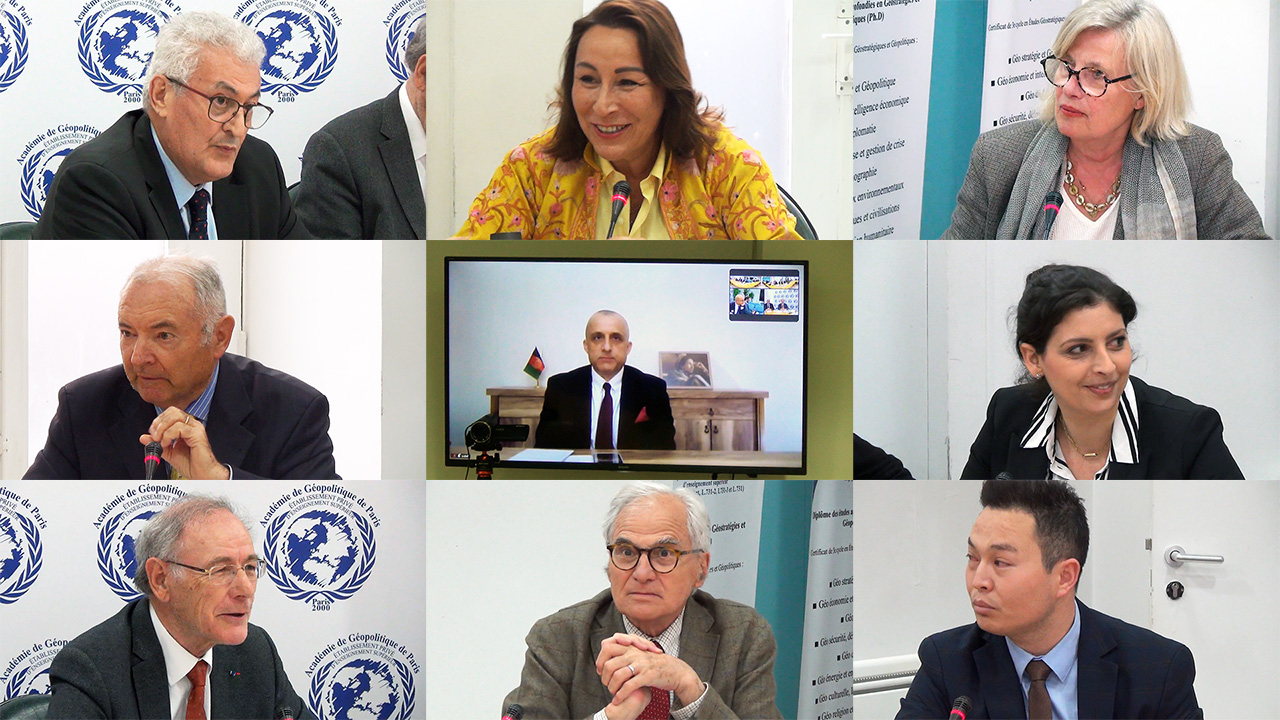
Report of the symposium on Tuesday 22 April 2025,
Co-organized by the Académie de Géopolitique de Paris (AGP) and Géopragma.
Afghanistan’s “burden of empires” is at a crucial crossroads in geopolitical paths. In collaboration with Géopragma, the Académie de Géopolitique de Paris organized the symposium “What future for Afghanistan?” Tuesday, April 22, 2025, dedicated to in-depth analysis of the prospects and challenges that will determine the future of this country, internal (Taliban regime, humanitarian situation, status of women, instability…) as well as external (geostrategic rivalries between international and regional powers, responsibility of the United States, etc.).
We had the chance to welcome with us on this occasion. M. Amrullah Salehwhich brought a unique perspective informed by its significant experience as former head of intelligence (2004-2010), Minister of the Interior (2019) and Vice-President of the Islamic Republic of Afghanistan (2020-August 2021) as well as Acting President.
COMPTE-RENDU
Dr. Ali RASTBEEN, President of the Académie de Géopolitique de Paris (AGP),
“Afghanistan at the test of time”.
Ladies and gentlemen, Since August 2021, Afghanistan has turned into a new reality. The Taliban’s return to power has not only changed its regime. He redefined the daily lives of millions of people and plunged the country into a multidimensional crisis.
First on a political level.The Taliban have established an authoritarian regime, without elections, without counter-powers, without fundamental freedoms. Women, ethnic or religious minorities, political opponents are excluded from public life. This lack of democratic legitimacy makes lasting stability very difficult.
Then diplomatically. The majority of countries do not recognize this new regime. The result is little aid, little investment, little trade. The country is closing on itself, becoming increasingly dependent on a few neighbours like Pakistan, Iran or China, which increases the risk of interference.
The economy also collapsed. Prior to this, international aid accounted for nearly three quarters of the state budget. Today, Afghanistan faces widespread poverty, massive food insecurity, and almost halted public services. And yet, the country has enormous mineral wealth and significant agricultural potential. But without security, without a stable legal framework, nothing can be valued.
The social fabric is also being strained.Ethnic tensions remain strong. Many families have fled, inside the country or abroad. The education system is at a standstill, and youth — the majority of the population — is deprived of hope. And it must be made clear that the situation of women is dramatic. More schools beyond primary school, more jobs, more freedoms. It is a systemic exclusion, which hinders not only human rights, but also any development.
In terms of security, Taliban control the territory, but not all armed groups. The Islamic State Group in Khorasan, for example, remains active. The borders are porous, the arms trade is large, and there is no professional national army. This creates constant regional instability.
And yet, Afghanistan remains a central part of the regional game. Its geographical position, between Central and South Asia, places it at the heart of major projects such as the TAPI pipeline or the Chinese Belt and Road Initiative. But for these projects to come into being, security and governance guarantees are first and foremost needed.
So, what future for Afghanistan?
The country faces enormous challenges. But there is no shortage of resources or talent. What is needed is an inclusive State, where women, young people and minorities have their full place. This is the only way to lasting stability.
The international community must play a responsible role. That means: soutenir sans imposer, accompagner sans instrumentaliser. It is by respecting the sovereignty of the Afghan people that we can build, in the long term, a more just and stable future for the country and for the whole region. Thank you.
Mrs. Caroline GALACTEROS, President of Geopragma, auditor of IHEDN and geopolitologist of the Balkans, director of the consulting firm PLANETING,
« Introduction ».
Thank you, Mr President.
So, I will make a very short introduction in English. I am Caroline Galacteros, of course I What I wanted to do is to welcome especially Mr. Amrullah Saleh, who is our special guest today. And I think it’s very important, and we are very, very happy to welcome Him. Probably all of you know this personality, training intelligence services chief, and then training interior minister, and then even VP, vice president of Afghanistan during a short but important period. So, I will just let everyone give their various sounds, and then we will have this discussion.
Thank you very much for being here with us. Even if it’s far away, we can see you, and we are very keen to listen to what you have to say. Because, of course, the Afghan file is very important. And personally, I would be very interested in getting your opinion about the foreign influences of different countries. Of course, I can think about the United States, but also Russia, or Pakistan and Iran, amongst others of course.
Mme. Patricia LALONDE, Former European MP, Vice-President of Geopragma
Hello, Mr. President., dear Amrullah, it’s a long time since we met. We were very close of Ahmed Chah Massoud, Afghanistan is always in our heart, especially women as we fought for women’s rights since a long time.
Since the brutal and chaotic U.S. departure in August 2021, the Taliban are now running the country and people, especially women, are suffering a lot. The world is facing a major geopolitical shift and the allies from one day will not be the same as the day later. U.S. help to the Taliban during the Russian invasion has unfortunately left undeniable repercussion on the future of Afghan politics.
Have the Taliban cut with terrorist groups like Al-Qaeda and ISIS? Which role neighboring countries could play? I mean Iran, Pakistan, Russia, and of course, central Asian countries like Uzbekistan, Kazakhstan, Turkmenistan etc. Some countries are already continuing to work with the Taliban. I mean China, Russia, Iran, of course, the U.S. is continuing to finance them. China is on the ground for mining. We recently heard that the Russian and Tajik forces have bombed mountains in Tajikistan to find the terrorist home. So, the Russian have now removed the Taliban from the terrorist organization. You are now part of the resistance against the Taliban in Afghanistan.
Could you tell what is, in your view, the future of Afghanistan? Do you think possible to have any contact or even some negotiation with the Taliban?
H.E. Mr. Eugène BERG, Essayist, former Ambassador of France to Namibia (1998-2002), Botswana (1998-2001) and Fiji (2004-2006), specialist in Russia, Ukraine, the Pacific, former Consul of France in Leipzig (1994-1998),
“An unprecedented testimony: what Mikhail Gorbachev said about Afghanistan”.
President, thank you for giving me the floor. It is an important day for me, for you and for everyone to have to give you a witness that is dear to me.
First, I have a connection with Afghanistan. I didn’t have the courage or time to go to your beautiful country. If Allah or God give me life, I will surely go. I’ve been interested in Afghanistan since 1964, where, as a student, a trip had been planned. I went to your embassy, 32 Raphael Avenue, and I was given papers and I still have the streets of Kabul with beautiful young girls in dress, beautiful, with things like that, a world long before.
Then, when I entered the Quai d’Orsay, at the time, we were distributing The World Still to beginners, I come from my lunch and what do I see? The World placed on my table – see, I have a very good photograph – 17 July 73, it would tell everyone: “Daoud, the king’s cousin, coup d’état”. So already, I’m thinking, something’s happening. And believe me, there aren’t many people who put Afghanistan.
Then I went to Iran. I saw in the famous garden in Ispahan, Faz and Shiraz. You know better than me, that’s when I started doing yoga, I was taken by the East and there was Afghanistan.
Well, then, I shorten 1979, everyone knows.
Besides, I am appointed Consul General in Leipzig, capital of the book in Europe, with the famous Baedeker guides, who are wonderful, I have some, on the region. And Mikhail Sergeyevich Gorbachev is invited by the Germans because he is celebrated as the one who allowed the reunification of Germany.
As consul of France, I am obviously part of the reception. I’m introduced, I remember as if it were yesterday to a man. Raissa, her wife, was sitting, was already sick, she died – And you know it was a fusion couple. He has done almost nothing without it and he has consulted it for a long time, which is very rare for a politician – And so, I’m introduced to him and I told him: Here, I am a consul of France and I am of Russian origin. He took my arm and he squeezed me. He looked at me and said: “Unfortunately, you are not part of the official lunch. It’s just for the German minister president who was called Vogel. But I’m interested, and come to my hotel when dinner is over, we’ll talk.” It’s a revelation I’m making. I’ll talk about it in a future book, certainly. And I arrived at midnight and a half and stayed with Gorbachev until 6:00 in the morning.
So we talked about a lot of things. I’ve taken notes that I’m putting in shape. And here, let’s talk about Afghanistan, I took back the notes he told me about Afghanistan. So, too, I think I’m revealing something. I had a discussion with him on many subjects: on relaxation, on the east-west, on the heart of international politics. But since we’re here to talk about Afghanistan, let me deliver things. I don’t know if these are state secrets, since there are very few secrets in the end. But at least my presentation is not purely historical. He’ll show the connection with the news. Because if I decipher Gorbachev who died in August 2022 – I have never met him since, of course, when I went to Russia a lot of times – I understand that the mistakes he wanted us to avoid when he was minister general were made before 2021. And it would be interesting to have your point of view.
So, what did he tell me? First, you know that he was responsible for agriculture in December 1978. Well, the coup d’état of April 28, 1978, you all know him better than I do, and I’m not going to repeat the story: land grabbing, socialization. And he, obviously, was against it. He knew very well that socialist agriculture did not work, especially in the way it was done, brutal, carelessly, and you know like me and better than me that the problems started from, say, September 1978-1979. But obviously, he didn’t have a say. He really had a lot to do. He was the junior, he was the secretary of the central committee, entered the political bureau, he was the protégé of Andropov and therefore he could not really say “we make an imbecility in Afghanistan”. He had too much to do, he didn’t weigh yet, and I felt in him a kind of spite: “Here, I couldn’t do it, it’s a shame, we could have done something.” You know, so many statesmen regret what they did… books or cemeteries are full of them.
Secondly, he confessed to me – it is not a secret – that he was not even warned of the Soviet intervention in Afghanistan. Well, you know very well, the political office has been talking for a year, he certainly didn’t want to go. We know very well that it is Youri Andropov, the boss of the KGB, the former repressor of 1956, Dmitri Oustinov and then Mikhail Souslov – the ideologue, the guy with glasses who knew Marxism – And so, I see him, right now, we’re sitting there, and I ask him, ” Qu’est-ce que vous auriez fait, vous ? ” He smiled, and he said, ” Devinez » But, cautiously, he did not say that he would have voted against. He might have lost his career. You see, all these are subtleties. I realized he was against it, but he didn’t have the courage at the time, in 1979, because it was so tight, you know. It was played… Andrei Gromyko could say he was against it, because it was a kind of giant. Moreover, it was not for nothing that he succeeded the presidency. But I felt that there was already a reluctance at home.
Then the very moment when he became aware that he had to get out of the waspier, let’s say, it was about Chernobyl in April 1986. Obviously, he had to consolidate his power, it took a year, and he saw very well that this bloodbath had to be stopped because, on the one hand, the population was beginning to lose confidence in the political elite, it is the famous “coffin”, the role of women. And here, see the parallel with Ukraine now. We don’t have the same situation. We’re not going to talk about it, we’ve got it, but Afghanistan was far away. But he told me several times that ” If we were to fight in Afghanistan, it’s to prevent Islamists from coming to us some day through the Caucasus, and everything. We are not just defending socialism, which we did in Prague in 1968. We know very well, we have Muslims. Well, then there were less than 20 million. We have to fight there. It is both the status of great power, it is our status in an area which is the Caucasus-Central Asia, where we have been since the Pamir of 1897, and we are here. If we don’t stop… ».
So of course, at the time, all the anxious people said, “They want to access the Gulf.” That was propaganda. It wasn’t the gulf, it was making a dike on it. And he insisted on that.
Secondly, it is interesting because it confirmed to me that after Afghanistan, the Soviet Union could no longer intervene elsewhere. And remember, the coup d’état from December 12 to 13, 1981, against Solidarnosc. The hard people wanted to intervene in Poland. And I remember, I was, okay, we even counted the number of deaths, how much to exfil, etc. And then Rocard, he said, “we will send the French fleet to the Baltic”. Do it! Easy to say. So, you see, he knew very well that Russia’s status was committed to it, protection, and that we had to leave.
Then we came, indeed, it is known, to the negotiation process. And that’s where I make a parallel – having seen my notes a posteriori – with the situation in 2021 and even with Ukraine now. What did the United States want? So obviously, as their ideological enemy withdrew, it was a fantastic victory for the United States. And so, they played to the maximum. And for people who know the game theory (“you have to do the minimum of maximums”), when you sell the maximum, the opponent wants the maximum and you find yourself with nothing. Better ask the second thing. And the Americans always ask for the maximum, we’ll take it out, and the maximum, they have it there. That’s what happened on August 15th and what happened after. We will see, and here, well, I do not make any parallels with the current situation, but it is interesting in terms of geopolitical and even geo-mathematical thinking.
So the position of the United States was the mutual withdrawal of all external forces, i.e. both the Soviet Union and then the foreign forces. And then they evolved. As they saw that they were winning, they demanded more. And above all – that is where I am making a parallel, correct me – with before 15 August: they refused the free elections in 1990 for Najibullah, the man…, the bull, the doctor who was in power until 1992. They wanted to keep him. So obviously he was the name of the Soviet Union, but he wanted to talk with the moderate Taliban. And then, we would have formed a coalition and prevented the total collapse and the seizure of power by the extremists. I don’t know if you follow me on this, but it would be interesting to see him.
And obviously, we all make this mistake. Look, the French didn’t want to talk to the jihadists in the Sahel, while the Malian powers, each time, did that. Like the FLN, we didn’t want to talk. Well, we got tough and so on. I don’t want to go back to history. I think these lessons of history are obviously easy to say after, but still it was repeated in the 1990s and then now. So obviously, the Soviets finally agreed that the Reagan administration would continue to arm the most radical factions of Mujahedin through Pakistan, which played a fantastic double-game, which stopped doubling the game in violation of the Geneva agreements. And that’s where it’s interesting, that’s where Putin criticises Gorbachev: “You shouldn’t have left that.” So, of course, I’m the one who interprets after, Gorbachev said, “Here, I couldn’t do anything, I had a fire at home, I had Afghanistan, I had to withdraw, to save my furniture at the same time, because I knew that if I was growing in Afghanistan, I couldn’t lead the Perestroïka I could not reform the Soviet Union and so on. The time was short.” But then it’s interesting that post-history shows you the mistakes. And of course it’s easy for us to criticize, but poor Gorbachev has given up, and of course it’s criticized by the current political elite, and that explains a large part of Putin’s position vis-à-vis Ukraine and other problems. They learned from history.
So the Soviets shared the goal, he said, of an independent Afghanistan, but he was particularly wary of the power of radical fundamentalists, which he repeated to me often. And he told me that he would somehow have wanted us to join him in fighting radical extremists, saying, “It’s not so much the Soviet Union that I keep, but that’s what we fight.” And there, obviously, disappointment, the American hawks sent him into his stuff by saying “it’s baratin, you want to preserve”, go ahead and so on. And then I felt a great sadness in him. So obviously he said that was because the Taliban returned on September 27, 1996. I met him a few weeks later, early 1997, it was easy for him. But our conversation is connected because precisely – And as I was following, I explained a little to you the Afghan affairs that were of interest to me, I asked him the question, among others, and obviously I felt it, he was very aware of things, he followed.
1996, we must not forget that it was his great enemy Yeltsin, and therefore all that Yeltsin said he was against, a little as in everything that Trump does with regard to his predecessors, he is necessarily against, they are fools and there are only those who are intelligent and so on… Well, that’s well known.
So obviously, the Geneva agreements, he said, the parties agreed to disagree, and Becker, quite hard, always insisted that they were not interested in elections and he quoted me – Finally, I saw him again after – Ambassador Dobrynine in his Memoranda explique : « The strategic objective and hope for Gorbachev was that Afghanistan would be neutral and that the United States would play a useful role with us in the future settlement. This turned out to be an illusion.Ion”. And here, I think this is one of the great turning points in history, which we have lost, and obviously some archives will open, but it still takes 20, 30 or 40 years. I, of course, only deliver oral things. All historians look at the writing, but already the oral has brought me, opened my eyes and brought me on interesting leads, and this is what I want to deliver to you.
Then I’m going to be quick, I’m going to show how he saw very quickly that Afghanistan was going to rot the Soviet Union. The coffins that would come back, the criticism – That’s where he obviously released Sakharov, all this. He saw very well how the “cancer” of Afghanistan would enter the Soviet body, and prevented it. So public opinion has opened up. So, what’s interesting – this is obviously post-discussion with Gorbachev – but since I knew, not a deputy, but someone who was in the entourage of the famous General Boris Gromov – the man who left on the Friendship Bridge on 15 February 1989, then he was in Crimea during the events of 2014 – I wouldn’t say more, it’s pretty confidential – But at least it’s interesting because he lived this withdrawal, and when I saw him after and went to Russia, just after August 2021, he said: ” Eugene, you know, we went out in dignity, but the Americans weren’t the same, they criticized us so much… » But finally, I’m just making a move beyond that.
So veterans, which is interesting, they’ve been completely abandoned, losers, I’d almost say poor guys. And it’s after years that they’re taken over. And when Putin arrived, there would be a whole study to do – but it has already been done – they have regained some sort of assurance, and some of Afghanistan’s veterans have founded a united party – Iedinaïa Rossia (United Russia) of Putin – And they played a role.
And another parallel, now look at the veterans of Ukraine: they are considered a new elite, as a really new class, they travel in business class and everything, obviously creates distortions but it shows for reason – at last comparison is not right – how much they were despised after Afghanistan that was a defeat but, a posteriori, the few lights Gorbachev had put on this, it is in my opinion revealed in part true.
One, we should have discussed with moderate Afghans to create a bridge; Two, he was disappointed because he wanted to cooperate, start cooperating with the West. This is an idea that I put in my History of the Cold War, you know the famous formula of General de Gaulle: ” Understanding, relaxation and cooperation ” The deal was made. The trigger was made. Gorbachev was a Social Democrat. He told me. That’s outside Afghanistan, but that’s the last message I’m delivering, and I’ll certainly record it. He was very disappointed that it was not coopted. We didn’t trust him. And remember, the last G7 in London in July 1991, just before the putschBush father was willing to give 30 billion to save Gorbachev. And John Major said, “No, no, he’s screwed, we’re going to give it to the successor.”
Well, that’s my interpretation, we made a big mistake. One would have maintained a kind of Soviet Union like the European Union with a common currency, but on that I wrote another article a long time ago, I would have had to get it out – one would not have had the present war, one would have actually had a Soviet Union with a common currency, an element exactly like Europe, one would have, instead of building us from the bottom up, one would have dismantled up and had a politically interdependent Soviet community, each would have had a seat in the UN, but one would have had a coordination of foreign prices, a common currency, like us, etc.
Unfortunately, history has passed, it is too late to return, but Gorbachev believed in it. See, that’s what’s interesting, is that he made the connection between all this. But of course, he confessed that he made mistakes, he was overwhelmed, by the left, by the right, and thought that time, history, might recognize him, and if I have a little contribution to make, it is precisely to animate this flame.
Despite all the mistakes he made – who didn’t make a mistake? ” Let him who has never sinned draw the first stone This is the message of Gorbachev. Of course I would have to read all my notes again, but I think I saw a man who remained optimistic, who was faith, he had his sick wife, it was sad to see this man still alive and everything, who loved this woman deeply, who knew she was going to leave. I believe this is a moment of Russian holiness, it is a moment in European history that I have had the happiness of living.
And to be without books, not our interview, but the meeting that took place between Gorbachev and the Germans was in Jena. So for people who love Jena, it is the famous victory of Jena, Napoleon against all forces. And that’s when Napoleon first met Goethe. Napoleon was about 40 years old and Goethe was 60. And there’s a page in the Memoranda Goethe, and we see Goethe coming home, and Napoleon is sitting at the table, Goethe waits, he asks, and that’s where Napoleon said: ” Here’s a man. ” Well, I think I met a man in Gorbachev. That’s it.
M. Amrullah SALEH, Former Head of Intelligence (2004-2010), Minister of Interior (2019) and Vice-President (2020-21) of the Islamic Republic of Afghanistan, Former Acting President.
The issue of Afghanistan is massive. I was navigating myself on which topic to choose in order to be relevant to the interest of the participants in Paris, to our Western audience, and also to the greater general public of Afghanistan. I have been a practitioner, I have been a policymaker, and also, I have been almost at the top of the pyramid of power for a while. I have been at the bottom of the pyramid and in the middle too. I do not want to take you back to the start of the turbulence, which was 1979 and the 1980s. So, I would like to focus specifically on the most interesting period, which is the post-Masoud era, the Western intervention, 9/11, and the experience of us working with the Western alliance led by the United States of America.
My focus will be on the period post-9/11, post the killing of our leader, the great Ahmad Shah Masoud, to August 2021, how I see the situation now, and how our diagnosis and perspective of the future are. First, August 15, 2021, was not only about the collapse of Afghanistan and the republic system only. I want to make it very bold and clear: it also marked the date signifying the collapse of the morale of the Western alliance. On August 15, 2021, whatever moral standing the United States had in Afghanistan and in the region collapsed. It collapsed in front of the eyes of the world. On that day, the West, led by the United States, or, let’s be very clear and simple, the United States of America, smashed every commodity named morality and values and pushed the good majority of the Afghan people into the cage of wolves, zombies, and under the bus.
Since that day, 8 million Afghans have lost their homes. They are either internally displaced because they are chased by the Taliban or they have left the country. They have primarily gone to neighboring countries, largely the Islamic Republic of Iran, Pakistan, Türkiye, Central Asia, Russia, the Middle East, and a very small number of them have been evacuated to Western countries. The mainstream American media, since August 2021, has been trying to blame the Afghan people, the Afghan politicians, the Afghan culture, anything associated with Afghanistan for this colossal failure. This media is like a flood and, at times, washes away everything in its way, perhaps sometimes sparing lonely trees that have deep roots, and maybe I am one of them, and they have not been able to silence me.
August 15 is when the United States of America said no to morality, said no to values, said no to human relations, said no to emotions, said no to human sentiments, and preferred to take it as a naked, largely anti-human interest. Let’s say it as it is: since 2020, no American media has ever mentioned that there was an SPA; no American media or politician is saying that there was a BSA with the legal, legitimate state of Afghanistan. No American media or politician is mentioning the number of bodies Afghanistan lost in that chaos. What they are repeating is 2,500 American servicemen and women who lost their lives while serving in Afghanistan. There are two types of deaths: the Afghan deaths, which are not counted, and the Golden Souls, which are the Western Souls who have died in that cause. They have names, they have faces, they have ranks, they have families, they have memories, and tens of thousands of my countrymen who believed in the promise and who trusted the word of the Western powers, specifically the words of the sole superpower of our time, don’t exist. What we have inherited is tens of thousands of graves and hundreds of thousands of orphans and widows.
The lesson one that I am going to pass to a future generation of Afghans and also to those who are still in the scene who have not given up, my number one takeaway from my very direct work with the CIA, with the Pentagon, with the State Department, with USAID, with the US diplomatic mission in Afghanistan, with almost every Western intelligence service that rushed to Afghanistan post-9/11, is this: they come there, they exploit your poverty, they exploit your naivety, they exploit your sincerity, and then they switch off their contact numbers and go. It may not be an applicable lesson for all our foreign relations, but certainly, this was the second time the United States backstabbed the Afghan people. They backstabbed us in the ‘90s after the fall and the disintegration of the Soviet Union; they abandoned us, they stopped assisting us. They gave us ruins, they gave us destruction, and all of the alliance we had with them in the ‘80s was forgotten. They came back in 2001; I can go on with the names of individuals who came and promised. They said, “We will stay, we will assist you, we will not make them a mistake of the past, we are ashamed of our past, this time this is a long haul. We will not allow Afghanistan to become a black hole again,” but what happened? They abandoned us again. Not only did they abandon us again, but after abandoning the Afghan people, to this very moment that I am talking to you, they are providing tens of millions of dollars to the Taliban. I want to repeat: they have provided over $18 billion to the Taliban since 2021.
A noble American soul by the name of Lisa Curtis was quoted yesterday. She was a member of the Doha negotiation team. She was a senior staffer in the National Security Council of the United States. She said, “We presented Afghanistan to the Taliban like a birthday cake.” Let me make another quote from a person who I know very closely and I have featured in his book, Henry Crumpton, a very senior CIA officer who has written a book called The Art of Intelligence. “We went to Afghanistan not to defeat the Taliban or ask them to surrender. We went to Afghanistan to secretly recruit the Taliban to help us.”
The public narrative that was given to us from 2001 to August 2021, based on these testimonies and papers that we get now, was deception. It is very easy to say that Afghans were corrupt, it is very easy to say that Afghanistan is not fixable, it is very easy to say that we are a country of drugs and etc. All those excuses, maybe true or untrue, do not wash the stinking black mark on the forehead of NATO in my country. They have created the biggest human catastrophe in the past three years in Afghanistan, and they are trying, by sponsoring mediators, literally. This is the number one lesson I have learned as a practitioner, as a policymaker, and as a decision-maker.
Lesson two: values and principles that were supposedly the foundation of Western civilization, particularly the United States’ civilization, evaporated overnight in the event that they saw immediately no immediate material interest in Afghans. The Biden administration injected 17 billion dollars to the Taliban in Afghanistan to assist them to consolidate the worst, most cruel, and inhumane clerical dictatorship Afghanistan has ever experienced. Why? Because the system based on values has become more expensive and more difficult to sustain, and thus, it was sold. By the way, I may sound angry; trust me, I am not. I am not a conformist to the frames of legacy media, I don’t want to be politically correct, and I don’t want to be in line with politically correct politicians as well, and I have no fear to express what is boiling in my chest.
Post-2021, statements from Blinken, from Thomas West, from Karen Decker, from this and that, all they were trying to do was to shield themselves behind this excuse that they were doing everything good, and only a man in his late 70s by the name of Ashraf Ghani was guilty. Ashraf Ghani was not guilty; his only guilt was over-trusting the United States. He should not have trusted the United States; he should have received with an open heart and welcomed the offer of the regional countries. We paid a massive price for our alliance with NATO, and what is now the fate of Ashraf then?
There are no values, there are no principles; what is there is a very naked interest. That naked interest can sometimes be secured with an alliance through aligns with terrorists, it can be secured through aligns with dictatorships, it can be secured through an alliance with religious fanatics. So, my advice to the Afghan people, particularly those who are fighting the Taliban, is we should also search for our own interest, and we should not believe blindly in such promises and slogans.
Lesson three: none of our neighbors are bad; they are our neighbors. They exist here, they existed, they didn’t leave. For over 20 years, we were lectured on how our neighbors were bad. And then what happened? When the United States of America left, tens of thousands of American-trained Afghan forces found refuge where? In the very soil of our neighbors. Some of these neighbors smile at us jokingly; it’s a tragedy-comedy. They say, “Where is the West? The West has gone thousands and thousands of miles away from its promises, both physically, morally, and politically.” Every single word the Russian political commentators and experts have been saying about Afghanistan, especially post-2011, has been proven true. President Putin has been saying that these people will backstab you, they will not stay, and when they leave, they will not say we are leaving; they will blame you for leaving. He was right. Our other neighbors were right too. They were saying the same, but we said, “How come the mightiest military alliance defending the living civilization of our time can lie to a poor nation called Afghanistan?” And they did.
Lesson four: as far as the specific interest of the anti-Taliban block is concerned, or the anti-Taliban constituency is concerned, we should not have given our arms to the DDR. We were demobilized, we were disarmed, we were never reintegrated. We were not integrated because it was not in the interest of the corporations, particularly the private security companies, particularly the prime maintenance companies, particularly the prime construction companies, to reintegrate us. They were with people of their own image. So, I give you an example: there was a company in Afghanistan operating by the name of Neo Lemon. They were charging the system; they were charging the system up to three billion dollars for the maintenance of the vehicles of the Afghan security forces. And in 2021, before the collapse of the republic, they came to us; they said, “We can do the same contract with you for less than three hundred million dollars.” We approached the Americans. We said, “This company, which you will pay three billion dollars a year, is ready to do the same amount of work for us for three hundred million dollars.” They said, “We are not going to pay you the three hundred million dollars.” We asked Neo Lemon why they are refusing to pay ten percent of what they were paying to you directly. And the reply was very simple: “If they financed this contract for three hundred million dollars, then the question will be, where was the two point seven billion dollars going in the last twenty years or less?”
So, why are they blaming us for corruption? Why? There is a very famous quote from Senator John McCain, a distinguished American. He met our ambassador Sayed Tayyab Jawad. Sayed Tayyab Jawad told him, “Honorable Senator or Congressman, from each dollar you gave to Afghanistan, eighty cents come back to Washington.” He says, “What’s wrong with that? That’s our own dollars.” Exactly. It was United States dollars. They have every right to do what to do with it. I’m requesting them to respect us as a nation. Do not call us corrupt. We are not corrupt. What we have inherited, as I say, the largest legacy we have is the graves of our dear ones. It hurts. The backstabbing is one thing, but this poison of tongue is another thing that is hurting us.
Some of you may say, “Was it all about the United States? Where were the Afghan leaders? What were they doing?” It was a colossal failure. I’m going to come today to the responsibilities of the Afghan leaders, including myself. The Doha agreement was not for a peace process; it was a contract between Washington and the Taliban to recruit the Taliban as instruments of foreign policy, regardless of the cruelty or the cost, to pursue geopolitical aims with non-democratic, non-transparent tools and instruments. These weekly cash shipments, despite the rhetoric of the Trump White House, are continuing. I have evidence that it is continuing. There is a simple question: why are they giving between $45 to $60 million to the Taliban? We all know that such cash assistance does not alleviate the suffering of the Afghan people. It hasn’t stopped migration. It hasn’t created jobs. It has consolidated the religious tribal dictatorship of the Taliban.
What is happening now? A myth has been created that there is no alternative to the Taliban rule. This is a very harsh insult to the human soul. Let me repeat it again: this is the harshest insult to the human soul. It is the most racist insult the legacy media, policymakers, commentators, and diplomats, especially from Western countries, are throwing at the people of Afghanistan. It is like degrading Afghans and Afghanistan to a human zoo. When you are saying there is no alternative to the Taliban, you are literally telling us that your destiny of the 20 years of our intervention is reduced to a human zoo. That is what is happening in Afghanistan in 2025.
I quoted Lisa Curtis. We did not fail. The largest military alliance on the face of the Earth presented my country like a birthday cake to the Taliban. That is the testimony of the American officials themselves. Doha was not a peace process; it was a conspiracy. In 2021, to the date of the collapse, the American military did not assist us to do operations in the North because the conspiracy was to allow the entire country to fall at the hands of the Taliban. When we defied the code of partnership with them, and we sent our commanders to Faryab province, 38 of our commanders were killed in less than one hour because General Miller refused to provide them air support. It was a month before the collapse of the republic. I accompanied President Ashraf Ghani to the White House. Every single word that Biden said was a lie, every single word the CIA director said was a lie, every single word Lloyd Austin told us was a lie. I asked them three questions.
Question 1: “Why is every single logistical contract coming to an end on September 1st, 2021, and you are not renewing it?” They said, “We will answer this at the technical level, maybe back when you are in Afghanistan.”
Question 2: “Every sign we see, the Doha process is more of a process of regime change; it doesn’t seem like a peace process. Biden said, ‘We stand with you, we are with you. We will not go ahead, we will defend the Afghan republic, and we will make sure there is peace, not a unilateral takeover by the Taliban.’” This was a lie.
I also asked Austin when I was accompanying Dr. Abdullah and Ashraf Ghani to the Pentagon; we said, “This is what the Taliban are doing. Does it mean you have ceased supporting the Afghan forces and actually you are assisting them instead?” They said, “We are going to send a technical mission to Kabul, and this technical mission will work with you on the details and make sure the capital region is defended until an intra-Afghan settlement is reached.” This was a lie because, in the secret annexes of the Doha agreement, actually, the United States committed that they will not assist the Afghan forces. And they also refused to say ANDSF; it is written, “the forces of the other side.” That is the magnitude of the betrayal and backstabbing.
Now, what is the situation right now? The situation right now is strategic ambiguity. It’s a calculated strategic ambiguity. The lack of clarity and major international stakeholders are deliberately reinforcing this ambiguity because the clarity is frightening; the clarity is what I am telling you, and it is frightening. It is dangerous; it involves risk. They know there is a snake in the kitchen, but they hope it will go away by itself.
We own that kitchen, and they have left the snake in our kitchen. Hope is not a plan. Hope is not a dream. Hope is not a strategy. That is why, despite the odds, despite the risks, despite the risk of even talking, we have not given up because we own the country, and we believe that the Doha conspiracy was designed to take it away from us for very malign geopolitical aims. If those geopolitical aims are not malign, my question is repeated again: the Taliban receive up to $60 million a week for what? UNAMA has spent $700 million since August 2021 to achieve what? To reinforce the strategic ambiguity, to reinforce the clouds, to reinforce the lack of clarity. It is not to bring clarity.
What is the meaning of clarity? The meaning of clarity and the removal of the ambiguity will be the following:
First, Afghanistan cannot be dominated either by an outside power, covertly or overtly, or by any single ethnic group in Afghanistan. The Pashtuns are not Taliban. The overwhelming majority of the Pashtuns are not the Taliban, but the Taliban are Pashtuns, particularly from the south. And 93% of the Taliban structure, regardless of where they are, is from one tribal group in Afghanistan. The United States doesn’t want you to know this. The architects of the Doha deal do not want you to know this. They never mention the name of Hibatullah in their statements. Why? If they have a problem with North Korea, they say, “The regime of Kim Jong-un,” or they have a problem with another country, they refer to that person in order to tell a society, “We have a problem with this person.”
Why is Washington refraining from naming Hibatullah as the super evil of our times in Afghanistan? Why? Has Washington put in place any mechanism to make sure that part of these tens of millions of dollars do not reach Hibatullah every week? No, it hasn’t. Let’s remember, if the ICC has chased Hibatullah, at least on paper, the ICC is a European entity. It doesn’t have the backing of Washington, and it has no teeth either.
So, clarity number one is: my country is dominated through a NATO-backed conspiracy by a religious tribal group, and it is going to collapse. The U.S. is funding it right now, and we hope it will stop. It has not stopped to this date.
Second, the Taliban’s religious tribal power structure relies on two factors: madrassa affiliation and rural tribal codes. Both of these codes are alien to the absolute majority of the Afghan people. It is unsustainable. UNAMA, despite spending $700 million and despite having 51 foreign expatriates in its structure, has zero impact on the behavior of the Taliban. After the conference in Doha, the Taliban brought about the PVPV law, Prevention of Vice and Promotion of Virtue, exactly a day after Doha 3. This was to tell you, “UNAMA, you are irrelevant. You are a show.” And when members of the Security Council extend the mandate of UNAMA, it’s a waste of resources; it’s a waste of every effort. It has no relevance in Afghanistan today.
Every ingredient of a massive civil war is in there. Our advice for foreign powers will be not to invest in the cheap Taliban crypto. I want to repeat: do not fall for this cheap Taliban crypto. It will collapse because it is alien to the very fabric of Afghanistan. It does not represent the ethnic groups. It does not represent the political diversity. It has not come through a process. It has come through a conspiracy and a deal. Every ingredient is there for this entity to collapse, and if it doesn’t go by itself, a civil war is on the way, whether you like it or not. Give the Afghan people a face. Do not reduce our cause to women’s education only. I appreciate your sentiments, but the issue in Afghanistan is not the education of women only. It is a massive human suffering, regardless of gender.
Now, as far as the region is concerned, the region must have the strategic courage to come up with its own formula and to get rid of this strategic ambiguity. The region should not wait for NATO version 2 to have a prescription. NATO has no prescription. The prescription of NATO is what we are seeing: an ongoing ambiguity that is costing the Afghans dearly and massively and that is costing the region in a lot of ways, which I do not want to articulate. Some of our neighbors, despite our evidence, despite our requests, despite our decades-long plea not to assist the Taliban, assisted the Taliban, gave them bases, gave them snipers, gave them bombs, gave them training. And you know what? The Taliban are now getting more assistance from Washington than those countries can. They should ask themselves, “What has changed? What has changed?” And still, if these countries believe that the solution is with the Taliban, the solution is not with the Taliban.
As far as the region is concerned, the Afghans are concerned, as far as various regions of Afghanistan are concerned, today there is a notion that the fighting spirit has died in the midst of Afghans, and the spirit of fighting is only alive with the Taliban. That is a myth that was reinforced by the injection of billions of dollars and the deliberate handover of Afghanistan, in the words of Lisa Curtis, as a birthday cake by NATO through the deal to this group. This is very unnatural, and it is going to end.
PUBLIC MATTERS (First session)
Eugene BERG
Well, thank you for your very, very, well, deep and very important speech. We could spend all the night discussing it, though I have only two or three little questions.
First, do you agree that Afghanistan should have been neutral and that was a mistake between Soviet Union and the West, and now, every bloc wanted to have Afghanistan as member and probably that was the mistake ? Afghanistan should have been, as it was at the beginning, a buffer state ? On this very controversial question, we can argue a lot.
The second is more technical. I’ve just read, because I’m also a gas-oil man, that the TAPI, the famous pipeline (Turkmenistan-Afghanistan-Pakistan-India) which UNOCAL supported with Taliban, after 1996, that the part from Turkmenistan has ended in September last year. Now, Afghanistan should follow this pipeline to Pakistan or India. In that case, India and Pakistan will buy gas and the Taliban regime will receive 2 billion dollars or 800 million dollars a year of fee that will support the regime, though indirectly, even if India is a big loser compared with Pakistan, with the arrival of the Taliban regime. India will indirectly support the regime, give it some extra revenues to follow its murderous politics. What do you think about that?
M. Amrullah SALEH
As I said in the beginning of my presentation, the timeframe of my presentation is post-Massoud, post-9/11, through August 2021. But in regards to your question about the neutrality, it is a very attractive concept. Afghanistan was offered a chance. It was offered a hand of assistance, and the hand of assistance was called “Strategic Partnership Agreement”. The United States told us, “This agreement is not against your neighbors. It’s a legal framework which allows us to assist you.” We didn’t know that legal framework was actually a paper for deception. Nobody talks about it. In that document, there is a clause that if the United States wants to withdraw from Afghanistan, they should negotiate with the Afghan government. They negotiated with our enemies. Not only they negotiated but with our enemies. They directly threatened us not to hold elections. Remember the election? They directly threatened us not to hold elections. And when we did hold elections, they bribed our election commission not to count the votes. And when the votes were counted, they bribed the political class of Afghanistan to be fragmented, in order not to create a unified negotiating team. If the USAID papers from Afghanistan are inspected, today, you will find out that they have spent hundreds of millions of dollars for creating a fake superficial political class. They bypassed the Afghan government. Afghanistan was poor, is poor. And they used this money not to help us, but to divide us. So therefore, the fact that the republic did not have a strong negotiating table because the United States did not want us to have a strong negotiating team. Every time Khalilzad would come to Kabul, he would meet 4-5 politicians before coming to meet the president. And he would send his message indirectly through media, what he would like.
As I said, it is over-simplification to say that this enterprise, which started in 2001 after 9/11, was actually spoiled by Ashraf Ghani. If this is the judgment of the strategists, I am afraid to say, this is the most stupid judgment. This is the most foolish judgment to say that Ashraf Ghani spoiled the effort of NATO in Afghanistan and brought about the collapse. That’s a simplification. That’s for the masses, so that they digest a simple story. In fact, from 2018 onwards, effectively Khalilzad was negotiating with the Taliban to recruit them and hand Afghanistan over to this group for geopolitical purposes.
What are those geopolitical purposes? I’m not interested to speculate, but I have evidence it was for geopolitical purposes. If it is not for geopolitical purposes, if Afghanistan has no regime, no government, no law, no regulation, no judiciary, no parliament, no election, nothing, why are they giving it $60 million a week? why do they come out publicly almost twice a month saying, “We do not want to support the opposition of the Taliban.” Why? Why are they telling people there is no alternative to the Taliban rule, and they want to imply that this human zoo they have created in Afghanistan is an acceptable new normal.
So, neutrality was and is a good thing. The neutrality was not violated by Afghanistan, again. We trusted this offer. We signed the Strategic partnership agreement almost with every single Western nation. Where are those papers? Okay, we are weak. We cannot take you to any court. We are not loud enough to fly that back in the face of the Western nations, but is that how a leading civilization wants to get credibility? Of course not.
Now, on the issue of TAPI, Khalilzad was a lobbyist for Taliban in the 90’s. Khalilzad was a lobbyist for Taliban post-9/11. Khalilzad remains a Taliban loyalist today. Was his appointment as chief negotiator a coincidence, or part of a design? Or maybe both. But he never represented the United States the way it should have been represented. If we had a one-hour meeting with him, 20 minutes he would be a Pashtun internationalist, 20 minutes he would be a US ambassador, 20 minutes he would be an international mediator, etc. etc. He carried multiple hats. So, that is the reality.
As to what should be the future of Afghanistan, we have a score to settle with the Taliban. It’s too early now to say, “What should be our future?” We have to, first of all, get rid of them and free our land, free our people. You know, if you look at the composition of the Taliban and if you look at how many massacres they have done, if you look how many people they have killed, if you look what they do in cities and areas where they are not welcome, none of that is reflected in the Western media.
M. Brice LALONDE
Mr. Vice President, Dear Amrullah Saleh, thank you very much for these very blunt and harsh words. We understand your bitterness, of course. But the question is, also: you are one of the voices of the opposition, you are a leader, and as you said Afghan people need hope. So, what’s the next move? How can you trigger and move in the Taliban regime? How can we bring down the Taliban regime? How does it start? Is it from outside the country? Is it from inside the country? Are they divided? How can we push? So, we are also asking for a strategy. Do you have that sort of answer, Amrullah ?
M. Amrullah SALEH
Thank you. I think it is not a matter of bitterness or sweetness. It’s a matter of conformity with a lie, or of non-conformity with the prevalent narrative. The prevalent narrative is based on deception. It’s based on lies. It’s based on a Doha deal conspiracy. So, somebody has to break it up. Somebody has to open this body and expose it. And I’m glad that I’m exposing it.
Now, as to the strategy of what should be done to get rid of this situation, now let us split our tasks so that we understand who should do want, at least what I should do and what’s our expectations from the Western civilization.
Number one, we request the Western civilization, the Western press, the Western consciousness, to not put unnecessary blame on the Afghans, to stop it. That’s a big contribution to our cause.
Number two. What is terrorism? Is terrorism a guy, an angry person killing two Americans in the streets of New York, or – God forbid – in the streets of Paris? It’s too bad. It shouldn’t happen. But do you know that we are now ruled by terrorists? Why are you not mentioning it? I’m not talking to you as a person. So, the West is now dividing the human life into several categories. And if I want to quote, you know, there is this golden billion and the non-golden, the dirt remains. So, it has become a norm that if we die, we are not counted, and our sacrifices are not counted, and our commitment was not counted. Our wisdom is not counted. Our dedication is not counted. What is counted is if you go to most of these meetings and they say, “What is the threat from Afghanistan against us?” Nobody says we had commitment there. We had agreements with the Afghan people. We have lifted, okay? We do not go there, but at least we should have the dignity of saying, “It’s our fault.” That helps.
Number three, don’t whitewash the Taliban. Every time a Norwegian diplomat comes out and talks positive about the Taliban, I sweat. I sweat. I tell you, if Norway takes 20 Taliban to a hotel in their capital and leave them there for six months, there will be protests… Do not whitewash the Taliban. Explain them as they are. And this whitewashing is a sponsored whitewashing. It’s not genuine. It’s not authentic.
Number four, do not say you do not support the anti-Taliban. At least remain neutral. Give us the right to express ourselves in whatever form and way that is effective to liberate our country. When you ask the largest military and political and economic block in the world come out and say there is no alternative to the Taliban rule, do you know the psychological impact of that on the minds and life of 20 million Afghan women? No. You cannot even imagine. So that’s number four you should do.
Number five, use the United Nations as the most effective platform to mobilize the world opinion against this situation. Don’t be conformist.
Number six, give us political support. What you are doing today is political support. Give us more space. Conditionalize your humanitarian assistance. Do not go there and provide assistance without having access to the society. Western NGOs have no access to the society. They are injecting aid into the darkness. Why are you doing it? Stop it. You think you are alleviating the suffering of the Afghan people? No, you are not. You are NGOs, but you know, calculatedly or uncalculatedly those NGOs are assisting the Taliban. Stop it ! The human tragedy has already happened.
And lastly, what will bring us back to your attention? What will bring us back to your attention? Another tragedy? Another non-formal strike? Another bad behavior? Again, I am appealing to you as the West is still the most dominant block in the world. It is not taking its responsibility seriously. It’s bypassing its responsibility. And that bypassing of your responsibility is not only a disservice to the Western civilization, it is also a disservice to the rest of humanity. You dominate the global institutions and you are not using those institutions to raise awareness about the Afghan plight.
That’s what you can do. Leave the rest to us. There is enough domestic motivation to topple the Taliban. They are not natural to our life. They are not natural to our social fabric. They are not natural to our being. We will topple them. We want the West to remain neutral, not to side in one way or another with the Taliban.
M. Karel VEREYCKEN, Institut Schiller
Mr. Saleh, after, after 40 years of war, we would like to hear what you have to propose as a peace strategy, and not only a strategy for civil war and civil strife. I mean, we know enough of the world conflicts… If you want to win a war you need a peace strategy. If not, you lose the war. So, what is your peace strategy ? Thanks.
M. Amrullah SALEH
I think you have misunderstood my recommendations or my suggestions for going ahead. Fighting and killing women, exactly, that’s not our choice. Okay, let me simplify it.
We want to study what is good for us as people. There is one man with his militia. He thinks he knows more than any of us, and he decides what we should start. We would like to choose the color for our dress. He thinks we are incapable of choosing the color of our dress, and he has to choose it. We think on March 21 every year we should go to the nature and eat some dry fruits, and he thinks that’s against the Quran. We would like our daughters to be doctors, engineers, nurses, lawyers, economists, etc. etc. and he thinks that he is in communication with God, and he thinks our daughters and sisters are quarter of a human being, and they lack 75% dignity of a human being. So, we would like to live like normal human beings, and this man and his militia believe that the rest of the world is abnormal and what he is doing is normal.
We think Afghanistan is a multiethnic country and they should have a say in their destiny. He believes, except his tribe and from his tribe few people, rest of the Afghans lack the wisdom to have a say in their destiny. Brother, the list goes on, and on, and on. Can you put yourself in our shoes and find a way to negotiate with this man? And if he asks, “Through which way?” He has left us no option. And he has left us no option because he believes the West has consolidated his power and is still consolidating his power.
When Western diplomats come out and say, “There is no alternative to this cruelty and it is the best new normal for Afghanistan,” can you imagine the impact of that on the Afghan society and on the spirit of the Taliban? Of course not. It is not the Afghan people heading towards the civil war. They are being pushed to go towards the civil war. There is already a civil war going on, but it’s not intense. The intensity is very low, but there is a civil war going on. Ask the ICRC (International Committee of the Red Cross), a noble Western agency, to report to you who are these 14,000 and plus detainees in the Taliban jails. Who are they? Why in 2025, a young Afghan man gets four years of jail time just because liking an anti-Haibatullah Facebook post? Do you know?
I think you misunderstood us. Life under the Taliban has lost meaning for bulk of the Afghan people. They’re exploding, and that explosion is inevitably called the civil war. What is left for us as an option, as a peaceful option? Not much. Because the peaceful option was implementation of the peace process which had started in Doha, and it turned out that it was not a peace process. It was a scheme, a map for regime change backed by United States militarily, diplomatically, financially. Thank You.
Ismaël PAIENDA, Co-founder and member of the Executive Committee of the Afghan Assembly of Specialists and Experts, consultant in Tourism, Sustainable Development, Investment and International Relations
Taking into account the fact that in 2021, with 350,000 soldiers and over $8 billion in sophisticated weapons, we were unable to defend ourselves. What is expected, taking into account the strategic and economic expectations of neighbouring countries and other powers? What do we expect from Afghans? What do they have to do for themselves? And what do we expect from the international community to find a solution? Thank you.
M. Amrullah SALEH
I think I have already responded, partly, to this question, but I am glad to repeat myself. The answer evolves around human dignity and the meaning of life. If you are deprived of the very basics of life, very basics, like choosing the color of your choice, like choosing the field of your education, like creating a calendar of activity for yourself, like taking your wife for a walk in the street, like dreaming a future for your children, like simply being a human being and having a normal life. If that dream is taken away from you, then you ask a question to yourself, “What is the purpose of life?” You see, it is not us choosing to fight. We are left with no option.
The notion that the Taliban cannot be challenged militarily is a myth. It’s part of the Doha deal conspiracy. And you say they were not defeated initially. They were not. Americans did not come to Afghanistan to defeat them. This is not my word. Right on YouTube, Henry Crompton, CIA official, spoke to the war commission and the conducts. He said, “We were not there to defeat the Taliban.” It’s there. You read all the memoirs of other people. Obama said, “We want to defeat the Taliban, but if we can’t defeat them in one year, we go.” With all due respect for the wisdom of President Obama, for his intellect, militarily that is the most incorrect. And I’m sorry to say, that is the most foolish statement for a military strategy. “They are all my enemy. I’m only here for a year. If I cannot find you in that year, I will go”. And then his military commander on the ground, General McChrystal, what did he do? He amassed 20,000 troops to attack Marjah. What was in Marjah? Nothing. I told McChrystal, I said, “There is nothing in Marjah. You are going into the desert town with few 1000 people, there will be no Taliban”. The Taliban was not effectively challenged militarily. That is a myth. And if the world doesn’t want the Afghan people to rise up and fight, they should stand with the Afghan people and help them gain their rights, very basic rights, through peaceful means.
We are not demanding Jeffersonian democracy. We are not demanding liberal order. We are demanding the right to education. We are demanding the right to be able to walk into nature. We are demanding the right to choose the education fit for our children. That’s taken from us. So, you think we should accept it?
Mme. Imen CHAANBI, Analyst and international consultant in geostrategy and economic intelligence, specialist in Africa and Middle East and Libya, director of 5WE Consulting and STRATEGIK.IA, auditor at IHEDN,
“The rights of women and minorities in Afghanistan: between religious ideology and Taliban authoritarianism. Perspective on inclusive governance? ».
Ladies and gentlemen, welcome to this conference on Afghanistan. To begin our discussion, I would like to share with you the words of Afghan writer Atiq Rahimi: ” In this country, even stones have a story to tell ” This quotation reminds us of the historical depth and complexity of Afghanistan, a country that, despite the challenges, continues to carry in it millennia of stories and remarkable resilience.
Following the announcement by the United States of the withdrawal of their troops from Afghanistan, the Taliban launched an offensive against Afghanistan’s national defence and security forces. Between May and August 2021, the Taliban quickly took control of the country, including 33 provincial capitals[1]. 15 August 2021 marked the official capture of Kabul and the departure of President Ashraf Ghani. After two weeks of chaos at Kabul International Airport, international forces officially withdrew from Afghanistan on 30 August 2021[2].
In September 2021, they formed an interim government led by Mohammad Hassan Akhund. Since their access to power, and despite some internal divisions, the self-proclaimed government has sought to establish its legitimacy while retaining the support of the international community.[3]. The resumption of power by the Taliban in 2021 has precipitated the country into an economic, social and humanitarian crisis where the Afghan people are subjected to extreme repression and serious human rights violations.
Over 29 million Afghans need both medical and food aid. International isolation and the various sanctions imposed on the Government have led the United Nations to reduce its humanitarian aid programme.
Expulsions of Afghan refugees by Turkey, Iran and Pakistan[4] increased the current crisis. The deterioration of the situation of women and girls in Afghanistan as a result of the recent adoption of the law on ” preservation of virtue and prevention of vice It was a unanimous challenge. The Government will replace the Ministry of Women’s Affairs in favour of the Ministry of Virtue Propagation and Vice Prevention.
Despite the condemnations of the international community, the Taliban rejected United Nations criticism of their policies. Thus they prohibit the entry of the UN Special Rapporteur on the situation of human rights in Afghanistan, Richard Bennett[5].
Discriminatory policy also extended to certain groups[6] ethnic groups represented by Tajiks, Hazaras, Uzbek Aimaqs, Brahouis or Baluches[7]. L’Afghanistan, symbole d’un multiculturalisme[8], remains weakened by a policy of exclusion towards religious minorities, including Shia, Hindu, Christian and Sikh.
Violations of rights and freedoms also extend to persons because of their alleged link with an NGO or foreign military forces.
These discriminatory restrictions imposed by the Taliban violate the human rights guarantees contained in many international treaties to which Afghanistan is a party[9], tels The International Covenant on Civil and Political Rights, the Convention on the Elimination of All Forms of Discrimination against Women or Convention on the Rights of the Child. By doing Sharia The Taliban, the sole source of law, have extended traditional and ancestral practices to positive law, thus denaturing the very foundations of Koranic texts and hadiths.
The sustainability of their power depends on their ability to respond to the urgent needs of their populations while respecting their rights and freedoms. These aspects are a condition sine qua non for all recognition by the international community. The establishment of inclusive governance will revive the Afghan economy through the return of foreign investment. This openness will promote Afghanistan’s return to the regional scene, making the country a key partner.
- The right of women and girls: between violation of rights and deprivation of freedoms
- Why are women the first victims?
The history of the status of Afghan women is the result of progress and regressions. Traditional and patriarchal traditions remain rooted in Afghanistan. After some progress achieved under the reign of the last Afghan king, Mohammad Zaher Shah, and then with the Soviet occupation, the living conditions of women are deteriorating, in the context of military conflicts, economic difficulties and the strict application of Islamic law (charia) depuis 1992.
« The Taliban’s entry into power in 1996 reinforces this situation. / (“Status of women in Afghanistan”, Wikipedia). After being expelled in 2001, and for 20 years, further progress has taken place, although limited (both in the form – more in theory than in its application – and at the geographical level – mainly confined to the urban areas of the country’s major cities). The Taliban’s regain of power after the departure of Western troops in 2021 led to a further decline in women’s rights, notably through the issuance of some 50 women’s decrees Emir Ebatullah Akhundzadeh. The Taliban stopped introducing new restrictions with the clear aim of completely removing women and girls from public space. These policies have strengthened the oppression suffered by women and girls in almost every aspect of their lives.
Law enforcement and exclusion from political life: res humana?
When the interim government was set up, Taliban ousted women from the country’s political decision-making process[10]. The Taliban rejected the 2004 Afghan Constitution, which proclaimed in article 22 that women and men were equal in law. The Ministry of Women’s Affairs has been replaced by the Ministry for the Promotion of Vertu and the Prevention of [11]. In addition, the dismantling of the institutional support framework for survivors of gender-based violence established in 2009 by the Act on the Elimination of Violence against Women[12].
Infringement of the right to freedom of movement and the obligation to be accompanied by a Mahram
Since August 2021, women have been limited in the exercise of their right to freedom of movement by a series of decisions and decrees of the Taliban authorities. Women cannot be alone in public or travel without male chaperone over 72 kilometres – Mahram. This restriction varies considerably between regions, but is less visible in Kabul.
On 7 May 2022, the Ministry of Vertu and Vice issued a decree requiring women to leave their homes only if necessary and to cover their faces in public. Other specific measures have limited women’s access to all public parks in Afghanistan. In addition to these restrictions, other measures at the local level, including some restricting women’s access to gymnasiums, baths and cafes, have been adopted. Self-school instructors were instructed to stop offering driving lessons and driving license exams to women.
Clothing restriction: the port of Chadri
Following their takeover, the Taliban launched public campaigns “recommending” women to wear a hijab covering them from head to toe. These “recommendations” have gradually evolved into an official dress code that is mandatory in public space.
On 7 May 2022, the Ministry of Vertu and Vice issued a more general decree requiring all women in the country to wear a hijab or cover their bodies in full, with the exception of their eyes, to appear in public. According to the decree, women civil servants who refused to comply with the rule had to be dismissed.
Restrictions on education
Women and girls are not allowed to attend education beyond primary school[13]. On 23 August 2021, the Taliban Education Commission announced the closure of all schools following the Taliban takeover. On 17 January 2022, the central de facto authorities announced that girls could return to secondary schools from the beginning of the spring semester at the end of March 2022.
On 23 March 2022 in the morning, however, the Taliban Ministry of Education came back to this commitment abruptly, announcing that secondary schools would remain prohibited for girls pending the development of an educational framework for girls in line with the Taliban’s interpretation of the Charia and Afghan cultural norms. This has led to the closure of schools throughout the country. de facto excluded girls in secondary education.
At the university level, On 20 December 2022, the authorities instructed universities not to enrol women in their institutions. In December 2022, the Taliban banned women from higher education[14].
Labour restrictions
There is no general “prohibition of work” applicable to women. Measures had deprived women of their right to hold positions. Women do not have access to NGO jobs or to certain sectors (except health). Women civil servants are requested to stay at home unless they cannot be replaced by men. The Taliban have also extended “the ban on women working outside their homes to jobs at the United Nations”[15]. The closure of 60,000 beauty salons in April 2023 affected women who supported their families. In February 2025, the educational radio for women was closed. On television sets, women had to cover their faces completely. Others gave up their work as journalists because they were targeted by terrorist attacks because of criticism of the Afghan government.
Return of arrests, arbitrary detention, torture and corporal punishment
Detention of women and girls following charges of “moral offences” such as sex outside marriage (zina) or women and girls detained for violating restrictions on the taxation of Mahram have become frequent.
Documented corporal punishment included cases of flogging, stoning, mutilation and summary executions. Note that Haibatullah Akhundzada announced the return of the stoning of women on the public road[16].
Autres discriminations
Their extreme interpretation of the sharia prohibited, access to health care without male relatives, singing, speaking in front of men or even looking through the window (obstruction).
According to the Special Rapporteur, “the serious discrimination faced by women and girls was a gender-based crime against humanity. He added that the Taliban’s goal of totally dominating women and girls by basing their regime on systemic discrimination could be described as “sexist apartheid”.[17].
- Girls: forced and early marriage
On 3 December 2021, the authorities had adopted a special decree on women’s rights, which states that “it is for women to consent to any marriage project affecting them and that no one shall force or coerce a woman to marry or pressure her to do so”.[18] »
Marriage without consent remains a common practice. There is an increase in early and forced marriage of girls aged 6-8. This crisis has led more families to offer their daughters in marriage because of the dowry they received.
The country faces an increase in child and forced (unwanted) early marriage, gender-based violence and femicide. The Taliban “has gradually dissolved the institutional framework for assistance to victims of gender-based violence that was in force under the previous government”[19].
The suicide rate among women and girls has increased.
- Afghan minorities: an institutionalized exclusion regime
Violation of minority rights: towards discrimination and exclusion from political and economic life?
Individuals of the Hazara, Uzbek, Turkmen and Tajik ethnic groups are increasingly marginalized.
Some members of these communities are forcibly expelled from their homes and lands. As for the Baluches, they are persecuted on both the Pakistani and Afghan sides. Enforced detentions and disappearances have been identified by Amnesty International.
It should be noted that in the framework of legal disputes relating to agricultural holdings, the Taliban ruled in favour of the Kuchi, nomads belonging to the Pashtun ethnic group. They also forced local Hazara populations to pay compensation in cases of livestock disappearance over 20 years ago. Kuchi attacks on Hazaras have been reported on several occasions.
Several homicides of Hazaras men have been recorded. Hazaras were killed in August 2023 in Khas Uruzgan district (Uruzgan province)[20] or in the province of Herat (dignitaries killed).
Religious minorities: terrorist attacks and discrimination
Religious minorities, including Shia, Sikh, Hindu, Christian, Ahmadi and Ismaili communities, continue to face marginalization, prejudice and discrimination.[21].
Restrictions have been imposed on religious celebrations and celebrations in the name of security. These included the commemoration in July of the Ashura, a celebration celebrated mainly by Shia Muslims. On 28 July, in Ghazni province, four Shia Hazaras, including one child and one woman, were killed and six others injured by Taliban forces, who fired to disperse rallies organized on that occasion.
The Taliban have excluded Shiite jurisprudence from the education system so that religious education is based exclusively on the precepts of the Sunni branch of Islam.
The armed group Islamic State-Province of Khorassan (EI-K)[22] claimed responsibility for several attacks in a Shiite Hazara mosque in Baghlan province. These attacks also affect Sunnis.
LGBTQI+ minorities
Persons perceived as having breached legal and/or societal norms, such as LGBTQI+ persons and persons suspected of being Westernized are victims of extrajudicial execution, torture or even public flogging.
The Afghan Government prohibits any consensual relations between persons of the same sex. This offence is punishable by death. They are subjected to discrimination, targeted violence or arbitrary detention[23].
Activist, NGO members and former government members
Members of NGOs, associations, journalists and any civil society activist are considered targets. In addition, people considered by the Taliban to be “collaborators” because they have an existing or past association with the former government[24] (Afghan National Forces members) and/or international military forces (interpreters). Finally, persons perceived as members or sympathizers of the Islamic State (IS) / Daesh are considered as threats by the authorities.
Another threat is anti-Taliban resistance groups that have emerged since August 2021. The largest group remains the National Resistance Front[25] (FNR), led by the son of Commander Massoud and based in the Panjshir Valley.
- Inclusive governance under the test of religious ideology and Taliban authoritarianism
Inclusive governance allows all citizens to participate in decision-making processes, thereby promoting equality, respect for diversity and accountability of institutions to the most marginalized. It is a major challenge for the Islamic Emirates, which will need to reform Afghan law and share power with other civil society actors.
Traditionalism: towards a rereading of Islamic foundations
Islam was able to bring about changes in the customs and customs of Afghanistan. The so-called Muslim practices concerning the situation of women do not correspond to the precepts and values of Islam.
Indeed, Islam has always considered women equal to men because they “have the same human dignity and perform the same duties”. By correcting the intellectual and behavioural deviation, the Koran affirms the original parity between women and men. A woman is a “being endowed with a personality and an identity of her own, a being of moral value and whose dignity must be preserved”[26]. It has the right to dispose of its property and has rights to education, education, property, marriage, inheritance, labour and social status. But Islamic law requires society to provide education and instruction to both men and women.
Throughout history, Muslim women have contributed to the political, scientific and social movement. Muslim women have the right to participate in all activities of society[27] “The quest for knowledge is an obligation for every Muslim”[28]. Even if Islam does not set a legal age, the relationship must be agreed.
The greatest scholars and scholars have evolved the texts through teleological interpretation. So representatives of the Sunni institution Al-Azhar, based in Cairo, issued a fatwa[29] to prohibit marriage of minors[30]. Access to knowledge, education, mastery of the legal corpus of Muslim law and history are elements to be taken into account in changing the attitudes of the Taliban. Islam respects and integrates religious minorities (Muslims and non-Muslims).
Spirituality belongs to the private sphere. It is the duty of the Taliban to force the doors of l’Ijtihad integrating some criticism of Islamic reason. “Emir Abdelkader spoke of the rights of all humanity (Huqquq al-insaniyya) are above the law including Muslim” [31]. An application stricto sensu, and wrong Shari’a opposes progress and modernity.
Islam can be recognized as a State religion while recognizing religious minorities and guaranteeing the rights and freedoms of all persons, whether Muslim or not.
Inclusive governance in an Islamic emirate: what modus operandi?
In establishing inclusive governance, it is necessary to:
- To establish a Constitution to guarantee respect for rights and freedoms, as well as the separation of powers, with reference to the precepts of Islam, such as the fiqh Hanafite[32]in the preamble.
- Decentralize power by granting more autonomy to the provinces to manage their affairs;
- Establish a national dialogue between representatives of civil, political and religious society [33];
- To have a representation of ethnic and religious diversity in decision-making and religious bodies;
- To include in a cabinet of men and women by equitable distribution;
- Improving governance and a system of bureaucracy (staff).
- Diversify the Taliban Religious Council in charge of informing policy decisions in the interpretation of the Shariah and the adaptation of texts to changes in society;
- Reforming madaris and Afghan law[34] ;
- To reintegrate women into the political, economic and social system. The development of Islamic financial products would enable better integration of women by developing economic and social activities[35].
- Prospects for international recognition of the Taliban government: what consequences?
Economic and financial situation of Afghanistan
The Taliban’s takeover of power led to a series of economic sanctions that led to the collapse of the country’s banking system.[36]. Gross domestic product (GDP) contracted between 30% and 35%[37]. UN and Taliban continued to provide health services and food assistance through regular cash injections[38]. The State’s resources come mainly from the collection of customs taxes and the tax levied under Zakhat[39].
Even though the government has banned the cultivation and sale of drugs, fields of opium have been detected.[40]. Corruption[41] and political instability are obstacles to any investment. However, the government has established a favourable legal framework for foreign investors[42] through the Investment Act.
Afghanistan: A strategic country for foreign investors
At the junction between Central and South Asia and at the gates of Europe, Afghanistan can serve as a gateway for investors seeking to enter the regional market. The country has an expanding middle class and 70% of the population is under 25.
With over 1,400 mineral deposits identified, Afghanistan is rich in coal, oil, natural gas, gold and copper. Country owns fertile land[43] and precious stones[44].
Coal is mined and exported mainly to Pakistan. In 2023, the Taliban regime concluded its first energy extraction agreement with the Chinese company Xinjiang Central Asia Petroleum and Gas Company to drill oil in the Amu Darya basin in the country. The Afghan government awarded a mining contract to China Metallurgical Group for the development of a copper mine to Mes Aynak[45].
Recognition would allow funds to thaw and investment to resume. Investments will have a social and economic impact by integrating young people as well as women. Economic stability will lead to security stability through a disarmament, demobilization and reintegration programme[46].
In parallel, security cooperation with border countries (Iran, Pakistan, India and Turkey) could be envisaged. In the long term, Afghanistan would be integrated into a regional economic project that would unblock it through ongoing projects – ex OBOR (One belt, one road), American or Iranian.
In 2015, the Chinese government expressed its interest in supporting the development of railway infrastructure and the construction of a hydroelectric power plant[47]. Inaugurated in 2019, the railway network connects China and Afghanistan. In December 2020, Iran inaugurated a new railway line with Afghanistan, facilitating the transport of goods between the two nations[48]. The railway infrastructure programme linking Turkmenistan, Tajikistan and Afghanistan would be implemented.
Conclusion
The establishment of inclusive governance will make it possible for the international community to recognise the Afghan regime and normalise it with the European Union. Ensuring the effective participation of women and ethnic/religious minorities in institutional forums and international negotiations is crucial.
The de facto authorities must “respect, protect, promote and implement all human rights of women, girls and minorities, including the right to non-discrimination and equal protection before the law, the right to freedom of expression, association, religion and peaceful assembly, the right to privacy, and the right to participate in public affairs”[49]. The country’s economic openness to foreign investors would help combat the humanitarian and social crisis[50]. Afghanistan will thus resume its place on the international stage.
The survival of the Taliban regime depends on its ability to maintain internal security while promoting respect for the rights and freedoms of the entire Afghan population. “By helping to create a more equitable and harmonious society, where every person is treated with justice and respect” (Prophet Muhammad), the Taliban will respect the precepts of Islam.
Poet Saadi:
” Men are members of the same body.
They were created from the same essence.
If fate were to hurt one of them.
The other members would not know the rest.
You that the misfortune of others leaves indifferent.
You don’t deserve to be called Man.”
Mr. Rector Gérard-François DUMONT, Geographer, Economist, Demographer, Professor at Sorbonne-Université, President of Population & Future, Vice-President of the Académie de Géopolitique de Paris (AGP),
“The geography of Afghanistan’s settlement; What geopolitical teachings? ».
Thank you very much, Mr President. Thank you, colleagues. I would like to offer you a little in the continuation of the questions raised this afternoon, in a few minutes, to take a look at the geopolitics of the ethnic groups in Afghanistan.
Knowing that, of course, like all geopolitics, it must normally be based on geographical knowledge. And since there has been no census since 1979, if my memory is good, of course, what one can say is necessarily imperfect. Except that observers still consider that the geography of ethnic groups in Afghanistan and their relative demographic weight within Afghanistan have not fundamentally changed, which is not the case in other countries such as Lebanon. So, when we look at this question, the first answer to try is whether there is a majority ethnic group. It is known that, of course, it is the Pashtuns who are the most numerous in the territories of Afghanistan, but it is generally considered that they weigh between 38 and 42 per cent of the population, and therefore they are not the majority, nor the other ethnic groups, be it Tajiks, Hazaras, etc.
The second question is to what extent the ethnic groups present in Afghanistan have a certain compactness of settlement or not. It is clear that with regard to the Pashtun, we have a strong compactness of settlement, as we have areas of Afghanistan where there are almost 100 per cent of Pashtuns, which obviously gives them a solid basis, either if there are desires, as we have seen in the past, to want to dominate other territories of Afghanistan, or as a retreat zone in different periods. So it’s still a big feature of the Pashtun settlement, because even though the Tajiks have a relatively large settlement in some parts of Afghanistan, they are more dispersed in other areas, where they are also a minority. So this is the second question to ask.
The third question, which I believe is perhaps the great originality of ethnic geography in this region, is that, in fact, most of these ethnic groups are cross-border. Therefore, most of them are not purely Afghan. So, I’m not taking the list back. One might consider the Hazaras to be a purely Afghan ethnic group, but in view of their religious ties with other countries, one can see that, too, they cannot be regarded as a sort of isolate within Afghanistan.
Given all these elements, what geopolitical lessons can be learned? And that is what I propose to clarify in conclusion to this short comment.
The first lesson is that considering how power can be distributed, it is certain that there are only two ethnic groups with a relative demographic weight that justifies a significant place in the Afghan government, so it is the Pashtuns and the Tajiks. And by the way, looking at the history of Afghanistan, we have had, or governments whose main leaders were Pashtuns, or governments whose main leaders were Tajiks. So, obviously, this is a first lesson.
The second lesson is that if there is an ethnic group that manages to seize the entire power, it will only be able to maintain itself by organizing a regime of terror. To the extent that it is a minority, even if there is this permanent problem in geopolitics which is that at the international level there is a tendency to consider that the one who holds the political capital holds the country – which is obviously totally wrong, but unfortunately that is what one is obliged to see in international relations. In other words, no lasting harmony is possible without inter-ethnic appeasement.
Finally, a third lesson is that the cross-border geography of different ethnic groups cannot be ignored, which does mean that the pacification, if I may say so, of Afghanistan can only be achieved if there is also pacification in neighbouring countries, which is not necessarily the case. Well, we know the situation of the Baluches in Iran or Pakistan. Of course, I’m not going to quote them all.
So, simply, in conclusion, I really wanted to stress that one cannot view in the same way a country that has this geography of the population of that ethnic group, that if there was a single ethnic group that dominated the whole country and had no cross-border relations. Thank you for listening.
M. Alain CORVEZ, Colonel (er) and International Strategy Advisor (Office Corvez),
“Afghanistan, crossroads of rivalries”.
Thank you, Mr. President. I am going to be very short because I am far from being a specialist in Afghanistan, although as an observer of geopolitics, I am very interested and even quite fascinated by the role of Afghanistan in this part of the world.
Geography, Rector Dumont, you said very well earlier, whether demographic or physical, is simply fundamental in geopolitics, and it is enough to look at a map to see that Afghanistan is strategically placed, since it is placed at the centre of the great empires that have succeeded each other in history and which still play a role. And as Mr Dumont also said, the borders of this country are borders that are not the borders of the population. Therefore, these factors are absolutely fundamental and must be taken into account.
So I think that the West has been very wrong in observing these ethnic realities in Afghanistan, of course, but also in other parts of the world and that, it seems, it cannot help but give moral lessons whenever it contemplates any country. That’s a mistake to keep from.
To be short, I think Afghanistan’s future is complicated by these rivalries, we heard an opposition leader, Mr. Amrullah Saleh, who told us very interesting things and indeed, but I think it was Mr. Karel Vereycken who asked the question: “Do you have a peace strategy?”, and that’s very complicated because if everyone proposes a war strategy to take power instead of the Taliban, it’s going to be more tragic than it may be today.
And as for Imen Chaanbi, she explained very well that the Taliban are what they are, but they are there. And we must try to see with them what we can do to help them, and to help all Afghans. I am a Gaullist, if we always return to the notion that General de Gaulle had, he said that he recognized not the regimes, but the states. He recognized China at a time when everyone was opening big eyes, that he dared to recognize China, because it was Communist China. It didn’t mean he became a Marxist and supported the communist regime. But he said, “It’s a reality, well you have to take it as it is.” And I, who have known great barons of Gaullism, know that whenever an ambassador was appointed in a country and he was going to see General de Gaulle before leaving, De Gaulle told him – I have very personal thoughts about some countries – “you go to this place. Well, the president is such. Well, we’ll have to deal with it, because he’s the president.” Understood: “It’s a bit fanciful for some, but well, it’s the President and you have to deal with him.”
I will end by saying that – I know that there are people who share this idea – but the West has failed all over the world, wherever it has intervened. I recently heard Jeffrey Sachs – I was talking about it at our lunch earlier – who said in an intervention: ” But if we want to try to walk towards peace, the Americans must stay at home and take away all their bases in the world, because the bottom of the problem is that ” If they don’t mix up with the Taliban, Tajik, Pashtun and others, maybe it’ll be better. We see the example in Syria where terrorists have been put in power, who are still terrorists even if they have a nice tie and a suit, and we receive them on red carpets in Brussels and Paris…
The last thing I would like to say, which I think is important in any case, is that, given this ethnic diversity, these unstable borders, the influences of all the countries surrounding Afghanistan, there are two powers, perhaps even three, very important, which have an impact on Afghanistan, namely Russia, China and Iran. And I think that these three countries, which are obviously in the process of getting closer, of multiplying alliances, of multiplying cooperation in the economic but also military field – we have seen this with the Chinese-Irano-Chinese maneuvers in, in the North Indian Ocean, near the Gulf, near the Strait of Ormuz – is to show the Americans that their domination of the world is over and that they are still the power that wants to establish its complete power in the world, but that now it is threatened, because there are other elements that manifest themselves and indicate that this domination of the world is being eliminated, and no doubt that President Trump, who is an original man to the least, but who is, I believe, a realistic, since he is a businessman, he is making contracts everywhere, and he is undoubtedly able to see that the interests of the United States are being realized. is now seeing that there is a new world that has emerged, and that we must adapt to it. And for Afghanistan, I think that Iran, China and Russia can continue, especially for Russia and Iran, which in their history has always had an influence in Afghanistan, they can help Afghans and perhaps the Taliban understand the realities. In any case, helping Afghans to have a peace strategy, in response to Mr. Karel Vereycken.
PUBLIC MATTERS (second session)
S.E.M. Azizullah OMARFormer Chargé d’affaires and Ambassador of Afghanistan to Switzerland and Kazakhstan
Thank you very much. I first quickly thank the organizers for this very important event. I am asked to be very quick so that’s why I will just mention the points and raise 2-3 questions. But if there is some interest in discussions in detail maybe, in another opportunity, I will be at your disposal. I’ve been formally the
Well, I very quickly respond on the TAPI project, as I have been involved five years negotiating these regional projects. No regional energy project will be possible in the future without the agreement of big donors and the regional political agreement. It won’t be possible. And this income is not very important. The question is about the income of Taliban before coming to power. You need to think about income of opium, dragging of the weapons, and the human smuggling. These are the three main income of Taliban.
And Taliban is not about only education and woman issue. I was interviewed by the BBC in the first days of collapse of the government, and I mentioned there that this is not about this education, woman, and all this ethnicity groups, and all this. These are all the details of the challenge. But at the top of challenge, from my views in Afghan, is a starting battle of value between Eastern and Western countries, including Afghanistan. The starting point of the common value is that there are, some mono-party democratic countries, like China, Iran, Russia, and all others. And then, on the other side, we can divide the world with countries with democracy values. So, if all this is okay within Afghanistan, then I think it starts to be okay for everyone. Taliban even challenges OIC (Organization of Islamic Cooperation) member countries with their perception and understanding of Islam. It has been declared in many statements of OIC.
And also, the last issue I am asking you all about, is what is the future? It’s not only Afghan people. You can leave them there, 30 million, and it’s kind of democracy or freedom, whatever you call this, and you’re okay. I think I know that some Western countries and even regional countries are okay. Whatever happens within the geography of Afghanistan is fine… But it shouldn’t be exported to the region and the world. This is, I think, what all concern is. Whatever is going on is fine if it’s within the geography, but if it goes out, it’s not good… I think this is the main challenging point. We need to, every one of us, think about this. Whether we will leave it like this or if we need to be taking action before this, if this understanding, this view, is okay. As Vice President Saleh said, think about Haibatullah. He wants to challenge all values, Islamic, mono-democratic countries and Western countries. So, I think he needs to be taken care of because for the next generation, 15 to 20 years old, it’s not safe at all for those who are in Afghanistan, and for those who are in Europe, as we have seen many evidences in Germany this year. And it won’t be guaranteed that it will explore a lot.
M. Amrullah SALEH
The most recognizable, easily substandard peace plan is a national constitution. A national process for a constitutional order must be started and the West should back it. And they should mandate the UN (United Nations) to consult the Afghans on a constitutional process. The word constitution is universally accepted. The constitutional process is a universally recognized legitimacy process. And it can lead us to a stability, it can lead Afghanistan to a domestic legitimacy, national legitimacy and reintegration of Afghanistan into the global fabric of order and governance.
I think we do not need a factionalist process, we do not need factional formulas. We need a national process to lead us to accepting each other, to respecting each other, to living under one umbrella, one ceiling. And the only ceiling which can bring us together is a constitution. Afghanistan has no constitution today. When I refer to the constitution, I do not necessarily ask for reinstitution of the republic constitution, although it was a very good constitution. We need a constitution.
And those who claim that the Taliban have majority acceptance, those who think the ethnic group of the Taliban are the majority, then fine. Why not to have a constitution? When you ask the Taliban for a constitution, they defer to you to the Sharia law. Sharia law is not a book. Go to the special intelligence, Google: there is no book called Sharia law. Sharia law is a series of references, of multiple sources, of enormous number of books. It depends on what each person’s understanding of Sharia law is. For example, you recently heard that the Taliban believe that the Salafi Sharia law, which has a big following in Eastern Afghanistan, is devious, is invalid. The Taliban believe that the Shia Sharia law is not Islam. And the Taliban believe that the Ismailis are nonbelievers. So, they worship the same Allah, they all accept the same prophet as the prophet, but in the eyes of the Taliban, they are nonbelievers. They have to be taxed more.
When it comes to the issue of minority vis-à-vis the majority, I think that, in 2025, subjecting a minority to the tribal code of a supposedly majority is not the way, though in Afghanistan, the statistics are not known. Who is majority? Who is minority? We don’t know. The last time Afghanistan had a scientific consensus was 1974 or 1975. I was probably 2-3 years old. Since then, we didn’t have a consensus.
Plus, as I said, if Taliban hold elections tomorrow in Jalalabad, they will lose. They will lose in Herat. Herat is a mix Pashtun and non-Pashtun city, they will lose. They will lose in districts of Herat. And trust me, they will lose in Kandahar. If not in the rural Kandahar and urban Kandahar, they will lose in the greater Paktia region. That is why they are anti-elections, why they are anti-Constitution.
Let’s not turn the situation as an accepted new normal for Afghanistan. It is a situation, but it is not accepted. As I said, why did 8 million persons leave their homes ? Why do people risk their lives ? Technocrats, educated Afghans, which have paid their life earnings to cross the Mediterranean to reach the shores of Europe, why ? Because there is no hope. Hope has been taken away from them. There is no prospect. It has been taken away from them.
The engagement with Taliban is a dead-end engagement. Biden paid them $17 billion. Has that stopped migration? Has that stopped mass exodus of Afghan people? No. Has that brought any stability to the situation? No. Has that created any clarity? No. The more money you pump into Afghanistan… There is a great American saying: “whenever you cut your loss, it’s good. Cut your losses”. The injection of money into the Taliban system, hoping that it will reform, hoping that it will improve, hoping it will see women as human beings, it will not happen. It has not happened so far.
You see, I am deliberately not concentrating on terrorism. Terrorism is mostly Western, interests, agenda. We did integrate our agenda into counter-terrorism, and what happened at the end? The United States literally bribed the biggest terrorist group, delisted them from blacklist. It’s easy to say Russians removed the Taliban from the list of terrorists. The United States removed them from list of terrorists in 2011, practically. In 2011, Barnett Rubin reached out to the Taliban, immediately after the killing of Bin Laden, and they started negotiating in the back of the Afghan government. And let’s remember that the Taliban have headquarters in Quetta, Karachi, Waziristan, Peshawar. And yet, the United States was paying billions of dollars to Pakistanis. For what? For passing through their territory to reach Afghanistan for logistics. They never tackled the issue of sanctuaries in Pakistan. It’s easy to magnify the mistake of others and not be self-reflected and not to stand in front of the mirror. I can give you concrete examples of how European countries, in order to avoid terrorist attacks, used to pay bribe for the Taliban command. Pay them bribe. Governor Azizi is there. He’s now ambassador to a governor. He knows exactly in Shindand area which European country was paying which commander of Taliban just to avoid getting attacked. You know, these security companies were spending more than the Afghan Security Forces, and they were paying part of that for the Taliban to pass through their territory safely. Those who say “we fought the Taliban, but at the end military victory was not feasible”, this is nonsense. The Taliban were not fought, as far as the Afghan Army is concerned, until 2009. An Afghan army did not exist. Some battalions existed. The Afghan Army did not exist because it was not in the interest of these private security companies to allow an Afghan army to come up and assume responsibility. The counter-argument will be “it was our money, it was our decision”. Fine, but let’s put the facts as they are.
And as far as the access of the NGOs to the situation. So, the NGOs do not have access, they are going through the filter of the Taliban, and that is a massive violation of the principles of being an NGO. The NGOs employ up to 80,000 Afghans. All of them have been vetted by the Taliban. The independent Afghans cannot find employment in these NGOs. So, the, the money you are sending in the name of humanitarian assistance is consolidating the Taliban.
Now, some countries were hopeful that this new enterprise, the Taliban, will bring them benefits, security benefits, strategic benefits, economic benefits. Some have been disappointed, others have gained certain leverages. But anyway, the peace plan we are advocating is very simple; a constitutional process. All ethnic groups must be given a choice to have a say in what type of constitution they want.
Do we want a Talibanized constitution? If it comes through the vote of the people, why not? Do we want a, uh, certain type of state structure? If it comes through the voice of the people, why not? But if you say the Afghans lack wisdom to start the constitutional process, that’s another issue. Afghans have a tradition of having constitutions. In the past 100 years we had constitutions. We had constitution in the 20’s, 30’s, and 40’s, 50’s, 60’s, 70’s… 80’s although turbulent. Twice in our history we had no constitution. The first Taliban, and the second Taliban period. Why isn’t the world asking for a constitution? Why try to zigzag in this way to appease the Taliban instead of mentioning the word constitution ? Because major powers are not interested in a constitution. The victimization of Afghanistan or the (…) geopolitical purposes is still the game. That’s what we want to be ended, right away.
Is the Taliban a popular movement? Where? Where are they popular? Wherever they are popular, they should win the war. I’m not advocating for killing all the Taliban. I have never advocated for killing every Taliban. Find a single interview of me asking that every Taliban should be eliminated. I am saying if they are part of the Afghan society, then they should be part of the Afghan society, not the owner of the Afghan society. We should not be condemned as the subjects of the Taliban, which we will never accept, and we have not accepted it.
Now, about strength, if it is judged that we are not able to bomb civilians, and we are not able to bomb hotels, and we are not able to kidnap tourists, we are not able to kidnap NGOs, that is why people think we are weak, well this is a different way, a different criterion of judging strength… Is the West rewarding a group which can only kill tourists, NGOs, aid workers, doctors, civilians? Would you like us to choose that path in order to become relevant and recipient of more money? I hope not.
So therefore, we appeal that France – which as you know is a member of the Security Council – should say constitution. Europe has a massive political weight. Next time they attend the Doha Conference, the UNAMA created a very – to borrow a word from Trump – “stupid” term called (…). It’s how to engage the civil society, how to create, how to bring NGOs. Why not use a simple word which has meaning for every Afghan: “constitution”? Why are you shying away from pronouncing the word “constitution” ? That is the best peace plan.
Dr. Ali RASTBEEN
What is your message to Europe about Afghanistan ?
M. Amrullah SALEH
I think I did give a message for you. I am more than glad to give that message again. The European countries, for the stabilization of Afghanistan, they should use their political, financial, economic and geopolitical weight to ask for a constitutional process in Afghanistan. That is the best peace plan. The constitutional process doesn’t exclude anyone. It includes everyone. We need a constitution. The Afghan people deserve to have a constitutional order. As I have said, twice in our History we had no constitution. When the Taliban took over for the first time in 1996, and today as they came back due to Doha conspiracy. We need to have a constitution, that is a big plan by its very nature.
My other message to the European countries is : please, stop your NGOs working with the Taliban, because your NGOs have no access to the Afghan people. They are their money in the name of humanitarian assistance. Its consolidating the Taliban. The money is not reaching the Afghan people. That is my second message.
And my third message is : let us give a human face to the people of Afghanistan. The issue is not the education of women only. The issue is a massive human tragedy. And this tragedy is somehow sugarcoated, covered up by the Doha peace agreement between the Taliban and the United States. That peace agreement is now the root of the evil which is going on, post-2021. It has to be dismantled. A new process in which the constitution should be the central word has to start, and Europe can assist a lot. And I also request the European media not to be conformant. The European media have massive interest. They should dig into it. The Taliban did not win the war. The Afghan army did not lose. Something happened. What was it ? Why are they not telling you about it ? Why aren’t they asking Washington ? Why did they remove Haqqani from the terrorist list ? Why was he in the terrorist list ? Why did they arrest Bachar (…) and convicted him for lifetime in prison, and then they released him ? Why ? Why every Guantanamo detainee is having a senior position ? Was Guantanamo a training center or a jail? I do not see any sign of suffering in these people. They are in good health. What was going on there ?
M. Reza JAFARI, President of Afghan Peace Dialogue and NGO Children of Afghanistan and Elsewhere, Director of the Franco-Afghan Cultural Centre, Director General of Bina TV and member of the Federation for Universal Peace (FPU)
Good morning, everyone. I have come here several times as a speaker and I think you know our views on the future of Afghanistan. The Afghan Peace Dialogue movement was created after the fall of Kabul.
It is interesting to tell the story of the Afghan Peace Dialogue movement, since after the fall of Kabul, we created an international resistance movement, since we were in emotion and the idea of accepting that the Taliban were in power in Afghanistan, not just for me and for the Afghan community in France, but everywhere in the world, it was inconceivable. And so, like many others, we reacted with emotion and created the international resistance movement against the Taliban.
But then, after a few months, we lost many relatives in Afghanistan, members of our movement. And very quickly, we tried to listen to the Afghans who stayed in Afghanistan, the Afghan women who began to protest against the Taliban in the first few days. And we have also come into contact with resistance and resistance in Afghanistan. We wanted to listen to them and not impose our vision from abroad. Unfortunately, in Afghanistan, we talked and many speakers spoke. Every time there was a foreign intervention, whether it was political or military, it failed. And so, our initiative was to really listen to Afghans and Afghans and not make the same mistakes that foreign powers have made for about 100 years.
We decided to change the name and name this Afghan Peace Dialogue movement. I don’t think Afghans talk enough. There are many movements today. We have the resistance movement of Ahmad Massoud, but also the movement Azadî (Freedom) which is led by another military and also others, such as the military council in Turkey which is led by former warlords, who are today mostly in Turkey, and you also have other movements that are in neighbouring countries, as well as dozens and dozens of feminist movements that are trying to oppose the Taliban.
And thanks to these movements, fortunately, until today the Taliban are not recognized by any country, whether they are countries in the region, or in the West, they have not had any recognition. But after four years, today, unfortunately, we see that still, in different Afghan movements – and why today? Because there was a lot of why… And I will tell you very simply, there is a lack of clarity about Afghanistan. Lack of clarity on the part of the international community, clarity on the part of the Taliban inside, clarity on the part of the Afghan movements outside. No one is clear about the situation in Afghanistan. No one has a clear position and a clear agenda, a common vision for Afghanistan.
And so I invite Mr Saleh and the other Afghan movements to come together to write a road map for Afghanistan. And there, share it with the international community, and also with neighbouring countries. I’ve been to neighbouring countries. Most agree to intervene and sometimes even sanction the Taliban to resolve this Afghan problem.
Today, we are talking about majority minorities: Afghanistan is the country of minorities, as you said very well. When we say majority, it may be because we often count the Pashtuns on the other side of the border, the Pashtuns of Pakistan, because unfortunately these foreign interventions… – Durand’s imaginary line, since the problem with Pakistan – until this problem is resolved with Pakistan, we will always have this problem.
And the question of water with Iran is a very big problem. And also with the other neighbouring countries… Afghanistan’s future is in the region. We need to talk with neighbouring countries, we need to talk with the region, and stop believing that most of the countries that were in Afghanistan for their interests are our allies. In Afghanistan, Western interventions have taken place several times, and in the last 20 years they have promised a lot to Afghan women, but also to the Afghan population. And unfortunately, the Afghan people have been abandoned by their own leaders, by their own policies, but also by the international community. And so I think today it is time for the Afghans to agree on a common agenda. And, just one thing, as long as Mr. Haybatullah Akhundzada the Supreme Leader of the Taliban will be there, there is no future for Afghanistan, there will be no future for the Afghan negotiations, since in these negotiations there will be no women, and as long as women and minorities are not in the negotiations, there will be no outcome to these negotiations.
And it’s sad to say that, but the only solution today is to eliminate Afghanistan’s most radical networks. War is not a solution. But today, in order to achieve a lasting peace, to find a common vision, we can talk with Kabul, with the policies elsewhere in Afghanistan, but unfortunately never with Kandahar. Never with the council of Haybatullah Akhundzada, who surrounds, whose members are extremists, terrorists who have nothing to do in Afghanistan. The culture they represent is not Afghanistan’s culture. Afghanistan has thousands of years of history and a very rich culture.
To conclude, I think we need to put our differences aside, and get together. What I tried to do last year here, with you, to invite more than half of Afghanistan’s former governments to France, to the National Assembly, but also here, and the representatives of the Ahmad Massoud movement were there, it was a former senator and also a former minister who were there, and we managed to draft a resolution together for Afghanistan. I think we need to do it nationally, but also internationally, with actors who, like our friend Mrs Lalonde, who is a very good, long-time friend of Afghanistan, also have people like Mrs Lalonde who is very interested in Afghanistan’s history, but who also wanted to help describe and share a common, clear vision for Afghanistan. And also include women.
In the last 20 years, foreign forces have failed. Afghan policies, we must admit, have failed. And today, over the last 20 years, the result is an educated generation. In Afghanistan, today, an educated generation that is ready tomorrow to lead Afghanistan in a democratic and inclusive manner. They must be consulted, invited and stopped making the same mistakes. In 2001, the Taliban were excluded and returned stronger. Afghanistan, as you said earlier, Mr Corvez, is a reality. It is a political group, it is such an armed, very strong Afghan group. These are tens of thousands. We can’t exterminate them, we can’t kill them. A common solution must be found. Thank you very much.
[1] Taking 33 out of 34 provincial capitals.
[2] On 6 September 2021, after taking over the Panjshir province, the Taliban announced that they controlled the entire country.
[3] By taking full control of the administrative apparatus, they begin to extend their power in all spheres of power, including the judiciary.
[4] More than 1.4 million Afghan refugees in Pakistan were at risk of being forcibly returned to their country. According to figures agreed in December, Pakistan had already returned more than 490 891 of them.
[5] Bennett was appointed Special Rapporteur in March 2023 to monitor the human rights situation in Afghanistan. The United Nations Assistance Mission in Afghanistan (UNAMA) must fully discharge its mandate, in accordance with UN Security Council Resolution 2679, and in particular its activities related to the protection of the human rights of women and girls. Note that his mandate was not renewed at the 54th Ordinary Session of the United Nations
[6] A religious minority is a group of people who, in a specific territory, have a religion that is not that of the majority of the population. Herats are the inhabitants of Herat, mainly Aimaqs and Tajiks.
[7] The Pashtun are concentrated in the South and South-East but present throughout the country. The Tajiks are located in the north and north-east as well as in the Kabul region. The Hazaras are located in the Centre (Hazaradjat) and Kabul area. Farsiwan/Heratis Aimaqs live mainly in western and southern Afghanistan. Pashtounes: 45.4%, Tajiks: 22.0%, Hazaras: 9.7%, Uzbeks: 8.4%, Aimaqs: 5.1%, Heratis: 3.8%, Turkmens: 1.9%, Brahuis: 1.2%, Baluches: 0.6% and Nouristanis: 0.6%.
[8] A population of over 42 million. The country is mostly Sunni.
[9] International Covenant on Economic, Social and Cultural Rights.
[10] December 7, 2021.
[11] Reuters, Taliban replaces women’s ministry with ministry of virtue and vice, 17 September 2021, https://www.reuters.com/world/asia-pacific/taliban-replaces-womens-ministry-with-ministry-virtue-vice-2021-09-17/
[12] The Act introduced 22 offences relating to sexual and gender-related violence, including rape, beatings, forced marriage and early marriage. It criminalized violations of women’s rights such as violations of the rights to education, work and health services. To this is added the infringement of the presumption of innocence and the right to a fair trial (non-compliance with procedural rules according to the current code).
[13] The Taliban have also introduced severe restrictions on the education of women and girls. Access to secondary schools and universities was prohibited, leaving thousands of young women without an educational perspective. Illegal schools, where girls continue to learn in secret, are increasing despite the enormous risks involved.
[14] BBC News, Afghanistan: Taliban ban women from universities amid condemnation, 21 December 2022, https://www.bbc.com/news/world-asia-64045497
[15] Amnesty international- https://www.amnesty.fr/militants-femmes-afghanes.
[16] Avril 2024.
[17] To note the European Parliament Resolution of 19 September 2024 on the deterioration of the situation of women in Afghanistan as a result of the recent adoption of the Law on “Promotion of Virtue and Prevention of Vice” (2024/2803(RSP) in which the Union supports the recognition of sexist apartheid as a crime against humanity;
[18] Decree of 3 December 2021 Afghan law, which defines girls under the age of 16 as minors for marriage.
[19] Amnesty international.
[20] Two Hazaras were reportedly killed on the border between the districts of Lal wa Srajangal and Dawlat Yar in Ghor 2023.
[21] Afghanistan: Human Rights Situation Amnesty International.
[22] Between August 2021 and September 2022, this group carried out at least sixteen attacks, mainly targeting the Shiite minority, but also the Taliban.
[23] The Afghan Government prohibits any consensual relations between persons of the same sex. This offence is punishable by death. They are subjected to discrimination, targeted violence or arbitrary detention.
[24] Those who have worked with the previous Afghan government, in particular former members of the judiciary (judges, prosecutors, lawyers), police and national security forces and their families
[25] The largest group remains the National Resistance Front (NRF), led by the son of Commander Massoud and based in the Panjshir Valley.
[26] And they said, O our Lord, we have wronged ourselves. And if You do not forgive us and show mercy, we will certainly be among the losers- Surah Al-Araf.
[27] Al imam al-Nawawi, in his book entitled Tahdîb al asmâe wa loughât, Al Khatîb Al-Baghdâdi in his book Târîkh Baghdâd (The history of Baghdad) and Al Sakhaoui in his book Ad- daw’e allami’ li ahli al qarn attasi’ (The lights of the ixe century) and Omar Réda Kahala, a contemporary author, in his Mou’ajam a’alâm annisa’e (dictionary female celebrities)- Women in Islam and its status in Islamic society
[28] Hadith- “Only a generous individual behaves generously with a woman and only an abhorrent being is able to humiliate them “, “they are a garment for you and you a garment for them” – Al-Baqara.
[29] A fatwa is a detailed legal opinion and there is no obligation to respect it, it is not a Qada.
[30] Marriage is based on consent, which requires that the young woman has reached the age of maturity and reason for it to be validly given,” said– Juin 2019.
[31] The tradition in Islam and its interest today – Cairn.info).
[32] The fiqh Hanafi derives his laws mainly from the Quran, hadiths (Muhammad’s teachings and practices), consensus (ijma) and analog reasoning (qiyas). It also includes legal discretion (istihsan) and local customs (urf).
[33] The final decisions go back to Amir al-Momin Sheikh al-Hadith Hibatullah Akhundzada Sahib- Amir Ul-Mu’minin
[34] Based on other Fiqh other than Hanéfite.
[35] Book by Alain Coppolani- “If Afghanistan was told”
[36] Country scores very low in ranking Doing Business the World Bank because of its administrative burdens and weak infrastructure.
[37] Annual gross domestic product per capita is US$ 368.
[38] These injections also indirectly support the Afghan currency and avoid an economic collapse.
[39] Every year, the inhabitants give back one fifth of their income.
[40] Fields over 230,000 hectares have been identified.
[41] According to the index of perception of corruption Transparency International Afghanistan ranks 165th out of 180 countries.
[42] In accordance with the Private Investment Act, which was adopted in 2003 and amended in 2006, the Afghan State committed itself to maximizing private investment and to creating a legal and administrative framework to encourage and protect foreign investment in the Afghan economy. This law also guarantees the same treatment for foreign investors as for local investors and allows them to obtain 50-year concessions on land (land ownership is not allowed for foreigners). Companies may be wholly owned by foreigners. Projects over USD 3 million must be approved by the High Commission on Investment (HCI)- https://export.agence-adocc.com/en/country fiches/afghanistan/investissement2
[43] The Islamic Emirate of Afghanistan began construction of the Qosh Tepa Canal in 2022 to grow a larger agricultural area.
[44] The value of these resources is estimated by US Department of Defense geologists and experts at approximately US$1 trillion. The country has emerald, jade, amethyst, alabaster, beryl, lapis-lazuli, tourmaline, ruby, quartz and sapphire. Afghanistan: how the Taliban have been financing themselves since … – BBC
[45] Located in Logar Province, this agreement was signed for a 30-year lease at a cost of $3 billion. It is the largest foreign investment in Afghanistan.
[46] The DDR (Demobilization, Disarmament and Reintegration) programme is supported by the United Nations in various contexts, aimed at reducing violence, promoting social cohesion and facilitating the reintegration of ex-combatants into communities, while adapting to local circumstances and integrating community violence reduction initiatives.
[47] The railway link between China and Hairatan, in northern Afghanistan, was established in September 2016, allowing goods to be transported from eastern China to Afghanistan in two weeks, compared to six months by road.
[48] In February 2021, Afghanistan agreed on a road map with Uzbekistan and Pakistan for a rail project linking the three countries.
[49] Recommendations of the international community.
[50] More than 29 million Afghans need help, 2 million children suffer from malnutrition.
Leave a comment