
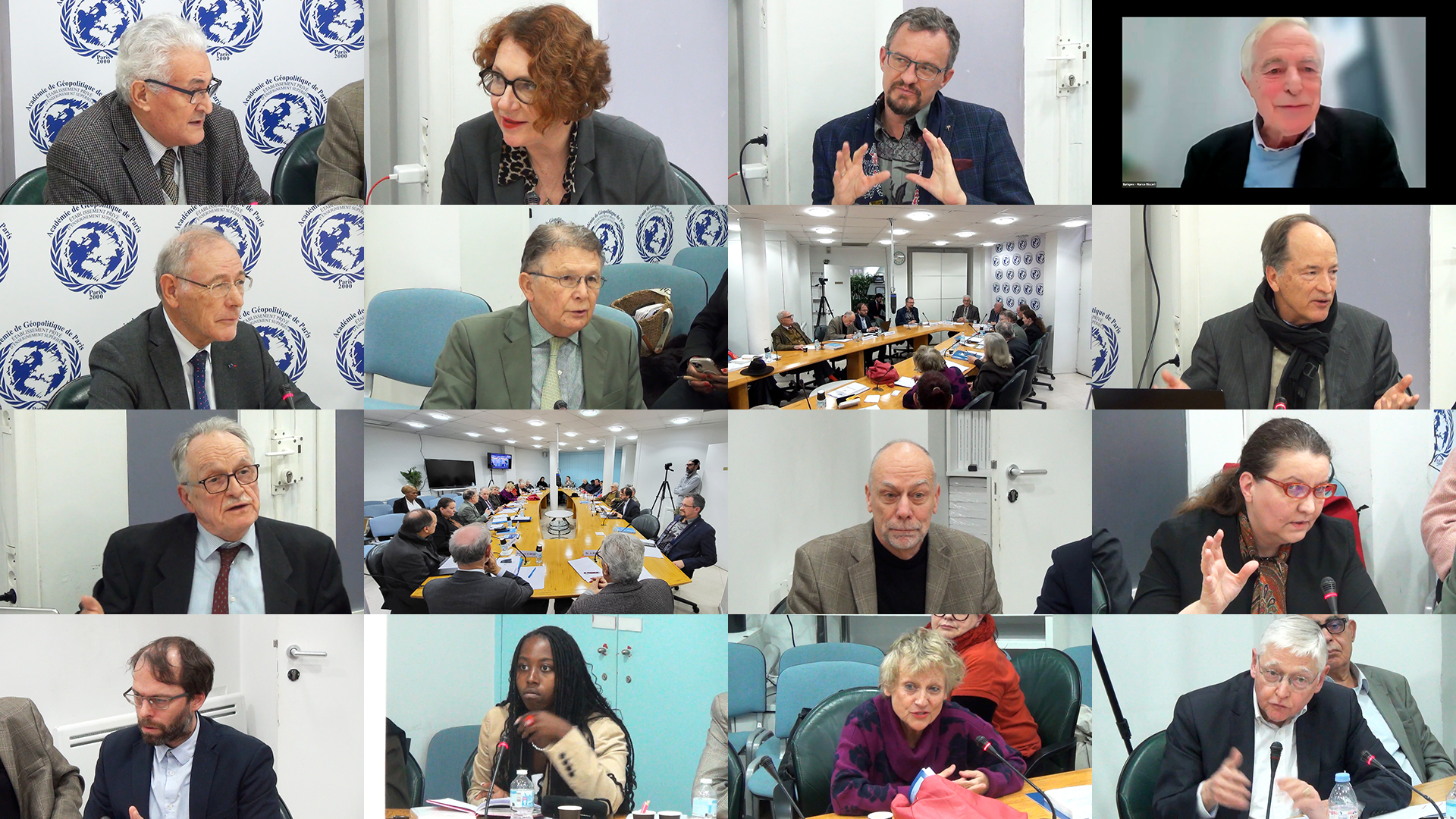
The Scientific Council of the Académie de Géopolitique de Paris (AGP) organised an international symposium on “The importance of BRICS in the transformation of the international order in the 21st century”.e Friday 28 November 2025 at 5 rue Conté in Paris.
Since the global financial crisis of 2007-2008, the limits of the neoliberal and hegemony model of the US dollar have emerged with great vigour. In this context, new power poles have emerged, including BRICS, a group of states that has continued to strengthen its cooperation and propose systemic alternatives in the economic, financial, political and cultural fields.
Today, the BRICS Group has been expanded to include 10 Member States and nine partner countries, and is a key player in the gradual overhaul of the international system. Its functioning based on consensus, volunteerism and inclusiveness is an original method clearly distinct from the traditional G7 and G20 formats. Faced with growing geopolitical tensions, successive economic and social crises, and persistent conflicts that disrupt global balance, understanding the evolution of BRICS and their influence in building a new international order is of paramount importance.
What is the essence of BRICS and how does cooperation manifest itself? What influence does it have on the internal and external policies of its members? What is the place in the emergence of a new multipolar international order, and how do Western countries perceive the phenomenon? Finally, what role do the BRICS play in the de-dollarization of the world economy? The symposium provided an opportunity to inform the current geopolitical dynamics and enrich the academic debate on the evolution of the international system by answering these fundamental questions.
COMPTE-RENDU
FIRST ROUND TABLE
Dr. Ali RASTBEEN, President of the Paris Academy of Geopolitics, “The BRICS and the recomposition of world power: towards the end of American unity? »
For more than three decades, international relations have been shaped by the spectre of American unity, a configuration unprecedented in modern history where only one power, the United States, has been able to concentrate military, economic, financial, technological and cultural levers, imposing its influence on the entire global system. This supremacy was particularly visible after the collapse of the Soviet Union in 1991, which left the United States without a strategic rival of the same magnitude, paving the way for a reorganisation of the world according to liberal, economic and security principles consistent with their own vision. This unipolar moment was perceived by several analysts as lasting, even irreversible, as power indicators seemed to converge in favour of Washington: The most powerful armed forces in history, the domination of the dollar, control of international financial institutions, technological leadership and unmatched cultural attraction. However, as the twenty-first century progressed, this hegemony began to be challenged by a series of profound changes, which saw the emergence of new poles of power, of which BRICS are the most structured and emblematic form.
The rise of BRICS is first and foremost the product of global economic transformations that have shifted the centre of gravity of the world to Asia and, more broadly, to the global South. China’s spectacular growth from the 1980s, followed by India’s, has profoundly altered economic power relations. As Western economies slowed down, faced with cycles of stagnation, financial crises and population contraction, emerging economies experienced impressive growth rates, increasing their share in world trade and strengthening their integration into international value chains. China, which has become the world’s second largest economic power, has particularly disrupted the international economic order by establishing itself as both the world’s factory, a structuring financial player and a strategic United States competitor in the fields of technology, industry and security.
India, thanks to its dynamic demographics and sustained growth in the technology and services sectors, has become a key player.
Russia, despite its more volatile economic cycles, remains a major player in the global energy sector and a major military power.
Brazil, an agricultural and industrial power, and South Africa, the economic hub of the African continent, complement this panorama of emerging economies, which together now represent a key pillar of the overall economic structure.
The rise of BRICS is not only economic. It is part of a growing desire to rebalance international institutions that emerging countries consider too favourable to Western interests. This criticism is not new: by the 1970s, the Non-Aligned Movement and the Group of 77 had already denounced an international order judged unjust, based on logic inherited from colonial domination and the polarization of the Cold War. However, these claims could never be translated into a coherent and lasting bloc. The BRICS, unlike the configurations of the past, benefits from the presence within it of major actors – China, India and Russia – able to compete credibly with Western powers. It is a space where these countries can articulate their criticism of Western domination, formulate alternative institutional proposals and coordinate some of their actions. The creation in 2014 of the New Development Bank and the Common Reserve Fund was a key moment in this dynamic, as it brought to fruition the BRICS’ ambition to develop financial tools that could compete with the World Bank and the IMF, long accused of imposing destabilising neoliberal policies on the countries of the South.
One of the most sensitive dimensions of this challenge is the question of de-dollarization. Since World War II, the dollar has been the main reserve currency, commercial billing and international settlement. This central position gives the United States considerable power: the ability to impose extraterritorial financial sanctions, control international transactions through their banking networks and finance their debt at an exceptionally low cost. The BRICS, by seeking to reduce their dependence on the dollar, aim to reduce the vulnerability of their economies to American decisions and to promote a more balanced monetary system. The growing use of national currencies in bilateral trade, the development of alternative payment systems at SWIFT and discussions about a possible common unit of account demonstrate a desire to build a more autonomous financial environment. Although these initiatives have not yet called into question the dominance of the dollar, they contribute to a gradual erosion of its centrality, reinforced by the economic sanctions used by the United States, which push some countries to diversify their alternatives.
At the geopolitical level, BRICS defends a multipolar vision of international relations. This vision is based on the principle that no State or group of States should impose its rules on the rest of the world, and that international relations should reflect the diversity of political models and historical trajectories. This view is opposed to the Western idea that liberal values – representative democracy, individual rights, market economy – would constitute a universal and non-negotiable horizon.
For BRICS, the plurality of political systems is a legitimate reality of the contemporary world. They also challenge the use of unilateral sanctions, which are seen as a tool of political coercion that violates the sovereignty of States. This position finds a particular echo in the countries of the global South, many having been subjected to Western sanctions or feeling marginalized by the international institutions dominated by the industrialized powers.
The recent BRICS enlargement to the BRICS+ reflects this growing attraction for a platform capable of expressing the aspirations of the global South. The accession of countries in the Middle East and Africa, some of which are traditionally close to the United States, shows that the international system is no longer structured by rigid alignments but by diversification of partnerships.
However, this geopolitical upsurge faces several structural limitations.
The BRICS, despite its ambition, is not a military alliance or an international organisation with a strong institutional framework. It is a flexible grouping based on consensus, which makes it difficult to draw up binding common policies. This flexibility is both a strength – as it allows Member States to maintain their strategic autonomy – and a weakness – as it limits the coherence and effectiveness of concerted actions. There are many internal differences: border tensions between China and India, regional rivalries between Iran and Saudi Arabia, water disputes between Ethiopia and Egypt or strategic disagreements between Russia and India. These gaps complicate the construction of a common agenda on security, global governance and climate policy issues. In addition, some Member States are pursuing strategic partnerships with the United States or Europe, which limits their engagement with BRICS.
The power gap between the members is also a difficulty. China, as the group’s first economy and emerging global power, exerts a disproportionate influence, which sometimes leads to distrust among other members. India, anxious to preserve its strategic autonomy, is reluctant to accept too strong Chinese leadership. Russia, weakened by Western sanctions and dependent on Beijing, is in a particular position within the group. Brazil and South Africa, although founding members, do not have the same weight as the major powers of the group. This asymmetry complicates the construction of a joint project capable of competing with Western order. However, despite these limitations, the BRICS represents a considerable symbolic and political force, as it embodies a widely shared aspiration for a more balanced and representative world order.
Another essential dimension of the ongoing transformations concerns the soft power. The West maintains an undeniable superiority in this field: its universities attract students from all over the world, its cultural industry produces content broadcast worldwide, its technological innovations dominate the digital economy. The United States has a unique ability to shape imaginations, impose narratives and legitimize its political model as the natural horizon of modernity.
The BRICS, in comparison, have soft power They are more fragmented, less structured and sometimes hampered by negative perceptions of their political systems. Despite China’s massive investment in media and cultural diplomacy, it is hard to convince some public opinion, particularly because of criticism of human rights or the perceived rise in power as an expansionist. India has a more positive image, a dynamic diaspora and a strong cultural influence, but it still faces internal challenges. Brazil, thanks to its culture, sport and diplomatic history, has considerable influence, but constant political instability limits its influence. South Africa retains a symbolic prestige linked to its history, but its economic difficulties limit its ability to influence. However, BRICS is developing a soft power powerful ideological criticism of Western hegemony, the defence of state sovereignty, the call for a more balanced order and the rejection of normative interference. This speech seduces many countries of the global South who see the BRICS as a credible alternative to an international system judged to be dominated by the West.
The rise of the BRICS should also be included in a broader analysis of power dynamics worldwide. American unity reached its peak in the early 2000s when the United States seemed able to intervene militarily anywhere in the world without encountering major resistance. The wars of Afghanistan and Iraq, despite the criticisms, had been waged in a context where no power could oppose them. However, the human, political and economic costs of these interventions have weakened the American position. The 2008 financial crisis further revealed the vulnerabilities of the Western economic model, resulting in a loss of confidence in American leadership.
China, which had gone through the crisis with some resilience, has seen its legitimacy strengthened. Russia, despite the sanctions, has shown, particularly in Syria, its ability to play a strategic role. India has consolidated its position as a major diplomatic actor. All these developments have helped erode the ability of the United States to impose its world view without dispute.
However, it would be excessive to consider that American unity is now totally outdated. The United States retains considerable structural assets that guarantee its dominant position: the world’s first army, technological superiority, strong military alliances, international currency of reference, unique innovation ecosystem and unparalleled cultural attraction. The US military base network covers the world, US technology companies dominate the digital economy and US financial markets remain the deepest and most liquid in the world. In addition, the United States is benefiting from a more dynamic demography than most major powers, particularly in comparison with China and Europe, which face an accelerated ageing of their population.
Thus, rather than talking about an erasure of American hegemony, we must recognize the emergence of a hybrid order, where elements of unipolarity, multipolarity and bipolarity coexist. The Chinese-American rivalry, which is increasingly shaping international relations, is the bipolar dimension of this new order. The rise of BRICS and regional powers contributes to the multipolar dimension. The persistence of American supremacy in several key areas constitutes the residual dimension of unity. This hybrid order is marked by tensions, rivalries and uncertainties. It is characterized by increasing fragmentation, where alliances are flexible, multiple partnerships and complex rivalries. In this context, the role of BRICS is ambivalent. On the one hand, it helps to weaken the US monopoly by introducing a plurality of voices into international debates, creating alternative institutions and promoting a multipolar vision of global governance. On the other hand, it is limited by its internal contradictions, the absence of a coherent political project and the difficulty of proposing a model of governance that can compete with the Western model. BRICS is not a homogeneous block; It does not have a unified ideological project. Its members share a criticism of Western order, but do not necessarily share a common vision of what the international order of tomorrow should be.
In conclusion, the rise of the BRICS is part of a profound reconfiguration of the world order. It reflects the affirmation of the global South, the contestation of Western hegemony perceived as unequal and the emergence of a multipolar system in gestation. However, this change does not mean the imminent disappearance of American power, but rather its repositioning in a more complex, fragmented and uncertain world. The future will depend on the ability of the great powers to manage this transition without falling into systemic confrontations, to recognize the legitimacy of a more diverse international order and to build global governance capable of responding to the challenges of the century. The BRICS, despite its limitations, embodies the idea that the international order is no longer the exclusive property of the West, and that the diversity of historical trajectories must find its place in global power structures. The international system thus enters a new era in which power is shared, challenged and redefined, paving the way for a profound reconfiguration whose contours remain to be clarified.
Prof. Ulrike GUEROT, Professor, political thinker, founder of the European Democracy Lab (EDL), “Can Europe stop its downward spiral? Thinking of Europe beyond the European Union and preparing it for a multipolar world”
I actually come from all this microcosm of European studies, from the “Jean Monnet” Chairs, so in fact all those who have taken care of the European institutions for three decades, and we see that they no longer work, because Europe, the European Union (EU) is still distorted or, in a way, perverted in a technostructure. The question that I’m intriguing is how this Europe can actually fit into what you’ve described – the transition of the world of Pax Americana to a multipolar world, and the place of Europe in it.
I’ve prepared some figures on what you said. What are we facing, what are we seeing? That a BRICS training, together with those who are now candidates, actually covers approximately 50% of the world’s population, all resources cheap labour (the cheap work), most of the global resources, a BRICS currency that is at least in planning, precisely for the strategy of de-collarization, the idea of a system of own trade – which will actually cut off the trading system of today where the North actually takes the resources of the South to refine the products and after resell them, so we could soon see ourselves facing a system of the North and a South system, where in fact the North will no longer have the resources and will no longer be able to sell to the South – and therefore the idea of a clean development bank. All these ideas were already in the pipes of the BRICS countries, and will sovereignly compete with the world of Pax AmericanaIn the Western world, NATO and all that it understands, liberal democracies. If we want to make a few small comparisons, you can see very well that the BRICS are in fact passing and being dominant over almost all the economic data, whether it is GDP, integration into the global trading system or, above all, at the population level. We see very well that the transition is stifling the West, the Liberal West or the countries of NATO/G7, so that the West system is in stress (…), if we can say so. And besides, the war in Ukraine is in a way the articulation of this war, since obviously it is not about saving Ukraine, or being liberal, but it is precisely about a proxy-war in which there is actually a confrontation between West and East, or NATO against Russia with China. That’s why what’s going on is very interesting for what we’re discussing.
At the level of energy production, or at the same time of autarchy (…) nutrition, food, the BRICS are emerging greatly – you see the parts in dark red. And since Mr Rastbeen was also talking about de-collarization, about the fall of the dollar, or about this idea that the world could “de-dollarize”, we see very well that the dollar’s rating is going down, although it must be said that the Americans are still very clever to stabilize the system at their own discretion. You certainly followed as I did that in August there was some regulation in the US financial markets on the stable coins, and that the Americans introduced the stable coinsto be saved by the EDF, i.e. they have created grosso modo an endless liquidation resource because if now the Federal Reserve must save stable coins, it actually adds a more or less private currency – because it is the currency of the GAFA complex, digital oligarchies that now have almost endless liquidity – which also says that the Americans will still, I think, be the only ones to survive crises, because they have precisely avoided a challenge. And so here too, we see very clearly that at the level of resources, and at the level of billions hidden in the financial markets, we see very clearly that the process of de-collarization is complicated because precisely and China and all the others still have a lot of reserves in dollars. But with the change of the SWIFT system – because it seems that the system that the BRICS invented makes passages, money transfers, in two real seconds, compared to several, one or two days, in the SWIFT system – I think we’re going to be very well able to witness, how to say, a really clear transition, or we could say that the BRICS countries have a very important gain in the transition.
So what about all this? I like the oldest map of Europe which is 1534 (found elsewhere in Austria) because I find this map talking to us. And my interest in study is: “How should Europe behave in this world in transition? Since we are Europeans, since we want to have a place in the multipolar world, the question is “what will Europe do?”.
With this map, it is already important to realize three phenomena, which will still speak today, because this Europe already lays its feet on the continent of Eurasia, therefore on Russia. She looks towards the East, and then she doesn’t turn her head towards Washington, just to get a symbol of this map. I find this sentence important because if you imagine today the NATO line, through this map, so you start with Sweden, Finland, and you go down to Turkey, in fact we will cut Europe into 2 below the navel… This is the real world today: Europe is cut in half below the navel, the Europe of this map. And so if you imagine a torso it would fall in the water, in the Atlantic. So I think Europe is completely torn apart. In fact, the war in Ukraine shows us very clearly that Europe is completely torn between being still completely under the aid of this American order, the liberal NATO of the West and all that, cut in half with a part of Europe that actually wants to go east, to Russia, not to lose China, also culturally, and besides what the Russians also say, (…) was very clear about this, that Russian culture considers itself part of European culture. So the tear touches Europe, touches Russia. There are many Russians who do not want to be pushed solely to the BRICS, to China, because they rightly claim that Tolstoy, Dostoevski, are all part of European culture. What I mean is that this transition between Pax Americana and the emerging BRICS countries play on the European continent and divide the continent as drawn in 1534. And it’s lamentable because if we say, again, that there is a direct line that cuts Europe in half, basically that means that Europe is dead… We, we do not know where to place ourselves because we are really trapped, because deindustrialization, de-dollarisation, Europe’s dependence on NATO, Europe’s dependence on the GAFA complex, all the servers, the entire European digital system are in the United States, so in fact we have three huge dependencies: it is the dependency for security on NATO; addiction GAFA complex and digital, the digital world including artificial intelligence (AI) that will add – the EU mobilized 50 million, while the Americans mobilized 500 billion for the AI program… – and the third dependency is the dollar. So the GAFA, NATO and the dollar are the three major dependencies of Europe, the liberal world, NATO, the so-called Western world. In fact, Europe is completely trapped not to free itself from this complex, or not to find resources. Besides, I speak in France, I am in Paris, I am not a big fan of Macron, but we must remember that when Macron started in 2016 the word European emancipation and “European sovereignty” was still at its beginning. I am not idealizing Macron, but this tone of saying that Europe needs emancipation, I found it at least a little smart.
So I think that Europe today has to deal with two questions: Shaping Europe beyond the EU (form Europe beyond the European Union); and Shaping Europe for a multipolar world (forming Europe for a multipolar world), and I come back from Brussels, from the European Commission last week, and the EU fails enormously on these issues. Because just talking about BRICS, or cooperating with BRICS, is basically taboo in Brussels. In Brussels, BRICS does not take place, and in itself I find it a disaster, it is even a cognitive dissonance for a continent which still claims to be the continent of theenlightenment (lights), humanism, etc.
The little bull with the woman in front is our logoEuropean Democracy Lab (EDL) because we have been thinking about these two issues for about ten years, and it is true that I find that the question on the table or else Europe, another Europe and not the European Union, could actually decide to leave NATO and, in a way, be part of the transition, i.e. to be an active member of the transition of the European Union. Pax Americana to a formation of BRICS, and to include the goal of European emancipation in the transition, i.e. that Europe would imagine a little like a Switzerland in big, Europe would imagine neutral, and it would imagine as a force which, in a multipolar world with great forces like China, Russia, India, Iran, etc., could bring to this multipolar world its capacity for diplomacy. Because it is still we the countries of Westphalia of 1648, which is actually the model of the UN, so Europe also has experience through its history with many wars, that it always needs a balance of powers. If I imagine Europe in a multipolar world, in the second half of the XXIe For my part, I imagine a neutral Europe, which has passed institutionally the European Union, and which offers itself as a place for diplomacy and as a resonant place to forge a balance of the great powers, because precisely the other elements of the multipolar world are in fact empires (China, Iran, etc.) while Europe, by definition, is postcolonial. European history, by definition, is a story where one has never let an empire grow, because each time it gives a war. So in fact Europe has the ability to balance perhaps the multipolar world, because it is by definition postcolonial.
You asked why Europe should become a republic. It was my little fantasy in a book published ten years ago, because the current EU system is under-known, in fact it is a technocracy. I worked for Jacques Delors, and by the way we still had the ambition of a functioning, democratic political system. No one has come into being, but it is clear that a democratic system must resolve, based on the principle of equality of its citizens. And this is not the case: we do not vote in the same way in the European system, we do not have the same constituencies, the same social rights, and therefore in fact the EU by definition. di sui generis is not a democratic system.
If a democratic system was to be established, Europe should be constituted as a republic, because normally when a republican system was formed, a political system with two chambers, with a way of functioning in which citizens were equal before the law. And so we would have a system of chambers where the EU Member States will pass into a second chamber to be in a sort of Senate, but we would have an assembly that will be based, just like a European national assembly, or republican-European, on an equal right to vote for all citizens.
I know it’s a fantasy, but since any system that doesn’t work will fail at some point, I think the EU will fail at some point. I also think that this particular moment is not very far in the future, but rather very close. We will see, and so maybe a utopian idea will see the day even sooner than we think. Thank you for your attention.
Prof. Gracjan CIMEK, Professor of International Relations, Polish Naval Academy (Gdynia), “The importance of BRICS according to the model of competition between actors of ‘new’ and ‘old’ eras of international relations” (en anglais)
Thank you very much. Dear President, dear professors, dear participants of our meeting, it’s a great honor for me to participate in this seminar on BRICS accompanied by so many distinguished researchers from all around the world. The importance of the topic of this meeting is confirmed by the rapidly changing international reality. I would like to express my special thanks to Professor Ali Rastbeen and Professor Drweski for their positive feedback to my initiative to organize this seminar, and to everyone who accepted my invitation. Now, let’s jump to my intervention.
In order to fully understand the role of BRICS countries in transforming the world order towards multipolarity, it is necessary to place it in the broader context of international competition, identifying different levels of influence according to the strength of the links between the actors involved. I have used ideal types to compare the actors of the new and old eras of international relations. I will present a multilevel model that will highlight the importance of the BRICS, which are not formalized and operating on a voluntary basis, except a real influence on the direction of change in the 21st century.
From a long-term perspective, the old era is a period in which Western powers dominated during the hegemonic cycles of the last 500 years, chromatic in American hegemony. Its result is the emergence of global multi-crises, raw materials, food, energy, transport, health and the environment. At the last BRICS Summit in Rio de Janeiro in 2025, President Lula da Silva, President of Brazil, pointed out that the world is in a deep structural crisis.
International law had become a dead letter, as had the peaceful resolution of disputes. In addition to an unprecedented number of conflicts since World War II, progress is threatened by neglect of the climate system, trade wars, attacks on the global healthcare system, intellectual property laws restricting access to medicines, and finally the fear of nuclear catastrophe. Neocolonialism means that foreign capital is used to exploit nations, which is why emancipations emphasize economic independence and diversification of the economy.
President Lula said that the essence of neocolonialism is the reverse Marshall Plan, implemented for decades by the International Monetary Fund (IMF) and the World Bank (WB), under which emerging and developing economies essentially finance the centers of Western capitals. International aid flows have declined, while the debt costs of the poorest countries have skyrocketed. The neoliberal model only accelerates inequalities.
For example, 3,000 billionaires have earned a combined $6.5 trillion since 2015, to quote President Lula da Silva. It is worth to remark that the term of the 14th BRICS Summit in China in 2022 was « strengthening the high-quality BRICS partnership, entering a new era of global development », as it reveals the direction of the group evolution in the second decade of the 21st century. During the summit in Burma in 2023, South African President Cyril Ramaphosa stated, I quote, « BRICS is an equal partnership of countries that have different views but a shared vision of a better world ».Therefore, BRICS can essentially be characterized as an inter-civilization association of countries for a new era. « The world has changed. we don’t need an emperor. We are sovereign nations ». These words from the Brazilian leader can be considered the essence of the new era paradigm, and led back to a picture – which is here on the TV screen – which is a description of my model division of actors of new and old era.
So, at the basis, we see competition between the United States and the People’s Republic of China, which the grapher Alisson described using the category of too key to destruct. A weakening hegemon provokes warfare out of fear of collapse at the hands of a new power. Alisson described that of 16 historical examples, the author proved that only 4 did not end in the hegemonic war. With its ability to impose its interest warning, the US changed its methods of conducting great power politics by updating. Of course, I talk about the Donald Trump era of the ruling of the United States. So, during his presidency, we can see the updating of that 1973 concept of American historian, Frederick Jackson Turner, based on the rhetorical feature of « dynamic frontier ». The key to bringing civilization peace to tame space, expand the so-called free land, and wrest it from the hands of barbarians.
A manifestation of this geostrategic change is the cancellation of the model of empire as a deterritorialized vehicle of individual freedom, liberal democracy, human rights, and the global market in the favor of territorial imperialists and the superior rights of American citizens with their specific identity. Instead of global information network and institutional governance, classical institution is developing, promoting spheres of influence, and thus updating the principles of classical geopolitics from the turn of the 19th and the 20th centuries or later periods of offensive realism in international relations.
Examples of these processes including open demands to annex Canada, attempts to take over Greenland, establish control over the Panama Canal, change the name from the Gulf of Mexico to the Gulf of America, attack on Iran, supporting of Israel, now threats against Nigeria, and sending the name to put pressure on Venezuela. The goal of the new American strategy is to weaken China, which is rightly considered the most significant threat to American dominance, including the disintegration of BRICS. Hence the threat of imposing 100% tariffs if a new currency is created that threatens to weaken the Dollar, accompanied by the narrative of death of BRICS by Trump, to decide to put India away, to departure from a confrontational stance towards Russia, the imposition of sanctions on South Africa, pressure on Brazil, and attempts to keep Saudi Arabia on its side.
But at the effect, new American geostrategy, emphasizing the pursuit of national interest and pragmatism in asserting opportunists and threats, allies and adversaries alike reject the messianic vision of the United States as a savior, and in fact the policeman. And Secretary Rubio said, « It is not normal for the world to have only one pole of power. It was an anomaly. It was the result of the end of the Cold War. Ultimately, we will return to a multipolar world. We are seeing this now in China and in some extent in Russia ». So, this is the basis of the realization between the model of so-called old era actors and the right new era.
At the next level, we see the geostrategic blocks. Geostrategic rivalry based on alliance becomes apparent. The Anglo-Saxon Heartland, which I remarked the works of Professor Kees Van der Pijl, which will give his speech later, the so-called « Five Eyes » Alliance comprising the US, the UK, Australia, New Zealand and Canada, are involved in defending American hegemony. Three of them have formalized their ties by creating AUKUS in 2021, to which they are attracting the other two, as well as Japan. And at this level, the countertrend is expressed by the emerging China-Russia-Iran-North Korea axis, formed during the Russian-Iranian war, which can be called a « Eurasian bloc », sometimes referred to as CRINK, as confirmed by the report from the US intelligence agency. According to the report, the United States is facing a new international sub-coalition, in which each actor flows its own area instead of creating a hierarchy and a centralized interdependence that could undermine the foundation of the unipolar war. Russia, China, Iran and North Korea would not form a formal bloc, but a network system with distribution of functions. China legitimizes this diplomatically and visually, but avoids open arms supplies. Iran supplies drones and will exchange technologies. North Korea is the main supplier of artillery and manpower, supporting of course Russia during this war. According to the DIA, Moscow is not building a union around itself, but a diversified logistic and technology chain.
However, in contrary of the description of this report, we can observe that allies’ ties in CRINK are formed on the basis of various legal forms. The Treaty of Mutual Assistance and Cooperation between China and North Korea, now in 2025 between North Korea and Moscow, Comprehensive Strategic Partnership of Coordination for a New Era between China and Russia, supporting of Iran, and many others which will be described in my article.
But look at the latest information. After Russia and China began selling modern weapons to Iran after the end of the Iran-Israel war in June 2025, a few weeks ago in a joint later to the United Nations, Iran, China and Russia have also opposed Europe’s attempt to impose sanction on Tehran as legally unfunded and without the (…). These strategic ties are a manifestation of the power of the three countries that belong to BRICS. Yes, only North Korea doesn’t belong to the BRICS, but the three others are part of BRICS.
At the third level, we see the NATO from the left, and Shanghai Cooperation Organization is a part of the model of New Era. And of course, NATO, which forms the foundation of the power projections capitalists of the collective West bloc of states, is the collective participation in international relations. But, with the collapse of the Soviet Union, the loss of its legitimacy saw a new one at the beginning of the 21st century. It became part of American Geostrategic Code of the War on Terror, now replaced by a rules-based order. The alliance’s potential was strengthened by the admission of Sweden and Finland in 2003-2004, while still emphasizing the need for further expansion towards Ukraine and Georgia. And in terms of defense spending, it appears to be the strongest military bloc. But NATO Secretary General Mark Rutte says the West is not ready for what awaits in four to five years, calling for a shift to war mode and increased production and defense spending. The justification is that Russia, China, North Korea and Iran are trying to weaken North America and Europe and transform the global order. But when we observe the effects of the NATO summit in Hague, there was minimalist in form and content, the main element of this is the increase of defense spending with a new target of 5% of GDP.
An opposite side is built by Shanghai Cooperation Organization, which was formalized as an intergovernmental international organization in 2001. In addition to synchronization in terms of expansion, there is also growing convergence between Shanghai Cooperation Organization and BRICS in terms of membership in the core and partnership belt. At the current stage, four members of the BRICS core, India, Iran, China, and Russia, are also members of Shanghai Cooperation Organization. The core of BRICS currently also includes two dialogue partners from Shanghai Cooperation Organization : the United Arab Emirates and Egypt. The newly created BRICS partnership belt also included two Shanghai Cooperation Organization core members from Central Asia, Uzbekistan and Kazakhstan, and one core member from Europe, namely Belarus. In addition, some core participants of Shanghai Cooperation Organization and partner economies have been granted membership in the New Development Bank (NDB) of BRICS in recent years, notably Uzbekistan and Bangladesh, which has applied for Shanghai Cooperation Dialogue Partner Observers. With the expansion of the Shanghai Cooperation Organization, the block launched a new format in 2024, and as we observe the development of this organization, it can show the way on how to develop also institutionalization of BRICS. An important aspect which isn’t present in BRICS but in the Shanghai Cooperation Organization is its category of indivisible security community. And of course, another important aspect regarding these two formal and informal organizations of new era is the promoting of building the new Shanghai Cooperation Bank, meant to help develop the global (…) infrastructure and would be part of the building of alternative institutions of those controlled by the West.
And the final level of confrontation between old and new era models involves informal institutions with real goals, and that’s why I put the BRICS at the same level as G7, because I don’t think it’s methodologically correct to put the BRICS at the same level as NATO, because there are different kinds of activities. That is the reason I have prepared those models.
G7 brings together the centers of capitalist West, of course. The main goal of this format was to maintain the purchasing power of the key currencies of the capitalist economy. Of course, Russia was part of it during the time of Yeltsin, and Russia didn’t want to be periphery of the West, and was dominated by the oligarchy elites. After, of course, the crisis in Ukraine, the West suspended Russia from G8, and in 2017 Moscow left the group. Now we can have that they want United States to promote that Russia is to be back in G8, but I think it is an irrational attitude.
But let’s look at the newest of G7 activities. In order to counter the appeal of China’s Belt and Road Initiative (BRI), it was within the G7 that the « Build Back Better World » project was proposed, arguing that the private capital would provide developing countries with 40 billion in aid, as an alternative of the proposition which came from, of course, China’s Belt and Road Initiative. And let’s jump to the description of the military situation between Iran and Israel. In the G7, G7 stated that « we (G7 leaders) reaffirm our commitment to peace and stability in the Middle East. In this context, we affirm Israel’s right to self-defense, to defend our support for Israel’s security ». And that is the clear difference between G7 and BRICS, as a part of this old and new era model, which I have described.
So, at the end of my speech, I want to highlight that for me, from my perspective, which is the effect of this kind of analysis that are part of my book focused on BRICS which I have now finished writing, (…), but I put on the screen the difference between paradigm of old era actors and new era actors. And, of course, when we describe each actor in international relations, I think we can position each country closer or farer from one of two ideal types. The paradigm of international relations of old era’s basic assumption is exclusivity. New era, inclusivity. That’s why so many actors want to participate in BRICS, and there are more and more.
When it comes to ideas on international governments, old era is based on this well-known description as « jungle versus gardens », the « west versus the rest », value-based order. New era is about dialogue between civilization and mutual learning, no enemy figure, order based on mutual recognition of subjectivity. No mentorism. When it comes to economy, old era means global capitalism in the interest of private corporations, without social responsibility. We have heard from the last 30 years the narration of freedom, but without responsibility. When it comes to new era, it’s adopting the economy to social development, regulated by sovereign national states. When it comes to security : old era, closed based on block mentality ; new era, open indivisible, as was described especially in Shanghai Corporation organization, but it’s also supported by BRICS. When it comes to political system, old era means promoting liberal democracy, legitimizing social inequalities. New era : locally contextualized, but focused on the social development. And last but not least, of course, different building of different mentality, based on different approaches of science. Old era : scientism, positivism, analytical attitude ; and new era : organicity, holism, and taking into account values in developing the society.
So, I think this is proposition of a model of description of the processes of the changing of nowadays world order – at the end of Dr. Rastbeen’s speech, it was also highlighted that now we observe the new era – and I think that it is a good analytical model to show where each block, state and actor is now in this objective of transformation of world order. Thank you very much for your attention.
Prof. Marco RICCERI, Professor, Secretary General of EURISPES, Institute for Political, Economic and Social Studies (Rome), “BRICS and United Nations reform” (en anglais)
Thank you and my congratulations to the Academy of Geopolitics of Paris for this important opportunity. In our institute, we have a group of experts, a think tank working since 2015 about BRICS topic. And we apply a multidisciplinary and systemic approach in studying this new coordination, its activity, its goals, its way of proceeding. In my contribution, I was very stimulated by the contribution by Gracjan Cimek about the new era. And the question that arises in my mind is how to be constructive in the new era ?
The first I want to put to your attention is concerning the clarification of basic concepts that are used in this particular period. Because we see that, both in literature and in journals, in the (…), there is a lot of confusion and mistakes. For instance, we read very often that globalization process is going to finish : the end of globalization. This is a completely wrong approach. Globalization is a process evolving in different periods, with different characteristics. And so now we are in the new stage of this process, and we have what we call « re-globalization », because the interconnection in our life, in our system, is so strong that it is designing a new possible process, a new possible evolution. So, let’s cancel this idea that we are living the end of globalization.
The second concept to help to put clarity in our documents and our approach, is concerning multilateralism. You read very frequently that multilateralism is at the end, and that the new multipolar world is increasing. It is not a multipolar world, it’s multi-centric, because in the new center, it is a sort of a community among the participants. So, we are not looking a new multipolar system or a new bipolar system, but we are living in a multicentric system in which are emerging new actors in political, economic and cultural terms.
The third concept to clarify well is that we use very frequently the counter-position between North and South, East and West, Global South… These concepts are very old, (…) West and East, but now in this current situation, are really not adapted, not a good point of reference. I think that we must really start to think about new concepts of reference. There was a debate a few days ago in Bologna. We must change our idea of Global South, or North and South. They are of no more service. Fourth element. So, in our way of thinking and applying to the BRICS situation and the global order, we must make clear the concepts, the basic concepts of reference.
Another point that is very important for me is concerning the contradiction of our time, of this period. On one side we have tensions, protectionism, conflicts, wars, etc., but from the other side we see that all the states, all the community of the states, is still working on common platforms of reference. This is a very important contradiction. And if we want to be constructive in the new era, we must put the main attention on what is uniting states and peoples and societies, more than what is dividing them.
I give an example. The community of states shares a common platform, starting for instance from the Agenda 2030 for sustainable development. Every community or state at the regional, or continental level have experienced its own methodology, policies, and so on. There are some countries that are going back, because too difficult. There are countries that are pushing to become more competitive, just going in the direction of sustainable development. In any case, the Agenda 2030 remains a common platform in which all the states, I repeat, all the states are committed to achieve goals and elements of progress. The same platform you find in the Pact of the Future, that was approved inside the United Nations last year. And just a few days ago, we have the second World Social Summit in Doha, in Qatar : if you look at the final declaration approved by all the states, you find a lot of elements of common commitment to pass from a development model based on quantity to a new development model based on quality.
So, there are two situations : tension and conflict from other side ; and common platform, common commitment, common challenges shared by all the community of states. And this involves also the idea of the common good, what we call common good, the common challenge for environment, for climate, democratic and social environment. These are the elements over which we must work to be constructive. If the community of states approves and continues to work in this direction, we must understand, clarify and support these efforts as academia to work with political decision-makers.
Concerning the BRICS. The BRICS are very active in this direction. And this is an important element. In the literature, and also in (…), you see that you read very frequently that BRICS are disruptive for the international order. I want to read and to call the value of the official documents approved by the BRICS in the annual summary, the factual declaration and many other official documents. Taking in mind that one thing is the declaration by the different leaders, one other completely different thing is the official documents approved by the summit. And what do I see in this document : I see a great, continuous, great effort to reform, not to disrupt the international order. This started from 2009, the first official summary, until the last summary. You find clearly based this project, this will of reform. For instance, the reading I have here, the final declaration of the last summit in Rio de Janeiro. They sign a more balanced multilateral system, global system, they recognize the central role of the United Nations organization. There is not one document in which they contest. They will not disrupt the United Nations. They want to reform, to make more valid, effective, the United Nations, as a central, main center, in a principal international institution. If you go to read the similar expression of will of reform concerning the World Trade Organization (WTO), it was just last year the 30thanniversary of WTO and all the states including the BRICS officially affirmed the very important role of this organization. Look at point five about United Nations, and point thirteen about WTO.
And also, about the G20 – and here I connect with the previous speaker. G20 is officially recognized as the basic engine for the world system and its economic development. So, the G20 is becoming the tool in which the BRICS can play a very important role, constructive and not destructive. If you have in mind that last 15th of October, the Secretary General António Guterres started with a work in progress with the first official document concerning the reform of the United Nations. We see that the BRICS can play a great role in proposing concrete reform of the United Nations.
My conclusion in this discussion is the following. If the BRICS are a reforming body, if the spirit (…) the United Nations, the WTO, the G20, the governance of the international system, we must have an attitude open to the other. And it is a great missake, especially from the European Union – the second speaker (Ulrike Guérot) was very clear – they are blind, because they don’t have dialogue. When we read the document approved by the European Parliament, you put your hands in the head! They are very closed and blind: ” We recognize that the BRICS are an important (…) but we invite to have relations with a single state ». So, this is written officially in the resolution by the European Parliament. So, we must change completely our approach in a period of deep changes and transformation. This is another concept (…). If there are bodies emerging in the international scenario, new institutional centers that want to reform, not to disrupt the international order, we must have an attitude open to dialogue. This is the first commitment of the European Union : to change its attitude, because it is too blind and not constructive.
Let me conclude with a reflection about always this idea to have clear concepts of reference. We use the word « change » and we use the word « transformation ». They are two completely different concepts. When I use the word change, that means I go in a way that I know well, find obstacles, try to remove the obstacles because I want to continue my way. When you use the term transformation, that means that you arrive to a crossroad in which you have different alternatives, and you have to choose what is better for you.
So, we are in the situation of structural transformation. The new scenario will be completely different from the scenario that we have now. That means academia and political decision makers have to work together to get an idea of the future that we want to build. Not a future to explore in (…) and so on, but a future to build what is the possible scenario that I want to build. This is the cultural and also philosophical and ethical (…) that is emerging more and more clearly in the new multicenter system that we have. Thank you very much.
SECOND ROUND TABLE
Rector Gérard-François DUMONT, Professor at the Sorbonne, Vice President of the Académie de Géopolitique de Paris, “The geopolitical consequences of BRICS’ differentiated demographic trajectories”
Thank you very much, Mr President. As you know, among my subjects of study there is one of the branches of geography and geopolitics that is called the geopolitics of populations, so I thought it might be interesting to compare the reality of BRICS with the geopolitics of populations, asking the following question: in view of this discipline (the geopolitics of populations), should we talk about unity of BRICS or fragmentation within BRICS? And to answer that question, I propose that you consider three points. On the one hand, the question of natural developments, i.e. the extent to which the laws of geopolitics of the population, namely the law of number and the law of differentials, actually help answer the question. Secondly, I will examine the migration systems of the different countries in their two aspects: immigration, thus attracting international immigration; and the repulsion aspect somehow, so emigration, and what does that mean in geopolitical terms.
On the question of the law of number, it is obvious and I will not teach anyone that, of course, the demographic weight of the countries of the BRICS, since the enlargement of the BRICS of 2025, results in differences in the number of inhabitants according to the countries of the BRICS extremely important. And these differences necessarily question the difficulty of finding common decisions, knowing that the objective of the BRICS is still to weigh a certain weight in the international concert of nations and that, already, the demographic weight they have, i.e. if we add up the populations of the BRICS we find 4 billion inhabitants, which make up 48% of the population of the world. It is therefore much more important than, for example, the five permanent members of the United Nations Security Council, who have a veto right as everyone knows. And so in this context we see that the demographic weight exists, and that it is scattered among extremely varied countries, and that this raises the question of accepting new members. It was found that there was ultimately more refusal than acceptance at the last BRICS meetings, and therefore one may wonder to what extent this is not evidence of fragmentation, some countries having been refused because another BRICS country considered it to strengthen its position, or where it was to avoid the promotion of a regional rival.
But what seems most interesting to me is that there are at least four types of natural demographic dynamics within the BRICS. We have countries such as Egypt and Ethiopia, which have an extremely high natural growth rate, because they have not completed their demographic transition. Second, South Africa, India and Indonesia are almost at the end of the demographic transition, so in fact they have a natural population growth which is explained by what is called demographic inertia, hence the effect of the momentum gained. Third type, Brazil, the United Arab Emirates, Iran, which are really in the demographic winter, with fertility well below the generation replacement threshold. And then, finally, China and Russia, fourth type, which are experiencing depopulation, so whose population is shrinking, and most likely we do not see the elements that could prevent further depopulation in the coming years.
So the result of these differentiated changes in terms of natural population growth is a considerable change within BRICS compared to the situation that prevailed when BRICS were created. When the BRICS were created, it is the most populous China. Today it is India, which is the most populous BRICS with a path of continuing a population increase, while China is depopulating. And so it is in this context that we must reread the objectives of the BRICS, which are a re-foundation of international financial organizations and the enlargement of the Security Council. I would simply like to quote two or three sentences from the statement of 6 July 2025 made in Rio de Janeiro on the 17th July.ème top of the BRICS. In this statement, for example, it states: We reiterate our support for a comprehensive reform of the United Nations, including its Security Council” And a little further: ” We reiterate our support for the aspirations of Brazil and India to play a greater role in the United Nations, including in its Security Council. ” So clearly, there is support for two members who have been calling for years to be permanent members of the Security Council, with the same prerogatives as others, so in fact with the right to veto.
On the one hand, India, which filed its application in 1994, but we see that the logic of being a member of the Security Council is justified because it is the most populous country in the world, it is justified also because in 1945 it was only a British colony, so the geopolitical context has changed and it is entirely justified. But we see the problem at once: is the other member of the BRICS, called China, ready to accept the other great Asian country having as many powers as it does in the UN Security Council? And you see that there is a first fragmentation problem.
Second element, Brazil. Brazil submitted its application in 2005 under the so-called G4, with Germany, India and Japan elsewhere. Brazil’s position here too is justified by its demographic weight, also justified by Latin America, Brazil being by far the most populous country in Latin America, which is not present in the UN Security Council. And then, when we think that the logic of BRICS is still a logic, to simplify I’m going to say “anti-G7”, it’s true that Brazil’s entry into the UN Security Council as a permanent member, with of course the right to veto, it would be almost a burial of the Monroe doctrine, since it would give weight to Latin America.
But at the same time, we have to see that there is also another country within the BRICS that is more populated than Brazil, which is called Indonesia. So Indonesia could have the same reasoning, saying, “One, I am the fourth demographic person in the world, so it would be justified if I were in the Security Council; Secondly, there is no one representing Southeast Asia, so why not me?” So you see that there too, within the BRICS itself, there is a difficulty in concretizing in a very precise resolution the intentions that were indicated in the Rio de Janeiro Declaration which I mentioned earlier.
The same problem of course arises for Africa’s representation on the Security Council. For a long time it was considered that it would not have been illogical whether South Africa, almost founder of the BRICS, for two reasons. First, because South Africa has the highest level of development of all African countries; and secondly, South Africa has this aura of “the rainbow nation” that has succeeded in defeating apartheid, etc. But, of course, this is not necessarily the way to please other African countries that are much more populous than South Africa: of course Nigeria, the most populous country in Africa, and then Ethiopia, simply, or Egypt.
So you see the difficulty of finding unity in the face of demographic differentials, which elsewhere will only increase in the coming decades.
I come to my second point, which is to examine the systems, the immigration systems of the various countries of the BRICS, and I will therefore propose a typology. The typology already begins by addressing extremely unattractive countries, which results in their immigration regime having virtually no geopolitical effect. I want to talk about China first. So you’re going to tell me that China still knows how to attract foreign students, at one time it was attracting entrepreneurial migrations but now it’s not interested anymore since, that’s it, it has benefited from the technology transfers that it wanted. Brazil is also very unattractive. Well, it is true that in recent years it has been a little more vis-à-vis Venezuela given the governance situation in that country. And then Indonesia, even though it has hosted some Rohingyas in recent years or a little Afghans, so it cannot be said that it is an attractive country. It is therefore neutral, in a way, migratory regimes that do not have geopolitical effects.
The second type of migration attraction is extra-BRICS migration attractions, which come from countries other than the BRICS, and whose geopolitical effects will be considered to be rather unfavourable, as it is migration that poses more problems than benefits in the countries they visit. I just start with South Africa. We are well aware that South Africa is a major immigration country, particularly for sub-Saharan Africa, we know at the same time that South Africans consider that these sub-Saharan migrants are the competitors in the labour market and that there has been extremely harsh violence, with deaths elsewhere, against immigrants, to such an extent that you remember that last year Nigeria was forced to send planes to repatriate these migrants. So finally, immigration to South Africa gives a negative picture of the ” rainbow nation” I was talking about earlier. As far as India is concerned, it is rather migrants from Nepal or migrants from Bangladesh who are Hindus, but it is a relatively small migration but, again, that India does not necessarily consider desirable. The best evidence is that India has built a wall with Bangladesh to reduce this immigration. The worst situation is that of Egypt. Egypt today is about 9 million immigrants, which are ultimately the result, in particular, of neighbouring wars: Sudan war, Libya war, Syria war, Yemen war… and Egypt would prefer that these immigrants did not arrive on its soil to impoverish a society that is not in a wonderful state. Similarly, many Eritrean, Sudanese and Somali nationals would do without Ethiopia, which did not bring much to Ethiopia. As for Iran, it has mostly welcomed Afghans, as everyone knows, it has not appreciated this presence so much, so that it has conducted operations to try to make them understand that it is sometimes necessary, even if it is not the case. manu militari, qu’ils regagnent l’Afghanistan.
As far as Russia is concerned, there is also a difficulty. So, there, in an intra-BRICS migration, since it is mainly, at this stage, talking about the Chinese who cross the river Love to go to the Russian Far East, which can be seen as an economic advantage because they are very hardworking people, but which still worries Russia because the Russians in this region are a population that is declining (low fertility, departures to the West), and therefore Russia is sometimes concerned that one day China is again demanding sovereignty over the Russian Far East, which in addition has significant resources. So you see that these intra-BRICS migrations can cause problems in the case I’m going to mention. Nevertheless, Russia appreciates another migration, but it is extra-BRICS, and Russia is indeed happy, especially due to the decline in its labour force, to welcome about 12 million people who come mainly from countries of the former USSR: South Central Asia, Ukraine, Armenia, Georgia… Although this labour force is often temporary.
Fourth, intra-BRICS attractions contribute to geopolitical synergies, and here I will give you two examples. The first example is that of these two BRICS countries, the United Arab Emirates and India. Clearly, the United Arab Emirates needs labour, is rather very happy to have Indians, and they are so happy that they considered it worth paying dividends to India, that is to say, making important trade agreements with the Indian government through a bilateral investment treaty, and the sovereign funds of the United Arab Emirates, in return for this Indian labour force, are contributing to India’s development through investments in port, energy or logistics. And to show that there indeed we have a geopolitical synergy India-United Arab Emirates, on February 14, 2024 Narendra Modi inaugurated a Hindu temple in Abu Dhabi. So you see it’s interesting, but is it part of the BRICS unit or their fragmentation? Perhaps eventually to their fragmentation, because for India it is in the interest to be present in the Middle East, through the United Arab Emirates, and possibly to counterbalance the Chinese presence in this region. So we’re more like bilateral logic, not a collective logic that could be that of the BRICS.
Secondly, geopolitical cooperation between the United Arab Emirates and Ethiopia. And here we are in the same way, I have seen on several occasions on the spot that the United Arab Emirates enjoyed seeing Ethiopian immigrants, sometimes to replace Pakistani immigrants who came from Peshawar (Pakistan) and whose control – for some of them, perhaps a minority of them – is considered more difficult. So again, a little in the same logic as the United Arab Emirates and India, so we have many agreements that have been made but which, too, are bilateral agreements, which are not in the collective logic of the BRICS.
The third point I have announced to you is: what about emigration from BRICS countries, which leads to the creation of extremely important diasporas, especially in Western countries and, of course, in the United States? There are essentially two diasporas that need to be analysed with regard to the BRICS issue, namely the Chinese diaspora and the Indian diaspora.
Regarding the Chinese diaspora, it is clear that it is fairly well controlled by the Beijing power. So apart from the exceptions, the Chinese diaspora is not involved in political affairs and is not involved in geopolitical affairs. It may, however, involuntarily serve the scheme, in so far as it does participate in the soft power China, that is to say, because of its presence in Western countries, it gives a good picture of Chinese cultural specificities. I will give only one example, but just look at the posters in Paris, it is the development of this Chinese sport that Tai Chi is in Western countries, which gives a positive image of China, and at the same time the Chinese government is delighted because it makes advertisements in China to show how much Europeans like Tai Chi. It’s good for the soft power China, but it has nothing to do with the BRICS question, there too we are in relations quite related to advantages specific to one of the BRICS countries, but not to all countries.
Regarding the Indian diasporas, we are in a completely different situation. India is a democracy, never wanted to control its diaspora, and even for a long time it was disinterested, but it has changed since the 1990s. There we have a diaspora that is very geopolitically mobilized, particularly in the United States. The Indian diaspora must have a considerable role in the geopolitical rapprochement between the United States and India, and the Indian Prime Minister has also been recognized. So clearly we have here a diaspora that serves India’s geopolitical objectives, but it does not give specific advantages to the whole BRICS itself, so we are in a specific relationship.
In conclusion, I would say that you see that there is a gap – all this is questionable, of course – between the media and even academic noise of the word BRICS, which is massive, which can give the impression that we are moving towards unitary geopolitical positions, and an extremely complex reality which can be highlighted by the fact that countries such as Saudi Arabia or Argentina have refused to enter the BRICS as you know, a little at the last moment elsewhere, and therefore in fact what we see in terms of geopolitics of the populations, is that the geopolitical identity of the BRICS group is still somewhat blurred, and ultimately not very conducive to very unitary geopolitical actions. For geopolitical actions that are very unitary, we will have to rely on something other than the geopolitics of the people. Thanks.
Thierry GARCIN, Associate researcher at Université Paris Cité, author of Fragmentation of the World (Economica, 2018), “The Global South and the New International Disorder”
The Global South, a powerful but heterogeneous movement
The expression of global South, which it would have been better translated into global South, is not entirely new, since American academics had already launched in the early 2000s. But it reappeared in the years 2010 and 2020, becoming an almost geopolitical reference since the beginning of the war in Ukraine (2022-…). This sudden rise in a suitcase concept was embedded in a threefold political, legal and economic context.
Contexte politique international power relations are governed by major predators, with various political regimes. Russia of course; Israel, accused of genocide in the Gaza Strip; China, which does not exclude the use of military force to recover Taiwan; the United States, which expressly claim certain territories of its allies (the Panama Canal area; Danish Greenland), and to the State of Canada, whose head of state is none other than the British sovereign. In particular, we see that the security of the European continent is being dismantled: the 1975 Helsinki agreements excluded changes in borders by force. Therefore, if we accept this new law of the jungle, what right does China have to condemn militarily handing over Taiwan?
Contexte juridique : the frequent violation of international law, including and above all by the five Greats who, under their status as permanent members of the UN Security Council, are nevertheless responsible “for the maintenance of international peace and security”. Starting with the three so-called “Western” members: the United States (Serb attack on the Kosovo case in 1999, thanks to the Atlantic Alliance; Iraq invasion in 2003; Colonel Gaddafi’s attack on Libya in 2011), the United Kingdom (same violations); France (Kosovo, 1999; Libya, 2011). Not to mention Russia (Moldova Transnistria, 1994; Georgia, 2008; Ukrainian Crimea, 2014; invasion of Ukraine, 2022). China is not left behind, with the occupation and development of islands and rocks in the South China Sea. In this area, mention should also be made of the exclusion (suspension, withdrawal) of the major American-Soviet and then American-Russian agreements on nuclear weapons, since nuclear arms control has become a battlefield. Finally, we can only see the rapid erosion of multilateralism, which allowed us to respect a common rule of the game, albeit imperfect but only rule of the game.
Economic context : the pivot towards Asia, announced by Secretary of State Hillary Clinton in 2011 and amplified by the creation in 2007 and the reboot in 2017 of the QUAD (quiet quadrilateral between the United States, Australia, India and Japan), this within the framework of the new doctrine of the Indo-Pacific more or less theorized by the Biden administration. Actually, there was something to worry about Washington. Had China not multiplied its GDP by 11 between 2001 and 2021 and exports by 7.5 between 2001 and 2019, while its share in international trade rose from 3 per cent in 2001 to 13 per cent in 2021? Moscow had already begun its reorientation towards Asia before the Ukrainian war (Russian gas pipeline to China, Siberian Force, decided in 2014). The rapprochement between Russia and China was celebrated (in the name of “everlasting friendship,” according to President Putin), even though Moscow was under Beijing’s obligation: bilateral trade accounted for 3% of China’s international trade, but 26% of Russia’s international trade. Last nail in the coffin of the world economy: the most favoured nation clause (which is good for others is good for me) fell under the vigorous assaults of the second Trump presidency. The World Trade Organization (WTO) was in a comatose state, with the United States neutralizing the Dispute Settlement Organization for years.
The dynamics of the global South
From the outset, the global South, mainly led by China, led a double crusade: economic, challenging the Western market law; political, challenging the panacea of the democratic regime. But again, this will to amend the international system or create another one is not yesterday. Just remember the advent of the Third World by Alfred Sauvy in 1952; the movement of neutrals and non-aligned (not on East or West) in the mid 1950s; the establishment of the United Nations Conference on Trade and Development (UNCTAD) in 1964; Pan-Africanism (Prime Minister and then President Nkrumah, Ghana); Pan-Arabism (President Nasser, Egypt); The theory of the three worlds (President Mao Tsé Toung, China); the North-South Dialogue (President Giscard d’Estaing, France); and the abusive multiplication of “G”, some of which have not lived long[1] and whose latest designs have often hosted regional organisations such as the African Union (AU) or the European Union (EU).
The search for a new international order is therefore not new. But it has been fundamentally renewed since the end of East-West relations and since international upheavals. Factors, cuts and fragmentations illustrate.
Deux facteurs the consequences of the remarkable demographic changes in the world[2] in recent decades and the rapid development of “emerging” countries (such as “new tigers” in South-East Asia, succeeding the “four dragons”). In addition, States that were later to be called “intermediate” countries gathered at the regional level, often successfully (Association of Southeast Asian Nations (ASEAN) in 1967; Economic Community of West African States (ECOWAS), 1975.
Two cuts The United States’ economic and financial crisis in the Subprimes (risk mortgage loans) in 2007, quickly internationalized in 2008, and the VOCID 19 pandemic as early as 2020, immobilizing a very large part of the world economy.
Deux fragmentations, North. One dealing with the growing divergences within the transatlantic space, especially with the beginning of the second Trump term; on the many intra-European divisions concerning major international issues[3].
As for the global South, his hour of glory was explained by denunciations, some ideologically questionable (renewing moreover with old communist propaganda, as well as the weight of colonization), other justified ones. For the latter: double standards for Western convictions, the case of Israel in the occupied and annexed Palestinian and Syrian territories is rightly cited; the excess of humanitarian interference, which has been celebrated at all times (“the bottled humanitarian”; the practice of Western sanctions (the United States “punishing” recalcitrant students); The enactment of standards that are supposed to be suitable for the whole world and that are free from the cultural factor, which is vital in international relations. Above all, the consecration urbi and orbi supposed universal Western values (human rights…). President Putin had a good game of talking about the “collective West”, which, however, was much more divided than he thought.
Conversely, the global South also suffered from major contradictions. China benefits first of all from the absence of a democratic clause in its political relations (it would be ill placed to do so). Test of truth in 2022, the UN resolutions condemning Russia’s attack on Ukraine did not win the accession of the developing countries, 44 per cent of the countries of the African continent refusing to “deplore” this invasion (votes tale, abstentions, absences…). The gap between rich and poor countries is binary, but the world’s greatest economic power officially recognizes that 11% of its citizens live below the poverty line (34 million out of 335). If China builds essential infrastructure in developing countries, it is in return for endless debt to the beneficiaries or for emphyteotic leases. It rejects American unity but aims to lead a “global majority”, which can neither claim universalism nor claims a world “with Chinese characteristics”. Abound by all virtues, the global South is not only instrumentalized but also essentialized.
U.S.-China structuring axis
From this perspective of the global South, China retains multiple and lasting assets, while those of the United States are not comparable.
As a magnet for emerging economies, China benefits from a very large regional market (populations, resources, dynamism), which is not the case for Latin America. Its projects are part of the long time that authoritarian regimes benefit by construction. Patient but diversified deployment of Confucius Institutes (28% in Asia)[4]), the Silk Roads, both land and sea, the signing of free trade agreements (Indonesia in 2005, Malaysia and Singapore in 2006, ASEAN in 2010…), the creation of an active Asian Infrastructure Investment Bank in 2016 and a Comprehensive Regional Economic Partnership (CEEP in English, which greatly benefits from the US withdrawal from the Trans-Pacific Partnership (TPP) in 2017), the establishment of new and highly questionable entrepreneurial standards (labour law, co-enterprises, the environment…), the proliferation of exchanges in yuan or rubles or other (the status of the dollar being reduced), the project of a future Development Bank within the Shanghai Cooperation Organization (SCO), all these vectors of radiation are remarkable. In fact, China has fully become a key country in the global North, as long as it exists: the world’s largest exporter, the first industrial country, the second world GDP, etc. The difference is that if Beijing wants the advent of “a community of destiny for humanity”, it is in the name of “equal and orderly globalization”, i.e. again ordered to Chinese.
The United States, for its part, has weapons to counter the global South and even its own allies. Their economic sanctions (the first from the 1960s) are often exorbitant. Their extraterritorial laws dating back to the 1970s were discretionary. Their ban on exporting goods with U.S. elements is dissuasive. The great “indo-pacific” gesture summons their partners in a containment (containment), although Asian countries have very differentiated trade relations with Beijing. In addition, Washington cultivates alliances, with bonds that can be gradual and evolutionary. And the United States maintains a clientelist practice of its strategic relations, for example by granting the status of “major non-NATO allies” (11 Asian countries out of 20, after withdrawal from Afghanistan).
On the contrary, China benefits only from a meagre network of alliances, which are themselves more or less solid: in the direction of clocks, North Korea, for a brief moment the Philippines, Cambodia, Burma, Bangladesh, Sri Lanka, Maldives (in addition to the oceanian micro-states). Finally, it is only an economic superpower (which, of course, is already masterful), but it cannot claim the status of political superpower or diplomatic (it often votes at the UN in the wake of Russia). It aspires to military power, and its sustained efforts prove this: defence budget, new weapons, sea or air incursions into distant areas (Barents Sea, Mediterranean, Red Sea, Alaskan shores, Bering Strait…). But it cannot be compared with the US global presence and its exceptional capabilities for force projection and intelligence, nor with its various major weapons systems (aircraft carriers…), despite impressive successes (space…). Finally, she has no experience of fighting since the short confrontation (in addition, lost) with Vietnam in 1979. As for the other classical factors of power, it makes great progress in the field of scientific and technical innovation (digital…), but cannot eventually compete in the monetary and financial sectors (the global role of the dollar in economic exchanges and in the composition of reserves) or in the cultural field (cinema, music, language diffusion…), to the point that the power of attraction, influence or seduction (the famous Soft Power) n’est pas son domaine d’excellence.
Conclusion
A major development in the contestation of the international system inherited from the end of the Second World War, the global South is not a political club (which would imply de facto solidarity) or a coherent grouping (its members, many, do not all go in the same direction). Rather, it is a gathering (which is not only a circumstance) and a well-understood association of interests, even in the eyes of Beijing of an association of general interest. But it is not structure that prevails, like BRICS+, without charters or statutes, general secretariats, operating rules, enlargement criteria, etc. Nevertheless, the global South has the strength of a movement and the strength of a global mobilisation. The fact that its perimeter is not drawn gives it a greater weight: The discourse he holds on himself can usefully be self-director. It also exists because it claims to exist.
But one may wonder if this blurry set does not mask a greater fragmentation of the world. In fact, there is a proliferation of opportunistic states, which practice regional or non-regional associations, several of which are seasonal or contradictory. How can we not mention in this regard the case of Turkey, which buys Russian armaments (S-400) incompatible with the American systems and those of the Atlantic Alliance of which it is a member, which sells drones in Kiev while refusing to sanction Russia for its invasion of Ukraine, which has also established confident relations with President Putin, etc.? The Hungarian Prime Minister is at best with President Trump and President Putin. Qatar is an objective ally of the Muslim Brotherhood while playing the role of mediator in Hamas-Israel negotiations on Gaza. The case of Syrian President Ahmed al-Charaa, former leader of the Islamist terrorist movement, could still be mentioned. Al Nosrareceived with honours in President Trump’s Oval Office. With a great sense of conceptual plasticity, Iran of the mullahs calls it “multi-vectorial politics”, while India displays a “multi-alignment”, a diplomatic concept that everyone is still waiting for definition. Rather than the global South, should we not soon talk about the “global South”?
Finally, this mobilization conceals a heavy trend in international society: the challenges of large countries, starting with China, are and will first be domestic. It’s no coincidence that President Trump is rehearsing America first. Beijing, but also Washington and Moscow (not to mention New Delhi), to take only these examples, have internal mountains to raise: the next decades are not acquired from them. In this perspective, the global South is a useful instrument for China, but it cannot be the alpha and the omega of its international policy.
Prof. Hall GARDNER, Professor, Department of International and Comparative Policy, American University of Paris, “The Trump Presidency and the BRICS” (en anglais)
Origins of BRICS++
BRICS++ had its origins in the reaction of Moscow and Beijing to NATO enlargement, the 1999 NATO war « over » Kosovo, and the US « multilateralization of containment » versus both Russian and Chinese interests and influence in Europe, Asia (i.e. conflict over Taiwan) and across the world. The formation of BRICS++ represents an effort by Russia and China to reduce, counter, if not undermine, US military predominance and global American / IMF and G-7 hegemony by means of establishing a so-called « multipolar » global world order. Member states may not agree on all anti-US anti- G-7 policies, but so far main goal is to assert political interests of members. The crucial question is whether BRICS++ will be dominated by China resulting in a greater polarization of the global system of BRICS vs US / G-7 predominance at the risk of major power war? Or can a more concerted global system arise which could better balance the interests of major and rising powers in which the US/G-7 find area of compromise with the BRICS++. Much depends upon the role of India as a key pivotal BRICS++ power.
NAT0-Russia Founding Act 1997
Senator Biden’s Speech
Just after signing the 1997 NATO-Russia Founding Act then Senator Biden gave a talk. I read the entire transcript on C Span so I don’t think it is a deep fake![5] Biden downplays the Russian threat to forge a Sino-Russian strategic « partnership » with the myopic argument that political-economic cooperation with the US and Europe represent Moscow’s only option
China’s and Russia’s Response
Ironically enough, Biden’s comments deriding the possibility of a Sino-Russian alliance came just a few months after Russian President Boris Yeltsin and Chinese President Jiang Zemin had signed a declaration on a “multipolar world” on 20 May 1997: « In a spirit of partnership, the Parties shall strive to promote the multipolarization of the world and the establishment of a new international order »[6].
Primakov Doctrine
This was at the time when the “Primakov doctrine” calling for a strategic partnership between Russia, China and India was beginning to take hold: the roots of BRICS. Contrary to Biden’s expectations, Russia and China started to expand their collaboration in areas of Eurasian security (SCO) and global political economy (BRICS), while Communist China ironically pushed for the world’s largest free trade agreement, tthe RCEP from 2011-20
The SCO
In April 1996 the Shanghai Cooperation Organization (Shanghai Five group) that included China, Kazakhstan, Kyrgyzstan, Russia and Tajikistan was created. In June 2001, Uzbekistan joined; then in June 2017, Pakistan and the rising power of India joined. Belarus joined in July 2024.
Sino-Russian Strategic Partnership [7]
On July 16, 2001, after NATO’s 1999 air war « over » Kosovo, the People’s Republic of China and the Russian Federation signed a 20-year strategic partnership– the Treaty of Good-Neighborliness and Friendly Cooperation. In 2002, Moscow forged the Collective Security Treaty Organization (CSTO). In 2007, The SCO and CSTO link to cooperate in « security issues », fighting crime and illegal drug traffic. In February 2022, the 2001 Sino-Russian treaty would be extended 20 years later when Beijing and Moscow forged a « no limits » partnership just before the Russian invasion of Ukraine after Moscow had annexed the Crimea in 2014.
BRICS++[8]
-2009-10 BRICS was formed: Brazil, Russia, India, China, South Africa.
-BRICS+: Egypt, Ethiopia, the UAE as well as Iran.
-2023 BRICS Summit: invitations extended to six newcomers: Argentina, Egypt, Ethiopia, Iran, Saudi Arabia, and the United Arab Emirates (UAE). Argentina did not accept. Trump ally President Javier Milei said that he would not « ally with communists »[9] even if only China was « Communist » in name only! Saudi Arabia remained silent.
-October 2024 BRICS++ summit introduced a new « partner countries ».
-In January 2025, Indonesia joined the BRICS as a full member. 10 BRICS: Brazil, Russia, India, China, and South Africa — plus Egypt, Ethiopia, Indonesia, Iran, and the United Arab Emirates.
The 10 BRICS partners are Belarus, Bolivia, Cuba, Kazakhstan, Malaysia, Nigeria, Thailand, Uganda, Uzbekistan, and Vietnam. The 20 BRICS members and partners represent more than two-fifths of the global economy: 43.93 % of world GDP[10], measured at purchasing power parity (PPP). The BRICS 20 have a combined population of 4.45 billion, or 55.61% of the global population. These statistics are meaningless unless China and India can better coordinate their political-economic and financial policies with the rest of the membership. The issue of BRICS membership has been diplomatically sensitive for Saudi Arabia since it was first invited to join in 2023, and remains so with President Donald Crump. US has been trying to wean Saudi Arabia away from joining BRICs, while pressuring India, Brazil, South Africa and China and Russia. Trump has hoped to draw Moscow away from Beijing and away from the BRICS by way of ending the Russia-Ukraine war[11].
Trump and BRICS++
President Trump stated in February 2025 that « BRICS is dead »[12]. He has repeatedly warned of additional punitive measures[13] against what he calls « anti-American policies » — in reference to the BRICS’ challenge to US hegemony. China has faced the prospect of a 145% tariff if it cannot cut a deal. Brazil and India have been slapped with a 50% rate. Half of India’s penalty is for buying discounted Russian oil. South Africa was given a 30% tariff Even newer members like Egypt could see their tariffs go up, due to their participation in BRICS. US will try to play on business risks of private BRICS companies in effort to break up the organization. On one hand, BRICS growth may offer new business diversification opportunities but on other hand, it requires navigating complex regulatory risks. Companies must invest in risk analysis, resilient supply chains, and global partnerships to succeed.
One proposal angering Trump is a BRICS-wide currency (Brazil’s president Lula da Silva). Another is new cryptocurrency or gold using a combined basket of BRICS currencies. A real BRICS currency would require a banking union, a fiscal union, and general macroeconomic convergence. The dollar is still used in more than 80 percent[14] of global trade. But this misses the point… The BRICS do not need a full currency to whittle away the primacy of the U.S. dollar[15] by means of increasing use of their own currencies for trading, especially China’s renminbi[16]. Despite U.S. threats, more countries have hoped to join the BRICS and increase trade in local currencies and explore gold-backed or digital alternatives. Even the US top trading partner Mexico, participated in the BRICS summit[17] in Río de Janeiro in 2025. Overtime, trade in local currencies could not-so-Gradually erod the dollar[18].
Brazil [19]
Even Brazilian President Jair Bolsonaro, Trump’s ally, now in jail, had said his administration would make active efforts to strengthen the BRICS (June 2019) and the China-backed New Development Bank: « Bringing it closer to the private enterprise and making sure it meets the funding needs of infrastructure is a priority in our administration ” Bolsonaro was not out as strong a supporter of the BRICS and de-dollarization as is Lula de Silva, nevertheless Bolsonaro began to realize the value of the China financial connection. And Brazil preferred not to expand membership to Iran and other radically anti-US countries, which could further divide the organization
New Development Bank[20]
With the addition of Colombia and Uzbekistan, the BRICS New Development Bank now has 11 members, including the founding five of Brazil, Russia, India, China, and South Africa, plus the United Arab Emirates, Bangladesh, Egypt, and Algeria. Financing roads, power plants, and development projects without political strings, NDB is seen as complementary to China-led Asian Infrastructure Investment Bank (AIIB), but both depend on China’s finance and strong credit rating.
South Africa
One of reasons trump has criticized South Africa with false claims of « white genocide » in the country is to break up the BRICS. But even South African businesses argue that « De-dollarization offers South Africa opportunities to reduce dependency on the US dollar, diversify its trade relationships, and enhance monetary independence ». This is true even if it also « introduces challenges, including transitional volatility, geopolitical risks, and adjustments in financial practices ». Nevertheless, « South Africa’s active participation in BRICS and other de-dollarization initiatives will likely shape its economic trajectory in a rapidly evolving global financial landscape »[21]. By boycotting G20 meeting South Africa, a member of BRICS, the US is shooting itself in the foot given South Africa’s influence in the region !!! He is handing much of Africa over to China which will use South Africa’s exclusion from the G-20 to strengthen BRICS !
Russia
Trump hopes to wean China and India from backing Russia while also weakening BRICS, but instead appears to be pushing friends and partners into the hands of rivals. US 22 October 2025 decision to add Rosneft and Lukoil, and their subsidiaries to the sanctions list prohibits US entities from doing business with these Russian oil companies. These US sanctions impact BRICS countries that buy Russian energy including China and India
China and India[22]
US sanctions threat on Russian Rosneft and Lukoil seems to have appeared to bring Moscow to bargaining table to end war with Ukraine, but primarily on Russian terms. Yet China and India have responded ambiguously. the two have begun to kiss and make up since their 2020 border clash. Both hope to circumvent US sanctions on Russia if possible as both seek underpriced Russian oil !
Regional Comprehensive Economic Partnership (RCEP)
To counter Trump tariffs, India has already signed[23] India-UK Free Trade Agreement, the European Free Trade Association (EFTA) and the Trade and Economic Partnership Agreement (TEPA). New Delhi is currently negotiating a free trade agreement with the European Union. India is reconsidering membership in the RCEP[24].
India and RCEP
India has not entirely given up buying energy and arms from Russia despite US promises to sell F-35. India is reconsidering membership in the RCEP. India needs China Japan and ASEAN compromise to join, so as to expand its exports and avoid high US tariffs. In response to U.S.-China tensions, multinational corporations, such as Apple, want to transform India into an export hub, creating favorable conditions for a return to RCEP, while belonging to BRICS.
RCEP
Signed in November 2020, RCEP Is world’s largest Chinese-led Free Trade Agreement (FTA) 30-32% of global Gross Domestic Product (GDP)[25]. 90% of tariffs within the FTA are eliminated with unified rules of origin and customs procedures. 2.4 billion people! Australia, Brunei, Cambodia, China, Indonesia, Japan, South Korea, Laos, Malaysia, Myanmar, New Zealand, Philippines, Singapore, Thailand, and Vietnam are all members. India would add 1.46bn people!
US and India
In an effort to draw India closer to US and way from Russia, China and BRICS, Trump designated India in a unique category as a « Major Defence Partner » (MDP) since 2016—that grants New Delhi access to high-end U.S. defense technology. In October 2025, India and US signed a major 10-year Defense Partnership Framework[26].
India and Future
While Trump has sought to break up BRICS++, the question remains whether his tariff and sanctions policies are further isolating the US—as India, Brazil, Russia, China, South Africa seek alternatives to US market without abandoning Russia and China altogether. If so, the US will continue to confront multiple challenges to its military predominance and waning hegemony regardless as to whether the BRICS++ can forge common geo-economic policies.
Future of the BRICS
US efforts to tighten alliance commitments with states like India, while also drawing Russia and China away from each other, in an effort to splinter BRICS and split the 2022 Russia-China « no limits » partnership, may not succeed in breaking the BRICS, that is, if the US does also find ways to compromise with BRICS members, such as India and South Africa over trade and high tech, while concurrently seeking geopolitical compromises with Russia over Ukraine and in the near future, China over Taiwan.
In short, US tariffs and sanctions have deepened mistrust between the US and BRICS members, accelerating their efforts, despite their profound geopolitical and ideological differences, to not only build alternative trade and financial systems, but to possibly forge a counter-alliance in the name of new ideology of « multipolarity ».
Much as was the case for Biden and the Clinton administration in 1997, when Biden and others did not see the full impact of NATO enlargement upon Russia and China, it is not clear the Trump administration foresees the not-so-long term impact of « America First », tariffs and sanctions policies on BRICS++, Europe and other countries.
Danger Ahead!
These US protectionist policies and sanctions on both friends and rivals alike risk pressing BRICS++ members together in a dangerous polarization of the global system— at the risk of major power war.
Prof. Kees VAN DER PIJL, Emeritus Professor of International Relations at the University of Sussex (United Kingdom), “Competitive State from a Historical Perspective” (en anglais)
Here, we see the image that will not come as a shock to most of you, because that’s what we have been talking all day. The group of the BRICS is growing faster economically in a very rough measure than the decline of G7 takes place. What I would like to do is to show that what is at stake here is a contest between two types of state-society relations, and that we are looking not at an external confrontation, an external relation, between the BRICS and the G7, but also at an internal one, a historically connected process of growth. And the end of my talk will be that what we must expect is not so much a victory of the BRICS in the contest with the G7, but a contest between the populations of the world and the oligarchies which have been forming especially in the last 20 years, and which also include the BRICS. They are not free from oligarchy either. Behind every leader, as we see them every night in the news, whether it’s Putin or Xi Jinping, there is one or more oligarchs who also have quite something to say in their respective countries. And they are looking much more eagerly towards the West than we would expect if we look primarily at the conflicts that are taking place.
This is the basic scheme that I’m using. It’s a religion that began to take shape in the 17th century-18th century, and that is between a liberal West which was essentially anglophone, so built around Britain and the British Empire, and the United States. You know, when they asked Bismarck, towards the end of his life, what he thought was the most important event in world politics that he had been witness of, he said « the fact that North America speaks English ». And if you also include Australia and New Zealand and Canada, of course, the former British Empire, you understand we are looking at a very homogeneous cultural space on which a space of common legal culture, a space of common political habits, a space of individualism, and ultimately a space of capitalism, has grown. Nothing of the sort can be detected in the BRICS. There is no cultural unity and also the other unities that I mentioned other than strategic, which is already quite something if you only think of tactical, has taken place.
Now the liberal West is here depicted as Wall Street, which is where capital is sovereign, and sovereignty means that you represent the highest authority, in the largest social (…), and below it is an open society. And as I will show in a minute, being in that open society is not always fun, it can be very deleterious to your safety, to our economic survival chances, etc. Now facing the liberal West are what I call the contender states. That are states that are not necessarily attacking the West, but that are states that want to be considered as equivalent, as equally entitled to the West. And here, the state is sovereign and the society below it is closed. And that again is a very important condition for the population affected.
Now, what I want to stress, and it will all be over very quickly, what I want to stress is that in the 17th century when these ideal-types began to form, the English-speaking space (so basically the British Isles and North America, so New England in the East of North America) also passed through the phase of the sovereign state and closed society. We should not forget that in the mid-17th century there was Cromwell, there was the Navigation Acts, and there was a closure of England’s society which for instance led to wars with my own native Netherlands, which at the time were commercially superior but in terms of population of course much weaker than England. And what happened in the English-speaking space was that the sovereign state and the closed society, which had been theorized for instance by Thomas Hobbes in The Leviathan (1651), was overtaken by a new ideologue of the ruling class, and that was John Locke. And he wrote of course the two treatises of government in which he explained that the state should not at all be sovereign in the sense that Hobbes phrased it, that the state should allow society to develop on its own account, and that led to sovereign capital.
So, we are looking here not just at ideal-types which are opposed to each other, which are historically connected, and that’s not just an intellectual nicety you know, to enjoy ourselves because its smart. That will take us back again to the BRICS, West versus BRICS condition, because it means that the BRICS, ideally, would also be moving to that liberal state which lies beyond the original Cromwellian-Hobbesian state-society relation and which is only retarded, so to speak, because the West is acting aggressively towards theses states and the processes in which they are involved. Now here we see the same figure again, but now with their populations attached.
For secure capital and its open society, humanity is an anonymous – ideally speaking – undifferentiated mass, which is for instance why the advocates of capitalism, like for instance Peter Sutherland, the Goldman Sachs banker who was also a director of British Petroleum and a host of other countries, but he was also the UN Commissioner for Migration. And he took this view that humanity is this anonymous mass which you approximate quantitatively. That means you have a certain amount of humanity here, and you have another amount of humanity there, and if the balance is wrong you simply move part of humanity to that other space. And his aggressive advocacy of migration was rooted in that idea. He claimed, and we’re talking about the 1990s and early 21st century, that migration is a human right, and every migrant should be welcomed and given the same right as any indigenous population. And he also had to say something about his indigenous population because he said that one of the great tragedies of Europe was that we stuck to our national homogeneity. We think it was very special to be a Frenchman or Frenchwoman in France, a Dutchman and Dutchwoman in the Netherlands, and he said literally in a BBC interview “you should attack that homogeneity because you have to follow what Australia and the United States did and that was mix a whole population into a new brew”, and here you have that brew at the bottom. Of course, what he didn’t stress was that this required that you would exterminate the original population… and the problem in Europe is simply that the indigenous population – and we’re not talking about political labels here – doesn’t want to be exterminated simply to (…). Now that is the perspective of the liberal state, the Lockean state, the state in the spirit of John Locke, the state where capital is sovereign. Of course, these are extreme ideal-types, reality is always more complicated.
But now look at the rival formation, the situation where the state is sovereign and society is closed. And here you see a segment of the world population which is not anonymous, and not free to move inside, outside, or to any place in the world. That means that at some point in its development – because we’re talking about the development – the sovereign state carves out a segment of world population as its own, and it protects it. It protects it against the extreme effects of market economics. Now in the BRICS of course, that is a bit of a problematic statement because some of the world records in exploitation of human labor have been broken in China, as we all know, in the apple factories and the other diversified western company workplaces. But the idea remains that a protectionist state also protects its population to some extent. Now, that precisely has always been the angle point of the attack of the western liberal forces, because they’ve always had the impulse, and not out of bad character but for structural reasons, to make that particular population part of the large undifferentiated mass of humanity, that we see here below.
And you see that for instance when the first really big contender state manifested itself, with France, and which is why the Arc de Sortomphe you see is placed as an illustration. For instance, the Napoleonic continental system was attacked by Britain and its clients on the European continent, but it became especially bought when Germany, after the unification of North Germany in 1871, not only demonstrated itsself as a powerful contender state in the field of basic science, industry, philosophy, arts – just think of the music of Wagner and all their friends etc. –, but then, in combination with a population again selected, carved out of the world of total humanity, anonymous humanity, and that was that the German population, relatively protected from world market pressures, developed a working-class movement, a labor movement – this is often forgotten – was ten times the size of the French labor movement at the time, and the English labor movement. The letter two were both 100,000 roughly organized as trade unionists. In Germany there were a million trade unionists. They were all organized in clubs, they had their own cooperative organizations. And that made the liberal leaders, the liberal strategicists, class strategicists, especially aggressive. And here you see a few of these. Cecil Rhodes at the bottom, the conquistador of the gold and diamonds of South Africa. You can really say of Him that he caused the Boer War, an initially tragic failure war against the Dutch settlements there, and of course always against the black original populations of Africa, and there his trusted confidant Lord Milner. And Lord Milner led a group within the British ruling class which remained in power until roughly the 1930s, and they had detected this danger in Germany, not just a laughing power, which strictly speaking could be met by economic competition, but they also detected this particularly strong socialist labor movement which might turn that economic advance into something completely new in terms of social history, really like an evolutionary species boost, if you can put it in that way. And that is why some very interesting books have appeared recently about the origins of the First World War, I won’t explain that in detail but these books claim it was never Germany that was the dream all the way that is a story that is most commonly sold to us. Of course, Kaiser Wilhelm II was a no case, but that didn’t mean that he was the really aggressive force in the clash that led to the First World War. That was something that was organized out of the city of London by the Milner group. And I can tell you, I found very convincing what I hear there.
Now we get to the last, and that is what I think is happening today, and it may take 5 years, it may take 50 years, but the main issue that we see today is that it’s not the BRICS versus the West, although of course we must recognize that, we must see the dynamics of that, we must see the population policies that are formulated from that angle, but what I think is happening is that the elites in the BRICS are eagerly looking to be included, as they were before, in the successors to the Milner group. The Milner group formed the Anglo-American group of ruling-class figures who conferred every year and sometimes entirely through the year about what to do, what their strategy would be, and after the Second World War of course we got the Bilderberg conferences, the Sortlateral Commission, the World Economic Forum, that we read about since a few years ago every day. The ruling-classes from the BRICS were initially included but were thrown out as part of the conflict between the West and the BRICS, and what will happen is not a definitive and final fight between the BRICS and the West but a struggle for democracy in which the populations of the world will fight their oligarchies, who for the moment I must say are considerably better organized, even in spite of the split along the BRICS-G7 lines, than the world population which of course as such doesn’t exist in any organized form, it only exists in the form of national contingents. And that was really what I wanted to add to your excellent discussions that we already had concerning the BRICS phenomenon.
Prof. Bruno DRWESKI, Professor of contemporary history and political science, “BRICS as an alternative to the unipolar model in crisis” (en anglais)
At the time of the bipolar world, the open conflict between capitalism and socialism allowed the emergence of non-alignment between these two rival poles politically, economically, socially and ideologically. This non-alignment gave colonized peoples the opportunity to mobilize in their struggle for independence and enabled the newly independent States to take advantage of the contradictions between the two world powers in order to obtain concessions. Thus formed, in what was then called the Third World, an alliance de facto between the laborious masses, the intellectual elites, the emerging bourgeoisies and the new independent states in search of recognition, an alliance which the great powers had to take into account. This situation has also given the Socialist and Third World countries a dynamic role in development strategies aimed at creating a new international economic order that considers social rights and the right to development as fundamental, contrary to the individual rights put forward by the capitalist states.[27].
Today, the situation has changed considerably: the united front of the emancipation forces has become fragmented, while, at the same time, the concentration of the means of production and exchange has centralized globally in favour of the Western bloc, under the hegemony of the United States. Existing social, economic and international contradictions have undeniably increased, leading to a proliferation of wars and conflicts, but they have also become much more blurred.
It is therefore necessary to build new social and national alliances, adapted to this new era in which peoples, while aspired to development, equality and peace, face the resurgence of warlike policies aimed at imposing a monopolistic, centralized and unipolar world.
The latest decision of the United Nations Security Council concerning Gaza is a clear example of the return of a purely colonial mentality, which despises the right to self-determination enshrined in the Charter of the United Nations.[28]. This is a typically regressive and reactionary situation, unimaginable in the 1960s and 1970s. This shows that the new alliances – BRICS, OCS, ASEAN, ALBA, AU, etc. – are not in a position to compete effectively to date with the “collective West”, centred on the United States and the US dollar, Wall Street, the City of London and, to a lesser extent, the European Central Bank based in Frankfurt[29]. However, this was the case in the past for the socialist countries, the Non-Aligned Movement States, the Group of 77 and even France de Gaulle. For the time being, Russia, China and Algeria are no longer in a position to oppose the American initiative supported by many Arab and Asian “client” States, which were allegedly previously denounced as “neocolonial states”.
Does this mean that BRICS, and at the same time other potentially alternative international structures, are useless to the construction of a “better” world order?
Contradictions between long-term trends and short-term tragedies
While there is ambiguity in the decisions taken by BRICS countries regarding current conflicts, despite growth rates, declining levels of poverty, the emergence of currencies alternative to the US dollar, new trade trends, scientific development, new directions for cultural cooperation, the “A Belt, a Road” initiative, etc., it should be noted that BRICS and associated countries are gradually building multipolar relations, which tend to slowly reduce the centrality of the United States. This creates, among other things, new trends in formerly pro-Western countries, such as Nigeria, the United Arab Emirates, Saudi Arabia, Colombia, etc., which are now developing new types of relationships, with the counterweight that BRICS are creating. And recent contradictions between the United States, Canada and most EU countries seem to show that, even then, confidence in the stability of the Western bloc is diminishing, at least among some elites. The mass massacres we have witnessed in Palestine over the past three years have greatly undermined not only Israel’s legitimacy but also, to a large extent, its Western allies, within the international community and within their own societies.
The roots of neocolonial policies
Colonialism and imperialism have always functioned within the framework of a central/peripheral relationship, which has not been fundamentally altered by the existence of the socialist camp and the countries of the Non-Aligned Movement. This unequal situation has taken place and is still occurring geographically, between and within countries, and socially, between a “central” and “peripheral” classes. This situation persisted after the socialist countries and some newly independent countries partially detached themselves from capitalism, but this rupture was still part of an integrated capitalist world economy around the United States, which dictated the terms of trade. All over the world, countries, nations and privileged social strata, which can be described as “supranational”, have begun to consider strengthening their position by negotiating a new division of roles and economic benefits with the still dominant world powers and their elites. This meant breaking with previous socialist tendencies and, consequently, with their general development policies in favour of society as a whole. This trend has been gradually growing, especially since the late 1970s, when the profits from the nationalization of the natural resources of the countries of the South were placed by corrupt elites in tax havens militarily protected by Western powers. This has also led these elites to often favour the purchase of luxury goods rather than investment in local production.
This policy became widespread after the collapse of the socialist camp, because it undermined the ideological legitimacy not only of socialist orientation policies, but also of all national development policies, even in the Western developed countries of Europe and Japan. This global momentum for neoliberal capitalism and a unipolar world centered on the United States developed from the 1990s to a very recent period. It became clear that even the most loyal elites in the United States, from the peripheral countries, whether from the “global South” or “Eastern Europe”, would not be accepted as equal partners within the narrow circle of the “privileged” who rule the planet. We have seen this with the evolution of Russia, Turkey and Hungary since the 2000s, but also later with the disappointment of continental European leaders over Trump’s “new US”. This has led to the emergence of new, more independent leaders such as Xi Jinping, Putin, Erdogan, Orban, Fico, Tebboune, etc. Broad sections of the peripheral bourgeoisie have become aware of the existence of a “glass ceiling” preventing them from gaining access to the highest positions at the world level, while new poles of development were emerging simultaneously, especially in Asia. This explains the emerging trends at work today in Third World countries, often renamed “Global South”, and in Russia. These countries tend to disconnect, at least partially, from the financial, monetary and security networks that have dominated the world since the dismantling of the Soviet Union. This is the raison d’être of the BRICS, the OCS, the “Group of 77 + China” (now more than 140 countries), ALBA, ASEAN and the African Union, etc.
Social structures of colonial countries and their consequences to date
The social structure of colonial societies consolidated the position of traditional clans, who took advantage of their influence to guarantee the economic interests of the metropolis: the bourgeoisie compradore. Faced with this social group directly linked to the colonial powers, the other social groups and classes living in the colonies had an interest in freeing themselves from the foreign power that exploited them and prevented them from developing freely in political, cultural and economic terms. This situation led the vast majority of colonial nations to unite around anti-colonialist movements, ranging from the national bourgeoisie, whose development depended on local markets, to urban and rural sub-proletariat, including the petty bourgeoisie, the peasantry and the working class. This situation explains the key role played by Marxist analysis in national liberation programmes, including in most nationalist or religious political organizations, despite the anti-religious tendencies that most Marxists still maintained, and despite the fact that Marxism itself was a world view emanating from Western colonial countries. From the late 19th century to the 1970s, the general tendency was to create united anti-colonialist mass fronts, representing different political or ideological orientations, but all ready to mobilize the masses against the colonial powers.
The Russian Bolshevik revolution, combined with the colonial situation, led to the Eastern Peoples’ Congress in Baku in 1920, the precursor of the Bandung Conference, which launched the concrete process of establishing the Movement of Non-Aligned States (MNA). This explains the Communist International’s support for anti-colonial revolutions and uprisings, beginning with the uprising of Abd el Krim in the Moroccan Rif, the alliance between the Chinese nationalists of Kuomintang and the Chinese Communist Party, the establishment of the Vietminh League, the elaboration of the Nasakom project by Indonesian leader Soekarno, Arab socialist projects, the Mossadegh government in Iran, the establishment of the Palestine Liberation Organization and the African National Congress of South Africa, which incorporated the South African Communist Party into its structures. At the end of this process, the united fronts of national liberation have succeeded, almost everywhere in the world, in gaining political independence, despite colonial attempts to divide peoples mainly on ethnic, tribal or sectarian criteria, Palestine being the most famous exception today.
These united fronts managed to unite almost all social classes exploited, oppressed or marginalized by colonialism, in order to achieve political independence. This involved the establishment of a state administration, a national bureaucracy, a national army, a flag, a national anthem, an airline and even an official currency, thus enabling large segments of post-colonial societies to enjoy stable wages and living conditions. However, political independence did not mean economic independence, as global networks, major trade routes and reserve currencies remained in the hands of the former colonial powers, increasingly integrated and protected by the main superpower of the time, the United States.
This situation, after formal independence, paradoxically favored the emergence of social classes capable of integrating into the pre-existing economic networks built by the colonialists, and tended to merge the former layers of the bourgeoisie comprador with new layers from the national bourgeoisies that had fought for independence. A similar phenomenon has also occurred in socialist countries, where important segments of the local bureaucracy have begun to seek to improve their standard of living in comparison with the richest countries in the world. On the one hand, the “Group of 77” at the United Nations was struggling for the inclusion in international law of the principle of the right to development and a new international economic order; On the other hand, in most non-aligned countries there was a growing tendency to borrow, especially from Western countries, thus starting what is now called the “debt trap”. This phenomenon has contributed to the “easy money” circulation and the formation of corrupt groups, increasingly concerned with economic independence and increasingly linked to the world’s major economic powers.
This situation explains why the Non-Aligned Movement (MNA) became increasingly divided between countries promoting revolution and socialism and those defending anti-communist and anti-socialist tendencies. On the one hand, there was the victory of the revolutionary national liberation movements in Cuba, Indochina and the former Portuguese colonies; on the other hand, the assassination of more than a million communists during the Indonesian coup d’état of 1965 and then the breakup between Mali and Egypt with the socialist countries. All these trends and counter-trends show not only the increasing divisions within the social classes formerly united in the struggle for political independence, but also the decreasing mobilization of the working classes to defend the radical national and social programmes they had supported at the beginning of the decolonization process. This development accelerated considerably with the dismantling of the socialist camp and the emergence, on its ruins, of a unipolar world. This has made it largely impossible to launch new autonomous development policies in the Third World, and to continue attempts at independence from American policies in countries such as France in the West or Yugoslavia in the East.
The reasons for the collapse of the movement towards a new international economic order
Once formal political independence was achieved, political decisions had to focus on economic development. In countries lacking capital, two options were available: to borrow where money was available, mainly in the richest Western countries, or to let the state invest to create a national economy, industry and enterprises. These countries were generally linked to Western economic networks and the protection of the state initially favoured the emergence of an increasingly independent national bourgeoisie capable of managing its own affairs. Strong contradictions then emerged between the proponents of more or less extensive socialization of the means of production and exchange and those of development policies advocating more or less national capitalism and even integrated global capitalism. New political trends and new leaders have emerged, supporting the private sector and breaking with the old autonomous development policies, attracted in addition by the promises of foreign investment from the rich capitalist countries. This phenomenon had already been announced by the Pan-African leader Kwame N Among these new leaders, it is worth mentioning, not so much the conservative and anti-communist leaders, who remained, from the beginning, faithful to the former Western colonial powers and to the United States, such as the Arab monarchies and the leaders of the “Françafrique”, but rather those who were at the origin of partisans, or at least sympathizers, national liberation movements, such as Suharto, Moussa Traoré, Sadat, Sassou Nguesso, Chadli, Compaoré, etc.
All these changes, sometimes brutal, cannot be explained solely by the personal choices of these leaders, or even by their corruption. Given the scale of the phenomenon, it is essential to analyse the transformations at work within the social forces in the Third World countries freed from colonialism or traditionally situated on the margins of the large capitalist market, such as the former socialist countries of Eastern Europe. In addition to the persistence of cultural phenomena inherited from archaic social traditions that survived the colonial yoke and the continued cultural hegemony of Western countries, including the American “film industry”, the political processes of the 1950s and 1960s allowed the creation of new economic structures, later privatized to the benefit of local state bureaucracies, in collaboration with the national bourgeoisies benefiting from the protection of the new independent state. This development was made possible simultaneously by new legal economic policies and by the development of underground parallel economies, sources of widespread corruption. Gradually, a growing share of the national bourgeoisies, who had benefited from independence, began to find more and more restrictive for their interests the socialist rules adopted as a compromise at the time of independence between the patriotic bourgeois classes and the then politically mobilized working classes.
Towards a new non-alignment based on renewed social structures
The emergence of new poles of power and development has already created a multipolar world. Russia, Brazil, India, Mexico, Turkey, Indonesia, South Africa, Venezuela, Algeria, etc., not to mention smaller countries, have joined the few nations that have never renounced a policy of strict national independence, such as China, Iran and Cuba. At first glance, this may seem like a re-editing of the situation of the 1960s, and some researchers even point to the similarities between the Post-Bandung Non-Aligned Movement, born in a bipolar world, and the revival of the Non-Aligned Movement, which would reappear with the emergence of the multipolar world around the BRICS and the OCS. But if this view is based on objective facts, an important difference must also be taken into account. The process of decolonization could not have been completed without the active role played then by the laborious masses mobilized for national liberation, even though, here and there, the national bourgeoisies and the petty bourgeoisie played a significant role. The situation is different today, as we see in all BRICS countries, and even in China, an officially socialist country, or Iran, an officially revolutionary country, that the main role in this evolution towards multipolarity is played much more by local entrepreneurs and managers than by workers or peasants. While the working classes and young people sometimes exert strong pressure, they are generally disorganized and no longer have the tools they previously had, such as the large trade unions, radical political parties or, in the case of Iran, radical mosques. Today, the working classes are best assigned the role of accompanying processes towards multipolarity, at worst as observers. This explains the current ambiguity in the foreign and economic policies of countries such as Russia, Turkey and Algeria, not to mention Egypt, Saudi Arabia, the United Arab Emirates and India, in Israel’s active conflict against the Palestinian people, with the support of the United States and the entire “Western collective”. We note that, almost at the individual level, the whole world, as never before, identifies with the struggle of the Palestinian nation, but this is not the case with States, including to a large extent those that constitute the “new poles” of the multipolar world, the BRICS.
The same can be observed in all other conflicts where countries and emerging powers hesitate to engage with the same consistency and tenacity as during the wars of national liberation, not only on the part of the peoples concerned, but also of the anti-imperialist powers that supported them at the time. Even Russia’s war in Ukraine has not led to a policy of massive mobilization of the Russian people by the Russian authorities. This had nothing to do with the mass mobilization movement that Stalin and the Soviet communists had managed to organize in 1941. It can be inferred from this that the ruling classes of countries seeking to move away from the western centre do not wish to place themselves in a position that would make them dependent on the goodwill of the masses of their own countries. Today, we are no longer dealing with revolutionary powers, but, in the most radical cases, with post-revolutionary powers. So there are “contradictions within the people”, in the words of Mao Zedong, which have developed to the detriment of the working classes in each country and, at best, to the benefit of the local bourgeoisies.
This ambiguous situation explains why Russia accepted the fall of Syria in the hands of former Takfiris Islamist terrorists, why Russia, China or Algeria did not actively support Palestinian resistance as they did in the 1970s and why they allowed Donald Trump to impose a new resolution on the UN. de facto With the approval of a mass of Arab and Asian countries, so-called members of the Non-Aligned Movement, but in reality, to a large extent, neocolonial instruments of world leaders, bankers and economies.
In this context, some of its members, such as the United Arab Emirates or even India, may view BRICS as an “insurance policy” in the event of a collapse of the US dollar and the Western bloc, rather than as a valid alternative. Russia seems deeply divided, from base to top. This division is manifested by the presence of two key figures in the Russian political and economic elite: Elvira Nabulina, who remains at the head of the Central Bank of Russia and clearly shows her adherence to the neoliberal dogmas of the IMF, and Sergei Glaziyev, a Ukrainian-born “Eurasian”, responsible for Eurasian integration and supporter of state interventionism. Algeria now focuses on its bold policy of reindustrialization in an environment where there are many imperialist pressures and threats, which can explain its isolation within the Arab League and its caution towards the United States
Two other powers have more marked features of a significant non-alignment: China and Iran. In China, although the social structure of the country and the founding principles of its political power are based on an alliance between the working class, the peasantry, the petty bourgeoisie and the national bourgeoisie, its influence is now much more visible than after 1949. At the same time, the structure of economic property and ideological education of the population give the working classes an unimaginable official role in other BRICS countries. In Iran, the ideology that legitimises the system is far from a Marxist analysis of classes, but it remains the fruit of a popular revolution promoting a revolutionary ideology centered on the poorest and encouraging cooperatives, which do not constitute a capitalist structure.
In reality, in all the countries mentioned above, whether they declare their commitment to progressive social policies, or even to socialist policies, or whether they are strictly capitalist, the military and economic aggression shown by the United States and its allies[30] against them pushes them towards economic emancipation which, in the long term, tends to strengthen the position of the working classes. This is due in particular to the fact that these countries pursue an industrial policy which, even capitalists, distinguishes them from Western countries dominated by financial capital, which, for the moment, can still apply policies of deindustrialisation and relocation.
But this situation does not change the fact that the BRICS countries have shown that they do not, to date, have the strength, and for some even the will, to develop a real alternative to global capitalism centered on the United States, currently in deep crisis. This is largely due to the social base of existing governments. This context gives the United States, in the midst of a crisis, time to maintain its hegemony and even to curb the influence of multipolar powers. This development is particularly evident in the Arab world, but there is also a counter-attack by the US in Latin America, East Asia and, finally, Europe, where anti-Russian sanctions have made the EU economies much more dependent on the US and far less effective than before the war in Ukraine.
At a time when most of the nations of the world are discovering the cynicism of Western governments in Palestine, but already perceptible in Libya, Syria, Sudan, the Democratic Republic of the Congo, etc., the BRICS and the OCS are preparing the conditions for a new multipolar world and a new international economic order. However, this will not be enough to make BRICS a success. What the non-aligned countries and the nations of the South, but also of the East and the West, need sorely today, is to regain the path of popular mobilization and creativity that will force their governments to overcome the current ambiguities that dominate both the conservative and neo-conservative West and the emerging powers.
In short, the BRICS are not an alternative to the current catastrophic situation of humanity, with its almost blind elites managing world affairs on a day-to-day basis without any long-term vision. BRICS is only a counterweight to this ineffective global “governance” but does not create a concrete alternative project on the social, cultural, economic, ideological, political and civilizational levels. However, the BRICS and the OCS, together with the “Group of 77” and the Non-Aligned Movement, or regional associations such as ASEAN or ALBA, create economic, cultural, scientific, political and military tools that prepare the ground for long-term global transformations. This has already affected Western societies, now increasingly aware of the need to find an alternative to the current global disorder.
Prof. Laura-Anca PAREPA, Associate Professor, Doctor of the Graduate School of International Studies, Doshisha University, Japan, “BRICS and the Geopolitics of De-Dollarization” (en anglais)
As the President has mentioned, my topic will be on the rise of BRICS and geopolitics of de-dollarization. This topic, especially de-dollarization, has been mentioned already by several speakers before me, but I would like to look a little bit more in detail.
First of all, I have mentioned that currently the international monetary system, as we know, is largely shaped by the Bretton Woods system. And even now, the U.S. dollar remains the backbone of global finance. And all these Western institutions, such as IMF and World Bank, are still representing the main financial architecture. However, this architecture has been generating persistent asymmetries of power, especially from the perspective of large emerging economies. And there was a turning point with the financial crisis of 2007-2008, when for many emerging economies this crisis exposed the vulnerabilities of the dollar-centric system. But also, the risks which are associated to the dependence, on the stability and policy choices of the United States and the Western-controlled financial system. So, in this context, BRICS, at that time composed only by five members, was starting to talk about de-dollarization. And since the first meeting in 2009, the group has framed its initiative on building a more multi-polar financial system.
The guiding question of my talk is actually how and to what extent BRICS initiative promotes de-dollarization and financial multi-polarity. And when we talk about de-dollarization, it doesn’t mean, in the BRICS understanding, abolishing the dollar. It actually means reducing excessive dependence on the dollar. So, what I’m interested in is not just whether BRICS complain about dollars, but what actually they are doing. What kind of institution they are creating, what kind of instrument they are developing, and how much impact those steps really have.
I will move over three layers. First, I will explain very quickly why BRICS care about de-dollarization. Second, what kind of initiative have been launched. And third, what are the limits and contradictions of this process.
BRICS, especially BRICS+, is a very broad grouping, which actually includes diverse political system, diverse economic structure, and very diverse foreign policy orientation. What unites them is not ideological uniformity, but rather shared concern about under-representation in the Western-led financial system, and also vulnerability within a dollar-centric based order. So, for BRICS, de-dollarization is not an ideological project of replacing the dollar. It’s better understood as risk management and pursuit of strategic autonomy.
There are several contradictions which stand out. The first one is reducing, as I said, exposure to dollar-related shocks. The second one is protection against sanction and financial correction that United States has been engaging. The third is policy autonomy, because they want to be less dependent on dollar funding in Western institutions. And the fourth is having a stronger voice in the global financial governance.
The early steps toward the dollarization within BRICS start in 2009 in Yekaterinburg (Russia) summit when they start to call for creating a new reserve global currency that should be more diversified, stable, and predictable. And they start to encourage the use of national currency in trade instead of using dollar. And the next step is 2011, in Sanya (China) summit, when they started to express their concern over dollar volatility and its impact on emerging markets. And from 2013 onward, they started to implement different concrete mechanisms for cooperation.
The most important summit, I would say, is the summit which took place in 2014 at Fortaleza (Brazil), when BRICS decided to establish two main institutions : the first one is New Development Bank (NDB) ; the second one is the Contingent Reserve Arrangement (CRA). Both of them somehow highlight the group’s dual strategy : expanding the development finance outside of traditional Bretton Woods system ; and building a parallel liquidity safety net. BRICS started since that moment to implement different concrete strategies to reduce dollar dependence among its members. One of them is local currency settlements (bilateral and intra-BRICS trade is done in local currencies), the second one is currency swap arrangement, the third one is loans in national currency, and the fourth one is digital currency experimentation. And I would like to talk very briefly about some of these.
The first one is the Contingent Reserve Arrangement (CRA), which is actually a parallel liquidity safety net. It has a pool of 100 billion dollars that BRICS member states can use when it’s necessary, especially in time of crisis. What is important to say is, within the BRICS framework, CRA is not designed as a substitute for IMF, but rather as a complement. So, those countries which are not so willing to use IMF can rely on BRICS’s CRA. Another pillar is represented by bilateral currency swap lines. And since 2014, we can see a growing network in China-Russia, China and South Africa, China-Brazil, Russia-China, and more recently China and United Arab Emirates. And this arrangement allows central banks to exchange currency directly, and to provide liquidity to their domestic banks and companies engaged within the partner country. And this is reducing the need to go through dollars as an intermediary currency.
If we look at the second institution, the NDB was created as an alternative source for long-term finance, and it’s particularly focused on infrastructure and sustainable development projects across the global South. Usually, in practice, if we try to understand what this bank is doing, we can see that until 2023 it has financed almost 105 projects, and between 2023 and mid-2025 it has also approved more than 76 projects, all of these for a total cost of $60 billion. As I said, all of them are focusing on infrastructure development, but what is important for NDB is the share of its portfolio : it’s dominated by the local currency. So, if we look at how they started to increase the use of local currency, we can see that in 2019 in the NDB portfolio, only 20% of exchanges were in local currency, but this has increased to almost 24% in 2023. And by mid-2025 it arrived at 30%. This makes the NDB as one of the multilateral banks which has the highest proportion of local currency lending.
If we look now at the intra-BRICS trade and the shift to national currency, we can see that this is another axis for de-dollarization. This is going quite gradually, and we can see that trade has been increased from $170 billion in 2008 to $700 billion in 2024. So, within this growing volume, the share of local currency has risen significantly. And according to the latest statistics, we can see that between China and Russia, for example, 70% of trade is done in national currency in 2023, and 90% of trade in 2024. And if we look at India and Russia, 90% of their trade is done in national currency, while between China and Brazil almost half of bilateral trade is conducted in their currency.
However, what is important to mention is the central role of Chinese yuan. Actually, Chinese yuan is accounting for almost 47% of bricks intra-group currency use. When we talk about alternatives that BRICS is trying to propose, we should also consider infrastructure through which payments are done. And since 2018, BRICS countries, particularly China and Russia, have been accelerating their efforts to develop alternative payment systems. So, they have been trying to link the national systems by enabling cross-border transactions outside of SWIFT. So, the idea is to avoid using the SWIFT system and the networks of Visa and MasterCard. For this, they have been implementing different measures to recognize their national cards. They have also moved to expand the acceptance of their cards and the system over all BRICS members. And we can see that following the war in Ukraine and also the prospect given by the unpredictable US presidency, the efforts of BRICS have been accelerating. For example, Russia has shifted almost all its oil and gas trade into rubles and other currency, while India has been starting to introduce its own currency into settlement mechanisms within the BRICS. Recently there have been some discussions about introducing the BRICS digital currency and introducing also the concept of BRICS Pay, which means creating a unified payment system which connects all these national infrastructures via an integrated platform. So, BRICS already started to engage in different pilot projects, for example in South Africa in 2019, in Moscow in 2024. So, they are advancing on this work.
If we look at the last initiative in 2024 and 2025, we can say that the ongoing initiatives are focusing on developing this common payment card and integrated digital payment network. They are also strengthening their own institution as a buffer against dollar liquidity shocks, and they are also trying to expand their membership with Uzbekistan or Bangladesh, becoming first non-BRICS members of the NDB. These are the ongoing initiatives.
To conclude my talk, we can say that first of all, the de-dollarization in BRICS is a very long-term and very complex process, which is driven by risk management but also by geopolitics. BRICS is not trying to kill the dollar, but is trying to rebalance global finance and to pluralize the alternative, so it is contributing to a very slow but steady transformation of the international monetary system. And what is important is that BRICS initiatives come up also with some normative challenges to existing institutions. For example, the NDB : it is emphasized that there is no political conditionality in lending, there is also no request for specific governance or policy reform, which are usually reforms linked with IMF and World Bank. Also, BRICS institutions are more inclusive in representing their members in decision making, and this is very important for emerging and developing countries. So, we can say that instead of a sudden break, BRICS is trying to build parallel mechanisms that gradually diversify.
Despite the BRICS dynamics, we can observe that there are also some structural limits. The structural limits are related, first of all, to internal divergence between their members. The second, to the fact that, still, the main members of BRICS are remaining tied to the dollar. If we try to look at the foreign reserves exchanges, we can see that China, India, Russia, and Brazil are actually among top ten holders of foreign exchange reserves in dollars. So, this is something that is keeping them tied to the US system, the Western system. And also, if we look among BRICS members, we can see that actually, in practice, only China has a strong Yuan, which is somehow having a global weight in the payments. Other BRICS currencies are more constrained by a small market.
If we try to look or understand what are some of the future trajectories of the BRICS, we can say that the first one is we can expect that BRICS will deepen their existing mechanism. The second is that BRICS will try to expand to new members and partners. But this kind of trajectory brings somehow different implications for the actors. For BRICS themselves, they will have not only more autonomy, but also more responsibility in front of other countries because they should provide a stable and predictable financial governance. Also, for US and Western institutions, there will be a pressure to reform the governance and make the system more inclusive if they want to remain relevant and legitimate. And for smaller developing countries, they will have more room to maneuver and negotiate better terms, but they will have also a more complex environment to navigate, between multiple centers of financial power.
So, BRICS are contributing to a very slow but gradual polarization of global finance. And while the dollar is still central and is likely to remain so for a while, it’s no longer entirely without a rival. Through all these arrangements that BRICS are doing, they are building slowly a more multiple monetary landscape in which emerging powers possess more tools, more options, and more leverage than in the previous Bretton Woods era.
Prof. David TEURTRIE, Director of the French BRICS Observatory (OFB), “The BRICS seen from Moscow”
Thank you very much, Mr President, for this invitation and opportunity to present this topic. Perhaps I will start with the Kazan summit, which took place in October 2024, which was the first summit of the expanded BRICS, otherwise called BRICS+. Of course, for Russia, engaged in this Ukrainian conflict which is considered to be isolated by the West, the diplomatic stake was important, and the least we can say is that the Kremlin was rather satisfied with the result because almost 30 countries were represented, and more than 20 heads of state responded to the invitation of Russian diplomacy, whose heavyweights, of course Xi Jinping, it would be doubted, but also Narendra Modi, and other heads of non-BRICS states, to the example of Recep Erdogan, the Turkish President, who knocked at the BRICS door even though for the moment his country was not accepted, but this Turkish presence illustrated the attractiveness of BRICS far beyond the global South traditionally critical vis-à-vis the West.
This summit, it illustrated a rather surprising dynamic view of Brussels and Washington, because since the beginning of the conflict in Ukraine it has been expected, in western capitals, that the global South would keep its distance from an isolated Russia, and a China whose relations with the United States would deteriorate rapidly. Not only is it not, but in reality the BRICS really started to expand from that moment on. So, of course, it is totally counter-intuitive, and it actually refers to the very strong fears of emerging countries of a return of Western hegemonism and the desire for a world, which can be called in different ways, but multipolar, in which these countries do not fully support each other, and in the UN votes it is clear that it is often quite nuanced in reality, but keep the means, keeping the possibility of having the choice, of freely choosing their political, economic and financial partner.
The presence in Kazan de Duterres, the Secretary-General of the United Nations, has also been noted because since the beginning of the war in Ukraine it obviously has, it is logical, its role, a very clear position on this war waged by Russia in Ukraine, in violation of international law, but this presence can be interpreted in particular with regard to the conflict in Gaza and, even though it was at that time already persona non grata In Israel, it was probably a way for him to send a signal to the West, showing that the UN bodies were particularly disappointed by his attitude towards the Palestinian tragedy, he could not ignore the widespread feeling in the global South of a variable geometry reading of international law.
As far as Russia is concerned, it is obviously committed, as we know, in what it regards as a geopolitical arm with the “collective West”. One incise, at present it seems to me that it is less divided than it seems, there are rather two readings on how to get out of the conflict, which are not quite the same. Looking at it, it is the United States that continues to feed virtually all intelligence into the service of the Ukrainians, and Donald Trump has put in place, added, sanctions that are even harder than his predecessor against Russia. So the reading of a Donald Trump pro-Russian is in my opinion to relativize, in reality the American elites are trying to get out of this conflict in the least worst way, in the most favorable way possible, before Ukraine collapses. This “collective West” put forward by the Russians, indeed we can see here a number of divisions, but what is important from the Kremlin’s point of view is that the BRICS are the embodiment of the challenge of the “rule-based international order” promoted by Washington and to which the Russians respond by saying, “we don’t know who defined these rules and what they are”.
What is less known is Russia’s central role in creating the BRICS forum. Indeed, Russian diplomacy was at the initiative of all the first meetings and the gradual institutionalization of BRICS in the late 2000s. It’s true, it’s more known, that the concept is owed to Jim O的Neill, who is a British analyst who had implemented the idea that there were major emerging economic powers, and he had included Russia at the time, in the early 2000s, when it was indeed experiencing a very high rate of catch-up growth in fact of the slump of the 1990s. It is still a genius that can be attributed to Jim O’Neill in the service of Russian diplomacy, if I may say so, because Russia, the gendarme of Europe of the first half of the XIXe century, Soviet superpower in XXe century, becomes a great power emerging in the XXIe Century! Emergent is a little surprising, late, but in fact allows Russia to finally re-establish itself a youth, a new youth on the international stage, and it allows it above all, from now on, to stand as a defender of the “global majority”, as is now widely said in Moscow. Who says world majority, says minority West, who would cling to its now unfair privileges.
To quickly recall this role of Russia, it was in September 2006 that the “BRIC”, at the time, took a first step towards institutionalization. Foreign Ministers meet on the margins of the UN General Assembly at the Moscow initiative. Secondly, the context of the financial crisis, which has been mentioned several times, has accelerated the movement because there has been an awareness of the fragility of the international monetary and financial system centred on the United States and King Dollar. And so it is always at Moscow’s initiative that the BRIC – still at the time – organise a ministerial meeting in Ekaterinburg and, for the first time, the meeting of the leaders of the four countries on the margins of the G8 summit. This is one of the reasons why, in reality, for Russia it is also a way at the time to participate in both instances, but in fact also perhaps soon to leave the G8 to join the BRICS. And finally, these same heads of state met a year later, again in Ekaterinburg, for the first official summit of heads of state. So you see that on all the first meetings Moscow is manoeuvring to structure this forum.
So how do we interpret this central role? Well, it refers first of all to a Russian diplomacy which is inherited from a long tradition, which is capable of finding innovative formats, which it proposed to its partners and in particular to a Communist China which was, at the time, remembered, centered on its economic development and which preferred to maintain a low profile on the international scene. So she left Moscow a little behind, especially for this kind of alternative forum creation in the West, which could not be seen very well since Washington. On the other hand, the other explanation for this activism is that in 2008 when Vladimir Putin’s speech took place in Munich, among other things – Russian elites considered that the integration they sought for 15 years – Yeltsin then Putin – in the Western system is a failure and they must find ways to turn to the great emerging powers.
Moreover, in the Russian vision, the “BRIC” and the “BRICS” are an expansion of an initiative still earlier. In reality, it dates back to 1998 when Russian Foreign Minister Evgueni Primakov proposed the creation of the Russia-India-China triangle – so the “RIC”, of which we hear very little talk but it is the acronym. Why? Because he is the forerunner of this reorientation, and therefore he wants to lead Russia to a rebalancing vis-à-vis the West, but it is not only vis-à-vis the West that it is being played, it is also because Russia is getting closer to China. And this rapprochement it is continuous, from Gorbachev to Putin, so there is a completely coherent guideline, but it fears, Russian diplomacy fears that by getting closer to China it will scare India, which is its privileged partner, and there its bond is very old and very solid, but it says “we risk pushing India back into the arms of the West, so we need a triangular format that allows us to keep India in Eurasia,” if I may say so. So obviously it’s going to be difficult to set up, this RIC format, because obviously India and China have all the disputes we know, but in 2005 it was launched during a meeting in Vladivostok. So the RIC is launched in 2005, and the BRICs are launched in 2006, so in fact there is quite a logic of expanding this Russian initiative. So, of course, in the 2010s Russia passes a little hand, in a way, to the benefit of China, because it has the financial and economic means to enable it – the Silk roads, the New Development Bank that was invented – to structure a financial and economic response to Western domination.
If China is somehow the banker of the BRICS, Russia is a bit of a leading ideologue. For this, she will handle the concepts. So, what are the big concepts? I have already mentioned some of them, such as the “global majority” which is increasingly reflected in the speeches of the Kremlin. The Kremlin now prefers the “global majority” over the “global South”. It must be said that for the great power of the high latitudes that Russia is, claiming to be from the global South is a little bit… As much as becoming an emerging power again, it’s still fine, but the global South may be a little bit… The second element I mentioned earlier is to refer to “the collective West”, again a concept that Putin’s Russia loves, to its status as a minority, clinging to its privileges as a former hegemonic power. In a way, for Russia, the BRICS are an instrument for the democratization of international relations, while rejecting the model of liberal democracy. That is, democracy at home is not necessarily… In any case not liberal and Western reading, but democracy in international relations, in the sense, at least better participation of emerging powers in global governance.
So, in Vladimir Putin’s most controversial discourses, the latter even opposes the “global majority”, no longer against the “collective West”, but against what he calls the “golden billion”: it is a billion Western inhabitants who, according to Vladimir Putin, would live in the crochet of the rest of the world since the period of colonization. It is a form of updating the international class struggle, and it is obviously akin to a reactivation of the anti-colonial discourse which was quite that of the Soviet Union. So there is a certain resumption of continuity, in fact, in Russian discourses, of conceptual elements that had been developed under the Soviet Union.
The other element which is interesting and which should be considered in order to determine whether it is partially contradictory is the emphasis on the concept of “civilization-state”. For the past decade, Russian elites have claimed that Russia is a “civilization state” alongside China, India and other major powers. This is, of course, a way, first of all, of distancing itself from the model of the European nation-state, so a desire to distance itself from this European concept, imported in a certain way, or exported, and, moreover, it is a way of trying to put an end to the Eurocentrism of the Russian elites who, whether critical or not of the West, in reality had always looked towards the West, for at least two to three centuries. So the state-civilization is a state that is self-centered, that does not need to borrow Western concepts, including Marxist concepts because, finally, Russia of the XXe century had also borrowed its ideology from the West. This appropriation of the concept of state-civilization also echoes ancient ideas in Russia, in reality, finally in Russian thought of the 1920s, in the Eurasism. The Eurasism of the 1920s, which is not to be confused with current Eurasism, had worked a lot on this issue of a Eurasian and Russian civilization.
The other element is the idea that Russia would be the guardian of so-called traditional values, which would be in opposition to the so-called values of inclusiveness and societal diversity promoted by Western countries. In a way, it is a form of soft power Russian, so in the West it may seem a little surprising, but in the rest of the world it speaks a lot, in Islam, and in other civilizations, knowing that the idea is not to export a religion, or to export a model, but to defend the idea that one has a plurality of cultures and models of development, which would oppose the universal will of a West which, behind universalism, would in fact hide a form of ideological imperialism.
The last element in this Russian vision of the BRICS, he agrees with Mrs Parepa very much, is the economic dimension. It was said explicitly by the Russians when they presided over the BRICS in 2024: one of the criteria for joining the BRICS was the refusal by the member countries, the future acceding countries, of the Western sanctions system. So there’s already the vision for the Russians that the BRICS would be some kind of anti-sanction shield. In addition, Russia has proved that a large economy – which is bigger than often seen from the West and our elites, since according to the World Bank and the IMF, in purchasing power parity (PPA) Russia is fourth in the world’s economic powers (in terms of GDP and PPP) so a weight even though it is far from the other heavy goods vehicles – can de-dollarize virtually its foreign trade, which was considered virtually impossible 5-10 years ago. At present, we are at 55% of Russia’s foreign trade, which is carried out in rubles, the rest is carried out in Yuans or other alternative currencies, and there are still only about 15 percent of Russia’s foreign trade, which is carried out in the currencies of so-called inamical countries. So in Russian statistics, no more dollars and no more euros, it’s put in a basket called “unfriendly country currencies”.
What is interesting, at last, and I will stop at that with a small conclusion, is that this dynamic of Russian de-dollarisation has a training effect, i.e. that it has obviously been mentioned in bilateral trade with China, but it goes beyond that. For example, with India, it encourages India to take the first steps, very timid moreover, of the internationalization of Rupee, but above all it forced India and the Indian authorities that were very reluctant on this, to start using Yuan in international trade. And finally, part of the trade between Russia and India goes through the Dirham of the United Arab Emirates (UAE). So there is a beginning of using this UAE currency as a trade vector. The UAE is also one of the new BRICS+ states, I would say the most going, the most active in the BRICS structure. Trade, on the other hand, is increasing very strongly, that is, for example, economic trade between India and Russia, before the war, was reduced to the military sphere, practically without any exchange. Russia is now India’s leading supplier of oil. And what’s very interesting is that when Donald Trump exercised a form of blackmail saying “either you stop importing Russian oil, or you are being applied very heavy tariffs,” he thought the Indians, too afraid to lose the American market, would step back. Well, it wasn’t at all. They have not retreated at all on this point and continue to import massively Russian oil.
So we can see that this BRICS dynamic, it is largely also fuelled by Western and American politics, it has already been mentioned strongly, because after all if the United States did not use the dollar as a means of sanction, it is pretty sure that India and Russia would have continued their exchanges in dollars. In fact, it is a largely imposed de-dollarization from outside. And besides, it’s interesting because a few years ago the Russian president said, “But we want to use the dollar, it’s the dollar that no longer wants us.” Finally, Russian diplomacy can enjoy this vision that it has had since the late 1990s to implement structures – in any case initiatives – parallel to the West, because finally, after twenty years, first, it has a worldwide success and obviously serves its foreign policy in this situation of confrontation with the West.
How to interpret the success of BRICS, since there are many more candidates than elected ones? And by the way, the BRICS have found the idea of the status of “partner state”, which means that we already have a second status that allows us not to totally reject the candidates, but to leave them in another kind of antechamber, well I would say that in a way it is what is seen as a weakness in the West that is the asset of the BRICS. In the West, there is often a tendency to consider that BRICS is not really a regional organisation, it is not an international organization, there is no seat, etc., and for BRICS members and candidate states, the BRICS do not lock up, precisely, in an alliance with binding rules. It is not a homogeneous bloc in which they must, in a certain way, obey a hegemon, but they have the possibility to implement a new form of multilateralism that feels better suited to the fluidity of contemporary international relations.
In this regard, I would like to quote the Minister for Foreign Affairs of India: ” It’s kind of like a club., dit-il. You don’t have legal contractual obligations with the other members, but it’s a place to be. Treaty-based concepts are typical of the old order. The new order is something more ” So we see that it is seen among the BRICS not from a negative point of view, but rather as an advantage that this format is relatively flexible.
What we must finally say, from the Russian point of view, is that beyond this format considered more suitable for contemporary international relations, in which States are increasingly reluctant to enter into firm alliances, it is also a means, contrary to what we see (…), that it is a means of making an anti-Western Russia-China axis, certainly partially, but it is also a means for Russia to rebalance its relations with China by including it in multilateral mechanisms that prevent Beijing, finally, outside any multilateral framework, from implementing unilateral hegemonic policy. Thank you.
GENERAL DISCUSSION AND TRADE WITH THE PUBLIC
The final part of the symposium is currently being transcribed and will be available online shortly.
Mme. Maeva DA COSTA, Student at the Centre for Applied Linguistics (Besançon), graduated from Pantheon-Assas University and HEIP School
My name is Melanie Da Costa and I graduated from Assas in Legal-Linguistics and from HEIP in International and Diplomatic Relations. My question would be for Professor Thierry Garcin, in relation to the rise of the global South. In your opinion, does it transform the traditional dynamics of Soft power, particularly in the linguistic and educational fields ? For example, do we see a change between legal and diplomatic language in relation to Western common terms? Is there a specificity, a specific terminology between BRICS countries?
Prof. Thierry GARCIN
In legal terms, there is above all a challenge to a number of norms, including economic ones, stemming from the Bretton Woods agreements, and often rightly. Recently, indeed, a number of years ago, China’s share of the IMF was increased a number of years ago. So there is, if you want, a reason for China, for example, to want standards. But look at one thing, when China wants complementary standards from others in the Bretton Woods system, they are also standards with Chinese characteristics, because it has been well seen in the world of work, the rights of workers are greatly reduced in its approach. When one sees the environment, the fight against pollution too, is to the Chinese and not (…) Western in a universal way. What we can also understand, since China may be the world’s first polluter, but it is a country of 1 billion 400 million inhabitants, and you can be much more severe towards the United States, which has 335 million inhabitants, which is the world’s second largest polluter and which, if you want, never really wanted to fight pollution. And it can be seen in the agreement, the Kyoto Protocol, which only Europeans have finally honoured and respected. We were the right students. China wants other, complementary standards, why not, but we also need to know that they are Chinese standards.
I think the other question was on the ” Soft power “, as we translate in French – why not speak French? – like attraction power, seduction power, etc. And so about this Soft powerThe network of Confucius institutes, etc., is often mentioned, but it is not in common with the Soft power Internationally and globally, which has been extraordinary. China – which was well recalled earlier by some – is certainly a superpower, but for now it is just an “economic” superpower. It is not a political superpower, it is not yet a military superpower, and it is not yet a superpower, we will say, cultural. It is one of the factors of power, precisely: political power, diplomatic power, military superpower, economic superpower, scientific and technical superpower, social and cultural superpower. It’s about a pleiade, about, if we have seven, it’s certainly a bundle of power factors that China is far from holding today, and even for a long time. I don’t really like it, but the United States is the only complete world superpower, I’m sorry.
The United States, and I don’t really like it, but the United States is the only complete world superpower, I’m sorry, even though for example in military matters China has made considerable progress, including in the projection of force, starting with the importance it places in its military fleet, i.e. the navy of war. It is not yet a military country that can project power in the way the United States does, which have a global vision. China does not yet have a global vision. It has a national vision, it has a regional vision, it has a very extensive vision of its military presence in the world, including in the Red Sea and also including the incursions it makes in the Mediterranean – one of the sea ramps of the Silk Roads being towards the Horn of Africa, the other obviously on the maritime plane is obviously towards the Arctic and another much more negligible is towards Oceania. But, if you want, China is still far from being a complete superpower, and it knows that very well.
And China, you know, it’s like cat versus dog. That is, it’s a meter forward, it doesn’t take any risk, it turns around right now to see if there’s anyone behind, you never know. As the dog runs straight into the middle of the forest, even if it gets lost. It’s a vet comparison, I know I agree, but it’s an image. China is far too wise and prudent to assert itself as a world superpower. It is, once again, only economically, it was recalled earlier.
And as for its cultural power, there is still, compared to the English language which is not only international but global, for the Chinese language wait a few decades before it knows the expansion of the English language today. We focus on China, but its priorities – for example, if you were the Chinese president, your priorities – are internal, fundamentally. They know that very well.
Mme. Christine HOLZBAUER, Financial Africa correspondent, producer, director and presenter of TV show “Mon heure d’Africa”
Hello everyone, Christine Holzbauer, I am a journalist and I am considered a specialist in Africa, since I have a program called “My hour in Africa”, which you can see on YouTube and which defends the African perspective on a number of cross-cutting issues. I would just like to quickly raise the question of the future of a number of emerging African states within the BRICS, and especially in relation to what is currently one of the major problems in Africa, i.e. the use of local currency, local currency, in order to facilitate internal payments, since there is always a race for the dollar in Africa. And as you know, we are putting in place a FTACAF (African Continental Free Trade Area) that is facing a bit of the problem of knowing: what currency? So are BRICS a future for the emerging powers of Africa, starting with Nigeria for example? It’s a question for whoever wants to take it.
And for Mrs. Laura-Anca Parepa, I was very impressed by your presentation on de-dollarization through the BRICS movement, but you were a little shy. My question for you is: do you think it’s going to evolve, that it’s going to get worse at some point, or that it’s going to stay shy, because de-dollarization really means defeating the power of the United States that uses the dollar as a real weapon, if I may say so? Or do you think that it will be like this kind of movement (…)?
Mme. Laura-Anca PAREPA
Thank you for your question. I think it is going to accelerate. I was not shy, but actually I was trying to say that the BRICS has planned a lot, but at the implementation level they have not been so successful, or they have not been going so rapidly. But since the conflict in Ukraine and because of Trump’s presidency policies, actually we can see that they are accelerating and they are implementing more quickly some of their actions, some of their plans. So, I think in the future we can see that it will accelerate and they will try to include also more members and convince the BRICS+ to use the local currencies in their exchanges. It was somehow the request of their last summit to all the BRICS+, in order to try to – at least at the bilateral level – use national currencies instead of Dollar. So, I think it will be evolving.
M. Paul THOMSON, Director of Financing Rights, Compagnie de Saint-Gobain
Hello, I’m Paul Thomson, I’m Director Finance Law at the Compagnie de Saint-Gobain, which is the holding I am here as an individual, of course. My question, for Professor Drweski, is: do you not think that more weight should be given to the very particular circumstances surrounding this resolution on Gaza? In other words, the fact that Gaza was completely under Israeli occupation, there were murders and war crimes that are abundantly proven, famine…, it was still very special circumstances. And in relation to that, whether this regime, which can be considered as having a small postcolonial, or neocolonial side, can nevertheless represent an improvement for people who live. And I add that the project is formulated to provide very explicitly that this American presence is of short duration. So we will see what will happen, but the concept is clearly that, with a sort of rise in power of a Palestinian authority. And even if it can be said that it may last fifty years, in the idea it seems to me that it cannot be said that the concept was completely ridiculous, since the Palestinian authority is not working very well, it is considered too soft towards Israel. So there was a real subject to be a Palestinian authority that can really do the job, so would there be no need to consider these particular elements before reaching your rather general conclusion?
M. Bruno DRWESKI
Yes, I agree, the situation was very complex. But let us say that, in principle and in law, this revolution violates the Charter of the United Nations, with the right to self-determination. There are no plans to hold elections. It is therefore not intended to apply the right to self-determination. I think that’s what counts, that will mark the peoples, because it’s not just about states – I understand the position of states. But the people, for them, betrayed the Gazans.
M. Gracjan CIMEK
After all of these amazing interventions, a synthesis came into my mind : that the future role of BRICS is related to the question : can we build real tools to help national-oriented oligarchies rebuild the sovereignty of states against transnational oligarchies, and then, build the conditions of mobilization of the societies which can as the effect impose justice inside the society and help BRICS to be trustful at the international agenda, a trustful alternative and implemented paradigm, which I have mentioned in my presentation. And dear participants, that is the questions which will need a next seminar. Thank you.
M. Raphaël BERLAND, Journalist and director, founder of the citizen media Circle of Volunteers
Hello, I’m a journalist and director, in addition to being a cameraman for the Academy. My question is to Bruno Drweski or anyone who knows the subject. I think Cecil Rhodes’ figure has been mentioned, which is not necessarily well known in France. It seems to me that he gave birth to the Fabian Society, of which I believe Bill Clinton and a number of prominent politicians in our time, and it goes back a long way. My question is: does there exist circles of influence on the BRICS side, as there are in the West the Bilderberg, the Council on Foreign Relations (CFR), the Sortlateral Commission…? Are there circles of influence on the BRICS side, simply? Thank you very much.
M. Bruno DRWESKI
Yes, so what’s interesting with the BRICS is all that’s interuniversity collaboration. There really, it progresses very, very regularly. So maybe they’re not think tanksMaybe they’re not NGOs, maybe that’s not what we’re used to in the West. But on the other hand, it’s something that deals with almost every scientific, political, economic, social subject, with a vision, in my opinion… Finally it builds a potential internal vision. We’ll see the results.
[1] Garcin Thierry, “South Global, BRICS +: two really geopolitical notions?”, in Population & Future Analysis, N° 52, Novembre 2024, pp. 2-31, lien : https://shs.cairn.info/revue-analyses-de-population-et-avenir-2024-5-page-2?site_lang=fr (accessed December 2, 2025). Many framed. See: Figure 4: “The multiplication of “G””. Figure 6: “New regional global groupings”.
[2] Dumont Gérard-François, Population geography. Concepts, dynamics, foresight, Paris, Armand Colin, 2018, reed. 2023, 256 p.
[3] Op. Cit., Garcin Thierry, « ‘Global South, BRICS +: two really geopolitical notions? »… See: Figure 5: “European Union: a foreign policy not found”.
[4] « Confucius Institute Annual Development Report 2024 », lien : https://ci.cn/en/qkylxq?file=/profile/upload/2025/07/02/1048263643_20250702100520A454.pdf (accessed December 2, 2025).
[5] « Joe Biden in 1997 – NATO expansion, Russia, China, Iran – Thin line between confidence and arrogance », Agora (sur YouTube), lien : https://www.youtube.com/watch?v=hPZNRZNvwCU (accessed December 1, 2025).
[6] « Full text of ‘Russian Chinese Joint Declaration on Multipolar World », Internet Archive, lien : https://archive.org/stream/RussianChineseJointDeclarationOnMultipolarWorldEstblOfANewIntlOrder19977pgsPOL.sml/Russian_Chinese_Joint_Declaration_on_Multipolar_World_Estbl_of_a_New_Intl_Order-1997-7pgs-POL.sml_djvu.txt
[7] « Security alliances led by Russia, China link up », Daily Times, 6 octobre 2007, lien : https://web.archive.org/web/20130911070120/http:/www.dailytimes.com.pk/default.asp?page=2007%5C10%5C06%5Cstory_6-10-2007_pg4_3 (accessed December 1, 2025).
[8] « President Lula calls BRICS The Heir of Non-Aligned Movements, Calls For Global Reform », VOI, 7 juillet 2025, lien : https://voi.id/en/news/492931 (accessed December 1, 2025).
[9] « Argentina formally rejects BRICS membership », Deutsche Welle29 December 2023, link: https://www.dw.com/en/argentina-formally-rejects-brics-membership/a-67856848 (accessed December 1, 2025).
[10] Norton Ben, « BRICS expands to 56% of world population, 44% of global GDP: Vietnam joins as partner country », Geopolitical Economy, 4 juillet 2025, lien : https://geopoliticaleconomy.com/2025/07/04/brics-expansion-population-gdp-vietnam/ (accessed December 1, 2025).
[11] « Fact Sheet: President Donald J. Trump Solidifies Economic and Defense Partnership with the Kingdom of Saudi Arabia », The White House, 18 novembre 2025, lien : https://www.whitehouse.gov/fact-sheets/2025/11/fact-sheet-president-donald-j-trump-solidifies-economic-and-defense-partnership-with-the-kingdom-of-saudi-arabia/ (accessed December 1, 2025).
[12] Gordon Nicolas, « Trump threatens a 100% tariff on ‘dead’ BRICS group if they ‘play games with the dollar’ », Fortune14 February 2025, link: https://fortune.com/asia/2025/02/14/trump-threatens-brics-tariffs-challenge-us-dollar/ (accessed December 1, 2025).
[13] Martin Nik, « Why is Donald Trump so afraid of BRICS? », Deutsche Welle, 8 juillet 2025, lien : https://www.dw.com/en/why-is-donald-trump-so-afraid-of-brics/a-73188532 (accessed December 1, 2025).
[14] Ismail Sumayya, « Can BRICS dthrone the US dollar ? It’ll be an uphill climb, experts say », Al Jazeera, 24 août 2023, lien : https://www.aljazeera.com/features/2023/8/24/can-brics-dethrone-the-us-dollar-itll-be-an-uphill-climb-experts-say (accessed December 1, 2025).
[15] Siripurapu Anshu, Berman Noah, « The Dollar : The World’s Reserve Currency », Council on Foreign Relations (CFR), 19 juin 2023, lien : https://www.cfr.org/backgrounder/dollar-worlds-reserve-currency (accessed December 1, 2025).
[16] Greene Robert, « The Difficult Realities of the BRICS’ Dedollarization Efforts – and the Renminbi’s Role », Carnegie Endowment for International Peace5 December 2023, link: https://carnegieendowment.org/research/2023/12/the-difficult-realities-of-the-brics-dedollarization-effortsand-the-renminbis-role?lang=en (accessed December 1, 2025).
[17] “Secretary De la Fuente Arrivals in Rio de Janeiro for BRICS Summit on Behalf of President Sheinbaum”, Secretaria de Relaciones Exteriores, Gobierno de Mexico, 5 Juillet 2025, lien : https://www.gob.mx/sre/articulos/secretary-de-la-fuente-arrives-in-rio-de-janeiro-for-brics-summit-on-behalf-of-president-sheinbaum-402359 (accessed December 1, 2025).
[18] D’Souza Shanthie Mariet, « A reality check for BRICS and the lofty dedollarisation agenda », The Interpreter, 18 novembre 2025, lien : https://www.lowyinstitute.org/the-interpreter/reality-check-brics-lofty-dedollarisation-agenda (accessed December 1, 2025).
[19] « Bolsonaro vows to boost Brics cooperation », Agência Brasil, 28 juin 2019, lien : https://agenciabrasil.ebc.com.br/en/economia/noticia/2019-06/bolsonaro-vows-boost-brics-cooperation (accessed December 1, 2025).
[20] Initial authorized capital of USD 100 billion. The NDB is a collaborative enterprise by the BRICS countries based on India’s proposal while the AIIB is a China-led institution created on Chinese initiative. Wang Hongying, « The New Development Bank and the Asian Infrastructure Investment Bank: China’s Ambiguous Approach to Global Financial Governance », Development and Change, N°50 (1), The Hague, Institute of Social Studies, 13 January 2019, pp. 221-244, link: https://www.wita.org/wp-content/uploads/2019/02/Wang-2019-Development_and_Change.pdf (accessed December 1, 2025).
[21] Ahmad Sajjad, « How Will De-Dollarisation Affect South African », Landlord Association of South Africa,
https://www.landlordsassociation.co.za/how-will-de-dollarisation-affect-south-africa/ (accessed December 1, 2025).
[22] Sukegawa Seiya, « A Chance for India to Return to RCEP ? », The Diplomat, 9 juin 2025, lien : https://thediplomat.com/2025/06/a-chance-for-india-to-return-to-rcep/ (accessed December 1, 2025).
[23] Zeeshan Mohamed, « India Suffering a Quiet Decline in Foreign Direct Investment », The Diplomat, 18 mars 2024, lien : https://thediplomat.com/2024/03/india-suffering-a-quiet-decline-in-foreign-direct-investment/ (accessed December 1, 2025).
[24] RCEP : Brunei Darussalam, Cambodia, Indonesia, Lao PDR, Malaysia, Myanmar, Philippines, Singapore, Thailand, Viet Nam, Australia, China, Japan, Republic of Korea, and New Zealand.
[25] « Regional Comprehensive Economic Partnership (RCEP) », Ministry of Trade and Industry of Singapore, 23 octobre 2025, lien : https://www.mti.gov.sg/trade-international-economic-relations/agreements/free-trade-agreements-fta/rcep/ (accessed December 1, 2025).
[26] « Framework for the U.S.-India Major Defence Partnership », Insight on India, 1 novembre 2025, lien : https://www.insightsonindia.com/2025/11/01/framework-for-the-u-s-india-major-defence-partnership/ (accessed December 1, 2025).
[27] The struggle for the New International Economic Order was revived at the United Nations in 2023 thanks to the Cuban presidency of the member States of the “Group of 77 plus China”. Towards a new international economic order: resolution adopted by the General Assembly”, United Nations. General Assembly (77th session: 2022-2023),
[28] < https://www.defenddemocracy.press/resolution-2803-when-the-security-council-becomes-a-tool-to-manage-occupation-instead-of-ending-it >
[29] Interventions of the Chinese Resaercher Zhang Sheng explaining Chinese internal contradictions about its relation towards the Palestine conflict : < https://www.legrandsoir.info/de-l-anti-imperialisme-mondial-aux-combattants-dandelion-la-solidarite-de-la-chine-avec-la-palestine-de-1950-a-2024.html?fbclid=IwY2xjawOTwdFleHRuA2FlbQIxMQBzcnRjBmFwcF9pZBAyMjIwMzkxNzg4MjAwODkyAAEetrCqudGTWXbv3wXTrQVvU20tRt1E1MwF81bEqC_UNM7Gj3Uk6kwhwx-KmuE_aem_8XdZyRFhIrOxXoCT5E5vMA > ; < https://www.tni.org/en/article/from-global-anti-imperialism-to-the-dandelion-fighters?fbclid=IwY2xjawOTwfZleHRuA2FlbQIxMQBzcnRjBmFwcF9pZBAyMjIwMzkxNzg4MjAwODkyAAEeVjSLQ5JwaTySct0mv8hjZ8D1WNYG0VadZKJBJBDyfpcIR3HHDvnRMppjfSo_aem_BXItlu3-zJRZDrNUjW6YrA > ; < https://www.youtube.com/watch?v=vbewnsfZCsc&t=13s >
[30] Cf. the declaration of the former Chirac’s French minister of education Jules Ferry concerning the « Western » roots of the war in Ukraine which pushed Russia towards the « Chinese alliance : < https://www.youtube.com/watch?v=QhD_qOhosXI >
Leave a comment