
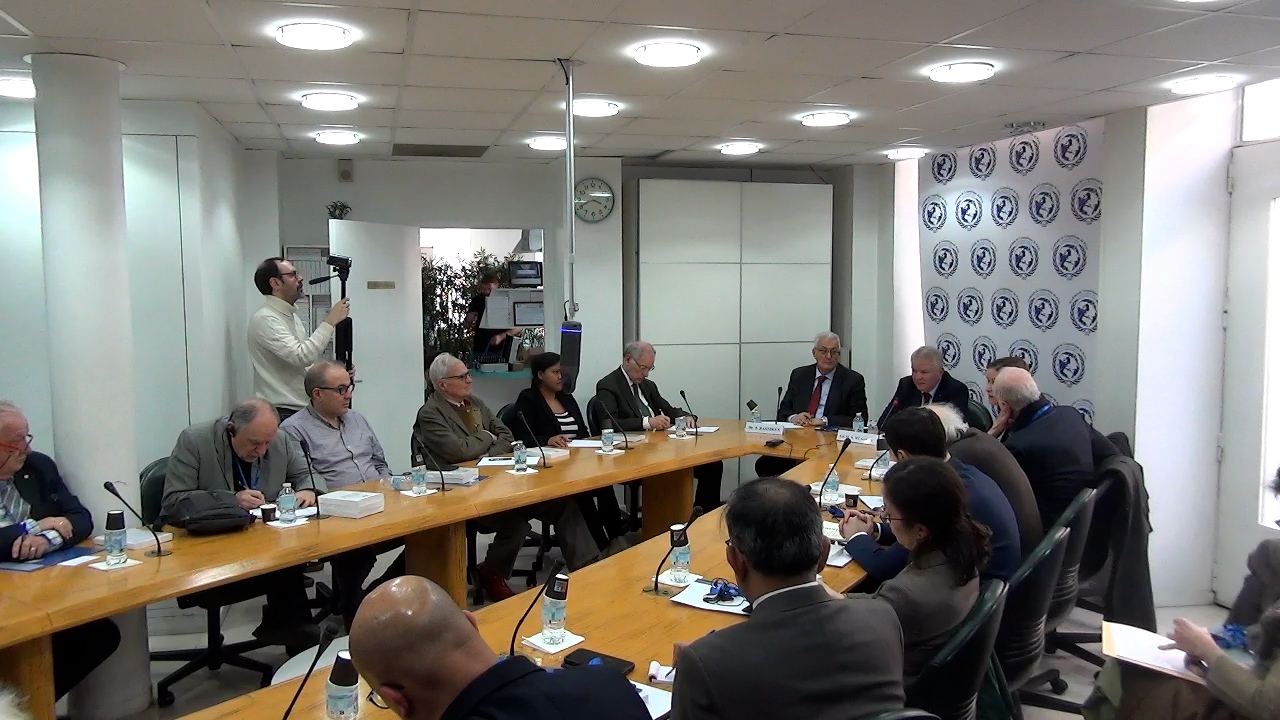
The Académie de Géopolitique de Paris held a conference on 17 February 2026 at its premises by H.E.M. Ambassador of the Russian Federation to France Alexey MESHKOV dedicated to “Strategic Issues in Euro-Asian Security”.
COMPTE-RENDU
S.E.M. Alexeï MESHKOV, Ambassador of the Russian Federation to France
Monsieur Rastbeen, chers amis,
I am pleased to have the opportunity to speak again at the Academy of Geopolitics in Paris. So thank you for choosing this afternoon’s nap, I’ll try to tell you interesting things so you don’t get bored.
Strategic issues in Euro-Asian security
Today, more than ever before, the question of global and European security is a matter of particular urgency and of a very practical nature. Why, now, is our world undergoing a profound transformation? After a brief period of unity, there is the emergence of a polycentric system of international relations in which many new centres of power and development are required and seek independent policy. Many years ago, in the late 1990s, I wrote an article about a transitional period in the world. So we know what we leave in the past, that is, the end of the bipolar system. And so I wrote in my article that we didn’t know where we were going yet. So my Western colleagues at the time laughed and advised me to read Fukuyama, “it’s the end of history “They said. But, today it is clear that this is not yet the end of history. History is becoming more and more fun, curious.
The collapse of the old Western-dominated model and the transition to a multipolar order are not smooth, let’s say frankly. Today, these are caused by Western countries’ reluctance to recognize new realities and to abandon their former privileged positions in world affairs. For years the crisis in Ukraine has been fuelling the Euro-Atlantic security system. Beyond Ukraine, the West exports instability throughout the Eurasian border, from the Arctic to the Middle East, through the South Caucasus, Central Asia and Asia-Pacific.
For many years, our country has worked sincerely with the West to build a common space of trust in Europe and the North Atlantic. I’ve invested 40 years of my life myself, huh? We have shown a genuine spirit of openness and willingness to cooperate honestly with the United States and Europe. And yet, throughout this time, the West has dismantled the architecture of global and regional security. It is enough to recall the collapse of the arms control system, namely the American withdrawal of the anti-missile defence treaties, the FNI, the ban on medium- and short-range missiles, the open sky, as well as the invasions of Afghanistan, Iraq, Libya, the imposition of a NATO-centric model, the organization of “color revolutions”, aggressive democratization and the imposition of non-traditional values.
The reality is that, contrary to the promises made, the United States and Europeans have continued to expand NATO and deploy its military infrastructure to the Russian borders. For us, it has become clear that the West was putting in place a security system that was not inclusive, but for itself, and aimed at countering not only Russia but also other centres of global development. I recall that in late 2021 and early 2022, so this is about the time we last saw each other, the West rejected our proposals to conclude agreements with the United States and NATO on mutual security guarantees. And the conflict in Ukraine was the culmination of this dynamic and led to the definitive collapse of the Euro-Atlantic security model based on NATO, OSCE and the European Union.
Today, the militarisation of Europe is accelerating. European leaders and senior military officials openly call for preparations for an armed conflict with Russia. European countries, including France, organize military exercises in which Russia is designated as their alleged opponent. France and the United Kingdom agreed to coordinate their nuclear forces and to launch a long-range missile development project. Berlin and London have signed a military cooperation agreement. All these developments create direct threats to the sovereignty of our country, to which we must respond, of course, through countermeasures. And the statements of German and Polish leaders on the possible creation of nuclear weapons, in fact, constitute a threat to the whole world.
All these trends marked a turning point in our reflection on how to ensure our own safety. It has become clear that pan-European cooperation structures have not been able to ensure cohesion between countries and prevent armed conflict. They were openly used by the West as an instrument of confrontation with Russia in a hybrid war. We no longer intend to waste time in vain. Since the objective of equal and indivisible security has proved to be unattainable in Europe, we propose to achieve it within the framework of a pan-Asian architecture.
Russia will now have the strategic direction of building a flexible and sustainable architecture of equal and indivisible security, as well as cooperation, across the entire Eurasian continent. It is home to more than half of the world’s population and 15 of the world’s 20 largest economies. Eurasia is the geopolitical centre of the emerging multipolar world, but it remains the only continent without a federative framework, a certain organization (…) to collectively address security issues, and we propose to remedy this situation. In 2024, Russia launched an initiative to create a unique security architecture in Eurasia to prevent and resolve conflicts. Its fundamental premise is equal and indivisible security for all, not for some privileged ones. The guiding principle is that each country has the equal right to choose the means to ensure its security, whether it is militaro-political neutrality or participation in alliances. But at the same time, this right cannot be exercised independently of another fundamental principle, namely that the safety of one cannot be enhanced at the expense of that of others.
Alors, que suppose cette initiative ?
It provides that States and multilateral organizations in Eurasia will assume primary responsibility for their own security, with a gradual reduction in the presence of the extra-regional powers in Eurasia. In practical terms, Russia proposes to integrate into this new structure existing formats in Eurasia, including the Shanghai Cooperation Organization (SCO), ASEAN (Association of Southeast Asian Nations), CSTO (Collective Security Treaty Organization), CIS (Community of Independent States), the Conference on Interaction and Confidence-building Measures in Asia (CICA), the Gulf Arab Cooperation Council (GCC). However, it will not be a vertical model but a mosaic of various agreements and commitments. The contractual range is broad, ranging from political confidence-building measures to full agreements, from non-aggression pacts to defensive alliances.
Recent examples include Russia’s agreements on security assurances with Belarus, as well as comprehensive strategic partnership agreements with the Democratic People’s Republic of Korea and Iran. The most important thing is that the model proposed is not closed and is not directed against anyone. This model does not exclude anyone, but on the contrary it is open to all countries and organisations on the Eurasian continent, including Europeans, if they renounce their hostile policies and recognize the right of others to security and development.
Recent practical approaches include a few. Russia supported Belarus’s idea of developing a Euro-Asian Charter of Diversity and Multipolarity in the XXIe century. It is in line with the Russian initiative to develop a Euro-Asian security architecture. This idea presents broad perspectives and will be implemented. The Charter should set out a strategic vision of the very essence of multipolarity, as well as the fundamental principles and objectives of pan-European cooperation, with particular emphasis on the theme of security in its overall meaning. The idea of its elaboration was publicly supported by senior representatives from various countries including Iran, the DPRK and Myanmar.
In short, we no longer see the point of developing a “European” and “Euro-Atlantic” security architecture, but rather of creating a new and expanded framework for relations in Eurasia. In the long term, the new model of relations with Europe in the field of security will be an integral part of pan-European architecture.
Thank you for your attention.
DEBATE – PUBLIC ISSUES
Dr. RASTBEEN, President of the Paris Academy of Geopolitics
Thank you for your clear, dense and particularly enlightening speech. Your analysis has made it possible to better understand the complexity of the issues related to Euro-Asian security, as well as the importance of dialogue and diplomacy in an international context marked by persistent instability. On behalf of the Académie de Géopolitique de Paris, I would like to express our gratitude for the quality and depth of your contribution.
We will open the discussion and give the floor to the public. You can ask your questions and we’ll take care of the answers. You have the floor, but apparently there’s no question at the moment, so if you don’t mind, I’m going to ask the first question, Your Excellency. As you know, today we have four delegations in Geneva: Iranians with Americans, and the Russian delegation with Ukrainian. In your opinion, what are the diplomatic acts and consequences of this meeting?
S.E.M. Alexeï MESHKOV
I think that now it is a little premature to anticipate and already give assessments of these events. Indeed, there are three in progress in Geneva. The first meeting is a tripartite meeting between Russia, the United States and Ukraine, which takes place in an expanded format, because the two previous formats were between the military, and thus it focused only on military issues. This is why our delegation is now headed by Vladimir Medinski, who was the head of the delegation, moreover from the beginning he is the adviser to the President, because this meeting will also cover political, territorial and other issues. There will traditionally be Steve Witkoff and Jared Kushner, there will also be the American Minister of Armed Forces, and the main military representative in Europe (this is the American representative in Europe), and also the Ukrainian delegation. The second meeting is a Russian-American bilateral meeting, so the Russian delegation will be headed by Kirill Dmitriev, and so it will focus on economic cooperation issues. At the same time, Geneva welcomes contacts between Americans and Iranians, but these contacts are not linked to the dialogue with Russia. It is still difficult to predict the outcome of a particular round of negotiations. In any event, Russia is obviously interested in moving as quickly as possible towards a comprehensive settlement of the Ukrainian crisis.
S.E.M. Jean-Pierre VETTOVAGLIA, Ambassador of Switzerland to Vienna, Bucharest and Paris (1988-2007), administrator of an international trade finance bank in Geneva (Trade Finance, BIC-BRED), essayist and lecturer (analysis and foresight of international relations)
Mr President, Mr Ambassador, you spoke about Geneva. I was an ambassador in Geneva in 1985 and I was one of those who organized the Reagan-Gorbachev Summit. We were filled with hope. As a result, I created the Crans-Montana forum in 1989 to allow all new governments in the Russian Federation and the Eastern countries to come to Europe in a way. And I note that the West, and the United States in particular, have always refused Gorbachev’s stretched hand. You introduced us to an Eurasian security project. Where my questions are: Will Western bellicism, for you, ever change (first question)? And: Is President Trump a hope for you?
S.E.M. Alexeï MESHKOV
Indeed, to some extent, it was quite unexpected for us to see all these russophobic moods, especially in Europe, because indeed we have invested a lot of years to build good relations, normal relations in any case, with the European Union, but unfortunately these hopes were vain. Remember Gorbachev’s time? Yes, we did a lot at the time to advance a new vision of European security, and besides, a lot was done with the emergence of the new Russia, a whole series of mechanisms for cooperation and interaction with the European Union came into being, twice a year we had summits with the European Union, once a year there were meetings of the governmental committees, and it was felt that something more would be achieved. For example, we have already reached agreement on the visa-free regime with the European Union, a 400-page document has been drafted. And today we see for example that the European Union has abolished, cancelled visas for Russian diplomats. So yes, the situation has changed, but in the wrong direction.
According to my estimates, this degradation became very clear from 2004. It is actually the year in which Russia paid all its debts. And of course, Russia was not at all happy, faced with this situation, hence Vladimir Putin’s famous speech at the Munich conference in 2007, where there were, of course, some warnings about the wrong direction. And today, of course, we have to react to all the militarist approaches, the declarations that are made in Europe, but also to military manoeuvres, for example, which are organised very close to our borders. Historically, Russia has never opposed enlargement of the European Union. Today, we are listening to the statements of Mrs Von der Leyen or Mrs Kaja Kallas, there is really a whole series of questions that arise.
As far as President Trump is concerned, what is, basically, the difference between President Trump and Europeans? He can listen. In Anchorage, Alaska, for example, which produced a basic formula for Ukraine’s peaceful settlement, it was really an interested exchange of views. Yes, while unfortunately, all contact with European leaders is really a conversation of deaf and mute, you know. But then we are obviously aware that the US administration is primarily defending American national interests. Then, as Secretary of State Marco Rubio said in his discussions with Lavrov, positions may diverge, but then we have to agree. It’s not a direct quote, I don’t have his words in front of me. But it’s the idea, I think, that everyone has their own national interests, which must be respected, and where it becomes complicated, we still have to try to find a solution.
Mr. Pierre Lévy, Journalist, editor of the monthly Ruptures
Thank you very much, Ambassador, for your briefing. You have chosen to focus your remarks on a possible balance, a possible Euro-Asian security architecture based on agreements, pacts, alliances, treaties that already exist for some of them. These include agreements between the Russian Federation and the Republic of Iran. However, we all have in mind that a few months ago, last June, the Israeli armed forces carried out a violent attack on Iran, which some called the 12-day war, ended – or at least concluded – by American aviation. And some observers may have considered that Russia’s help or support to Tehran had been, how to say, perhaps considered a little quiet. So is it your appreciation and how do you judge the relevance of these agreements and the usefulness of both parties to this mutual agreement?
S.E.M. Alexeï MESHKOV
I think you have seen as well the reactions of other states to the bombing of Iran. Russia, on the other hand, condemned the strikes and declared its categorical refusal to face the threat of further military strikes. Russia has not stopped implementing our economic projects with Tehran. During this twelve-day war, our staff did not leave the place, I am talking about employees, for example, at the Bouchern nuclear power plant, no one was evacuated, and neither did embassies. So in several international forums, we have expressed our position of principle and we have called things by their name, especially when there has been an attempt to organize another color revolution in Iran.
Mr. Sébastien PERIMONY, Schiller Institute Africa Office
How do you assess, here in France, and in Russia, Emmanuel Macron’s recent positions to want to re-engage in a dialogue with the Russian Federation, in relation to what he said about the European Union’s desire not to engage in dialogue at all?
S.E.M. Alexeï MESHKOV
We never closed the door to dialogue. With all due respect for the media, real dialogue cannot take place through the media. We need concrete. You may remember that in July last year there was a telephone interview between Macron and Putin, President Macron called, but after there was no concrete or significant progress in any case. I have already said, for us, the position, the position of the leaders of the European Union is truly surprising, because it seems that they aspire to undermine all the possibilities of relaunching dialogue. But if there is no dialogue, how can we agree?
M. Nikita PINCEMIN, Student
My question concerns the future, and also technology. You’re talking about creating an architecture between Europe and Asia, but are you also considering creating a network, such as Elon Musk with Starlinkbetween Europe and Asia?
S.E.M. Alexeï MESHKOV
It’s not exactly the same, for me it’s still a separate subject, it’s not the same as talking about Eurasian security. Otherwise yes, Russia is currently developing many systems at national level. For example, we have a system Max which is a little similar to WhatsApp, which has several possible applications, but there is obviously all that is artificial intelligence which is also growing, but then here I will not confuse the two subjects, for me it is really a little different. There are obviously also systems of connection, of closed communication.
Mme. Rojontsoa Tsihoarana RANAIVOARISOA, Researcher associated with the Academy of Geopolitics of Paris
Mr Ambassador, earlier you spoke about the fact that each country has an equal right to choose its own security. And how does Russia ensure that its security support does not turn into interference in the internal democratic process? This is precisely what you blame for France. In particular, some Western reports accuse Russia of conducting disinformation operations to fuel anti-French sentiment. This is the case with the Russian presence in Madagascar. So, what’s your answer to these analyses? Thank you.
S.E.M. Alexeï MESHKOV
Frankly, I didn’t hear anything about the Russian presence in Madagascar. We could talk about the French presence in Madagascar… We do have our embassy in Madagascar, yes, and yes in Moscow I think that we also sell lobsters from Madagascar, but Russian policy is to say that we must stop ingesting in the internal affairs of other countries. As you know very well, it is not we who have organized the color revolutions in the last twenty years all over the world, especially in Ukraine. You know, I have not seen any publication, any statement by the representatives of the European Union, NATO, in relation to the Ukrainian crisis no one ever said that Russia’s security interests should also be taken into account. But well, that Russia is always accused of all evils, we’re already used to… Every day in the French daily press There’s something about that. Frankly, I saw for example an article – I didn’t finish it, though, I couldn’t – who said that Epstein was a Russian agent… Then we found a rare frog with which, apparently, it is presumed that we would have poisoned Navalny, without any evidence. Besides, the frog probably might come from Madagascar, I don’t know!
M. Bruno DRWESKI, Professor of contemporary history and political science, member of the Scientific Council of the Academy of Geopolitics of Paris
You obviously talked about security, and therefore about security organisations. I would like to ask you about the BRICS. So, I know the BRICS is an economic organization, but do you not think that the BRICS, because it promotes new economic relations, new cultural relations too, somewhere are part of a global process of de-dollarisation, which in the long term is an alternative to unipolar order?
S.E.M. Alexeï MESHKOV
Yes, de-dollarization is going on anyway. But if you are talking, for example, about the objective of creating a single currency within the BRICS, for the moment such objectives are not present. So we have chosen another path, including the thousands of sanctions that have been imposed on Russia: we preferred to conduct our trade in national currencies. The most advanced states, let’s say, in this project are Russia and India. But in general, in the last 50 % of our foreign trade is in rubles. But here I repeat again, for now we do not think of creating a single motto for BRICS.
Mme. Myriam GERBERT, Press Officer of H.E. Mr. Jean-Pierre Vettovaglia
I am Finnish and was born there. I just wanted to ask Mr. Ambassador about the situation in my country with Russia at the moment. Thank you.
S.E.M. Alexeï MESHKOV
In fact I am very pleased, for the first time in all these years there are representatives of the European Union who attend my speech, my speech, because I am no longer invited to speak anywhere, nor to attend receptions. When I was a deputy minister, one of the directions that was assigned was the Arctic Council, and various structures in the Baltic Sea. And there was a kind of idea received, a kind of cliché that all the countries of Northern Europe shared: we all thought the Baltic region was the most stable, the quietest region in Europe. So here we can ask about the foundations and reasons of NATO and the European Union, why they did what they did, but in any case, today it is one of the most tense regions. We are always afraid of possible attacks on the Kaliningrad region, or we are told that we will intercept our ships, we must say that we have a fairly large fleet in this region. What’s the point? Frankly, I don’t know, but I don’t understand what Finland has done.
Since the time of Paasikivi, Ahtisaari (former presidents of Finland), we have always had very close, very friendly relations with Finland. For example, dairy products have always been imported. Do you remember our former Foreign Minister Gromyko? His grandson once said, “When I die, put on my grave a small box of Viola cheese.” Viola, a cheese that we actually bought a lot, it’s a kind of Kiri here in France. So the border with Finland was the border of peace and trade. Very close to the border, on the Finnish side, there were many large shopping centers built especially for Russian tourists. Many Russians from the St. Petersburg area bought secondary houses, small country houses too, in Finland.
So where are we today? The border is closed, all these malls went bankrupt, because except for the Russians there was no one, it was really near the border. The border we share is over 1000 km long and today we are trying to militarize it. So we’ll have to take countermeasures. The small houses that the Russians had bought, now apparently we want to expropriate them. And then I really don’t understand what Finland has to gain.
M. Jacques CHEMINADE, President of Solidarity & Progress, presidential candidate (1995, 2012, 2017)
Mr Ambassador, President Putin, in a recent speech, said that the unipolar world was over. More than multipolar, he called for a “polyphonic” world and said with the principles of non-interference, mutual development and mutual security. In Munich, Marco Rubio praised Western colonial society. I have the quotations. Donald Trump said that the countries of the BRICS and the Shanghai Cooperation Organization had to be brought back to reason, and he treated them almost as enemies. So how can we reconcile these two approaches? And is there really a spirit of Anchorage?
S.E.M. Alexeï MESHKOV
We hope the spirit of Anchorage is still there anyway. After that, I had a slightly different reading of Rubio’s intervention in Munich, in any case it seemed that he talked about the fact that the unipolar world belonged to the past. You know, even if we look at the presence of colleagues around this table, in this room, coming from all over the world, we see that the world is already polyphonic and multipolar. After you know, not everyone likes to have strong competitors on the international stage, especially in the global economic market. And today, the BRICS are stronger than the G7. I speak in terms of economy, precisely, of population and also of territory. Then, as part of the BRICS, we are not aiming at a confrontation with the United States at all, and each BRICS country conducts its own dialogue with the United States, and these dialogues are personalized, it varies from country to country. Then we have what we have.
M. Jacques CHEMINADE
Do you believe, Ambassador, that the symbol of a tunnel on the Bering Strait can be a means of making public the idea of mutual development? At an earlier time, my American friend Lyndon LaRouche and Mr Menchikov had spoken of a Menchikov-LaRouche tunnel. Now, could we talk about the possibility of a Trump-Putin tunnel that would restore a symbol of peace in the world through the development of security?
S.E.M. Alexeï MESHKOV
Indeed, this topic was discussed in Anchorage. We’ll see. I have to say that there are a lot of projects under development, economic projects primarily between Russia and the United States, but which will ultimately succeed? For now, it’s really hard to predict. But this is why Mr Dmitriev is in Geneva today, because this meeting is mainly dedicated to economic projects. And I can tell you that on the table there are really big numbers, big volumes. But unfortunately, for now, the dynamics are not very positive. Recently, the United States has again imposed new sanctions against a large oil company, making their work much more difficult of course.
Mme. Adriana YEPES, Researcher at the Paris Academy of Geopolitics
Mr Ambassador, considering that the strategic stakes of Eurasian security are deeply linked to the global dynamics of power and cooperation, how do you assess the interaction between the major powers in terms of political credibility and energy security, in particular the oil cooperation agreements between Russia and Venezuela in the face of transregional humanitarian crises, in particular the risks of gender-based violence and forced displacement of Venezuelan migrant women? What role can diplomatic cooperation between Russia, France and their European allies play in developing comprehensive responses that simultaneously take into account energy security, political stability in Venezuela and the protection of the human rights of vulnerable populations?
S.E.M. Alexeï MESHKOV
Already, as you know, Russia has strongly condemned the United States military aggression against Venezuela. We have expressed our solidarity with our Venezuelan friends. The next day, in fact the very first day, President Putin met with the Vice-President-in-Office, Delcy Rodríguez, and of course we welcome the government’s desire to ensure unity, political cohesion, to overcome all the risks of a constitutional crisis and also to ensure a stable, coherent, sustainable and peaceful development of Venezuela. We see that the Venezuelan authorities are trying to launch, build new modalities of their relations with the United States, and of course we believe that Venezuela must be guaranteed the right to define its own destiny, and we confirm our support for the constitutional authorities of Venezuela to protect their sovereignty and national interests. Of course, today there are discussions about how to ensure the safety of Russian companies working in this country. You mentioned Europe, but I find it difficult to imagine any oil cooperation with Europeans on this subject. In every new package of sanctions, they include either Russian companies or new tankers, they try to intercept our tankers, and I think they even set the date – but I don’t remember the date – when they will definitely stop buying Russian gas and oil. So, with the European Union, frankly, I see no room for possible cooperation. I am often asked this question, whether we are suffering from sanctions. I do. You know, we have a fairly large embassy, there are several buildings and so to supply the embassy, we had bought gas from a company girl of Gazprom which has been closed. And so today, we have to pay for gas three times as much as we paid in the past. But the budget is the same.
Mr. Benjamin Quénelle, Correspondent in Russia for Le Monde
First question in Russian. Second question: Are you planning to attend this concert by the Maestro Teodor Currentzis (the conductor)? Would you like Valery Gergiev (the conductor) to perform in Paris? Because you talked about how important culture is.
S.E.M. Alexeï MESHKOV
The first question was about Mr. Ouchakov’s possible visit to Paris. I am not going to comment on this, Russia, we do not confirm this subject. So no confirmation. Gergiev yes, I wish he could come here to France. Because before, every year, in fact, he was coming to France with the Mariinsky Theatre Orchestra, and today he is also director of the theatre, and so yes, I have always attended his concerts, especially since you have a very beautiful room, the Philharmonic of Paris, and today I can only attend his concerts in Moscow, and it must be said that every time I come, I enjoy it, yes. So yes, I would put a suspension point. Otherwise, it is difficult to characterize this approach of refusing the arrival of artists. You remember, I think, very well, the exhibitions that took place at the Louis Vuitton Foundation, these were the collections of Chchukin and the Morozov brothers. To return to Gergiev, you know, next year it’s going to be his birthday and of course Gergiev would like to come here to France and give concerts. In fact, culture, I confirm once again, could be that starting point for normalizing relationships.
M. Jacques CHEMINADE
When we talked about Venezuela, I think of today’s danger, it’s Cuba.
S.E.M. Alexeï MESHKOV
Yes, we obviously support Cuba. I think for all, for many of us, the “island of freedom” is not words in vain, it says something. And, well, at the moment, we are looking at the possibilities to support Cuba because the current blockade is a frightening act in fact. We have about 400,000 tourists in Cuba, now perhaps a little less, but that’s the figure. You know, because of the decisions of the European Union, our planes cannot stop in the countries of the European Union, and the problem is that in Cuba there is not currently enough fuel for the planes, there is not enough kerosene, so we can come to Cuba but to refuel for the planes is a bit complicated. And so that’s it, but we’re looking at possible solutions, so I think that planes will have to stop in the friendly African countries on their way back. So yes, Cuba is fully supported during this difficult time for them.
M. Jacques CHEMINADE
Excuse me for coming back, I’m finishing my question, Marco Rubio has a personal interest in Cuba, so tension. Are we making known in Russia what is happening in France, those who oppose in France the blockade of Cuba? Is it also known that in the American House of Representatives there is a representative named McGovern who said that the blockade of Cuba should be stopped? And most importantly, is Russia, the rumours fair or not, would it consider providing oil to Cuba?
S.E.M. Alexeï MESHKOV
Yes, we have some information coming. For the second part of your question, you understand that speaking publicly about possible oil deliveries, let alone delivery routes, is just not possible.
M. Michel TAMINE, Professeur d’IUT
Did you watch, and what do you think about the film about President Putin who has just been out for a few weeks (The Kremlin Mage) ?
S.E.M. Alexeï MESHKOV
No, I didn’t see the movie, but as I said, I stopped reading things, seeing things, because I can already anticipate what’s going to be said… But, well, I was a little told, but I didn’t see it myself.
General Jacques PERGET, Comptroller General of the Armed Forces (2S), former lecturer in international relations (Université Paris-Dauphine) and former holder of the “Pierre Massé” Chair in Industrial Economics (Université Paris 2-Assas)
Excellency, Ambassador, I am Jacques Perget, an old French general. I should like to refer to the questions put to you by Mr Chemade concerning the statement made in Munich by Secretary of State Rubio, following, a year later, that of Vice-President J.D. Vance. Why? Because his point is very clear. He justified the actions of the United States in the name of a mission, of a Messianism proper American, which was to defend a civilization and therefore, if necessary, trigger a war of civilization. This is the heart of his subject, the heart of his speech, which obviously gives him a totally different scope. And in my opinion, it puts Russia, given what Russia is historically, geographically, in a situation where it will have to choose. You have presented us with a pan-European security architecture including the barycentre, excuse me, it is essentially in Asia and not at all, or very little, in Europe. So as a result, if you want, it asks questions. How can Russia react to Mr. Rubio’s statements? It is a war of civilization that the United States claims to engage, so it is in relation to this civilization that it is to determine itself.
S.E.M. Alexeï MESHKOV
Yes, there are several points. Munich conference. And besides, I’ve been there several times, but it’s been about ten years since we’ve been invited, and I was a little surprised that Wolfgang Ischinger took over as president. I read a little about the comments in Europe: apparently everyone was afraid that it would still be Vance coming and going a little bit back a year ago. And Trump would be even more scary, I think. So here, Rubio is a little considered a dove of peace that was sent. Now, he gave the speech as he did.
As I have already said, Russia is by itself a country-civilization, and I think that the events of recent years have moved us a little towards awareness of this particular status, so Russia really cannot join in, join another civilization, to anyone, where in fact our flexible approach to pan-European security. A new security architecture is needed in the world, but not only in security, it also requires a new economic structure in the world. After that, we do not support the dissolution of existing international structures, such as the World Trade Organization (WTO), the World Bank or the International Monetary Fund (IMF), despite all their shortcomings. We are talking about the need to reform them. You know, about ten years ago, even more, a structure was created called the “Dialogue of Civilizations”. I think this kind of structure could be a platform, a centre for dialogue. Each country has its own national interests, and I have already spoken of this in relation to Rubio, but these national interests must not be antagonistic to the interests of other actors, other partners. Recently, everyone has been a bit excited about military questions and solutions, and there is little talk of diplomacy, but I think diplomacy still has a say. Well, maybe I’m just protecting my diplomatic caste a little, but in general, we also want to participate in global processes.
Dr. Ali RASTBEEN
Your Excellency, I wanted to know what Russia’s place is in international peace efforts in Gaza?
S.E.M. Alexeï MESHKOV
I can answer briefly. President Putin has proposed to the Americans to release a billion dollars of Russian money, which remains frozen in the United States, and to direct all this money to help Gaza, the Gaza Strip. Apart from that, we have always expressed our support for the two-State solution and for the peaceful resolution of this crisis.
President Gérard-François DUMONT, Professor at the Sorbonne University, President of the journal Population & Avenir and Vice-President of the Académie de Géopolitique de Paris
Thank you, Mr. Chairman, thank you, Mr. Ambassador, for your presentation and your answers to your questions, I may end with a rather simplistic question, but it is to be sure that you have understood the whole message that you have sent us. In other words, in order to simplify, seen from Moscow, we are in fact concerned with a change of geographical scale. For years, you also recalled with President Putin’s speech at the Munich conference in 2007, Russia sought a Euro-Atlantic security architecture. And she had no response to these repeated requests. This is probably the reason for the change in geographical scale that you have made very clear, which would therefore be a security architecture in a much wider, Euro-Asian framework. And so I wanted to know a little bit about how this scale change happened, the transition from one scale to another, and exactly when it was decided? And second, related to my first question, you did not at any time mention the United Nations (UN). Can the UN, in the spirit of Russian power, have a role to play in the search for this Euro-Asian architecture?
S.E.M. Alexeï MESHKOV
I am not going to give you the date of the change of approach, but this decision has muried when we realized that Euro-Atlantic structures and security did not have a future. But yes, I think that the last drop that made the vase overflow was indeed the end of 2021, when Russia made two proposals, two agreements, one with NATO on European security, the other with the United States, also on the security issue, and received no answer. And it was also linked to this evolution of the global situation in the world, with this emergence, this formation of the multipolar world. And a very simple question was asked: there is the League of Arab States, there are also associations of Latin American countries, and there is also the African Union. However, our continent, the largest, is devoid of a similar structure, there is no federating structure, a sort of umbrella structure, there are several, which are smaller, more specialized, and here’s nothing, there is no forum where we can discuss such questions. But our approach is inclusive, and I think that this approach does not exclude – again if there is interest and if there is a change of position – also implies the integration of Western European countries and members of the European Union. This is really a purely geographical approach, so if it is a European or Asian country, any country must have the right to participate in these processes. But on the other hand, to allow the extra-regional powers to decide our destiny, I think it is something that should no longer work in the world today. Russia also occupies half the territory of Europe, Russia participates in this process, so it is already half of Europe that participates, but you are obviously also invited. All are invited to attend.
Yes, today everyone criticizes the UN. But there is no other world organization. We can talk about United Nations reforms. So yes, the United Nations must continue to play its role in the world, but once again reforms are needed because we must admit that today the United Nations is not in full shape. Our Minister for Foreign Affairs Lavrov, for 10 years he was permanent representative to the UN. And he was asked this question: why this animosity of the United States vis-à-vis the United Nations? He replied: “probably because the United States does not like to agree too much or seek compromises”… They have their vision, and it’s good. As far as we are concerned, no, Russia is not for the collapse of the UN, but I think that neither France, moreover, because the status of permanent member of the Security Council does not invite such reflection.
Public issues
Leave a comment