
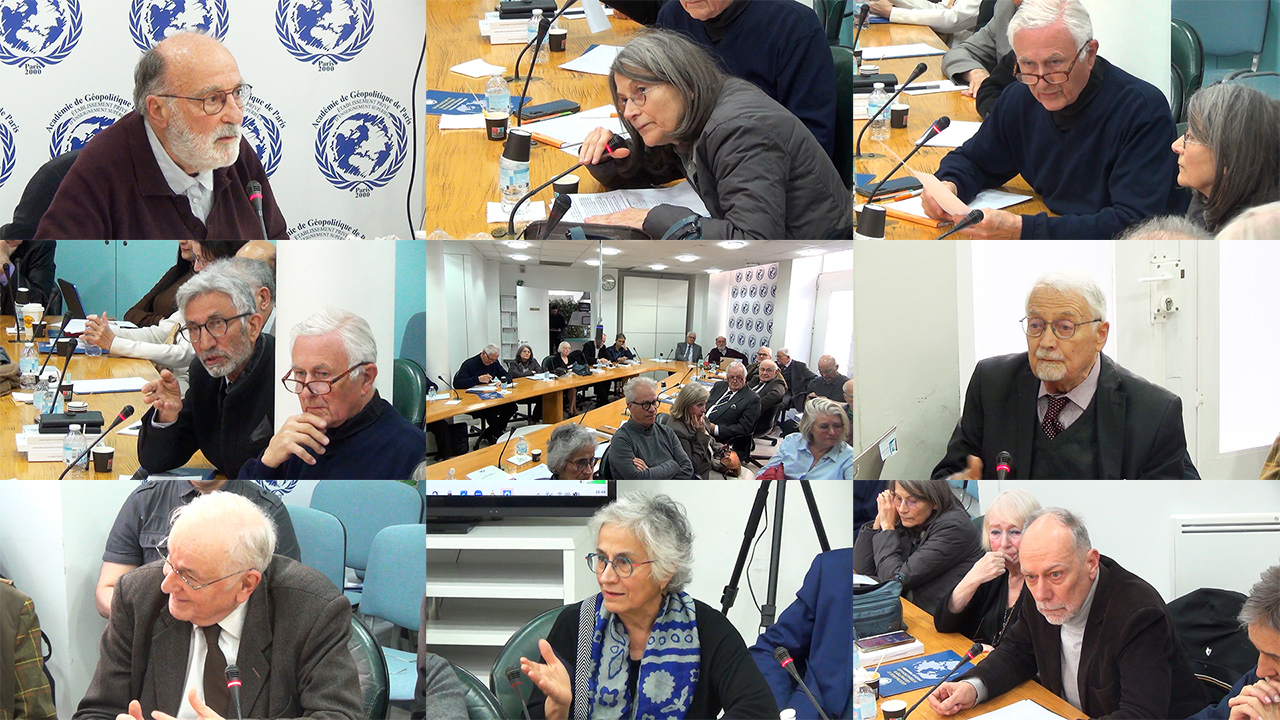
Follow-up to a screening-debate
“Chapter VII. Palestine next door tomorrow »
In partnership with the Association d’Amitié France-Syrie, the Académie de Géopolitique de Paris organized a screening-debate on the short film « Chapter VII. Palestine next door, tomorrow by Bernard Cornut, polytechnician, geopolitician and member of the Board of Directors of the Association d’Amitié France-Syrie. The screening was preceded by a debate on ” Strategic climb in the Middle East ».
SUBMISSION
The film of Bernard Cornut proposes an in-depth reflection on the prospects for a settlement of the Israeli-Palestinian conflict through the adoption of a binding UN Security Council resolution, under Chapter VII of the Charter of the United Nations (1945), which could impose an international framework for the implementation of a sustainable political solution. This approach raises fundamental questions concerning the role of international law in resolving conflicts, the limits of the veto mechanism in the Security Council, and the prospects for a political solution based on the coexistence of two states.
The Académie de Géopolitique de Paris invited researchers, lawyers, diplomats, political scientists and other experts from the Middle East to participate in this meeting in order to contribute to the discussion on the legal, diplomatic and geopolitical dimensions of the Palestinian question. In particular, participants included:
S.E. Michel RAIMBAUD, former Ambassador of France
Jacques CHEMINADE, President of the movement Solidarity and Progress
Colonel Alain CORVEZInternational Strategy Advisor
Majed NEHMÉ, Franco-Syrian researcher and journalist
Dr. Ali RASTBEENPresident of the Académie de Géopolitique de Paris
Speakers analysed strategic developments in the Palestinian question, geopolitical dynamics in the Middle East, regional tensions involving the United States, Israel and Iran, as well as the challenges of international law in managing contemporary conflicts.
STRATEGIC ESCALAD IN THE MIDDLE EAST
Dr. Ali RASTBEEN, President of the Paris Academy of Geopolitics, “Strategic escalation in the Middle East: rivalries between the United States, Israel and Iran, and international humanitarian issues”
Since the end of the Second World War, the international order has been built around the fundamental principles enshrined in the Charter of the United Nations, first and foremost the sovereignty of States, the prohibition of the use of force and the peaceful resolution of disputes. These principles have been the basis of contemporary international law and have long served as a reference to the relative stability of the global system.
However, recent developments in international crises highlight a structural contradiction: if international law continues to be invoked in diplomatic discourse, it is simultaneously circumvented when the strategic interests of the major powers are at stake. This tension between legal normativity and power realities is one of the major features of contemporary international governance.
The Middle East appears today as space where this contradiction is most pronounced. For more than two decades, the region has been marked by a succession of military interventions, indirect conflicts and strategic rivalries involving both international powers and regional actors.
The invasion of Iraq in 2003 by a coalition led by the United States was a structuring turning point. Legally challenged, this intervention has profoundly destabilized regional balances and accelerated the dynamics of political fragmentation.
The war in Syria, which began in 2011, then transformed the region into a theatre of indirect confrontations between major powers, including the United States, Russia, Turkey and Iran. This protracted conflict has helped to establish lasting structural instability, characterized by interlocking geopolitical rivalries, massive humanitarian crises, energy tensions and deep strategic recompositions.
In this already fragile context, the Palestinian question remains a central and structuring element of regional and international tensions. Since 1948, it has represented both an unresolved historical conflict and a symbol of the limits of international governance.
The recurrent cycles of violence, the critical humanitarian situation in the Gaza Strip and the lack of a lasting political solution illustrate the current impasse. Despite United Nations resolutions affirming the right of the Palestinian people to self-determination, the political process remains deeply blocked.
This configuration is now adding a new strategic dimension: direct confrontation between the United States, Israel and Iran.
This is one of the most worrying geopolitical developments of the early 21st century. It opposes two major military powers, the United States and Israel, to Iran, which is central to regional strategic balance, with a network of influential alliances and a significant indirect projection capacity.
Tensions between these actors have intensified around several structural factors: Iran’s nuclear programme, the strategic rivalry between Israel and Iran, and indirect confrontations in several regional theatres. Targeted strikes, drone and missile attacks, as well as asymmetric operations, have contributed to increasing the risk of a shift to open conflict.
This confrontation goes far beyond the bilateral framework and affects the entire Middle East. It carries a high risk of regional escalation involving indirect actors, including Iran’s allies in Lebanon, Iraq or Yemen. It also undermines maritime security in the Strait of Ormuz, a major strategic corridor for global energy trade. The Strait of Ormuz is indeed a nodal point of the international energy system: nearly a fifth of the world’s oil flows pass through it. Any significant disruption of this route would have major overall economic consequences, including higher energy prices and increased instability in international markets.
Beyond strategic considerations, this crisis has an essential human dimension. Civilian populations remain the primary victims of armed conflict. In this context, the protection of civilians and the maintenance of humanitarian assistance channels must be a top priority.
International solidarity is crucial here. France, faithful to its humanitarian tradition and its commitment to human rights, pays particular attention to assistance to civilian populations affected by international crises. Its work is based on fundamental principles: neutrality, impartiality and humanity.
In the current context, France is able to play a significant role in humanitarian assistance to the affected populations, including towards the Iranian and Lebanese peoples. It should be recalled that geopolitical crises must in no way lead to the isolation of civilian populations. Peoples cannot be collateral victims of strategic rivalries among States.
Iranian and Lebanese societies, rich in history and major cultural heritage, have made essential contributions to global civilization. In times of tension, it is essential to preserve human, cultural and scientific ties. Humanitarian aid, academic cooperation and cultural exchanges are essential tools for maintaining dialogue between societies.
As a permanent member of the United Nations Security Council, France has a special responsibility in promoting multilateralism, international law and peace. Its diplomatic tradition is based on a balance between strategic realism and adherence to legal principles.
In this context of crisis, its role can be structured around several areas: support for ceasefire initiatives, relaunching negotiation processes and strengthening humanitarian assistance to affected populations.
It is clear that war is never a lasting solution. Its initiation in a context where diplomatic channels remain open constitutes a challenge to the fundamental principles of international law, including those relating to the sovereignty and territorial integrity of States.
In the face of this situation, the priority of the international community must be de-escalation. The establishment of a ceasefire and the resumption of dialogue are strategic imperatives to prevent an uncontrolled extension of the conflict.
In an international system in transition to multipolarity, marked by an intensification of strategic competition, the reconstruction of an order based on law, cooperation and diplomacy is a major challenge. France and Europe have a particular responsibility in this regard: to contribute to the stabilization of the international system and to promote a vision based on cooperation rather than confrontation.
From this perspective, humanitarian aid to the civilian population, including the Iranian and Lebanese peoples, is not only a moral requirement, but also a strategic instrument of humanitarian diplomacy, allowing for the maintenance of channels of communication and the preservation of links between nations.
In conclusion, there must be clear solidarity with the Iranian, Lebanese and Palestinian peoples, as well as with all the civilian populations affected by a conflict widely perceived as unjustified and without a legitimate foundation.
This situation raises serious questions under international law. It seems to violate the fundamental principles of the UN Charter, in particular the prohibition of the use of force outside strictly regulated cases. It also questions respect for international humanitarian law, particularly with regard to the protection of civilians.
Recent developments also raise the question of compliance with international nuclear non-proliferation commitments, as well as obligations under the normative frameworks of the International Atomic Energy Agency, whose mission is to ensure the transparency and security of nuclear activities.
Beyond these elements, this war undermines the very foundations of international peace and security. It weakens collective regulatory mechanisms and increases dynamics of instability, both regionally and systemicly.
Jacques CHEMINADE, Chairman of the movement Solidarity and Progress, “A Mutual Security and Development Architecture for Peace”
We’re at war. After being prepared by the Anglo-American narrator, we are plunged into war. Benjamin Netanyahu and Donald Trump train the whole world, until they call for war in the name of peace! It all began with the refusal to recognize the Palestinian state by the Western powers and, above all, to tolerate that Gaza was an open-air prison, now a mass grave, and that the West Bank was the prey of criminal settlers. For when blood flows and the inadmissible is promoted, a chain of alliances is created which leads to the same situation as that which led to the two world wars of the XXe century. The Israeli and U.S. aggression against Iran is, alas, a logical consequence of a state of mind to which our governments have been complacent or allowed to lead.
The Trump and Netanyahu governments have thus betrayed human rights, international law, the ideals of their own religions and, in the United States, the letter and spirit of their Constitution, by waging a war without consulting Congress. The result, beyond the horrors of the present war, is that four major nuclear powers face each other, the United States and Israel on one side, China and Russia on the other, which have concluded mutual protection agreements with Iran. It is this direct confrontation that has been tried to avoid throughout the XXe during the Cuban missile crisis, which created the conditions for a nuclear war, then fortunately avoided by the wisdom of the leading Russian and American leaders, and the intercession of Pope John XXIII. Today, it is vital that the same wisdom prevails, without which the widespread burning of the Middle East would bring about the conditions for the burning of the world. We are already beginning to see discussions, at the level of military and geopolitical experts, on the possibility of using tactical nuclear weapons on the battlefield, which Emmanuel Macron has unfortunately excluded with regard to France.
The reality is that two countries with nuclear weapons, the United States and Israel, are attacking a country that does not have nuclear weapons and is committed to not doing so. The reality is that the US government, through Iran, which is a member, is taking on the efforts of the BRICS and their associates of the world majority to replace the financial empire of the dollar with a new architecture of mutual development. He returns the situation: it is the Iranian regime that is accused of being the aggressor while under the bombs! Just as Palestinian organizations have been accused of being the aggressors of the Israeli State, which has historically, since its founding, taken control of their land through violence and crime.
Today, Iranian officials blocked the Strait of Ormuz to defend themselves. Strategic Seaway through which more than one fifth of the world’s oil and gas flows. The strait is only 54 kilometres wide and the two shipping corridors used by the tankers are even narrower, about 3.7 kilometres each. Beyond missile or drone strikes, Iran has a stock of thousands of mines, including drifting mines, which it could attempt to use to further block the strait. Finally, the destruction of submarine cables, which would cause the interruption of communications directly affecting the financial markets, remains another option. Thus, it is understood that the insurers have suspended their guarantees for ships, oil tankers, gas tankers or others that would attempt to pass through the Strait, and that Donald Trump finds no “partner” to help him unblock the Gulf militarily. It remains a very dangerous series of gas or oil field strikes, such as the one launched by the Israeli army of the Iranian gas field in South Pars, of which Donald Trump was reportedly informed, according to the Wall Street Journal. The Iranians responded on 18 March by striking the Ras Laffan complex in Qatar for the second time, causing considerable damage.
It is therefore clear that Iran will not surrender, unlike Donald Trump’s rodomontades. The most worrisome is Trump’s military-messianic drift and his entourage. A wounded tiger becomes man-eater, as Kipling said in the times of the Indian army. Today, there are in Israel the Ben Gvir, Smotrich and their accomplices among the settlers. But we must not overestimate their power. Without American support in arms and dollars, they wouldn’t control anything. With regard to Trump, we have all seen his hand-imposed session in his White House office by the evangelists and his “spiritual” counselor Paula White. We have seen the transformation of the U.S. Department of Defence into the Department of War. We listened to Peter Hegseth trying to convince the American military that God was with them, and to hold sessions watered by the Book of Joshua by saying the word crusade. We have seen the billionaire Christian Zionists and the Miriam Adelson push for crime. All driven by their beliefs that to exist one must destroy his enemies – the conception of the “existential enemy” of Carl Schmitt, the lawyer of the Third Reich, who swarmed along with the writings of Ayn Rand. The “Peace Council” of Donald Trump and Tony Blair has become a War Council, to which more and more States invited to participate respond with a refusal, polite or not.
The majority of the American people today are opposed to this war (65% according to polls) and former Trump supporters, like Majorie Taylor Greene or Tucker Carlson, remind him that he had promised to be “a servant of peace”. Anti-war protests are spreading to the United States. Pope Leo XIV, himself American, condemned the war, and the cardinal archbishop of Chicago, of the Augustinian order as Leo XIV, vehemently denounced the sequence of Truth Social, broadcasting images of bombs falling on Iran accompanied by music-hall tubes, pointing out that mocking the suffering of others is absolutely contrary to the spirit of Christianity. In a statement issued on 17 January, the patriarchs and religious leaders of Jerusalem condemned Christian Zionism, which triggered a very violent reaction by the US ambassador to Israel, Mike Huckabee, himself even more fundamentalist than his colleague in Paris, Charles Kushner, whose company and that of his son, Jared, was allegedly saved by the banks of the Wall Street system, with the approval of Jeffrey Epstein.
Today, therefore, the question is how to get out of this waspier that can lead to a world war, at the risk of succeeding, of escalation into a nuclear conflict. On the ground, under current conditions, there can obviously be no military solution. Because the defeat of one or the other would be frontally unacceptable. The solution is to change the game rule. The Russian economist Sergei Glazyev has just declared to Mumbai that the world, whose closure of the Strait of Ormuz is a major point, should push the BRICS to speed up their plans to implement a monetary base instrument, based on two reference baskets, one based on all the currencies of the partner countries, the other on a set of commodities whose prices would be fixed by long-term contracts, and not delivered to speculation on the financial markets.
Technocratic? No, on the other hand, for a polyphonic architecture of peace through mutual development and security: a change in the rule of the world game. Illustrative? No, because this is in concrete terms the approach that Leo XIV outlined during the celebration of the Jubilee Place Saint Peter. He mentioned the great thinker of the dawn of the Renaissance, Nicolas de Cues, who, in order to overcome the notion of opposition of the opposites, which inevitably leads to war – the fight against the existential enemy – implements the principle of coincidence of the opposites, peace, working together for what De Gaulle called the cause of Humanity. Abstract? No, a very concrete opportunity to seize. Mrs. Helga Zepp-LaRouche formulated this approach in a letter to the Pope to encourage him to defend a dialogue of all religions beyond their different rites and practices. Of course, all components of civil society must mobilize for peace, to escape our worst enemy, analytical pessimism and morbid delectations.
We live one of these moments of history where we have to rise to the top of the mountain to see things up. The more the peril grows, the more the saving increases, as long as we commit ourselves to it.
Colonel Alain CORVEZ, International Strategy Advisor, “Contemporary Perspectives of the Israeli-Palestinian Conflict”
In your introduction, you enlightened the landscape with a light of truth. It is indeed very important to understand that in recent years we have gradually entered a world without laws, and that acts against the objective realities of the world. I would like to say that the bloody and terrible conflict that is currently taking place, when we know the murders, assassinations and deaths of the Iranian people, there are also Israelis who have died, certainly more than what we hear since war propaganda is done in both directions, that is to say that we are preventing the actual losses of Israel and the United States from being made known and, on the other hand, we are increasing others and we are even going, with an actor like Donald Trump, to say that he has obliterated everything, as he says, and that Iran is completely dead, however Iran stands up to him and stands up to this whole coalition hope. So this refusal of international law, and this law of the jungle, the law of the strongest, began with the creation of the state of Israel in reality, since it was contrary to all that the Jewish population even wanted. This is what De Gaulle explained in his press conference in 1967: the formation of this State did not correspond to the needs of the international order. Not only did he not correspond, but he even disagreed with a balanced and peaceful order of the international situation. Since that creation, he has again returned to De Gaulle, and has explained it, since it was created, that State has ceased to attack, already, the population in the territories that the United Nations had given it, but then it has continued to expand and not to respect international law. It only increased, and we’re getting to today. If he could do all this, this small state, Israel, is because since 1948 she had the support of one of the two great powers of the time, which was the United States of America. But since then, American hegemony has developed, and today nothing stops it, no moral force, since the president of the United States responding to journalists of the New York Times 2-3 months ago, after the Venezuela case, said that nothing would stop him, that the only one that will stop him is his own vision and morality. Since he has no morality, he can do whatever he wants…
So the underlying problem, and Jacques Cheminade explained it very well also in his presentation, is that there is no more morality in international relations. We see this amorality, but ostentatious, of the United States and Israel, which faces, on the other hand, powers that are also great powers, China and Russia, which dare not react in time, extraordinary attitude that is not normal, because they know well that if they said “you stop or then I deploy my military force” it would be nuclear war, so they are in a restraint, and the contrast is striking between Putin’s and Xi Jinping’s positions against the agitation of both Netanyahu and Donald Trump.
If I returned to the establishment of the State of Israel in 1948, as you said very well Mr. President in your introduction, is that why Iran became the number one enemy for Israel? This is because from its inception, the Islamic Republic of Iran, in 1979, Shia Islamic Republic, has taken up the defence of the Palestinian cause. But Palestine was once made up of a majority of Sunni Muslims, many Christians, who have greatly diminished because they were forced to leave because of the conflicts, precisely, and therefore they were mostly Sunni Muslims. What is characteristic is that this power, which is also a great power, Iran, and which is rooted in the immense Persian culture, this power has exceeded its own religious interests, if I may say, since it deliberately supported the Palestinian cause from the beginning, and therefore Shia supporting Sunni.
Another proof of this transcendence of religious divisions within Muslim society is the extraordinary work that General Qassem Soleimani (1957-2020) had done to overcome precisely this division between Sunism and Shiism, and he achieved extraordinary results, and it can be said that the April 2023 agreement signed in Beijing between Saudi Arabia and Iran was a victory. post-mortem of Qassem Soleimani, since when he was killed in Baghdad, on an official mission, he came to prepare precisely a meeting between Saudi Arabia and Iranian officials. So his work was, in addition to his military genius because he managed to organize military resistance to American imperialism by integrating the concepts of war “from the weak to the strong”, the war of commandos, and he achieved in this field, also strictly military, huge successes on the ground. If Hezbollah has become what it has become, if the Houthis have become what they have become, in Iraq also Hashd al-Shaabi and the other Shiite militia that is in the axis of the resistance, are results of the work of Qassem Soleimani. And today, Israel, seeing well the aura – because besides Iran was not only a great power that developed its influence in this Western Asia, throughout Western Asia Iran has an influence because it is not only a strong power, but it is a power that brings values that are universal, so in front of us we have a very small state that thinks only of selfish values about its own future. So we are with the struggle of Palestine, and Iran’s support for it in the exacerbation today of this attack that was triggered, in a way that is deceiving in the official statements of the various leaders, including Donald Trump and his team, Pete Hegseth and the others, and that is one of the reasons that makes me think that this could be the beginning of the end of the United States of America, because it is clear that the majority of the Americans, of the American people, are hostile to this war and now we see important leaders showing their difference of view with Donald Trump’s policy and his areopage. Joe Kent, who resigned, but yesterday I believe, Tulsi Gabbard, the National Intelligence Director of the United States, did indeed recall that Iran was absolutely not threatening the United States, implying: This war was a mistake.
So I think that Iran, in the world, is increasingly viewed as a power that threatened no one but was in an unacceptable way attacked by this small country, Israel, which wants only to expand and impose its supremacy, not only on Palestine as we know it because there have been official statements by Israeli leaders, for these people Lebanon is part of “Great Israel”, as well as Syria, Iraq, Egypt. And so in this climax that we have reached and with the horrors that occur every day, it is clear that Iran, despite all the sufferings that it is currently experiencing, does not weaken, it is able to stand up to the United States of America, and we know that Trump had sent people to try to negotiate and that one of the answers, d’Ali Larijani I believe, which replied ” during the Ramadan period (ou en en ce mois saint) We don’t argue with the Devil ” Iran said it would go to the end, until its national rights were respected. And now, with the blockade of the Strait of Ormuz we also see that the balance of forces is not the one that all the French television screens want to show us by wanting to spread Trump’s propaganda by saying “we won the war, they are crushed, they no longer have the means to defend themselves”, and is still asked the rest of the world to come and help him in his war to unlock the Strait of Ormuz, it clearly proves his weakness.
I’m coming back to Palestine. Indeed, this Israel-United States war against Iran is the climax of the Palestinian struggle against the dispossession of their lands by Israel and, alas, in a world that has lost all honour and morals, and that dares not oppose Netanyahu and especially the American President, because Netanyahu – And we don’t know if he’s in hell or he’s still somewhere, that he’s hiding, since we haven’t heard of him in a long time – whatever it is he can do, he and his team, what they do, only because they have the full support of the United States of America.
Majed NEHMÉ, Franco-Syrian researcher and journalist, “Jerusalem: central issue of Israeli-Palestinian rivalries”
Thank you first for the invitation. I’m not that expert, but I’ve been in this conflict since I was born. You mentioned the need to respect international law. That is true, but international law as represented by the Security Council is unfortunately unfair, it does not represent law. Moreover, as the predecessor said (Colonel Corvez), the very creation of the State of Israel was contrary to international law. And then all UN resolutions were not respected, and Israel was never punished for its human rights violations. Israel is the only country in the region that has the atomic bomb, and Iran is being attacked, which did not, even though the leader, the Ayatollah Khamenei (1939-2026), had issued a religious notice prohibiting the manufacture and use of the atomic bomb. See, that is, it’s the law of the jungle. It has always been China’s position since the Israeli-American aggression against Iran: it is the law of the jungle. Unfortunately.
Concerning Al-Quds (Jerusalem), since that was my intervention, on the Palestinian question to mark a little the international day of solidarity with Palestine, so Jerusalem as the future capital of the State of Palestine now symbolizes the Palestinian national identity, that is not only Jerusalem, it is all Palestine, and the struggle of Arab peoples against the Zionist colonial project.
This project was designed and promoted by colonial powers as early as the 19th century.e well before the Security Council, well before the Second and First World Wars.
On November 18, 1917, when British troops led by General Allenby entered Jerusalem, the British newspaper The Herald said: ” Jerusalem is saved by the British after 673 years of Islamic rule ” It’s one of the Herald (He shows the room a photocopy of the front page of the newspaper).
A few days earlier, the same month, the same year, on November 2, 1917, the British government adopted the Balfour Declaration, on behalf of the Secretary of State for Foreign Affairs of the United Kingdom, promising the creation of a ” foyer national juif In Palestine. This declaration constitutes an official recognition by Britain of the Zionist project in Palestine, in flagrant violation of the commitments made to the leaders of the Pan-Arab world in rebellion against the Ottoman Empire. As an anecdote, the British Council of Ministers which adopted the Balfour Declaration voted unanimously on the draft, except for one vote: it was the vote of the only British Jewish minister who had opposed the statement.
Then, later, the secret agreements of Sykes-Picot, it was the same year, almost a year before, signed on 16 May 1916 after negotiations between November 1915 and March 1916 between France, the United Kingdom with the avalanche of the Russian Empire and the Kingdom of Italy, providing for the division of the Middle East at the end of the war, into several zones of influence for the benefit of these powers, which amounted to depicting the Ottoman Empire and betraying the promises made to the Arabs concerning their joining the war against the Ottoman Empire.
This was the culmination of the Zionist project conceived by Great Britain and its Western allies – because it was necessary to go back a little further – in 1840, after the defeat of Ibrahim Pasha (1789-1848) who wanted to defeat the Ottoman Empire and renovate it, thus opposing the Western projects relating to this dying empire, called at the time “man sick of Europe”. For European powers, it is imperative to leave “the sick man” still ill, while waiting for the right time to share his remains. So Ibrahim Pasha, who had unified Syria and Egypt, and who was about to overthrow the Ottoman regime, was beaten by a Western military intervention led by Great Britain, and Russia, including France that landed forces in Lebanon at the time, and they gave the injunction to Muhammad Ali (1760-1848) to stay in Egypt, not to cross the border, so they recognized his right to govern Egypt only, and no longer look towards Syria and the Ottoman Empire. The purpose of this, which was considered at the time as a nightmare, i.e. to renovate the Ottoman Empire, to oppose, to avoid such a nightmare in the future, Lord Palmerston, the then British Prime Minister, imagined the creation of a buffer state between Asia and Africa, between Syria and Egypt, so that such an experiment would not happen again. Hence the idea of a Zionist state, which was incarnated, later realized with the Zionist movement. At the time it was the Zionist Christians who designed this project, which did not have the backing of the Jews in the world, it was a minority project.
July 25, 1920, three years after the famous Balfour Declaration and the entry of Allenby into Jerusalem, the French troops commissioned by General Gouraud also entered Damascus. They were preceded by Allenby in Jerusalem who had declared that he had just ended the Muslim rule in Jerusalem. So he entered Damascus, after the famous battle (…) to apply by force the Sykes-Picot accords. As the first French High Commissioner in the Levant, Henri Gouraud (1867-1946) entered Damascus and went to visit the tomb of Saladin (1138-1193), before which he said: ” Wake up Saladin, we’re back! My victory here is the victory of the Cross over the Crescent ” It’s great from a secular republic!
Without this brief historical reminder it is difficult to understand the current convulsions that tear the Arab East as a whole, or even beyond as seen with Iran, which was not part of that area at the time, and the centrality of the Palestinian cause in the anti-colonial liberation movement. On 7 October 2023, despite the genocide perpetrated by the Zionist entity against the Palestinian people, showed the impossible victory of predatory Zionism in this region. The strategic consequences of this flood are incalculable for the future of the Arab-Muslim world and for the emerging new world order, because the current aggression against Iran will not stop only in Iran. We heard Netanyahu’s threats even against Pakistan. He had officially declared that after Iran it would be the turn of all powers that could threaten Israel’s security. Moreover, it is Western doctrine: Israel’s absolute supremacy must be ensured against the Arab-Muslim world. So here’s this vast program.
The strategic consequences of this deluge are incalculable, since seismic geopolitical shocks have not ceased to undermine the very foundation of American order in the region, it is still early to make a comprehensive assessment, but this does not prevent us from highlighting some lessons or conclusions:
Israel appears more than ever as a Western colony. This was proved, from the first day after October 7, 2023: all Western leaders visited Israel to express their solidarity.
The normalization of some countries in the region with Israel is currently on the rise, I think it will end as well.
The Israeli plan to deport the Gazans failed, since that was Israel’s goal.
However, since 7 October 2023 there has been a massive exodus of Israelis, leaving Israel for Europe and the United States. These departures question the very foundations of the Zionist project and weaken the future of the Zionist project. This low-noise emigration still represents about 900,000 people.
The “demographic bomb”, which shook the leaders of the Zionist entity, starting with Ben Gurion (1948-1963), is now a reality: there are now more Arabs on the entire historical Palestine, between the river and the sea, than Jewish Israelis.
S.E.M. Michel RAIMBAUD, Former Ambassador of France
I thank Bernard Cornut for the film shown today, whose subject is not as trivial as it might appear at first sight. It is irreproachable to want to put an end tomorrow to the tragedy imposed on the Palestinian people eighty years ago, and the conclusion would be logical in normal times: the Security Council must be seized of the question, since its raison d’être is to play the major role in conflict, peace and war and to “bend” the veto of the likely opponents, by enforcing international law, international legality, humanitarian law (more importantly)…
But we are not in normal times, we are even going through completely abnormal times, where we must mourn all logic, all normality: international law is more than a memory, the power of the Security Council is totally alienated, and it is hardly diplomatic to properly qualify the role and behaviour of the major players of the day. The Security Council itself is nostalgia. To the point that no one has found strange that President Trump’s wife is opening a new model Council.
The Trump phenomenon is essential, when it comes to the head of state of a great power, who claims more than ever a hegemony of divine law, but in a confusing way: should we laugh at it or cry about it? Because he’s a bit like the “Bétise Lady” of Jacques Brel’s song: How does he have so many lovers and agents, so many representatives and so many fiancés… It is not surprising that the heads of state of the West, but also those of Eurasia or elsewhere, do not dare to pipe word, acting as if… It was a good example of the promotion of women’s rights.
In these circumstances, it seems difficult to place any hope in the Security Council. Unless you always believe in an unlikely “transaction of the century” where Palestinians will be losing anyway. The Trumps and their affids decidedly have a very special conception of conflict resolution, especially when they believe they have proposed the miracle solution.
Trump and his son-in-law returned to the Middle East: hello the damage….
The Security Council no longer exists, it has given way to the Peace Bureau (sic), where Donald Trump makes requests and answers, assuming for life an absolute power… Amen.
PROJECTION OF THE FILM:
« Chapter VII. Palestine next door, tomorrow »,
realization Bernard Cornut, August 2025, 33 min.
SESSION QUESTIONS AND DEBATE
Bernard CORNUT
Here’s the Charter of the United Nations, which I have in my pocket and almost every day since the 2003 Gulf War, I have been to New York on the Security Council, and I bought this, I always have it with me. It has flaws: the only flaw is that only Chapter VII provides for enforcement, whereas in all the justices of the world there is justice on the one hand, the courts, but there is also the police to enforce court decisions. However, in this note (document distributed) I recall what Chirac said on the eve of the Gulf War in the Assembly: On the one hand he said, like all the parties elsewhere, there are double standards, but he added, on the eve of the Gulf War, Jacques Chirac to the Assembly, as Rocard had said “this is not a war, there is no need to vote on the part of the Assembly, it is an international police operation”, and that is exactly what it is, it is an international police operation, but precisely there is only Chapter VII which defines the means of an international police, including by force with the advice and control of a staff. So these are the dozens of articles in Chapter VII, which nobody mentioned in France anyone, except recently someone on television 2-3 days ago, I congratulated him elsewhere, and on the other hand last year the former Irish President, Mr. Higgins (2011-2025), who spoke in a letter to the Secretary-General of the Security Council, said that Chapter VII should be implemented. But in France, nobody. No one. No one. It is as if the use of legal, legitimate force against the State of Israel, or for the Middle East was impossible to use against the Israeli State.
I know the region well, and for six decades I have visited everywhere, from Morocco and Algeria to Pakistan, India, Afghanistan, etc., Saudi Arabia, the two Yemen (when they were two), Djibouti, Sudan where I also made a documentary film in 1986 when oil had fallen and we had Chernobyl, so I know society well, I speak Arabic about, a little Turkish (I understand) and so I went to all societies. I would like to add that my mother-in-law was Iranian, paediatrician, trained in Tehran and then in Moscow (the first pediatrician in Iran, that’s what I said), and my father-in-law was Iraqi, lawyer, founder of the anti-imperialist league in Iraq in 1934, diplomat and then ambassador, in India, Czechoslovakia and even at the United Nations. And so both laymen, one Shiite and the other Sunni obviously, so all the explanations by Shiism-Sunism I don’t believe at all, at last I see that it is simplification or manipulation of the ignorant. I also worked in Gaza in 1984, I shook up in Arafat elsewhere in (…), who signed a paper for a project, and in the West Bank very often, in the region of Nablus (or Nablus), near Jenin, Zawayda, on the problems of energy, environment, waste, and moreover recently I did a mission just before the Covid-19 in October 2019 on municipal water management in the major cities, i.e. Nablus, Ramallah and al-Khalil (or Hebron).
All this to say that I know the situation well, I’m trying to be neutral, but I’m trying to be deep and I’m trying to talk not only to the general public but also to the officials, which is why I made contact with Paul Soler via Stéphane Romatet, who is now an ambassador to Algeria based in Paris, whom I knew 31-32 years ago when he was stationed in Amman (Jordan) and which seems reasonable to me, and Paul Soler also, according to journalists. I did not meet him but he replied several times about my analyses of the war in Ukraine, Syria and Iraq, and elsewhere, which are essentially problems of deficit of the local constitution in relation to ethnic, religious and regional diversity. This analysis has attracted a bit, because it is the same problem that we have in Ukraine, which we had in Syria, and that we have not yet completely solved, even though the Russians have proposed a ” constitution of the Syrian Republic”, and also in Iran where there are still Armenian, Jewish, Christian, etc. MPs, and so there are still conscious efforts in Iran to try to deal with these problems. It’s nowhere perfect, but I said elsewhere in this note to Paul Soler, I said “it makes you smile but we won’t be credible to discuss peace in the Middle East, especially to solve these problems of constitution and diversity, when we haven’t solved the problem of Corsica”. And that was heard, because in Corsica it is forbidden for the regional Parliament to discuss and debate in Corsica. But the last time President Macron went to Corsica, I heard his speech, he said, “I’ll make sure you’re allowed to do that.” And in fact it has an opposition of the French Ministry of Interior which says “no, no, no question, the French constitution”, etc… And then the right told him “we can’t change the constitution, we have to change it for that, we don’t want to do that,” so let’s stay with the ban on speaking Corsican, as it was in Turkey where we didn’t have the right to speak Kurdish 30 years ago, etc.
So you have the project, you can ask questions about other aspects of the film, but I’m focusing a little on that, on your views or the explanations to be given on certain parameters, but I’ve read about all the peace plans that were made before Oslo, after Oslo, etc., on the Palestinian problem, there are things that have not been put in and that I put in there, and that I think are very important.
For example, I am talking about settlers, and not just about settlements, since I believe that television, always targeting extreme people, I claim that – Palestinian ambassadors have told me – the majority of settlers are not armed and violent people, even though ministers recently tried to distribute weapons. Most, as we see in the extract of the INA that I was so happy to find, they come from Russia or elsewhere because there are apartments that are three or four times cheaper than in Jerusalem, well equipped, modern, with a swimming pool, schools, etc. And besides, there is an ambassador of Palestine who said that among the Jews, there are at least half who eat pork, who are not Jews at all, etc., and who come, it is the process of colonization: This is how the French, during the colonization of Algeria, came, because it was more beautiful with more sun, there was better wine etc. to do, so it’s a principle of colonization but the colonists only have this responsibility to have been colonists without being really aware of the harm that it was doing to others, and to support, pay taxes to the government that finances the colony, who gives aid and all that. But so we have to deal with the problem of the settlers because some will remain in a state of Palestine once they know the laws, whereas in the agreements of Algiers (1962) the FLN had said “Europeans can stay under Algerian laws” but we did not know Algerian laws, there were plenty of weapons everywhere, so there were massacres and so finally everyone left.
And in the case of Armenia, which I often quote also because it is not at all known, after the reconquest of its sovereign territories, Nagorny Karabakh, even though it has a great Armenian tradition, Armenian population, two years ago in October the Armenian Prime Minister immediately said – I heard, it was translated on France 24 – “The Armenians of Nagorny Karabakh, I prepare them 40,000 places, but I do not encourage you to leave”. And the same day – I also heard it in translation at France 24 – Azeri President Aliyev said: “The Armenians of Nagorny Karabakh can stay, they will be treated as Azerbaijani citizens”. And we knew Azeri laws, it was enough to go on the internet or on the registers. And in fact, like France, the media, said there is no trust in the Azeri etc., that Europe did not move to say what are the Azerbaijani laws concerning people who have been there for centuries, people who have been fighters and killed etc., well everyone has fled and there have been traffic jams, and some deaths in the traffic jams, while there has been, from what I have read, only one death after the ceasefire. And besides, I remind you that The World It took three weeks to mention the previous war in which Armenian fighters, Armenian militias and the Armenian army forced from 300 to 400,000 Azeri, three times as much as Armenians who left.
So here you have to look at the details of history and always look at the human problem behind it, and try to apply international law as best as possible and apply it firmly and foresightedly. I now open the debate, do not hesitate to ask questions today and also later, since I put my e-mail on the document I distributed.
Question of the Chamber
When was that?
Bernard CORNUT
It’s up to you, it’s over. I communicated it to two Elysée counselors hoping they would read it and have a little courage.
Question of the Chamber
How long ago did you communicate?
Bernard CORNUT
I finished the film in August 2025 last year and aired it in my village because most of the scenes were shot in the village – there were 90 people, it was the largest assembly in the village. I shot with people from Apt, for two hours we debated, and I presented it for the peace movement, in zoom, and then here today. And then I present it on April 11 in Montreal, in the cinema of the University, and then in California in private people, because there are dangers, in university friends in Portland, Oregon. I’m not going to San Francisco, I’m flying by and then I’m going to Bakersfield University, which is a university between Los Angeles and San Francisco, where I have friends who are going to invite people home. I’d like to go after that, but on the 4th of May I get my knee operated and I won’t be able to move much. But I can send you the film: once you know the principles of the debate, you can liven up. I have English, Chinese, Turkish, Spanish, and I am waiting for the Arabic, Italian, and Russian versions.
OLLIVIER Agnes
Do you have any contact with the National Committee for the Gaza Administration? Which has a more or less advanced rehabilitation project but which includes Ali Chaath and other technical engineers in the various fields for the reconstruction and rehabilitation of Gaza, and therefore proposes a number of solutions. It’s huge, besides, the work is huge, the work to be done, but I mean, of course, it’s things that have to be legally – there Chapter VII of the UN Charter – but also concretely on the ground, so the reconstruction of Gaza, because all the debris is really worse than what was in Hiroshima without radiation! If we read, for example, the newspaper of Dr. Hachiya, who is therefore a survivor of Hiroshima and Nagasaki, who kept his newspaper, and cared for elsewhere, and what he says is truly upbuilding. I don’t think we should do that again, and that’s a huge job, even in health. It’s huge.
Bernard CORNUT
Yes, peace and sovereignty is the priority. Ceasefire, peace and sovereignty, recognition…
Someone in the room
Massacres every day, genocide every day, it continues. So I don’t know, the reconstruction of Gaza, we’re not here!
Bernard CORNUT
I read this plan, which was designed mainly by Egyptian engineers, which is good, I have read a lot of it. Long before Trump’s 20-point plan I’ve got here. And so, as several countries have tried to integrate things, old, more reasonable, say, into the peace plan, indeed this plan they have put someone to do it but as my colleague Halima said, it is first of all the ceasefire, peace, a peace agreement, the full sovereignty of a Palestinian State, recognized etc. Before you put it on. Trump’s 20-point peace plan is completely unrealistic.
Remarque d’un participant
Article 4, you quote Syria. Lebanon is missing in my opinion.
Bernard CORNUT
Lebanon was not re-invaded. But that goes without saying, as a project, I am well aware of it. I was at Fatima’s door, I know.
Ismaël PAIENDA
I meant, in relation to what Madame comes to talk about, now there are people who die all the time, all the time, we attack, the human aspect is completely neglected, so what can we do, in concrete terms, each one of us? You know, there’s a saying in French that if you can’t be a sun in the sky and light up the whole world, you can be a candle, and in the glow of that candle other candles to light up and form a sun. Specifically, what should we do and can do? It is a responsibility towards other peoples, because there is a poem by Saadi, a great Persian poet, who says that human beings are like members of one body, and the suffering of one member does not leave other members indifferent. If you remain indifferent to the suffering of others, will you deserve the term “human being”? What do we have to do, what can we do each one of us by giving one another hands, humanly?
Bernard CORNUT
We need to talk about the situation in order to raise awareness among the European people, beyond those who are activists, who know things and who demonstrate, so that our European leaders, particularly France and England, and the Americans too, are responsible and take matters seriously. Those responsible, no longer be accomplices. So legal actions are moving forward, demonstration actions are everywhere. I am a member of 4-5 associations, I did demonstrations in London, France, etc., in Lyon (my city) and elsewhere in the Vaucluse. And for the leaders to have the courage to act and to consider precisely solutions to impose force on the Israeli, occupying, terrorist, etc. state, such as The World wrote – for the first time he said that Israel “applies terror” in the West Bank, while in Turkey, for example, I have copies of newspapers in 2004 or 2007 where it marked “terrorist state” (” Israel terörist devlet “). Words are words. So it’s to raise awareness that I made this film, so that 90% of French people who don’t know much see things, because the media are so distorted… I often speak on Iranian television in French, and in other media, in public speeches and all this, I never utter the word “Hamas”, I always say “the party of the Muslim resistance that largely won the 2006 elections under international supervision”. I’m unattackable. I use the word Muslim, because when I was a student I read many books about the Muslim religion, the Muslim city. When we say “Islamic”, people think “Islamic”, etc. They don’t understand anything. So it’s a party, it won the elections, which were under international supervision, so Europe was wrong not to recognize Ismaël Haniyeh as Prime Minister. And to ensure that, after a while, there must be some kind of coup d’état, finally a political change in Gaza, because the PLO was fighting against the democratic power of that party. So if we explain things well, people will understand, but actually in the media we never explain things well, unfortunately, whether it is Iran, Palestine, Syria, those countries that I have known for a long time.
Ismaël PAIENDA
One thing is that in the Charter of the United NationsI think that if I am not mistaken it is said that if one country is attacked by another or invaded, that country has the right to resist whatever means. Are they terrorists or resistors? So… These things don’t work together.
Bernard CORNUT
Sure. And if I have not yet been asked about “how you describe the attack of the Muslim resistance party” I would have said: “the one of the organized party is legitimate, because it is Palestinian civilians under occupation who took advantage of the doors being opened, who have escaped years of blockade and occupation, they do have crimes that could be considered war crimes, but let us also judge the occupants”. So that’s what I would have said. And, again, I am my experience to be unattackable.
Ismaël PAIENDA
A little reminder. At the time of the Shah, Iran would become the third power. And at that time he was not the friend of Israel and anyone. As there was the Soviet Union, so they had to make a dam, and Iran was armed to the teeth. And there he was no one’s enemy. Now that Iran has begun to defend Palestine, humanly it has become the enemy of each other. I don’t understand.
Bernard CORNUT
Yes, but Shah’s Iran was already infiltrated by the Mossad, who had someone in the Tudeh, a homosexual, and who also had an anthropologist (an ethnomusicologist) who was responsible for recording Iranian popular music because it is a means of raising awareness, disseminating popular music. It was done in Syria too, massively, it was done in Iran. It is a good way to mobilize people when there are rebellions, let us say prompted by foreign secret services. And it should also be remembered that Iran, when it seized the American embassy, seized the archives that had been shredded. They were reconstructed by girls for months and months. So they learned, actually all the combined Israeli-American scumbags to try to destabilize Iran. And on the other hand, even longer ago, I was a subscriber for three decades at Middle East Journal, it’s one of the best reviews on the Middle East, published in Washington every three months, and I had read an article specific enough to understand how Mosheh Sharet and Ben Gurion had obtained recognition de facto of the Israeli state by Iran in the time of the Shah, maguilling with a certain Tabababai, who was at the same time vile, corruptible, and who wanted to have a political ambition. So it was very instructive for me to understand that more than forty years ago.
S.E.M. Michel RAIMBAUD
Overall it makes me dream a little bit anyway, not dream, but I think that on that train, for every conflict that we say is in the process of settling there are three or four that arise everywhere. I believe that it cannot be handed over to the states responsible for all these wars and the indescribable situations that remain. We cannot address their reasons, because they are not responsible. And their public opinions. All the Westerners, I live in an ordinary environment, they are no more stupid than others, but I find that in public opinion, they are finally completely closed, they don’t care. It’s not that they’re people with bad feelings, but they don’t care. They don’t know the situation, they don’t know what it means, they say, “We’re not for nothing, what can we do after all?”, and they think it’s good because they’re being ignored by saying that we’re big democracies, and the rest are tyrants of all kinds, Islamists, because they’re Muslims, etc. etc.
And then there is this enormous, this terrible and immense power that the price regret, however, of the Holocaust has. This weight of the Holocaust has become a kind of war weapon for Israel. Still, everyone knows. While ultimately, if there was a settlement of the Palestinian question to be made, it was not necessarily the foundation of a Jewish state – assuming it was the remedy. No problem, but Holocaust leaders had to be asked to give them asylum. There’s someone who’s called, I think it’s Rony Brauman, who’s a great man, who’s a Jew himself who said that if there was a way, you had to ask – it was Germany obviously, a little France but it was Germany – you had to take a bit of Bavaria and then it’s there, you built the state of Israel, and then a final point. But not in Palestine, with people who were there, who had nothing to do with the Holocaust, because if there is a place on the planet where Jews were treated well and fairly, it is in Muslim countries and Muslim-dominated countries, whether temporary or perpetual, these are the only places.
Bernard CORNUT
Yeah, but we can’t do the past again. You have to know it, explain the past, criticize it, analyze it, but you can’t do it again, so anyway…
S.E.M. Michel RAIMBAUD
I will, I do not ask any better, but on the day we see a single result, at that time we will say “well, well others can take three millennia”… Human life must extend considerably, because otherwise it is not even my children, grandchildren or great-grandchildren… It will never have human and historical memory, nothing will ever happen. Countries that are oppressed, except for having resisted before, must prevent the drama from happening, as Iranians try to do. I think they don’t even need justification, they were assaulted, and assaulted how, how much? We come to kill the heads of state, all those who have influence, to kill them at home (drones), all kinds of chainages, to kill them at home, it is still a great novelty, it blurs international law. The people who do international law are the heads of state, those responsible. But when it doesn’t work… So how can we expect any progress in the international community? That’s how I see things, I’m not a joke at all. I wish I could. Besides, that’s why, if I insist on Mr Trump, I don’t know if you’ve had the opportunity to read Trump’s speeches, well, you’re fantasize. You think it’s not possible for anyone like that to have such responsibilities in the world.
Jacques CHEMINADE
I have two questions. The first: how do you deduce that the assassination of Ari Larijani took place the day after his demonstration at the head of the day for Palestine, which he had taken the lead with the crowd. The second question: What do you think of Ofer Bronchtein’s efforts?
Bernard CORNUT
Let’s say I often put myself in the place of secret services to imagine what they can do. In the demonstration, they were able to put a small GPS transmitter hanging under his jacket, and know where he is the next day. And anyway, with WhatsApp and mobile phones, we know – except mine – where we are all the time. I’m an activist, but I’ve never had trouble. They don’t know where I am, so… And so, they bombed his house because it was pretty easy, or “bakchicher” his driver or someone. The logistics manager of Arafat had been hijacked by Mossad until 1992, 1993, things like that, so he knew when he was going to Baghdad to see Saddam, there was someone who was telling. But all this must be denounced. Larijani, on television, I heard him on France 24, they gave one of his speeches, he said: “there is no solution through wars, we have to make a diplomatic dialogue”, etc., and then, the commentators, the journalists who spoke, they said quite the opposite of that. So it’s amazing, that there’s someone still spreading an interesting text from Larijani, showing that he’s intelligent, that he’s a man of peace, that he wants dialogue, that he doesn’t believe in war, and then we’re talking as if he were a great terrorist leader, he would have done all the murders against the demonstrators, etc. That’s why I say that it’s important, the media, to spread a true, realistic discourse, a good analysis, based on history, sociological, anthropological knowledge, and analysis of secret services, because in France we rarely talk about Mossad’s actions.
Jihane RAIMBAUD
A little remark. It is very good as an idea, indeed, the only thing is that at the present time we must not dream, because the media only spread what they are asked to spread. Everyone knows that the media are gathered in the morning, they have a speech to make, and they hold it. They care for them, so they hold him. Then how to reform, how to pass a resolution like that? It can only be possible with profound reform of the Security Council and the United Nations. All of this has to be flattened, and from there to date something, not Trump’s, but a real body, and at that point actually a resolution like this can pass. But now, given all the disasters that follow one another, there is no longer only the Palestinians who are outside their homes, there are the Syrians, there are the Lebanese.
In Lebanon today, millions are being displaced.
Bernard CORNUT
I read a sentence from an important Zionist around 1930, who wrote this: “We hold the world press, nothing can happen to us anymore”. In fact, the mechanism, it was at the time of the polls, statistics, all that., they understood that public opinions are made by the big headlines of the media or the cinema, and therefore if we control the advertising agencies, because most of the newspapers can only live from advertising still today, apart from 2-3 who made the effort to refrain from it, by advertising, and actually the advertising agencies are controlled precisely for that. But there are other media now, there are all alternative media, there are social networks – I don’t have one because I want to think, not have stuff every five seconds that happens – the film will be in free access in about a month, so it will spread, and there are other people who are acting, Francesca Albanese, etc., they are people that can’t stop talking, so little by little, and I think that there is, indeed, a proportion of the population and media around the world that understand things and that actually get to know other than in the mainstream media. But we must be able to disseminate fair, true, well-founded information with historians. And I see, for example, on Iran, there’s Raimbaud talking, there’s Regnault talking, there’s Thierry talking, but maybe only 10% of people talking. The others are beautiful opponents who have not been to Iran for 20 years. But it is progressing, and the reform of the United Nations requires the Security Council. So until the Americans agree, or others, it won’t change. So that’s why we need to use this, and I also point out that resolution 2803, passed on 17 November, which is shameful, in which Algeria voted, it explained it well – I spent until 2am to listen to all the debates after resolution, what is called an explanation of vote – it is not under Chapter VII. So in fact, Trump, or his international stabilization force, currently has no legitimate right to use force to disarm Palestinians in Gaza and illegal armed settlers in the West Bank.
So anyway there will be other resolutions, and it’s true that it’s not going fast enough, but it’s true that I understood that France is trying to have a coalition not to move on by itself, because if it’s advancing alone it’s getting hit, we’re going to send him a killer, whatever, so that’s why now there’s the declaration of December 24th, Christmas Eve, I doubt there’s a lot of people reading it, there’s 14 countries including Germany that talked about the right to self-determination of a Palestinian State, the Palestinian people. And to two sovereign states etc., so there are evolutions, but indeed the media speak little about it, and the process is slow, because it is indeed risky in the face of the dangerous maneuvers of the Israeli state, Likud. And if it lasts so long, the Likud came to power in 1977. In 1981, Begin made maneuvers, bombarded Iraq, the civilian nuclear research centre in Iraq, under false pretexts, since even the head of the Israeli squadron refused to shake his hand when he came to the Tel Nof base, because he realized, in view of the CEA’s statements, that it was a lie. But since 1977, apart from some interruptions, the Likud – and therefore Netanyahu – has been in power, and they have plans, over 30 years, over 40 years… When we read the documents you probably know, 1982. I knew Pisani very closely. Pisani was very close to Mitterrand, at last Gaullist. When he was with De Gaulle, there was a visit from Ben Gurion to Paris. Pisani himself who was next door – he was the Minister of Culture at the time – he said: “I heard Ben Gurion say to De Gaulle: “Arab countries, we will have them all by taking them one by one”… And then the American plan for the New American Century (PNAC): destroy 7-8 countries, etc., the plan published in 1982 on the strategy for Israel in the 1980s: how to divide all countries, etc., we know, is marked, but not enough people talk about it. So that’s all we have to talk about. Not enough people talk about it, don’t hesitate there’s no fear to have.
S.E.M. Michel RAIMBAUD
I think we should not forget, because all this is a plan, so a plan to destroy seven states, and this is following the attacks of 11 September 2001. There was then a plan, it was the Pentagon, CIA, etc., it had been distributed to Pentagon officials that it had been decided by the White House and all the lobbies which supported it to destroy seven countries. Iran was the last on the list, the last that had resisted so far, the others went to the pan one after the other. And so Iran was the last on the list, and so it’s in progress now. It’s a plan. A plan like that is simmered over two decades or three decades. Let’s say the whole talk, because it’s a little bit of the words of good will, etc., etc., it’s dark, it’s lost in the distance, it’s absolutely useless because people, those who are responsible for this chaos, they don’t care.
Bruno DRWESKI, Professor of Contemporary History and Political Science, Lecturer (HDR) at INALCO, member of the Scientific Council of the Academy of Geopolitics of Paris
As a historian, I believe that politics is done with power relations, and that all wars, all the states that have been formed after being occupied have been formed either by war or by power relations, whether Algeria, post-apartheid South Africa, whether it be all decolonization, and even in Europe, the states that were born after the collapse of empires, is because empires have been collapsed. So I think that realistic means simply that Palestinians will not get out of it other than through armed struggle. Like Algerians, Poles, Vietnamese, etc. I think either armed struggle or creating the balance of power that makes the other one afraid. That is, as long as powers like the United States are not afraid, they will not give in.
The other point is, if we look at Israeli opinion, it is mostly not for war, it is mainly for genocide. So can we ask the Germans in 1943 to hold discussions to try to respect international law? In 1943, the Germans were Nazis. Today the Jewish Israelis are predominantly Nazi. And I think we have to say it.
Bernard CORNUT
Polling in wartime is necessarily (…), that is, people do not dare to say what they think. That’s clear. I remember the Gulf War well, the French and the English were mostly against: as soon as the war started, the polls showed that they were in favour. It’s classic, it’s poll bias.
Raphaël BERLAND, Journaliste
I am going to join Bruno Drweski, i.e., if one imagines that Germany, Japan or Italy had the right of veto with a UN that would exist during the Second World War, the solution could never have come from the Security Council. So what brought down the Nazis is the military power ratio on the ground, and it’s not diplomatic discussions, unfortunately. This does not mean that diplomatic discussions are of no use: they must be continued, because they reveal to the world and to public opinion the duplicity of Israel, the United States and their allies. That’s what I think.
Bernard CORNUT
To the historian, I say it was Prescott Bush and the banks that financed the Nazis, too, so that must be said. Thanks to historians for telling the history of power relations, but also of the evolution of public opinion. Because it’s moving too.
Leave a comment