
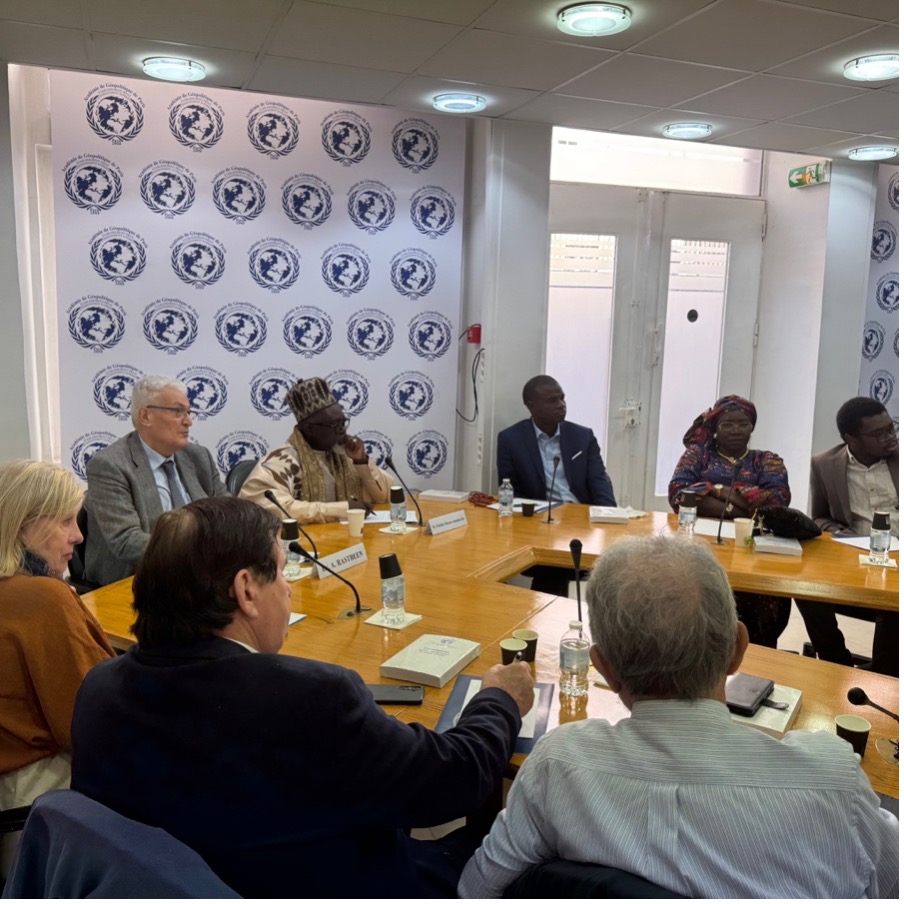
The Académie de Géopolitique de Paris organized a conference on spiritual diplomacy as a complementary vehicle for stabilization and mediation in contemporary international relations, Wednesday 8 April 2026 at 5 rue Conté in Paris. The main intervention was provided by Sheikh Thierno Amadou Ba, a recognized figure in religious diplomacy and inter-spiritual dialogue at the international level.
SUBMISSION
At a time when contemporary conflicts are increasingly integrating identity, cultural and religious dimensions, conventional diplomatic approaches show their limits, giving spiritual diplomacy a growing role as a tool for analysis and action. It mobilizes non-State actors, including religious authorities and inter-spiritual networks, to influence the dynamics of peace, dialogue and reconciliation, often outside traditional institutional frameworks.
The experience of Sheikh Thierno Amadou Ba, the keynote speaker of the conference, illustrates in concrete terms the new forms of non-state influence in international relations and their growing role in mediation and conflict prevention processes. Sheikh Thierno Amadou Ba has been Khalife de Bambilor (Senegal) since 2001, founder of Bambilor TV and NGO Fawzywanadiaty, Ambassador of Peace (of the Federation for Universal Peace). He is a promoter of spiritual diplomacy, interreligious dialogue and social and humanitarian engagement.
The purpose of the conference was to bring together experts and various actors around several areas of structural thinking, including the role of the spiritual authorities in managing international crises, the articulation between classical diplomacy and religious diplomacy, the contribution of ethical and spiritual values to building peace, and the prospects for integrating these approaches into contemporary global governance frameworks. It was a particularly relevant opportunity for dialogue and exchange to understand the ongoing recompositions of the international scene and the new dynamics of peace in this changing global environment.
COMPTE RENDU
Dr. Ali RASTBEEN, President of the Paris Academy of Geopolitics, Opening and welcoming remarks.
Ladies and gentlemen, good morning, thank you for your presence, and thank you very much to Mr. Khalife Sheikh Thierno Amadou Ba for having honoured us by attending this meeting. It’s a great pleasure to meet you.
As you know, we are an educational institution, in France, and in France the law on secularism imposes the separation of politics and religion. Today, in today’s world, religion has a responsibility: responsibility for their peoples, responsibility for its history, and responsibility for its future. And unfortunately, today we see that societies that are well (…) progress, customs, abuse international law, and this abuse unfortunately is not condemned by any religious. The essential religion came to educate society. When society has been educated, no society needs a religion. But now it’s the opposite.
And that is why we have the honour of receiving the Khalife, who will explain a little about the situation, about the responsibility of religion for peace. Peace today is in danger. The dangers of society concern the responsibility of religions. If we talk about religions, that is, we talk about dignity. If we talk about dignity, we talk about the responsibility of all societies, which concern religion.
Today, as we know, the United States, a large country at the military level, financing, at all levels, etc., most religions are settled in the United States, and most religious fanaticism is also based in the United States, but it is the United States that is making mistakes… send missiles, bomb universities – not just hospitals – on behalf of defending democracy… The United States had already tried in Iraq, Venezuela, Afghanistan, they did not succeed. Why didn’t they succeed? Since it is an element that serves large “petrodollars” societies. The human is responsible for dignity.
I didn’t want to make a speech, but just a welcome word. You are welcome, we listen to you according to your education and training as well as your other missions, and we hope to benefit from your knowledge and knowledge. We are yours, Your Excellency.
M. Mouhamadou Bachir MBENGUE, Executive Director NGO Fawzy Wa Nadjaty (FWN), “Presentation of the Delegation and Khalife”.
Thank you very much, thank you for your welcome. I will introduce the Khalife delegation before giving him the floor for his communication. My name is Mouhamadou Bachir Mbengue, I’m one of Khalif’s assistants,
I’m accompanied by Mrs. Mbeugné Dieng, who is a member of the Federation for Universal Peace (FPU), who is now the Vice-President at the level of Senegal,
Also in the delegation, I am accompanied by Mr. El Hadji Malick Ba, disciple of the Khalife and assistant in charge of international relations,
Following him, you have Mr. Salihou Keita, an expert in public procurement, a senior executive of the administration, former Director General of the International Trade Centre in Senegal and who has led a lot of innovations in the organization, circulation and deployment of the faith, who today works as an international expert and is a member of the delegation,
Following him, later, Mr. Kame Seydou Nourou, the Khalife Digital Communication Officer,
And Mr Joël Broquet, who is the “bridge”, if I may say so, between the organizations and the Khalife. He is the president of the Association Carrefour des Acteurs Sociales, and he also works with the Khalife to organize the International Colloquium on Religious Diplomacy (CIDIR) in France, and on many other projects on which we will return,
And Mr. Patrick Jouan, I am speaking for our delegation, which was a great contribution to the implementation of the agenda that the Khalife is following, (…) and Mr. Jacques Marion, who received the Khalife yesterday and elevated him to the rank of Ambassador of Peace. Today Khalife is part of this great network of Peace Ambassadors of the Federation for Universal Peace (FPU),
And there is also (…), a journalist expert in communication, who has just arrived.
I will now introduce the Khalife.
You know, in Senegal we are a secular country, with 95% Muslims, 4% Christians, 1% traditional religions. But we are a country where living together is a legacy. Today, Christians and Muslims in Senegal are a family. We are the only country that has a mixed cemetery, where mixed marriage is celebrated, where the first president of Senegal was Christian, elected by religious guides. Senegal is a country where Islam is a brotherhood. Fraternities are the great communities. There is the Tijane Brotherhood (Tijaniyya) which many know, from Morocco, the Mouride Brotherhood (Mouridiyya), the brotherhood Layeniyya.
The Khalife here is part of the great community, the Tijane Brotherhood. He is a religious guide, and thousands and thousands of disciples recognize themselves in him, and his disciples from outside Senegal he will visit them to strengthen their faith, their spirituality, but also in the context of life in general, see the difficulties that accompany them. These religious guides are a sort of safety valve in Senegal.
Yes, it is true, politics is separate from religion, but religion has an essential foundation in political life. We are the only country where when the president is elected, in the morning, the next day or the evening, he will act with allegiance to these religious guides, to go around all the religious guides to make an act of allegiance. It is with these guides that the stability of the country is involved. The last example I give is at the Covid-19. Senegal was saved from the Covid-19 by its religious guides. It is not the laws, measures or orders that have been taken by the State that have made our citizens respect the wearing of the mask or social distancing. Senegal in the first week experienced many deaths and indiscipline, because it is a young country. Most of the population is young and most of the population works in (…) so they do not depend on a wage (…). So we had to go out looking for food so we wouldn’t be hungry, except the government took steps, that it wasn’t a reason to confine them. The president had to go to the religious guides, so that the next day those religious guides would appear on television with a mask, wash their hands, and pray, saying that we could close the mosques so that the city would be quiet.
It’s the same in a lot of cases, and I’m not going to lengthen, but it’s to say that it’s because of this now that, the Khalife having understood this, all the usefulness of these religious guides as well as Muslim or Christian and Jewish obedience, that beyond their legitimacy it is necessary to go towards their legality to build what is called religious diplomacy. I think that in this, the Academy of Geopolitics of Paris will make a great contribution to the construction of a Chair of Religious Diplomacy.
Just to explain the dimension of this foundation, which through religious diplomacy has set up what is called the CIDIR, the International Colloquium on Religious Diplomacy, to conceptualize, to have a (…) conceptual. This man, through interreligious dialogues, signed a convention with the Vatican, through the Prefect of the Dicastery for Interreligious Dialogue. This man, through the fight against illegal immigration, is working so that young Africans can be trained and there is a normal, balanced exchange, so that those who find it difficult to make their social security work, to charge for their (…), can provide these young people who have strength, with adequate training, so that our young people, our brothers and sisters, can travel in dignity, in the image of what is not done. Here is this man, who came today to tell us about his experience, his experience. Thank you, Mr Thierno Amadou Ba.
Cheikh Thierno Amadou Ba, Khalife de Bambilor (Senegal) since 2001, founder of Bambilor TV and NGO Fawzy Wa Nadjaty (FWN), Ambassador of Peace (Federation for Universal Peace), promoter of spiritual diplomacy, interreligious dialogue and social and humanitarian engagement, « Spiritual Diplomacy and International Peace ».
Thank you Mouhamadou Bachir MBENGUE. Mr Ali Rastbeen, President of the Académie de Géopolitique de Paris, Mr Jacques Marion, President of the FPU, Mr Joël Broquet, President of the Eurafrican Partnership, Mrs Dieng, President of Peace in Africa-Centrafrique, Ladies, Ladies and Gentlemen, illustrious assembly, allow me first of all to express my sincere thanks for the honour that I am honoured today to address the Académie de Géopolitique de Paris. Thank you very much. I would also like to acknowledge the quality of the work and reflections that drive this prestigious institution, a true crossroads of knowledge and international dialogue.
In a world marked by persistent tensions, deep geopolitical recompositions and multiple-dimensional crises, there is a need to rethink the instruments of peace and dialogue among nations. While classical diplomacy remains an essential pillar of international relations, it alone cannot respond to the complexity of contemporary dynamics. It is in this perspective that the reflection that I wish to share with you today, around a concept that is both ancient in its roots and innovative in its applications: spiritual diplomacy.
Thus, my communication will revolve around three main axes: first, the limits of classical diplomacy in the face of the emergence of spiritual diplomacy; Second, the actors of this diplomacy, true peacemakers; and finally, the conditions for its effectiveness as an instrument for global peace.
AXE 1: Classical diplomacy and its limitations in the face of the emergence of spiritual diplomacy
Ladies and gentlemen, diplomacy, in its formal sense, is an institutionalized, legal and recognized practice, exercised by representatives of States, often sworn in, and embedded in a specific normative framework. However essential, this diplomacy is not without limits. It evolves in societies deeply marked by cultural values, moral references, and religious beliefs that influence collective behaviour.
It is in this context that spiritual diplomacy, which, far from being new, is part of an ancient historical continuity where figures such as the wise, the priests or the prophets were already playing a role of mediation between men and the sacred. But beyond this natural complementarity, one must also have the courage to recognize a reality: there is still today a form of mistrust between these two spheres. Very often, classical diplomacy and the spiritual sphere look, so to speak, in faience dogs.
On the one hand, some academic or political circles have a reserve or even a distrust of the religious. On the other hand, some spiritual authorities may perceive state diplomacy as being distant from ethical or moral values. This opposition is largely based on misunderstandings. In a rigorous scientific approach, it becomes necessary to overcome these divisions. It is the spirit that counts, more than individual practices. Classical diplomacy and spiritual diplomacy are expected to complement each other.
AXE 2: The actors of spiritual diplomacy, peacemakers and universal mediators
Spiritual diplomacy is not limited to religious in the strict sense. It is also expressed through philosophical currents that have proposed real lifestyles based on an elevation of the human being. Here we can mention Epicurism and Epicurism, which advocate the search for inner peace, Zeno of Citium and Stoic tradition based on self-control and reason. These approaches constitute in their own way forms of intellectual spirituality, oriented towards individual and collective harmony.
At the same time, on the religious level, history teaches us that the great traditions have been carried by major figures: our prophet Muhammad, Jesus Christ, as well as Moses, etc., who have not only conveyed spiritual messages, but also helped to structure entire societies around ethical, social and legal values. In this dynamic, it is also important to value figures from the Muslim and African world, such as Sheikh Ahmed Tijani, whose thought and heritage today constitute a true spiritual bridge between peoples, promoting living together, solidarity and moral elevation.
AXE 3: Diplomacy for Peace
How can we transform this resource into a real instrument of global peace? In this context, three levels of action can be envisaged.
First, to strengthen scientific and academic engagement. It is now fundamental to include spiritual diplomacy in a rigorous scientific and academic framework. As such, initiatives such as the International Colloquium on Religious Diplomacy (ICIDIR) are major advances.
Secondly, to establish frameworks for dialogue and trust at the corporate level. Peace is not built solely at the summit of States. It is also being built within societies. It is therefore necessary to promote regular meetings, genuine spaces for debate and respectful dialogue between religious, political and social actors. This implies a double commitment: respect for religious beliefs in their diversity, but also a responsibility of believers to guide, without questioning their faith, their practice in accordance with the laws and the general interest. In other words, it is a matter of balancing spiritual freedom and social cohesion.
Thirdly, fully integrate spiritual actors in crisis management. It is essential to recognize that in many contemporary conflicts the religious dimension is present, whether explicit or implicit. In this context, it would be counterproductive to marginalize spiritual actors. On the contrary, they must be involved in crisis resolution processes, as they have legitimacy among the people, a capacity for mediation, and an influence on consciences. One can think, for example, of complex situations such as those related to Israel where the religious dimensions are deeply intertwined with political issues. Conversely, some experiments show the effectiveness of this approach.
In conclusion, at the end of this reflection, it is clear that spiritual diplomacy is neither a marginal alternative, nor an idealistic utopia, but rather a complementary and necessary resource in the quest for world peace. In a context where contemporary crises are often rooted in deep identity, cultural and religious dimensions, ignoring the role of spiritual actors would mean depriving themselves of an essential lever of understanding and mediation. The challenge is not to oppose classical diplomacy and spiritual diplomacy, but to articulate them in an integrated approach, based on dialogue, mutual recognition and respect for fundamental human values. By strengthening their academic anchor, promoting spaces for dialogue within societies and fully integrating spiritual actors in crisis management, it becomes possible to build a more inclusive, humane and, above all, more effective diplomacy.
Thus, spiritual diplomacy can become not only an instrument of peace, but also a vector of hope for a world in search of meaning, stability and harmony. Thank you for your kind attention.
MEETING OF ANSWER QUESTIONS
Question-and-answer session being transcribed.
Leave a comment