
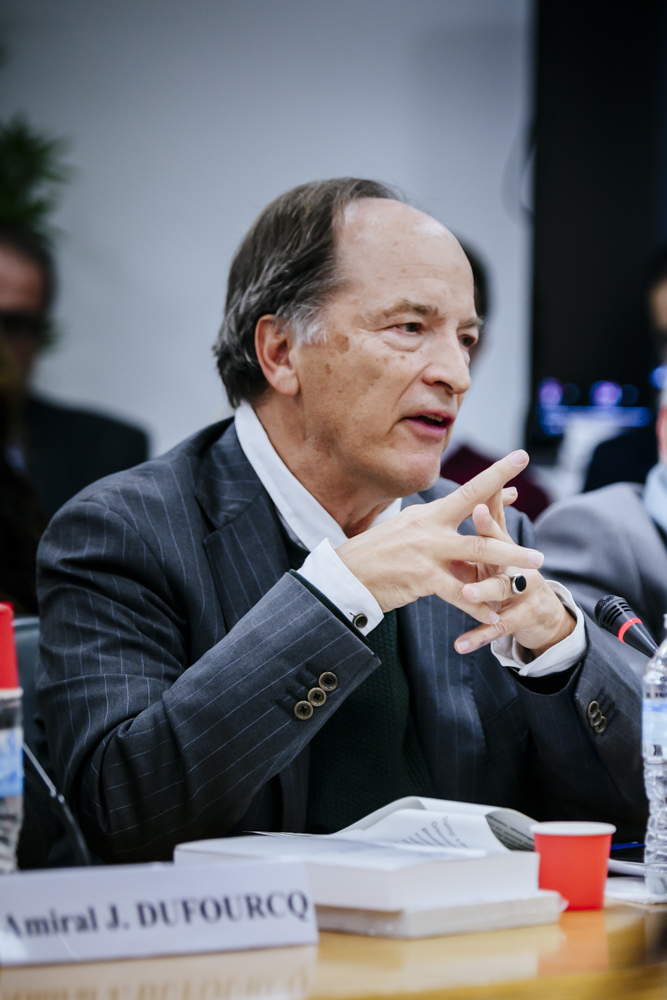
Prof. Hall GARDNER
Executive summary“BRICS++ and the Trump administration” briefly recounts the history of Russia’s rapprochement with China in response to the American decision to opt for a “limitless” NATO enlargement, leading to the Sino-Russian strategic partnership of twenty years signed in July 2001. The text then analyses the responses of the United States and the Trump administration to the formation of BRICS++ since 2009. He argues that US tariffs and sanctions have exacerbated mistrust between the United States and BRICS members, accelerating their efforts, despite their deep geopolitical and ideological differences, not only to build alternative trading and financial systems, but also to potentially forge a counter-alliance in the name of a new geopolitical ideology advocating a “fairer” and “multipolar” world order, in order to counter the “unipolarity” and political-economic hegemony of the United States, at the risk of dangerous polarization of the global system. Much will depend on India’s decision to turn to the United States and the G7 or to Russia and China and the RCEP, assuming that the United States itself cannot break the “without limits” strategic partnership between Russia and China.
Keywords: BRICS+, Donald Trump, USA, Russia, China, India, Brazil, South Africa, NATO, Europe, G7, Geopolitics, Hegemony, Multipolar, Unipolar.
Abstract: “BRICS++ and the Trump Administration” briefly outlines the history of Russia’s turn toward China in response to the U.S. decision to pursue an “open-ended” enlargement of NATO, which resulted in the twenty-year Sino-Russian strategic partnership signed in July 2001. It then examines U.S. and Trump administration responses to the formation of BRICS++ since 2009. The analysis argues that U.S. tariffs and sanctions have deepened mistrust between the United States and BRICS members, accelerating their efforts, despite profound geopolitical and ideological differences, not only to build alternative trade and financial systems but also to potentially forge a counter-alliance in the name of a new geopolitical ideology advocating a “more just” and “multipolar” world order, in order to counter U.S. “unipolarity” and political-economic hegemony—thereby risking a dangerous polarization of the global system. Much depends on whether India shifts toward the United States and the G7 or toward Russia, China, and the RCEP, assuming that the United States itself cannot break the Russia–China “no limits” strategic partnership.
Key-words: BRICS+, Donald Trump, United States of America, Russia, China, India, Brazil, South Africa, NATO, Europe, G7, Geopolitics, Hegemony, Multipolar, Unipolar.
Leave a comment