
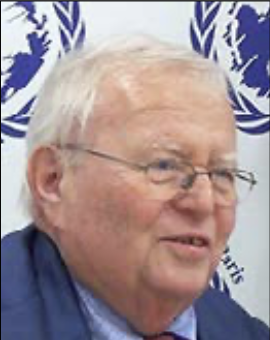
Jacques MYARD
Executive Summary: In Palestine, tensions are deep and multidimensional, with the region marked by religious, identity and political passions, which ignite three main groups: Palestinian Arabs, Jews, and Christian Arabs and other Christians. A cultural revolution, similar to that experienced by the Germans after 1945, is a necessary transformation and could lead to Peace. Consistent with the 1947 UN plan for sharing, the two-State solution provided for an Arab State and a Jewish State, as well as an international status for Jerusalem, but that proposal was rejected by the Arab States in 1948. Realizing this solution requires recognition of Palestine as a State by France, in order to launch the process and persuade other powers to do the same, and also requires support for democratic forces in Israel in order to weaken ultra-nationalist governments and groups. The situation in Palestine is a multiple-entry equation: settlements in the West Bank, Israeli-Palestinian relations, reconciliation between Israel and Iran, and the search for new Abraham agreements are all important issues. On 10 May 2024, 143 countries voted for the integration of Palestine as a full member of the United Nations, despite the opposition of the United States. Without an immediate solution, the problem requires a cultural revolution and France must play a more active role in regaining diplomatic independence and emerging from its vassalization.
Keywords: Palestine, Israel, Impasse, 1947 Partition Plan, Religion, Identity, Politics,
Geopolitics, International Relations, Diplomacy, Arabs, Palestinians, Jews, Christians,
Christian Arabs, Miracle, Cultural Revolution, Germany, United Nations, Solution à deux
States, Jewish State, Arab State, Jerusalem, Recognition, France, Ultra-nationalists, Colonies,
West Bank, Iran, Abraham Accords, United States of America, Independence, Middle East.
Leave a comment